
On this page
Start here
Quick answer
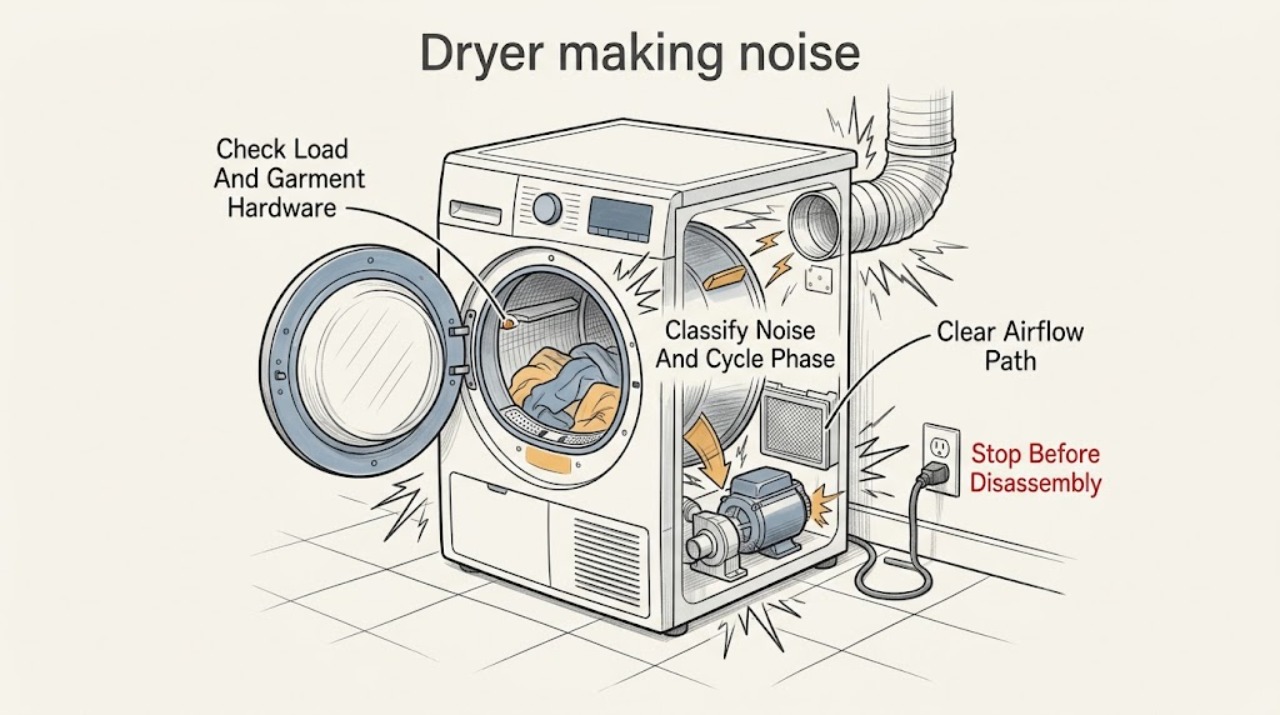
Some AEG dryer noises are normal: a compressor can be louder at the beginning of a heat-pump cycle, and the drum, fans, pump, condensation transfer, and heat-pump compressor can all produce sound. A new bump may be a transit mechanism releasing, while zips and buttons can rattle. First identify the cycle phase and sound, stop and wait for the drum to be still, then check the load, accessible lint filter and condenser/air path, door opening, and installation clearances against the exact manual. Do not open panels or reach behind a stacked or heavy appliance. Stop using the dryer for a burning smell, smoke, sparking, severe rubbing or grinding, a jammed drum, damaged cord, or a noise that persists or worsens after the safe checks; arrange qualified appliance service.
Work through in order
Diagnostic checks
Use only checks that match the exact appliance or system and its official guide.
-
Check 1
From a clear standing position, listen during one supervised cycle segment and record whether the noise occurs at startup, during drum rotation, while a fan or pump runs, or during the end/cooling stage. Describe it as a hum, metallic knock, rattle, scrape, rubbing sound, or high-pitched noise, and note any error or drying change.
Expected result: The noise is limited to an expected operating phase and drying is normal, or it is sudden, harsh, persistent, or paired with poor drying or an error.
Next step: If the sound is phase-limited and the dryer performs normally, continue with the load and filter checks. If it is harsh, new, persistent, or paired with a warning, stop the programme and use the service boundary.
Stop if: Stop immediately for smoke, burning smell, sparking, abnormal heat, a jammed drum, severe rubbing, or a damaged cord or outlet.
Why this matters
Why: AEG identifies compressor startup, drum, fan, pump, condensation transfer, and some heat-pump metallic sounds as normal possibilities. A worsening mechanical sound or a sound with a performance or warning change needs escalation.
-
Check 2
After the drum stops and the dryer is cool, check whether the load is clearly excessive or contains hard buckles, zips, buttons, or another loose object that could contact the drum. Remove only loose, obvious items and follow the load limit in the model manual.
Expected result: The noise changes when a hard garment item is removed or the load is reduced, or the same noise remains with a small, soft load.
Next step: Make one supervised retest with a suitable load. If the noise remains, especially as a scrape, grind, or repeated knock, stop and arrange qualified service rather than adding lubricant or opening the cabinet.
Stop if: Stop if an object is lodged, the drum is hard to turn in normal operation, the drum is rubbing the cabinet, or retrieval would require tools or panel removal.
Why this matters
Why: Garment hardware or overloading can create rattling or make the motor work harder, but a noise that remains with a light load points away from a simple load explanation.
-
Check 3
Switch the dryer off and disconnect it from power as required by the manual; wait for it to cool. Clean the accessible lint filter and, if the design has one, the condenser or air channel using the model instructions. Do not reach into a fan housing or remove covers.
Expected result: The filter or condenser is visibly clogged, airflow improves after permitted cleaning, or the accessible path is clear while the noise remains.
Next step: Reassemble only the user-removable pieces and make one supervised cycle check. If the noise persists or drying remains poor, stop using the dryer and provide the maintenance result to a qualified technician.
Stop if: Stop for a damaged filter, hot surfaces that have not cooled, water near electrical parts, a blocked internal passage, or any need to open a panel.
Why this matters
Why: Restricted filtration or airflow can affect dryer performance and sensor operation and can make the appliance work abnormally. A clean filter does not clear an internal fan, motor, compressor, or drum-support fault.
-
Check 4
If the dryer is new or recently moved, inspect only from normal access for a transit block still visible in the door opening, a dryer that is visibly unlevel, an external vent or cabinet contact, or a stacked arrangement that appears to shift. Use the exact installation manual for transit and stacking details.
Expected result: The noise began on first use, a transit item is visibly present, the cabinet contacts a wall, or the installation looks stable and clear.
Next step: Remove only a clearly identified door-opening transit block as the manual directs. Do not move a heavy/stacked unit or manipulate rear drum locks without safe model-specific access; arrange installation or appliance service instead.
Stop if: Stop for an unstable stack, a dryer that walks, rear access blocked by a wall, an unidentified transit part, or any work requiring lifting, panel removal, or reaching behind the appliance.
Why this matters
Why: AEG says a first-start bump can be a normal transit release, while unreleased drum locks can cause rubbing as the drum rotates. Contact, poor leveling, or an unstable stack can amplify noise or create a safety issue.
-
Check 5
Before running another cycle, decide whether the noise remains after the single safe load, filter, and installation check, or whether there is an error, poor drying, overheating, water, smoke, burning smell, sparking, or a damaged electrical connection. Do not repeatedly restart the dryer or try to locate the source by removing panels.
Expected result: The noise is gone and no warning symptom is present, versus persistent/worsening noise or any electrical, heat, drum, or performance warning.
Next step: For persistent or hazardous symptoms, leave the dryer out of use and arrange qualified appliance service; use a licensed electrician if the household outlet or wiring is the concern. Give the technician the model and recorded observations.
Stop if: Stop now for smoke, burning smell, sparking, abnormal heat, a jammed or scraping drum, severe vibration, water leakage, or repeated electrical trips.
Why this matters
Why: A resolved garment or maintenance issue can be monitored, but a persistent mechanical sound or any safety symptom is not confirmed safe by another test cycle and may involve an internal component.
Use your observations
Decision map
Find the observation that best matches what you see, then follow the next safe action.
-
PATH 01Next step
What you see
The sound occurs during compressor startup, drum rotation, fan/pump operation, or a heat-pump cycle and the dryer completes normally without a warning or performance change.
Do this next
Treat it as a possible operating sound and monitor it rather than replacing a part based on sound alone.
-
PATH 02Next step
What you see
The noise is a rattle or knock and the load contains hard buckles, zips, buttons, a loose object, or an obvious overload.
Do this next
Stop, wait for the drum to stop and cool, remove only loose accessible items, and use a suitable load.
-
PATH 03Next step
What you see
The lint filter, condenser, or accessible air channel is blocked and the dryer has noise together with poor drying or abnormal programme behavior.
Do this next
Clean the user-accessible filter or condenser exactly as the model manual directs, with power disconnected and the appliance cool.
-
PATH 04Safety boundary
What you see
A new heat-pump dryer makes a rubbing or scraping sound as the drum rotates, or the first-use transit setup is uncertain.
Do this next
Do not reach behind the unit or manipulate rear drum locks without the exact manual and safe access.
Why this path and its safety boundary
Safety stop: True
-
PATH 05Safety boundary
What you see
The noise is persistent, worsening, grinding, or severe, or it is accompanied by smoke, burning smell, sparking, abnormal heat, a jammed drum, water, or repeated electrical trips.
Do this next
Stop the dryer immediately and do not run another test or open the cabinet.
Why this path and its safety boundary
Safety stop: True
Helpful context
Understand the symptom
Classify the sound before chasing a part
Listen from a safe standing position and note whether the noise starts during the first minutes, when the drum rotates, while a fan or pump runs, or as the programme ends. A heat-pump dryer can make a higher initial compressor sound and metallic or knocking sounds, and AEG lists the rotating drum, fans, pump, and condensation transfer as operating sounds. That does not make every noise harmless: a sudden change, grinding or harsh scraping, a jammed drum, or a symptom paired with poor drying needs a service boundary.
Check the load and accessible maintenance areas
Wait until the drum has stopped and the appliance is cool before opening it. Remove a few items if the load is clearly excessive, and check garments for buckles, zips, buttons, or other hard objects that can rattle against the drum. With power disconnected as required by the manual, clean the accessible lint filter and, where fitted, the condenser or air channel. A blocked filter can affect airflow, efficiency, and sensor operation; cleaning it does not prove that an internal fan, bearing, or drive fault is fixed.
Treat a new dryer and a rubbing noise differently
On a newly installed dryer, a first-start bump can be the release of an automatic transit mechanism, and some models have a transit block at the door opening that must be removed according to the manual. If a heat-pump dryer scrapes or rubs as the drum rotates, AEG specifically links that symptom to rear drum locks not releasing correctly on some new models. Do not reach behind the dryer or rotate rear locks by guesswork, especially if the unit is stacked; use the model manual or arrange service when the required access is not safe.
Inspect clearance and installation without moving the appliance
Look from normal access for a cabinet or vented exhaust path touching a wall, a loose external item, a door that does not close, or a dryer that is visibly unlevel. AEG notes that an electrical installation near the fan housing or a loose fan can contribute to rattling, and that installation conditions can affect performance. Do not pull a heavy or stacked dryer away from the wall to investigate; follow the installation instructions or have a technician create safe access.
Use evidence to decide whether service is needed
Record the exact model, programme, sound type, whether the drum rotates freely during normal operation, any error code, and whether clothes dry normally. If the sound does not fade on a new machine, returns after one safe check, or is accompanied by poor drying, overheating, smoke, a burning smell, sparking, or an electrical warning, stop using the dryer. A qualified technician should diagnose the fan, motor, drum support, compressor, heating, control, or wiring rather than having the user dismantle the cabinet.
Safety boundary
Stop conditions
- Do not open panels, reach into the fan or drum-support area, or manipulate rear drum locks without safe model-specific instructions and access.
- Do not move a heavy or stacked dryer, repeatedly restart a noisy cycle, or use lubricant to mask a scraping or grinding sound.
- Stop immediately for smoke, burning smell, sparking, abnormal heat, water, severe vibration, a jammed drum, damaged cord, or repeated electrical trips.
When checks do not resolve it
Need a professional?
The noise remains after one safe load, filter, and installation check, or it becomes louder or harsher., The drum scrapes, grinds, is hard to turn, or a new heat-pump dryer may have an unreleased rear drum lock., Drying performance is poor with abnormal noise, an error, overheating, or a blocked internal airflow path., There is smoke, burning smell, sparking, water, a damaged cord/outlet, severe vibration, or repeated electrical trips.
Common questions
FAQ
Are some AEG dryer noises normal?
Yes. AEG lists compressor startup, a rotating drum, fans, a pump transferring condensation, and some heat-pump metallic or knocking sounds as possible operating noises. The sound is more concerning when it is sudden, harsh, persistent, worsening, or linked to poor drying, an error, overheating, or another warning.
Why does my new AEG dryer make a bump or scraping sound?
A first-start bump can be a transit mechanism releasing, and a transit block may need removal from the door opening according to the manual. AEG also documents scraping or rubbing on some new heat-pump dryers when rear drum locks have not released correctly. Do not reach behind a heavy or stacked appliance by guesswork; use the model manual or arrange service.
Can an overloaded dryer make a humming noise?
It can. AEG lists a stuck or struggling motor and overload as possibilities for humming and suggests removing some items and trying again. Wait for the drum to stop, use a suitable load, and stop if the hum persists or the drum, cabinet, or performance is abnormal.
Can a dirty lint filter cause unusual dryer noise?
A blocked lint filter, condenser, or air channel can affect airflow, efficiency, sensor operation, and drying performance, so it is a worthwhile user-maintenance check. Clean only accessible parts with power disconnected and the dryer cool; a clean filter does not rule out a fan, motor, compressor, or drum fault.
When should I stop using an AEG dryer because of noise?
Stop for smoke, burning smell, sparking, abnormal heat, a jammed or severely scraping drum, water, severe vibration, damaged wiring, or repeated electrical trips. Also stop for noise that persists or worsens after one safe load, filter, and installation check; a qualified technician should diagnose internal parts.
Read the exact guide
Official sources
- Tumble dryer not drying, not drying properly, too long dryingAEG · AEG vented, condenser, and heat-pump dryers; exact model instructions take precedence.
- What to check before contacting AEG consumer serviceAEG · General AEG appliance guidance, including tumble dryers; model-specific documentation always takes precedence.
- Tumble Dryer generates scraping/rubbing noise while drum rotatingAEG · AEG heat-pump dryers with the documented rear drum-lock design; use the exact model manual for any installation procedure.
- Tumble dryer emits unusual noisesAEG · AEG tumble dryers; exact model manual and installation instructions take precedence.
Community feedback
Share a repair observation
Share a plain-text repair observation. Accepted observations are published automatically; this page may take a moment to update.