
On this page
Start here
Quick answer
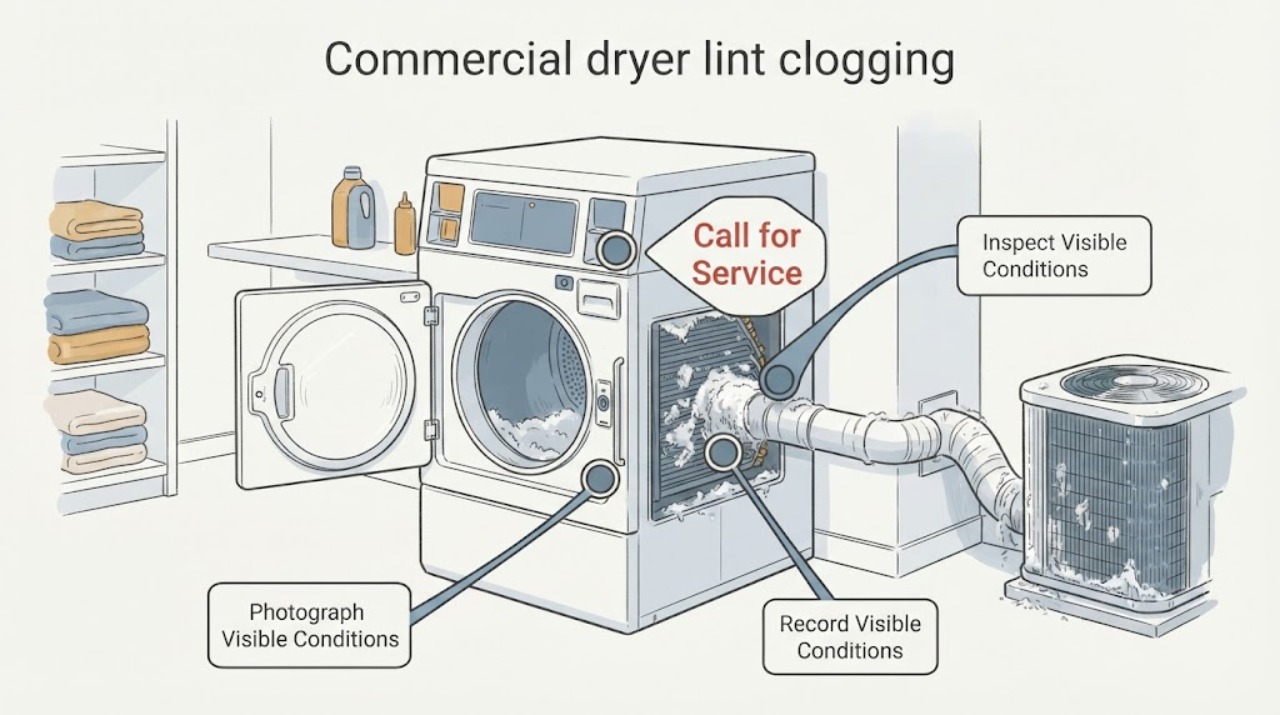
First confirm which condenser is clogged. In the commercial-gym scenario, lint at a nearby HVAC outdoor condenser points to an exhaust-discharge and housekeeping problem, not proof that the dryer has an internal condenser. Keep the dryer out of service if lint is accumulating around hot equipment, then identify the dryer and HVAC models, inspect the dryer lint screen and exhaust route, and have the HVAC coil assessed with power isolated. GE and Whirlpool guidance requires a model-appropriate, unobstructed exhaust path to an approved outdoor termination; a Lennox official manual specifically lists lint from clothes dryers as material that can be drawn into condenser coils. Do not add an unapproved booster/filter arrangement, wash a coil with a power washer, open refrigerant or electrical compartments, or assume a coil-cleaning method from another model.
Work through in order
Diagnostic checks
Use only checks that match the exact appliance or system and its official guide.
-
Check 1
Photograph and record the dryer data plate, the HVAC outdoor-unit data plate, the exhaust termination, and the location of lint on the coil or surrounding surfaces. Determine whether the dirty coil is the HVAC outdoor condenser or a dryer heat exchanger, and obtain both manufacturers’ manuals before choosing a cleaning method.
Expected result: The lint is on a separate outdoor HVAC condenser; it is inside a dryer heat-pump/heat-exchanger assembly; or the equipment identity and coil location remain unclear.
Next step: If the outdoor HVAC coil is affected, route the issue to HVAC and dryer-vent maintenance together. If the dirty surface is inside the dryer or the identity is unclear, stop at model identification and use the exact dryer manual or qualified commercial service.
Why this matters
Why: Lint from clothes dryers can be drawn into HVAC condenser coils, but a generic dryer topic does not establish that every dryer has a user-cleanable condenser. Equipment identity controls the safe procedure.
-
Check 2
Take the dryer out of normal production if lint is accumulating around the exhaust, HVAC unit, or other hot equipment. With the equipment stopped and safe to access, empty and inspect the dryer lint screen according to its manual and record how quickly it reloads during towel processing.
Expected result: The screen is damaged, missing, heavily loaded between cycles, or lint is present on nearby hot surfaces; or the screen and surrounding area are clean.
Next step: Correct the documented lint-control and housekeeping process before returning the dryer to heavy service. Escalate repeated rapid loading, damaged screens, or lint on hot equipment to commercial laundry service; do not run without the required filter.
Why this matters
Why: A missing or overloaded lint-control step can allow combustible lint to spread. OSHA treats lint on surfaces and heat-producing equipment as a workplace fire hazard, while a clean screen does not rule out duct or termination problems.
-
Check 3
From outside the cabinet, trace the dryer exhaust to its termination. Look for crushed or kinked ducting, lint in accessible duct sections or the hood, a termination aimed at the HVAC intake, a screen/grid, or a discharge location where lint can collect. Do not alter duct diameter, add a booster fan, or install a filter box without the exact dryer design and a qualified vent review.
Expected result: The route is restricted, terminates where lint can be drawn into the HVAC coil, has an obstructing screen, or cannot be verified; or the route is clear and correctly terminated away from air intakes.
Next step: Remove only clearly external debris that the exact manual permits, then have a commercial dryer-vent professional review routing, termination, make-up air and local code. Leave any restricted or unsafe installation out of service until corrected.
Why this matters
Why: GE requires model-appropriate ducting and says exhaust should reach outside or an area where lint buildup is not a problem. Whirlpool identifies crushed or obstructed vents and hoods as causes of poor airflow and long dry times. These sources do not approve a universal filter-box or booster solution.
-
Check 4
Have the HVAC technician isolate power before accessing the outdoor condenser, inspect both the visible coil face and the air path for lint, and document bent fins, blocked airflow, fan behavior, or other damage. Keep hands and tools away from live electrical and refrigerant sections.
Expected result: Lint is a surface obstruction with intact fins; lint is packed between fins or the coil is bent/damaged; or the unit has abnormal fan, electrical, refrigerant, or pressure symptoms.
Next step: A qualified HVAC technician should select the cleaning direction, method and any fin repair for the specific coil. Stop at visual documentation if access requires panel removal or if electrical, refrigerant, fan or pressure work is involved.
Why this matters
Why: The opened Lennox manual says dryer lint can clog condenser coils and reduce efficiency, and it limits owner-level maintenance to light-pressure brushing while warning about sharp edges and power isolation. Trane recommends trained service for coil cleaning and warns against high-pressure washing.
-
Check 5
After the vent route, lint controls, and HVAC coil are corrected by the appropriate service providers, record one supervised production cycle: lint at the termination, airflow, drying performance, and any new HVAC temperature or runtime issue. Keep the towel-service lint log with the equipment maintenance records.
Expected result: Lint quickly returns to the HVAC coil or surrounding area; the dryer still has poor airflow or long drying; the HVAC still runs abnormally; or the area remains clean and performance is normal.
Next step: If any abnormality remains, stop production as needed and reopen the combined dryer-vent/HVAC service call with the recorded observations. If performance is normal, continue the manufacturer and site maintenance schedule rather than waiting for another heavy deposit.
Why this matters
Why: Recurrence points to an unresolved discharge, duct, filter, airflow or equipment-location problem; clean coils alone do not prove the source has been fixed. Normal observation after correction supports the maintenance change but does not establish a universal cleaning interval.
Use your observations
Decision map
Find the observation that best matches what you see, then follow the next safe action.
-
PATH 01Next step
What you see
Lint is visibly collecting on a nearby HVAC outdoor condenser and the dryer exhaust terminates toward that unit or its air intake.
Do this next
Keep the dryer/HVAC area under controlled service, correct the termination and lint-control design with a qualified commercial vent/HVAC professional, and have the HVAC coil cleaned using the specific unit procedure.
Why this path and its safety boundary
Why it matters: The evidence supports an exhaust-discharge pathway and housekeeping problem; it does not prove an internal dryer condenser fault.
-
PATH 02Next step
What you see
The dirty component is inside a heat-pump/condenser dryer, or no one can identify the coil and model.
Do this next
Use the exact dryer manual or qualified commercial laundry service to identify access, cleaning method and drainage requirements. Do not spray, open panels or use a pressure washer based on a different brand.
Why this path and its safety boundary
Why it matters: The assigned symptom is architecture- or model-dependent; outdoor HVAC coil guidance cannot be transferred to a dryer heat exchanger.
-
PATH 03Next step
What you see
The dryer duct or termination is crushed, blocked, screened, aimed at an air intake, or discharges where lint accumulates.
Do this next
Remove the dryer from heavy service until the route is reviewed and corrected to the exact dryer installation instructions and applicable code.
Why this path and its safety boundary
Why it matters: The dryer exhaust installation is not providing a verified safe, low-obstruction path; this can explain lint deposition and poor drying without identifying an internal dryer failure.
-
PATH 04Next step
What you see
The HVAC coil has bent fins, abnormal fan or electrical behavior, refrigerant/pressure symptoms, or requires panel removal to reach the blockage.
Do this next
Disconnect or isolate equipment through the site procedure when safe, keep staff away from the unit, and schedule qualified HVAC service; do not probe, recharge, straighten fins aggressively or wash a live unit.
Why this path and its safety boundary
Why it matters: The work has crossed from visual housekeeping into HVAC service. The official HVAC sources reserve inspection and detailed coil cleaning for trained or qualified service and warn about shock and fin hazards.
Helpful context
Understand the symptom
Separate the dryer exhaust problem from the HVAC coil problem
A condenser coil may belong to the nearby HVAC outdoor unit, while a heat-pump or condenser dryer may have its own heat exchanger. The assigned dryer has no brand or model, so identify the machine and the coil before cleaning anything. If lint is collecting on an HVAC condenser near the dryer termination, the useful decision is to control where lint is discharged and to have the HVAC coil serviced safely; that observation does not identify a failed dryer component.
Treat towel-service lint as a workplace housekeeping and fire issue
OSHA says lint buildup on surfaces and heat-producing equipment can increase fire risk and calls for routine cleaning of surfaces and lint traps plus written housekeeping and maintenance procedures where applicable. A busy towel operation should therefore document lint accumulation, filter cleaning, exhaust condition, and the nearby HVAC coil rather than relying on an informal “clean it when it looks dirty” rule. The exact interval still belongs to the dryer, duct, HVAC and local-code requirements.
Keep model-specific coil cleaning with the HVAC service procedure
The Lennox manual supports a light-pressure soft-bristle approach for its identified equipment and requires power off before maintenance; Trane likewise recommends trained HVAC service and warns that high-pressure water can bend condenser fins. Those are equipment-specific boundaries, not permission to remove panels, spray refrigerant equipment, or use the same method on an unknown commercial unit.
When checks do not resolve it
Need a professional?
Arrange qualified commercial dryer-vent and HVAC service immediately when lint is accumulating on hot equipment, the duct or termination is restricted, the dryer is gas-fired and venting is uncertain, the HVAC coil is packed or damaged, or any panel, electrical, fan, refrigerant or pressure work is required. Stop repeated operation if there is smoke, burning odor, overheating, abnormal fan behavior or a fire concern.
Common questions
FAQ
Is a clogged condenser coil necessarily inside the dryer?
No. In a commercial towel operation, lint may be drawn into a nearby HVAC outdoor condenser. The dryer model and the coil location must be identified before choosing a cleaning procedure; the opened Lennox manual specifically names clothes-dryer lint as a possible condenser-coil contaminant.
Can I put a filter box or booster fan on the dryer exhaust?
Do not assume that a universal filter box or booster fan is approved. GE and Whirlpool guidance requires a model-appropriate exhaust path, and GE warns that screens can collect lint. Have the complete commercial duct and termination design reviewed against the dryer manual, local code and the HVAC intake location.
Can staff pressure-wash the condenser coil?
No generic pressure-washer instruction is safe here. Trane warns that high-pressure water can bend or damage fins, and Lennox requires power off and light-pressure brushing for the equipment covered by its manual. A qualified HVAC technician should choose the method for the actual unit.
Why does towel service matter to the maintenance plan?
The topic involves frequent commercial towel processing, so lint-screen loading and surface housekeeping should be logged rather than treated as occasional residential cleaning. OSHA identifies lint on surfaces and heat-producing equipment as a workplace fire hazard; the exact schedule still comes from the equipment and site requirements.
Read the exact guide
Official sources
- Dryer - Installation Information for Exhaust DuctingGE Appliances · Official GE general exhaust guidance used only for the external decision that a dryer must have proper ducting and a termination where lint buildup is not a problem. It is not a model-specific commercial installation manual for the assigned dryer.
- How to Clean Condenser CoilsTrane · Official Trane general condenser-coil safety guidance used only for the non-model-specific boundary that trained HVAC service is recommended and power washers can damage fins. It is not applied as a cleaning procedure for the assigned unknown HVAC unit.
- INSTALLATION INSTRUCTIONS — Merit Series ML15KSPV Units Heat PumpLennox · Exact Lennox ML15KSPV manual used for the supported mechanism that clothes-dryer lint can enter condenser coils, reduced efficiency/damage risk, power isolation, sharp-edge and light-brush boundaries. It is not a model match for the assigned unknown dryer or HVAC unit and does not establish compatibility or a universal cleaning procedure.
- Laundry — Fire HazardsOccupational Safety and Health Administration · OSHA workplace laundry guidance used for fire-prevention boundaries around lint on surfaces, lint traps and heat-producing equipment. It is not a dryer model manual or a substitute for local code/commercial service requirements.
- Long Dry Times - Commercial DryerWhirlpool Product Help · Official Whirlpool commercial-dryer support page used for external vent/lint observations only: crushed or blocked venting, clear hood and lint screen, and model-specific service escalation. It does not identify the assigned unknown dryer or authorize HVAC coil cleaning.
Community feedback
Share a repair observation
Share a plain-text repair observation. Accepted observations are published automatically; this page may take a moment to update.