
On this page
Start here
Quick answer
Excessive vibration from a GE dryer is most often caused by an unlevel dryer, a soft or uneven floor, a loose anti-tip or leveling leg, an uneven load, a foreign object, a loose cabinet fastener, or a worn belt, drum slide, or support component. Stop immediately for smoke, a burning or gas odor, sparks, a hot or damaged cord, a gas leak, scraping that worsens, a dryer that walks or tips, or a drum that binds; keep the dryer off and arrange qualified service. With the dryer empty, cool, and unplugged, confirm that it stands on a solid level floor, all required legs contact the floor, nothing leans against it, the lint filter opening and drum contain no loose objects, and the exhaust hose is not crushed. GE says leveling prevents vibration and tipping, an unbalanced load can move, and thumping, humming, persistent squeaking, scraping, or a damaged belt require service. If the vibration returns after one controlled empty and small-load check, stop using the dryer rather than changing parts by sound alone.
Before you begin
Safety first
- This article supports empty, cool, unplugged ordinary-access inspection, load redistribution, leveling, and external vent checks only. Do not open panels, test live circuits, inspect moving parts, alter gas connections, run a gas dryer without its vent, or continue using a dryer with persistent abnormal noise or movement.
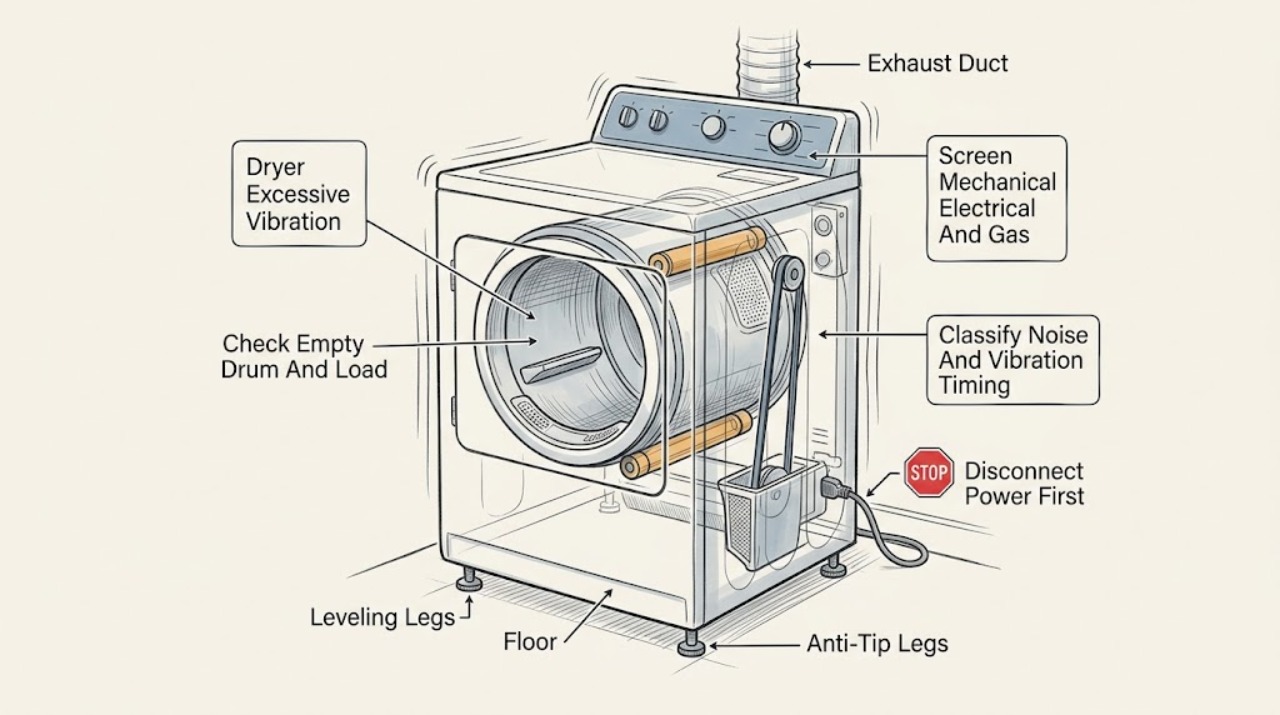
Work through in order
Diagnostic checks
Use only checks that match the exact appliance or system and its official guide.
-
Check 1
Stop the dryer and inspect from a safe position for smoke, a burning or gas odor, sparks, a hot or damaged cord, a gas leak, a cracked cabinet, a drum that binds, or movement that could tip or strike a wall.
Expected result: Record whether the hazard is electrical, combustion-related, thermal, structural, or mechanical and whether the vibration occurs with an empty drum or only with a load.
Next step: Keep the dryer off. Disconnect power only at a safely accessible disconnect; for gas odor or a suspected gas leak, leave the area and contact the appropriate utility or emergency service from outside. Arrange qualified appliance service for smoke, sparks, heat, structural damage, or binding.
Stop if: Do not restart a smoking, sparking, gas-smelling, tipping, binding, or electrically damaged dryer, and do not use a gas dryer without its approved vent path.
Why this matters
Why: A safety hazard overrides balancing or leveling. A normal exterior permits only cool, ordinary-access checks; it does not justify opening the cabinet or operating a gas dryer with a disconnected vent.
-
Check 2
With the dryer off, record whether the symptom is a thump, hum, scrape, chirp, squeak, rattle, or cabinet shake and whether it starts at startup, follows drum rotation, appears only when hot, or changes with the load.
Expected result: Classify the event as a load-related shake, constant cabinet vibration, a loose-object rattle, a rotation-linked scrape or thump, a heat-related squeak, or a gas-burner sound on a gas model.
Next step: Use the matching load, floor, accessible-object, or vent check below and preserve a short description of the sound for a technician.
Stop if: Stop if the sound is scraping, grinding, rapidly worsening, accompanied by odor or heat, or impossible to localize without removing a panel.
Why this matters
Why: GE lists some startup and drum sounds as normal but treats persistent thumping, humming, repeating squeaks, scraping, and a damaged belt or drum slide as service clues. A gas valve or burner sound is different from a cabinet that physically moves.
-
Check 3
Remove the laundry, close the door, and make one brief empty-drum observation; then, only if the empty dryer is stable and quiet, run a small, evenly distributed load rather than a single heavy or bulky item.
Expected result: Record whether the vibration disappears when empty, returns only with one load, follows a heavy item, or remains at the same drum position with no laundry.
Next step: Redistribute or split the load, avoid combining unusually heavy and light items, and make one controlled test. If an empty drum still shakes or the dryer walks, stop and request service.
Stop if: Do not hold the drum, reach into a moving dryer, run an obviously overloaded or damaged load, or keep testing a dryer that moves across the floor.
Why this matters
Why: Vibration that follows a load points toward distribution, load size, or a small item migrating in the drum; vibration when empty points toward leveling, floor, drum support, belt, roller, cabinet, or motor diagnosis.
-
Check 4
With the dryer empty, cool, and safely disconnected, place a level on top first side-to-side and then front-to-back; adjust the leveling legs according to the model instructions so all required feet contact a solid, secure floor, including front anti-tip legs where fitted.
Expected result: Record whether the cabinet rocks, a foot or anti-tip leg was off the floor, the floor flexes, the dryer is on an unstable riser, or leveling changes the vibration.
Next step: Tighten or adjust only the documented legs, use a second person for a heavy unit, and make one empty-drum observation. If the floor, riser, stacking kit, or leg is damaged or the dryer remains unstable, arrange installation or appliance service.
Stop if: Do not tilt a loaded dryer, remove anti-tip hardware, stack without the model-approved kit, or place the unit on an improvised platform.
Why this matters
Why: GE says leveling prevents vibration and tipping; its leveling guidance specifies checking both directions and notes additional anti-tip legs on some gas or top-load models. A soft floor or loose riser can continue transmitting motion even after the legs are adjusted.
-
Check 5
With power disconnected and the dryer cool, remove the lint filter and look into its opening, inspect the drum for coins or other loose items, and check exposed cabinet screws and anything leaning against the cabinet; use gloves if the filter opening has sharp edges.
Expected result: Record whether an object rattles or changes location, a screw is visibly loose, the drum seal area shows a foreign object, or the noise is a metal scrape, repeated chirp, or thump.
Next step: Remove only a loose object that is plainly accessible without reaching past sharp edges or guards, tighten only exposed fasteners as the manual permits, and make one empty observation. Request service for scraping, belt, seal, slide, or internal-object clues.
Stop if: Do not reach into the cabinet, defeat a guard, pull the drum seal apart, remove a belt, or use the dryer after finding a frayed belt or metal scraping.
Why this matters
Why: GE links foreign objects below the lint filter or in the drum, loose cabinet screws, worn drum slides, and a frayed belt with abnormal dryer noises. Objects in the drum or a clearly accessible screw may explain a rattle; a seal, slide, belt, or internal object needs service rather than deeper probing.
-
Check 6
Inspect the accessible rear exhaust hose and outside cap without disassembling the dryer: verify the hose is not crushed, kinked, collapsed, or rubbing the cabinet, the outside cap opens, and no item blocks the dryer intake or leans against the unit.
Expected result: Record weak outside airflow, lint or snow at the cap, a hose touching the cabinet, a plastic or collapsed duct, excess heat or moisture, or no vent-related symptom.
Next step: Correct only an accessible external obstruction or contact and arrange professional duct cleaning or installation review when the path is restricted. Make one normal attended test; if vibration or heat persists, stop and request service.
Stop if: Do not run a gas dryer with the vent disconnected, use plastic flexible ducting where prohibited by the model instructions, or reach into a running exhaust or fan.
Why this matters
Why: GE says restricted airflow can increase heat and drying time, and a vent or cabinet contact can transmit vibration. A gas dryer requires its vent connected because combustion products may enter the room without it; a vent check does not diagnose drum supports.
-
Check 7
After the load, level, floor, accessible-object, fastener, and vent checks, run one short attended cycle with a stable small load and stop at the first return of excessive movement, scraping, odor, heat, or electrical or gas concern.
Expected result: Record whether the dryer remains stationary, whether vibration returns at startup or a particular drum position, whether the sound changes as the unit heats, and whether drying or airflow is also abnormal.
Next step: Discontinue use and arrange qualified GE service with the model, sound description, load, floor and leg findings, object and fastener checks, vent observations, and test result.
Stop if: Do not repeat failed tests, open panels, test live circuits, inspect a moving belt or drum, or replace rollers, slides, belt, motor, or control by sound alone.
Why this matters
Why: Improvement after redistributing a load, leveling, removing an accessible object, or correcting an external vent contact supports that condition as a contributor. Persistent empty-drum vibration, a rotation-linked scrape or thump, heat-related squeak, or worsening motion points to internal or installation diagnosis.
Use your observations
Decision map
Find the observation that best matches what you see, then follow the next safe action.
-
PATH 01Safety boundary
What you see
Smoke, burning or gas odor, sparking, a hot or damaged cord, a suspected gas leak, severe heat, or a cabinet or drum that may tip or bind is present.
Do this next
Keep the dryer off, disconnect power only if safely accessible, leave a gas-smelling area and contact the appropriate utility or emergency service from outside, and arrange qualified service.
Why this path and its safety boundary
Why it matters: This is a safety stop, not a balancing adjustment.
Safety stop: Do not reconnect, run a dry cycle, open panels, or operate a gas dryer without its approved vent.
-
PATH 02Safety boundary
What you see
The dryer is stable and quiet when empty but shakes with one heavy, bulky, tiny, or mixed load.
Do this next
Redistribute or split the load and make one controlled test; keep heavy and light items from creating a severe imbalance.
Why this path and its safety boundary
Why it matters: Load distribution or a small item migrating to one side is plausible.
Safety stop: If the empty dryer vibrates, the load test makes it walk, or a thump persists, stop and request service.
-
PATH 03Safety boundary
What you see
The cabinet rocks, a leg or anti-tip leg is not contacting the floor, the floor flexes, or the unit is unstable on a riser or stack.
Do this next
Level the empty dryer in both directions using the model instructions and verify the approved stacking or riser hardware.
Why this path and its safety boundary
Why it matters: Installation stability can amplify normal drum movement and create a tip hazard.
Safety stop: If the floor, leg, riser, stacking kit, or cabinet is damaged or the dryer remains unstable, arrange service or installation support.
-
PATH 04Safety boundary
What you see
A rattle, scrape, repeated chirp, rotation-linked thump, frayed belt clue, drum-seal object, or noise that appears after heating remains after accessible checks.
Do this next
Keep the dryer off and arrange qualified service with the sound timing and accessible inspection results.
Why this path and its safety boundary
Why it matters: A foreign object, drum slide, belt, support, motor, or cabinet component may be involved.
Safety stop: Do not disassemble the drum or continue using a dryer with metal scraping, a frayed belt, or worsening thumping.
-
PATH 05Safety boundary
What you see
The hose is kinked or touching the cabinet, outside airflow is weak, the dryer becomes unusually hot, or drying time also increases.
Do this next
Correct only an accessible external contact or obstruction, use the model-approved metal vent path, and have the duct professionally inspected when the restriction is inside the wall.
Why this path and its safety boundary
Why it matters: A vent restriction or hose contact may be transmitting motion or causing heat and airflow problems.
Safety stop: Do not operate a gas dryer without the vent or ignore severe heat, lint accumulation, or a damaged duct.
Helpful context
Understand the symptom
Match the vibration to the event
A short start-up squeak, a drum-turning sound, a thump that follows the load, a scrape once the drum heats, and a steady cabinet shake point to different paths. Note whether the dryer is empty or loaded, electric or gas, on a stand or stacked, and whether the motion is side-to-side, front-to-back, or a walking movement.
Leveling is a stability check, not just a noise adjustment
GE says leveling prevents vibration and helps prevent tipping. Each required leg must contact a solid floor; some models also have front anti-tip legs. A dryer that rocks, has a leg suspended above the floor, or sits on an unstable platform can amplify an otherwise ordinary drum imbalance.
Load and loose-object clues matter
A small item can migrate to one side of a drum, while a heavy mixed load can create a repeated thump. GE also identifies objects below the lint filter, foreign objects in the drum, cabinet screws, drum slides, and a damaged belt as possible noise sources. Inspect only cool, accessible areas; internal drum support work belongs to service.
Venting and vibration can appear together
A kinked or collapsed exhaust hose can restrict airflow and heat the dryer, while a hose or rigid duct touching the cabinet can transmit vibration. GE recommends proper metal venting and checking the outside cap, but a gas dryer must not be run without its vent because combustion products can enter the room.
Safety boundary
Stop conditions
- Stop for smoke, burning or gas odor, sparks, a hot or damaged cord, suspected gas leak, severe heat, a tipping or walking dryer, drum binding, or a cracked cabinet.
- Unplug before maintenance or cleaning and do not reach into a moving drum, lint opening, fan, belt, or exhaust path.
- Do not run a gas dryer without its approved vent, test live wiring, remove guards or panels, or modify gas or electrical connections.
- Do not continue using a dryer with persistent thumping, humming, scraping, repeated chirping, a frayed belt, worn drum slides, or a noise that develops after heating.
- Stop after one controlled test if leveling, load redistribution, accessible-object removal, or external vent correction does not prevent excessive vibration.
When checks do not resolve it
Need a professional?
Arrange qualified GE dryer service when vibration remains with an empty drum, the dryer walks or tips, leveling and a stable floor do not help, a belt, drum slide, roller, seal, motor, or cabinet fault is suspected, a thump or scrape persists, a noise worsens after heating, a vent restriction cannot be safely corrected, or smoke, gas, electrical, or severe-heat symptoms occur. Provide the exact model, gas or electric type, sound description, timing, load behavior, floor and leg measurements, riser or stacking details, accessible-object and fastener findings, exhaust condition, and one-test result.
Safety scope: This article supports empty, cool, unplugged ordinary-access inspection, load redistribution, leveling, and external vent checks only. Do not open panels, test live circuits, inspect moving parts, alter gas connections, run a gas dryer without its vent, or continue using a dryer with persistent abnormal noise or movement.
Read the exact guide
Official sources
- Dryer - Taking Too Long To Dry Clothes or Not Drying at AllGE Appliances · GE's official dryer performance support article; electric, gas, and model-specific vent and cycle requirements vary.
- Dryer - LevelingGE Appliances · GE's official dryer support article; exact leg count and anti-tip arrangement vary by model and gas or electric installation.
- Dryer - NoisesGE Appliances · GE's official dryer noise support article; sound characteristics and component layout vary by model.
- Dryer - Things To Check For A Venting IssueGE Appliances · GE's official dryer venting support article; duct requirements and permitted testing vary by model and fuel type.
Community feedback
Share a repair observation
Share a plain-text repair observation. Accepted observations are published automatically; this page may take a moment to update.