
On this page
Start here
Quick answer
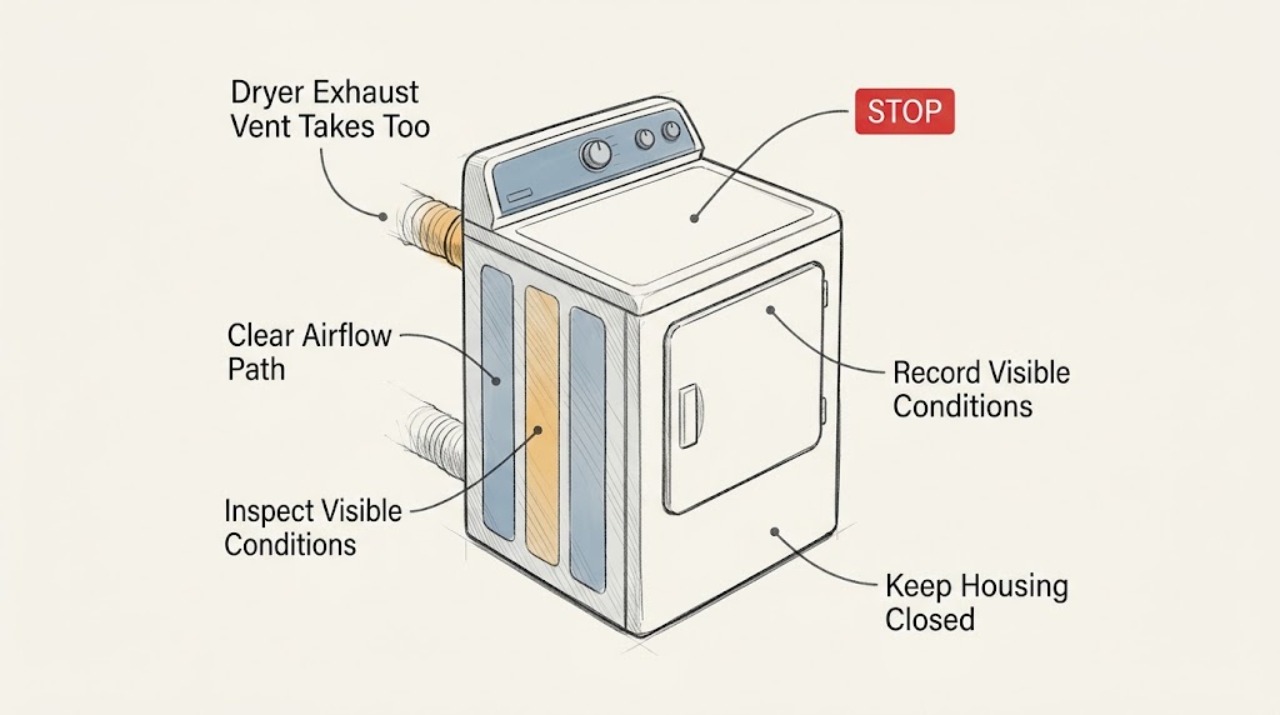
When a vented dryer heats but takes too long to dry, restricted exhaust airflow is a leading suspect. Start with the lint screen, any restricted-airflow or check-vent message, the visible hose behind the dryer, and the outside hood: lint, a crushed or kinked hose, too many bends, excessive length, or a blocked hood can keep moist air from leaving. Observe the outside flap and warm exhaust from a safe position, but do not pull out a gas dryer, disconnect the duct, open the dryer cabinet, or reach into the hood. Stop using the dryer for a burning smell, smoke, unusual heat, or no outside airflow, and arrange qualified vent cleaning or appliance service. If the vent path is clear, the dryer may need diagnosis for heating, sensor, blower, or control faults.
Work through in order
Diagnostic checks
Use only checks that match the exact appliance or system and its official guide.
-
Check 1
With the dryer cool and off, remove and inspect the lint screen using the normal hand-accessible procedure. Note whether it is covered in lint or has a waxy fabric-softener residue, and check the dryer display for a restricted-airflow or check-vent message without opening the cabinet.
Expected result: The screen is visibly loaded, has residue that blocks the mesh, or the dryer reports restricted airflow; alternatively, the screen is clean and no airflow warning is present.
Next step: Clean the screen according to the owner's instructions and make one normal observation with a correctly sized load. If the warning or long drying remains, stop repeated cycles and inspect the outside airflow or arrange vent service.
Stop if: Stop if the screen is damaged, the lint area is hot or scorched, there is a burning smell or smoke, or cleaning would require opening the dryer cabinet.
Why this matters
Why: A loaded or coated screen can reduce airflow and increase drying time. A clean screen and no warning do not clear the rest of the exhaust path, because lint can collect in the hose, wall duct, hood or dryer interior.
-
Check 2
During one short, normal dryer run, observe the exterior exhaust hood from a safe position without reaching into it or standing in a vehicle lane. Look for the flap opening and feel only for the presence of warm, moist exhaust from a clear distance; do not use a hand, tool or ladder to probe the opening.
Expected result: The flap opens and a steady warm airflow is present, or the flap stays shut, airflow is weak or absent, or lint, snow, debris, a nest or another obstruction is visible.
Next step: Stop using the dryer when outside airflow is absent or the hood is obstructed, and arrange qualified vent cleaning or inspection. Clear only loose debris that is safely reachable from the ground and permitted by the installation instructions; do not dismantle the hood.
Stop if: Stop for smoke, scorching, hot surfaces, a damaged hood, wildlife, a blocked roof or high wall outlet, or any need to climb, reach inside or use a tool at the exterior opening.
Why this matters
Why: Strong outside airflow makes a completely blocked duct less likely, while weak or absent airflow indicates an obstruction, crushed or disconnected route, or another ventilation problem. A flap that does not open can allow moisture and lint to remain in the path.
-
Check 3
From the front and side of the appliance, inspect only the visible section of the exhaust hose behind the dryer. Record whether it is crushed, sharply kinked, detached, sagging with lint accumulation, made of plastic or foil, or connected without obvious damage; do not pull the dryer forward.
Expected result: The visible hose is compressed or kinked, appears disconnected, uses a material not allowed by the manual, or looks intact but the outside airflow remains weak.
Next step: Leave the dryer off and arrange qualified vent inspection when the hose is damaged, disconnected or inaccessible. If a gas dryer would need moving, do not disturb the gas connector; give the professional the photographs and the dryer model.
Stop if: Stop for a gas smell, a damaged gas connector, a hot or scorched hose, exposed wiring, a loose appliance, or any need to move the dryer or disconnect the duct.
Why this matters
Why: A crushed, kinked or unsuitable hose can substantially reduce airflow and trap lint. An intact visible section does not prove that the concealed wall duct, joints or hood are clear.
-
Check 4
Compare the visible exhaust route with the dryer installation manual: note whether the duct runs unusually long, has many bends, is routed through a tight space, or has a hood location that can collect debris. Do not cut, shorten, reroute, tape, screw or replace the duct as an improvised test.
Expected result: The route is short and unobstructed, or it has excessive length, multiple bends, a tight crushed section, visible lint buildup or a hood exposed to recurring debris.
Next step: Give the route description and manual to a vent professional or appliance technician for cleaning, airflow testing and correction. Do not add a booster fan or change duct materials without confirming that the appliance and local requirements permit it.
Stop if: Stop if the route is in a wall, ceiling or roof space, requires ladders or crawling, has damaged building materials, or would require cutting into the structure.
Why this matters
Why: A longer or more sharply bent route can reduce airflow and encourage lint buildup, while a clear route makes an appliance-side heating, blower or sensor issue more likely. The permitted route depends on the exact dryer and installation instructions, so a generic length limit should not be assumed.
-
Check 5
Use the lint, outside-airflow, visible-hose and route observations to decide whether the next step is a vent cleaning, an installation correction or appliance diagnosis. Record the load size, selected cycle, whether heat is present, dry time compared with normal, display messages, and whether the symptom began after the dryer was moved or the vent was changed.
Expected result: Cleaning or an accessible correction restores strong outside airflow and normal drying, or drying remains slow despite clear airflow, or the dryer becomes unusually hot or unsafe.
Next step: Arrange qualified appliance service for persistent slow drying or a suspected internal fault, and arrange professional vent cleaning when the route cannot be verified. Keep the handoff record instead of running repeated cycles for comparison.
Stop if: Stop immediately for smoke, burning smell, scorching, an unusually hot cabinet, electrical arcing, a gas smell, no outside airflow, or any internal repair or measurement.
Why this matters
Why: Improvement after airflow is restored supports a vent restriction. Persistent slow drying with strong airflow shifts attention to the heater, blower, sensors, controls, load or installation; overheating or a safety warning requires the dryer to remain out of use.
Use your observations
Decision map
Find the observation that best matches what you see, then follow the next safe action.
-
PATH 01Next step
What you see
The dryer heats, the lint screen is clean, but the outside hood has weak or absent airflow, a closed flap, or visible lint or debris.
Do this next
Stop using the dryer and arrange qualified vent cleaning or inspection for the hood, hose and concealed duct. Do not reach into the outlet, climb to it or repeatedly run cycles.
-
PATH 02Next step
What you see
The visible hose is crushed, sharply kinked, disconnected or made from a material the owner's installation instructions do not permit.
Do this next
Leave the dryer off and have a qualified professional correct the route or duct material, especially if moving the appliance could disturb a gas connection. Do not improvise a replacement or use the dryer with a disconnected vent.
-
PATH 03Next step
What you see
The hood opens with strong airflow and the visible route is intact, but the dryer still takes too long to dry or does not heat normally.
Do this next
Arrange appliance diagnosis for heating, blower, sensor, control, load or cycle issues. Vent airflow being present does not prove that internal components are healthy.
-
PATH 04Next step
What you see
There is smoke, a burning smell, scorching, an unusually hot cabinet, electrical arcing, a gas smell or no outside airflow.
Do this next
Stop the dryer, keep the area clear and obtain qualified appliance or vent service; for a gas smell follow local gas-emergency guidance. Do not reset a tripped breaker and resume drying or open the dryer cabinet.
Helpful context
Understand the symptom
A vented dryer must move warm, moist air through the exhaust path to the outdoors. A clean lint screen does not prove that the hose, wall duct or exterior hood is clear. The most useful first distinction is whether the dryer heats while little or no air exits outside. If it heats and the outside airflow is weak, restricted venting is more likely; if airflow is strong but the dryer does not heat normally, the appliance itself needs a different diagnosis.
Look only at accessible surfaces. Lint screens and an exterior hood that can be seen from the ground are reasonable observations, but moving the appliance can crush the hose or stress a gas connection. Plastic or foil accordion ducting can kink, trap lint and restrict airflow; the correct duct material and route depend on the dryer installation instructions. Do not compensate for a restricted route by running repeated high-heat cycles.
Treat poor drying as a safety clue, not only an efficiency complaint. Lint and blocked ducts can cause heat to build up. Stop for a burning odor, smoke, scorching, an unusually hot cabinet, damaged ducting, or absent outside airflow, and have the vent or dryer assessed before using it again.
Safety boundary
Stop conditions
- Stop immediately for smoke, burning smell, scorching, an unusually hot cabinet, electrical arcing, a gas smell, damaged wiring or no outside airflow.
- Do not use the dryer with a disconnected, crushed or damaged exhaust path, and do not run repeated high-heat cycles to compensate for a restriction.
- Stop any check requiring the appliance to be moved, a gas connector to be disturbed, a wall or roof duct to be opened, a ladder or crawlspace, the dryer cabinet to be opened, or live electrical testing.
Only after diagnosis
Potential parts
- dryer exhaust duct
Only consider this category if a qualified professional confirms that the existing duct is crushed, damaged, unsuitable for the dryer or incorrectly routed and specifies an approved replacement.
Confirm the exact dryer installation instructions, duct diameter, material, route, connectors and local requirements before selecting a replacement. - exterior dryer vent hood
Only consider this category if inspection confirms that the outside hood or damper is damaged, blocked by its design, or no longer opens and closes correctly.
Confirm wall or roof location, weather sealing, duct connection and manufacturer or building requirements with a qualified installer.
When checks do not resolve it
Need a professional?
Arrange professional vent cleaning or inspection when outside airflow is weak or absent, the hood is obstructed, the hose is crushed or disconnected, the route is concealed, or long drying continues after the lint screen is cleaned., Arrange appliance service when the vent has strong airflow but the dryer does not heat normally, remains slow after the vent is verified, displays a recurring warning, or has a suspected blower, sensor, control or heating fault., Stop using the dryer immediately for smoke, burning smell, scorching, unusual heat, electrical arcing, a gas smell, damaged ducting or no outside exhaust airflow., Do not move a gas dryer, disconnect its duct, disturb the gas connector, open the cabinet, measure live components or alter the vent route without qualified help and the applicable installation instructions.
Common questions
FAQ
Why does a dryer take too long to dry when it still gets hot?
A dryer can heat while restricted exhaust airflow keeps moist air from leaving. Clean the lint screen, observe the outside hood from a safe position, and arrange vent inspection if airflow is weak or the route is crushed, kinked, long or obstructed.
How do I know whether the dryer vent is blocked?
During one short normal run, observe whether the outside hood flap opens and warm moist air exits. Weak or absent airflow, lint or debris at the hood, a restricted-airflow message, or a crushed hose points to a vent problem; do not probe the duct or use a ladder to investigate.
Can I move the dryer to clean the exhaust hose?
Do not pull out a gas dryer or disturb its connector. If the duct cannot be inspected or cleaned without moving the appliance or disconnecting the hose, leave the dryer off and arrange qualified vent or appliance service.
Is a long dryer vent a fire concern or only a performance issue?
It can be both. Longer or more sharply bent routes can reduce airflow and encourage lint buildup, while lint and blocked ducts can increase heat. Use the exact installation instructions and arrange professional correction rather than improvising the route.
Read the exact guide
Official sources
- CPSC Publication 5022 - Overheated Clothes Dryers Safety AlertU.S. Consumer Product Safety Commission · CPSC dryer fire-safety guidance linking long drying and damp clothes to blocked lint screens or exhaust ducts, and identifying airflow, duct and overheating precautions
- Clothes Dryer Fire SafetyU.S. Fire Administration · U.S. Fire Administration dryer fire-safety guidance on lint filters, vent cleaning, damaged or restricted venting, outdoor vent covers and professional installation or service
- Long Dry Times - DryerWhirlpool · Whirlpool dryer guidance on restricted airflow, lint screens, crushed or kinked hoses, outside exhaust hoods, vent length and persistent long drying
Community feedback
Share a repair observation
Share a plain-text repair observation. Accepted observations are published automatically; this page may take a moment to update.