
On this page
Start here
Quick answer
A Bosch dryer can take too long when the lint filter, heat exchanger or condenser, moisture sensor, air inlet, or exhaust path needs attention; the selected program, an overloaded or very small load, high initial moisture, poor room ventilation, or a delayed or adaptive time display can also be involved. Start by confirming the program and load, clean and fully dry the lint filter, clean only the model-approved sensor or heat-exchanger area, and check that the air inlet and accessible vent exit are unobstructed. If clothes remain damp after these checks, an airflow warning or error returns, the dryer becomes unusually hot, or cleaning requires cabinet access, stop troubleshooting and arrange qualified Bosch service.
Before you begin
Safety first
- This article covers program and load comparison, model-approved filter, sensor, heat-exchanger, condenser, air-inlet, room, and accessible vent checks only. Do not open the cabinet, probe live circuits, reach into fans or heaters, operate without required filters or exhaust, or continue use after a hazard or persistent incomplete drying.
Work through in order
Diagnostic checks
Use only checks that match the exact appliance or system and its official guide.
-
Check 1
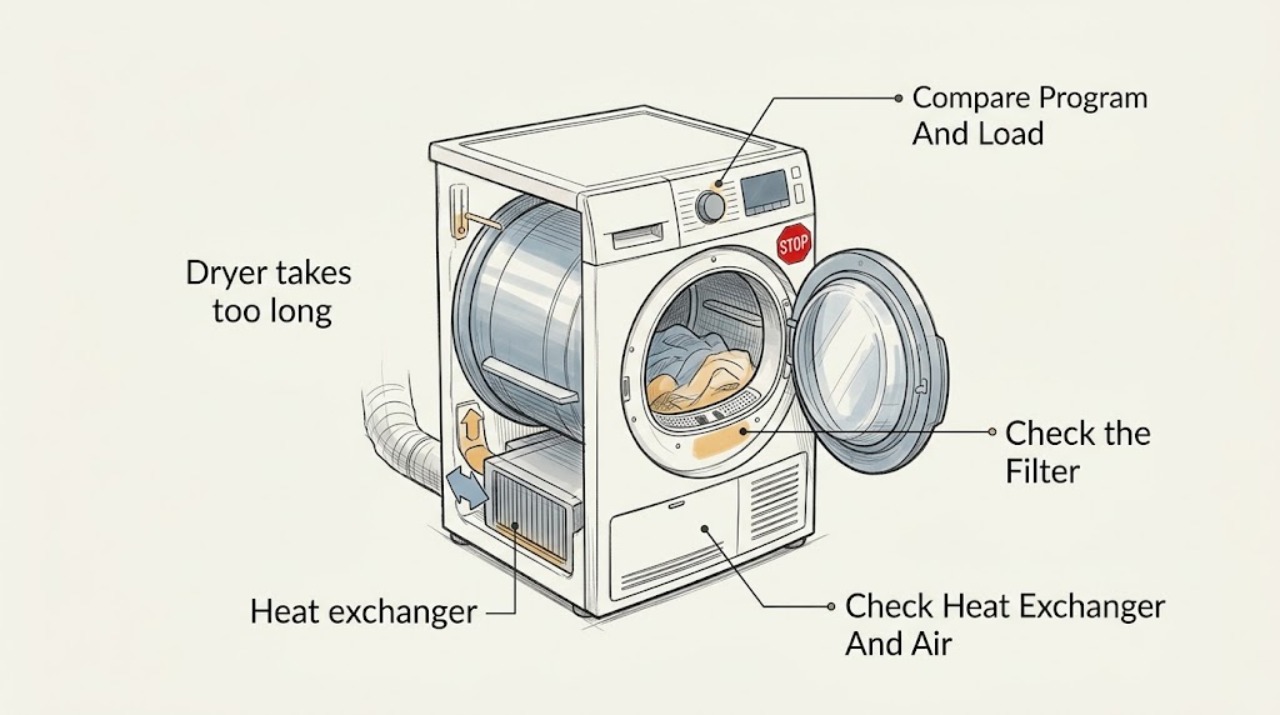
Record the selected program, displayed remaining time, fabric mix, load weight or volume, and how wet the laundry was when it entered the Bosch dryer; do not compare a bulky or very wet load with a light sensor-cycle expectation.
Expected result: Note whether the program suits the materials, the load is packed tightly or extremely small, the washer left the load unusually wet, the display time changes during the cycle, or every program produces damp clothes.
Next step: Use the program and load guidance in the exact owner's manual for one comparable load; if comparable loads remain damp or time increases sharply, continue with maintenance and airflow checks.
Stop if: Do not overload the drum, run a program outside the fabric-care label, or keep testing if the dryer is unusually hot, smells burned, displays a warning, or has damaged wiring or a cord.
Why this matters
Why: An unsuitable program, overloaded or underfilled drum, high initial moisture, and adaptive time estimate can make a cycle appear too long without proving a dryer fault. A consistent long result across suitable loads points to filter, sensor, airflow, heat-exchanger, or service checks.
-
Check 2
Switch the dryer off and follow the Bosch manual to remove, clean, and completely dry the lint filter; locate the moisture sensor near the filter or drum and wipe it only with the model-approved soft damp cloth method.
Expected result: Record whether the filter contains lint, dust, hair, or residue; whether it was damp when removed; and whether the moisture sensor has visible limescale or detergent or fabric-care residue.
Next step: Reinsert the filter only when fully dry and seated, then use one comparable load; follow the exact model manual for sensor cleaning and do not substitute a solvent or abrasive cleaner.
Stop if: Do not operate without the lint filter, use a wet filter, scrape the sensor, pour liquid into the cabinet, or remove panels to access hidden lint.
Why this matters
Why: Bosch says a blocked filter reduces efficiency and that residue on the moisture sensor can affect sensing. A clean, dry filter and sensor with no drying improvement shifts suspicion toward the heat exchanger, air path, load, program, or an internal fault.
-
Check 3
Identify whether the model is vented or ventless, then inspect and clean the heat exchanger, condenser, or maintenance-filter area only as the Bosch manual allows; also make sure the front air inlet and surrounding space are not blocked.
Expected result: Record whether the model has a heat exchanger or condenser that is dirty, a maintenance indicator, lint or dust around the inlet, or an air inlet blocked by laundry, a wall, or stored items.
Next step: Restore only the model-approved clean, dry, and correctly fitted components and clear ordinary obstructions around the air inlet; request service if a maintenance flap, exchanger, or condenser cannot be safely accessed or remains restricted.
Stop if: Do not run with a removed filter or condenser, force a maintenance flap, insert tools into a heat exchanger, or obstruct or disconnect an exhaust path to test drying.
Why this matters
Why: Bosch documentation links a dirty heat exchanger or filter and insufficient air supply or a blocked inlet with long drying. Vented and ventless designs have different serviceable areas, so an unverified cleaning method can create a new problem.
-
Check 4
For a vented Bosch dryer, inspect the accessible vent exit and hose for a blocked hood, kink, crushing, or weak warm-air flow; for a ventless model, check room ventilation and the specified air inlet instead of searching for an outdoor duct.
Expected result: Record whether air exits steadily, the outside hood opens or is blocked, the hose is kinked or crushed, humidity or heat accumulates in the room, or the unit has no external vent by design.
Next step: Clear only ordinary accessible lint or debris and restore the vent or room-air arrangement required by the model; have an inaccessible or persistently restricted path professionally inspected.
Stop if: Do not disconnect a gas or vent system and operate the dryer, run a gas dryer without the required outdoor exhaust, push the appliance into a crushed hose, or open the cabinet.
Why this matters
Why: Bosch says an obstructed vent exit or air inlet can extend drying, while manuals identify inadequate air circulation or room conditions as contributors. A restricted accessible path is different from an internal fan, heat-pump, or control failure.
-
Check 5
After the load, filter, sensor, heat-exchanger, air-inlet, room, and vent checks are complete and safe, run one comparable cycle while remaining nearby and document the final dryness, actual duration, temperature, and any code or warning.
Expected result: Classify the result as normal drying, improved but still long, damp after completion, a time estimate that changes but the load dries, or no improvement with a recurring code, overheating, weak airflow, or abnormal noise.
Next step: Use the dryer only when the result is repeatably safe and acceptable; otherwise stop and arrange qualified Bosch service with the model, program, load, time, maintenance steps, and result.
Stop if: Stop for smoke, burning odor, unusual heat, sparking, damaged cord, water near electrical parts, a recurring error, or any need to open the cabinet or test live components.
Why this matters
Why: Improvement after a load or maintenance correction supports that condition as the immediate contributor. Persistent incomplete drying or a warning after the specified checks makes an internal airflow, heat, sensor, fan, control, or installation diagnosis more likely.
Use your observations
Decision map
Find the observation that best matches what you see, then follow the next safe action.
-
PATH 01Safety boundary
What you see
Only a bulky, mixed, very wet, overloaded, or unusually small load takes longer, or the displayed remaining time changes while the load eventually dries.
Do this next
Use a comparable load and the exact program guidance in the owner's manual; compare actual dryness and duration rather than the first time estimate.
Why this path and its safety boundary
Why it matters: The program, fabric mix, initial moisture, load size, or adaptive estimate may explain the duration without establishing a dryer fault.
Safety stop: Do not keep increasing load size or heat when clothing is scorching, the dryer is unusually hot, or the odor or warning changes.
-
PATH 02Safety boundary
What you see
The lint filter is coated or damp, or the moisture sensor has limescale or detergent or fabric-care residue, and drying improves after the model-approved cleaning.
Do this next
Keep the filter clean, dry, and seated and clean the sensor only as the manual permits; request service if the condition returns quickly or drying remains incomplete.
Why this path and its safety boundary
Why it matters: Filter restriction or inaccurate sensing is a plausible immediate contributor to the long cycle.
Safety stop: Do not operate without the filter, use abrasive cleaners, scrape sensor bars, or pour liquid into the cabinet.
-
PATH 03Safety boundary
What you see
The model-approved heat exchanger, condenser, or maintenance filter is dirty, or the front air inlet is blocked, and drying improves after safe cleaning or clearing.
Do this next
Follow the model maintenance schedule and keep the air inlet unobstructed; arrange service if the area cannot be safely accessed, remains clogged, or the dryer overheats.
Why this path and its safety boundary
Why it matters: Reduced heat transfer or air supply may have been limiting drying performance.
Safety stop: Do not force panels or flaps, use the appliance with a removed exchanger or filter, or insert tools into internal fins or fans.
-
PATH 04Safety boundary
What you see
A vented model has weak outside airflow, a blocked or crushed hose or hood, or a ventless model has a blocked inlet or poorly ventilated room.
Do this next
Restore the model-required vent or room-air arrangement and have an inaccessible or persistent restriction professionally inspected before continued use.
Why this path and its safety boundary
Why it matters: The exhaust or surrounding air path can extend drying and raise heat or humidity, but an internal obstruction has not been ruled out.
Safety stop: Do not run a gas dryer without its outdoor exhaust, operate with a disconnected hose, or push the dryer against a crushed vent.
-
PATH 05Safety boundary
What you see
Suitable loads remain damp after the filter, sensor, exchanger, air inlet, program, and vent checks, or the dryer displays a recurring warning or code.
Do this next
Stop troubleshooting and arrange qualified Bosch service; provide the model, load and program, actual duration, dryness result, codes, and maintenance observations.
Why this path and its safety boundary
Why it matters: A concealed airflow, heater, heat-pump, fan, sensor, control, or installation problem is more likely than a simple maintenance condition.
Safety stop: Do not bypass a warning, repeatedly reset a code, open the cabinet, or replace a heater, sensor, fan, or control without diagnosis.
-
PATH 06Safety boundary
What you see
The dryer is unusually hot, emits a burning odor or smoke, sparks, has a damaged cord, or water is near electrical parts while drying is slow.
Do this next
Stop the cycle and disconnect power only through a safe normal disconnect if appropriate; keep the appliance out of service and arrange qualified repair. Leave the area and contact local emergency services for active smoke or fire.
Why this path and its safety boundary
Why it matters: This is an immediate fire, electrical, or equipment-damage boundary, not a normal long-cycle branch.
Safety stop: Do not restart, open the cabinet, handle scorched wiring, run without the lint or vent components, or continue resetting the breaker.
Helpful context
Understand the symptom
First decide whether the time is actually excessive
A Bosch program may adjust its remaining estimate as it senses the load, and a load that enters the dryer very wet or contains heavy fabrics can legitimately need more time. Compare the result with the selected program and the load type, not just the first number shown on the display. If every load is damp or the duration has changed sharply, proceed to the filter, sensor, airflow, and heat-exchanger checks.
Clean the parts that control airflow and moisture sensing
Bosch directs owners to clean the lint filter, wipe residue from the moisture sensor as the model permits, and check the vent exit for an unobstructed stream of warm air. Bosch maintenance guidance also identifies lint, dust, and residue on filters or a heat exchanger as efficiency problems. On a ventless model, follow the manual for the condenser or heat exchanger rather than looking for a nonexistent outdoor duct.
Use the result to set a service boundary
If the filter, sensor, load, program, air inlet, and model-approved heat-exchanger or vent checks do not restore drying, the remaining possibilities include a concealed airflow restriction, heater or heat-pump problem, fan, sensor, control, or installation condition. Do not open the cabinet or improvise around a safety warning. Give the technician the model, program, load, displayed duration, dampness result, airflow observations, and any code.
Safety boundary
Stop conditions
- Stop immediately for smoke, burning odor, sparks, scorching, a damaged or hot cord, water near electrical parts, or an unusually hot cabinet or room.
- Do not operate without the lint filter, heat exchanger, condenser, or other model-required filter in place and completely dry.
- Do not obstruct or disconnect a required exhaust path, block the front air inlet, or operate a gas dryer without its required outdoor exhaust.
- Do not open the cabinet, probe live circuits, reach into fans or heaters, force a maintenance flap, or replace internal components without model-specific diagnosis.
- Do not keep running repeated cycles when suitable loads remain damp, a warning or code returns, or the dryer becomes hotter or slower than normal.
Only after diagnosis
Potential parts
- lint filter, heat exchanger, or condenser component
Consider this category only when the exact model's component is damaged, cannot be cleaned or fitted, or a qualified diagnosis confirms it is restricting drying.
Match the complete Bosch model or E-Nr and the component design; do not operate with a missing, wet, or incorrectly fitted filter or exchanger. - moisture sensor or sensor assembly
Consider this category only when residue has been removed per the manual and a qualified diagnosis confirms inaccurate sensing or damaged sensor hardware.
Confirm the exact model, sensor location, and diagnosis before ordering; cleaning residue alone does not prove the sensor is failed. - vent or air-inlet component
Consider this category only when a qualified inspection confirms a damaged, crushed, or incompatible vent or inlet component is restricting airflow.
Follow the model installation requirements and restore the complete air path before using the dryer. - heater, fan, heat-pump, or control component
Consider this category only after qualified diagnosis confirms an internal heating, airflow, heat-pump, or control failure following the accessible maintenance checks.
Confirm the complete Bosch model, diagnosed failure, and manufacturer parts information before ordering; do not infer a part from long drying alone.
When checks do not resolve it
Need a professional?
Arrange qualified Bosch appliance service when suitable loads remain damp after the filter, sensor, heat-exchanger, air-inlet, room, and vent checks; a warning or code returns; the dryer overheats; airflow remains weak; or internal access is required. Use a licensed electrician for damaged or overheating electrical connections. Stop immediately for smoke, sparks, burning odor, scorching, water near electrical parts, or a hot damaged cord, and contact local emergency services for active smoke or fire.
Safety scope: This article covers program and load comparison, model-approved filter, sensor, heat-exchanger, condenser, air-inlet, room, and accessible vent checks only. Do not open the cabinet, probe live circuits, reach into fans or heaters, operate without required filters or exhaust, or continue use after a hazard or persistent incomplete drying.
Common questions
FAQ
Why is my Bosch dryer taking longer to dry than before?
Check the lint filter, moisture sensor, heat exchanger or condenser, air inlet, and vent path, then compare a suitable load and program. A sudden change across comparable loads or a recurring warning needs Bosch service.
Can a dirty lint filter make a Bosch dryer take too long?
Yes. Bosch says lint on the filter reduces efficient operation. Remove the lint, wash the filter if needed, let it dry completely, and reinsert it. Never run the dryer without the filter.
Could the Bosch moisture sensor cause long drying?
Residue on the moisture sensor can affect sensing. Bosch identifies the sensor near the lint filter; clean it only as the exact manual permits, then compare a suitable load. Persistent incomplete drying requires service.
Does a Bosch heat-pump or ventless dryer have an exhaust vent to clean?
Not every dryer uses an outdoor exhaust. Identify the model first and follow its manual for the condenser, heat exchanger, filters, and air inlet. Do not force a vent-based procedure onto a ventless design or obstruct its required room air.
When should a Bosch dryer with long drying time be serviced?
Arrange service when suitable loads remain damp after the model-approved filter, sensor, heat-exchanger, air-inlet, room, and vent checks; a code returns; the dryer overheats; airflow stays weak; or cabinet access is needed. Stop immediately for smoke, burning odor, sparks, scorching, or damaged wiring.
Read the exact guide
Official sources
- How to Clean & Maintain Your DryerBosch Home Appliances · Bosch US dryer maintenance guidance; maintenance-flap and heat-exchanger details vary by model.
- Dryer Not Drying Completely | Dryer TroubleshootingBosch Home Appliances · Bosch US dryer troubleshooting guidance; exact programs, parts, and access vary by model.
- Bosch Dryer Use and Care ManualBosch Home Appliances · Bosch US use-and-care manual for the linked model family; the exact owner's manual for the installed E-Nr controls.
- Cleaning Your Dryer’s Filter | Dryer MaintenanceBosch Home Appliances · Bosch US dryer filter maintenance guidance; follow the exact model manual for filter access.
Community feedback
Share a repair observation
Share a plain-text repair observation. Accepted observations are published automatically; this page may take a moment to update.