
On this page
Start here
Quick answer
A dryer that takes too long to dry with weak airflow usually has a restriction between the lint screen, drum, duct, and outside hood. Stop and let it cool, then unplug it before checking the lint screen, the reachable hose for crushing or kinks, and the exterior hood for lint, debris, ice, landscaping, or a flap that does not open. Warm but damp clothes, elevated laundry-room heat or humidity, lint around the door or lint housing, and a weak outside exhaust support a vent problem. GE says proper vent material, duct length, obstructions, and a working wall cap are important to dryer operation; Whirlpool likewise advises checking the hose, hood, and full house vent when airflow is weak. Use the correct cycle and load, but do not compensate with extra heat or repeated cycles. Do not operate a gas dryer with its vent disconnected, open the cabinet, reach deep into the duct or lint housing, or bypass a thermal safety. If the full vent path is concealed, damaged, or still weak after safe cleaning, or if the dryer is hot, smells of burning, trips a breaker, or shows a warning, keep it off and arrange qualified dryer-vent or appliance service.
Before you begin
Safety first
- Homeowner checks should remain limited to a cool, unplugged lint screen, reachable transition hose and hood observations, load and cycle documentation, and safe exterior airflow observations. A qualified professional should clean or test concealed ducts and inspect the blower, heater, sensors, thermal safeties, internal lint, wiring, and controls.
Work through in order
Diagnostic checks
Use only checks that match the exact appliance or system and its official guide.
-
Check 1
Stop the dryer and disconnect power from a safe, dry position if it is excessively hot, smells of burning, produces smoke or sparks, has a hot or discolored plug or outlet, or trips a breaker; keep it off and clear the area.
Expected result: The dryer only has a gradual increase in drying time with no heat, odor, smoke, or electrical warning, or one of those danger signs is present.
Next step: For smoke or fire, leave and use emergency help. For burning or electrical symptoms, arrange qualified appliance or electrical service and do not restart. If no hazard sign is present, continue only after the dryer is cool.
Why this matters
Why: Weak airflow can cause overheating, while burning and electrical symptoms may indicate a hazard beyond a routine vent restriction.
-
Check 2
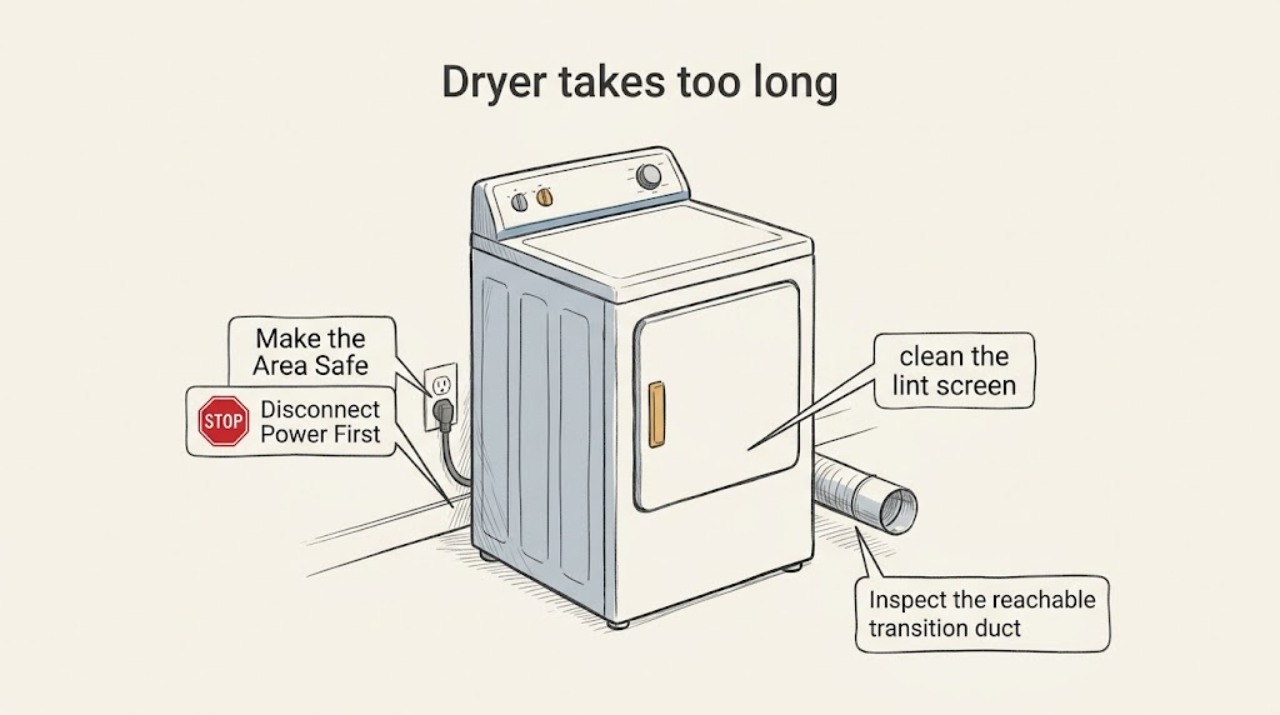
With the dryer cool and unplugged, clean the lint screen and inspect it for softener or detergent film, tears, warping, or a poor fit; clean residue only according to the model instructions and dry the screen before reinstalling.
Expected result: The screen is packed, coated, damaged, missing, or clean and correctly seated.
Next step: Replace only a damaged screen with a model-correct one and reinstall it fully. If airflow remains weak or drying remains slow, stop using higher heat and inspect the reachable exhaust path.
Why this matters
Why: Lint and residue can reduce airflow, while a missing or damaged screen can let lint enter the dryer. A clean screen does not clear the house duct or internal airflow path.
-
Check 3
Inspect the reachable transition duct behind the dryer for crushing, kinks, holes, excessive slack, or lint, without pulling a stacked or gas dryer farther than its installation instructions allow.
Expected result: The hose is crushed, sharply bent, visibly blocked, damaged, made of plastic, or appears open and correctly routed.
Next step: Keep the dryer off until damaged or crushed ducting is repaired with model-appropriate venting. Do not tape over damage as a permanent repair, reach into the cabinet, or strain gas and electrical connections.
Why this matters
Why: A collapsed, kinked, unsuitable, or blocked transition duct can restrict airflow close to the appliance. An open short hose does not prove that the wall or roof duct is clear.
-
Check 4
From outside, inspect the exhaust hood and surrounding area during a brief normal operation only if the dryer is cool, has no hazard symptoms, and the owner instructions permit it; observe the flap and the strength and steadiness of exhaust flow.
Expected result: The flap stays closed, airflow is weak or intermittent, lint or debris blocks the hood, snow or ice is present, landscaping is in the way, or the flap opens with strong flow.
Next step: Stop use and arrange vent cleaning or repair for weak flow, a blocked hood, or a concealed run. Clear only loose debris safely reachable from outside; never enter the duct or operate a gas dryer with the vent disconnected.
Why this matters
Why: A blocked termination or weak flow supports a restriction somewhere in the full duct path. Strong flow makes a severe external blockage less likely but does not rule out an appliance airflow fault.
-
Check 5
Record a normal load's size and fabric, whether clothing enters the dryer wetter than usual, cycle and heat setting, drying time, outside airflow, laundry-room heat or humidity, warm-but-damp results, and lint around the door seal or lint housing.
Expected result: Loads are warm but damp, cycles have lengthened, the room is humid or hot, lint appears around seals, or drying improves with a smaller correctly sorted load while airflow is strong.
Next step: Keep the dryer off when airflow is weak or heat is excessive. If the vent is confirmed clear, use only the model-approved cycle and load guidance; request appliance service if the symptom persists.
Why this matters
Why: The first group supports weak ventilation or a restriction. Improvement with proper load size and strong airflow makes load selection or washer extraction more likely, but it does not excuse a hot or unsafe appliance.
-
Check 6
Check that the selected cycle is not Air Dry or an unsuitable low-heat setting for the load, that the load is not overloaded or mixed with heavy and light items, and that the dryer has not been stopped before its cool-down phase.
Expected result: The cycle was inappropriate, the load was oversized or poorly sorted, clothes were unusually wet from the washer, the unit was stopped early, or the correct cycle still produces weak airflow and long drying.
Next step: Correct the load or cycle only after the exhaust path is safe. If the correct cycle still runs long or airflow is weak, stop repeated testing and arrange vent or appliance service.
Why this matters
Why: Cycle, load, washer-extraction, and interrupted cool-down issues can change drying time, but they do not create weak outside exhaust. Persistent weak airflow remains a vent or appliance issue.
-
Check 7
Gather the exact dryer model, fuel type, warning or error text, lint-screen condition, transition-duct material, approximate vent run and bends, hood location and airflow, load and cycle, recent move or vent cleaning, and any heat, odor, noise, or electrical symptom.
Expected result: The vent run is concealed or long, weak airflow persists after visible cleaning, the dryer is hot despite strong hood flow, or a warning or error remains.
Next step: Give the record to qualified dryer-vent or appliance service and request a complete airflow and safety evaluation. Do not select a heater, thermostat, thermal fuse, or blower part solely from a long-dry symptom.
Why this matters
Why: A concealed duct restriction may require specialized cleaning, while strong exhaust with persistent long drying keeps blower, sensor, heater, control, internal lint, or electrical causes in consideration.
Use your observations
Decision map
Find the observation that best matches what you see, then follow the next safe action.
-
PATH 01Next step
What you see
Outside airflow is weak or absent, the hood flap does not open, and loads are warm but damp or the laundry area is hot or humid.
Do this next
Keep the dryer off and arrange qualified vent cleaning or repair. Do not continue cycles to see whether the obstruction clears.
Why this path and its safety boundary
Why it matters: A restriction in the hood, wall or roof duct, crushed hose, lint-filled run, or excessive bends is more likely than a simple cycle-selection problem.
-
PATH 02Next step
What you see
The screen and reachable hose are clear but outside airflow remains weak, or lint returns around the door or lint housing.
Do this next
Stop use and request a full vent-path cleaning or flow test. Do not push tools deep into the duct or dryer cabinet.
Why this path and its safety boundary
Why it matters: The concealed house duct, termination, or internal lint path remains restricted; the short visible section cannot clear the full exhaust route.
-
PATH 03Next step
What you see
Outside airflow is strong and the load and cycle are appropriate, but drying remains slow or the dryer becomes hot.
Do this next
Keep the cabinet closed and arrange qualified appliance service for internal airflow and temperature testing. Do not replace or bypass a safety part based on the symptom alone.
Why this path and its safety boundary
Why it matters: A severe external restriction is less likely, while a blower, moisture sensor, heater, thermostat or thermistor, internal lint, control, or electrical issue remains possible.
-
PATH 04Next step
What you see
Drying improves with a correctly sorted, smaller load and strong outside airflow, while the dryer is not unusually hot and no warning appears.
Do this next
Follow the model and fabric-care guidance and monitor normal loads. Arrange service if weak airflow, excess heat, long cycles, or damp loads return.
Why this path and its safety boundary
Why it matters: Load size, fabric mix, washer extraction, leveling or cycle selection is more likely than a blocked vent.
-
PATH 05Next step
What you see
Long drying is accompanied by burning odor, smoke, sparks, a hot plug or outlet, a breaker event, visible lint fire, or an extensively damaged exhaust duct.
Do this next
Disconnect only from a safe position, leave the dryer off, and use emergency help for active fire. Arrange qualified appliance or electrical service before any further operation.
Why this path and its safety boundary
Why it matters: A fire, electrical, lint, or mechanical hazard outweighs ordinary vent troubleshooting.
Helpful context
Understand the symptom
Weak airflow is the key clue
Drying requires heated air to pass through the load and carry moisture out of the dryer. If the outside hood has little flow, the restriction may be in the lint screen, transition hose, wall duct, roof or wall termination, or a hidden section. GE notes that a dryer unable to remove heat and humidity can become hot or sweat, while Whirlpool lists warm damp loads and a hot or humid laundry area as airflow warning signs.
Check the simplest restrictions first
Lint screens can be clogged or coated with softener residue even when they look clean. The reachable hose can collapse behind a dryer, and a hood can be blocked by lint, debris, ice, landscaping, or a flap that sticks. Do these checks with the dryer cool and unplugged where possible. Do not move a stacked or gas unit in a way that strains its connections.
The full duct path matters more than the short hose
A clear transition hose does not prove that the in-wall, attic, or roof run is clear. GE says duct length, turns, material, and outside-cap operation affect performance; Whirlpool recommends checking the complete vent path and arranging professional cleaning when needed. A long or concealed run should be evaluated by a qualified vent professional rather than cleaned by guesswork.
Separate airflow from load and cycle causes
Oversized or mixed loads, heavy fabrics, clothes arriving unusually wet from the washer, low-spin settings, an air-only cycle, or an unsuitable heat setting can extend drying time. These causes do not explain weak outside exhaust, a hot laundry area, or lint around the door. If the dryer performs normally with a correctly sized load and strong exhaust, review the load and cycle before suspecting a part.
A persistent problem can be inside the appliance
If the duct and hood have strong flow but the dryer still takes too long, a blower wheel, internal lint accumulation, moisture sensor, heater, thermostat or thermistor, control, or electrical supply issue may be involved. Those components cannot be identified from drying time alone. Keep the cabinet closed and use the model manual and a qualified technician for internal testing.
Long drying is a safety signal, not just an inconvenience
Whirlpool warns that lint and restricted airflow can lead to overheating. Stop for burning odor, smoke, sparks, unusual electrical heat, a tripped breaker, or a dryer that becomes excessively hot. Do not run extra cycles to see whether the airflow improves, and do not use the dryer with a missing screen or disconnected exhaust.
Safety boundary
Stop conditions
- Stop immediately for smoke, fire, burning odor, sparks, a hot or discolored plug or outlet, a repeated breaker trip, or visible lint ignition; leave and use emergency help for active fire, and do not restart the dryer.
- Do not operate with the lint screen removed, exhaust disconnected, hood blocked, or vent path severely restricted or damaged. A gas dryer must not be run without its exhaust connected because combustion fumes can enter the room.
- Do not open the cabinet, reach deep into the lint housing or duct, touch the heater, blower, wiring, or thermal controls, bypass a fuse or thermostat, or move a stacked or gas dryer beyond its installation instructions.
- Arrange qualified vent or appliance service when outside airflow remains weak, the run is concealed, long drying returns after cleaning, the dryer remains hot with strong hood flow, or a warning, code, or abnormal electrical symptom appears.
Only after diagnosis
Potential parts
- dryer exhaust duct or exterior hood
Consider replacement only when inspection confirms a crushed, punctured, incompatible, or damaged duct or hood; long drying and weak airflow do not identify the exact vent component.
Match the dryer model, approved duct material, diameter, routing, termination, clearances, and local requirements; do not substitute by appearance. - dryer lint screen
Consider this only when the screen is torn, warped, missing, or cannot seat correctly after cleaning; a clean screen does not prove the duct is clear.
Match the exact dryer model, dimensions, mesh, and seating arrangement; never operate without the approved screen. - dryer blower wheel or airflow component
Consider only after qualified testing confirms a damaged, obstructed, loose, or unbalanced blower or related airflow part after the exhaust path is verified.
Match the exact model, wheel design, rotation, motor interface, and approved access procedure; internal cabinet work is service work. - dryer moisture sensor or temperature-sensing component
Consider only when a technician confirms a failed sensor or temperature-control component after airflow and load causes are ruled out; long cycles alone are not proof.
Match the exact model, sensor location, electrical specification, mounting, wiring, and approved diagnostic procedure; never bypass a thermal safety.
When checks do not resolve it
Need a professional?
Safety scope: Homeowner checks should remain limited to a cool, unplugged lint screen, reachable transition hose and hood observations, load and cycle documentation, and safe exterior airflow observations. A qualified professional should clean or test concealed ducts and inspect the blower, heater, sensors, thermal safeties, internal lint, wiring, and controls.
Common questions
FAQ
Why is my dryer taking a long time if the lint screen is clean?
The wall or roof duct, transition hose, exterior hood, or internal airflow path may still be restricted. Check the full exhaust route and outside airflow; a clean screen alone does not clear it.
Can I disconnect the vent to see whether drying improves?
Do not use a disconnected exhaust as a routine test. A gas dryer must not operate without its vent because combustion fumes can enter the room. Have a qualified professional test the airflow safely.
Could the washer be causing long dryer times?
Yes. If clothes leave the washer wetter than usual or a low-spin setting was selected, drying takes longer. That does not explain weak outside airflow, elevated heat or humidity, or a vent warning, which still require attention.
Should I replace the heater or thermostat because drying is slow?
Not from this symptom alone. Verify the lint screen, load, cycle, and full exhaust path first. If airflow is strong but drying remains slow or the dryer overheats, qualified appliance testing can identify whether an internal sensor, heater, blower, control, or electrical issue is involved.
Read the exact guide
Official sources
- Cleaning the Dryer DrumWhirlpool Product Help · Whirlpool states that lint in the drum or venting can obstruct airflow and lead to overheating and potentially dangerous situations.
- Dryer - Clothing Too HotLG USA Support · LG describes cool-down as tumbling with airflow and no heat, identifies a clogged or restricted exhaust as a cause of excessive heat, and directs owners to repair when the condition persists.
- Dryer - Things To Check For A Venting IssueGE Appliances · GE explains that weak airflow at the wall cap typically indicates duct obstruction and warns that gas dryers must not be operated without a vent.
- Dryer - Taking Too Long To Dry Clothes or Not Drying at AllGE Appliances · GE identifies exhaust condition, duct material and routing, lint-screen care, load and fabric, washer moisture, and cycle choices as relevant to long drying times.
- Dryer is not Drying or Experiencing Long Dry TimesWhirlpool Product Help · Whirlpool lists weak outside airflow, warm damp loads, elevated heat or humidity, and lint around seals as signs of restricted ventilation and advises unplugging before inspection.
- Dryer - Hot to the Touch or SweatsGE Appliances · GE connects excess heat and humidity with restricted airflow and distinguishes an electric-only vent test from unsafe operation of a gas dryer without its vent.
- Check Vent Light on DryerWhirlpool Product Help · Whirlpool identifies a Check Vent indication as restricted airflow and lists crushed venting, blocked hoods, excessive length, and multiple bends as causes to investigate.
Community feedback
Share a repair observation
Share a plain-text repair observation. Accepted observations are published automatically; this page may take a moment to update.