
On this page
Start here
Quick answer
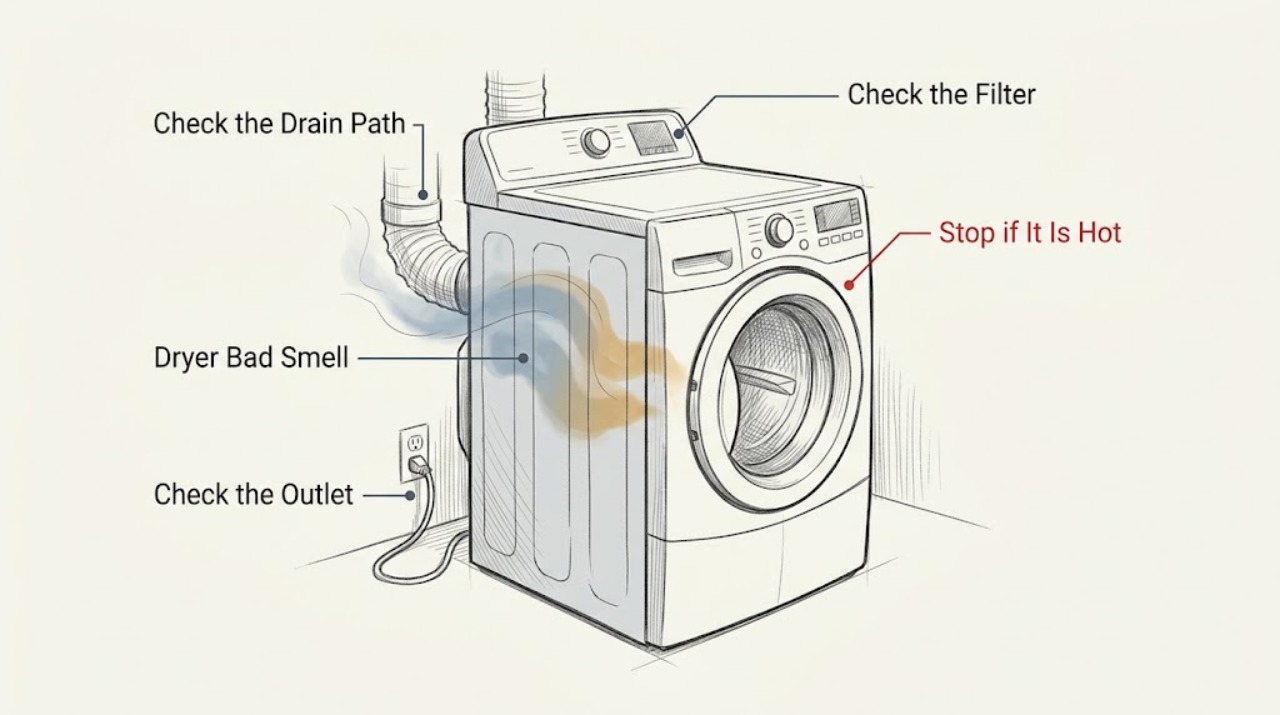
A dryer bad smell is not one diagnosis. A damp or musty odor can come from wet laundry, residue, or a dirty drum; a hot lint or burning smell can indicate restricted airflow or an overheating part; a sharp electrical odor points to a cord, plug, outlet, motor, or control fault; and a rotten-egg odor on a gas dryer may signal a gas emergency. Stop the dryer before investigating, remove the load if it is safe, and inspect only accessible lint, drum, vent, cord, and outlet areas. Do not run another cycle after smoke, flame, arcing, a hot connection, repeated breaker trips, suspected gas, or a carbon-monoxide alarm.
Work through in order
Diagnostic checks
Use only checks that match the exact appliance or system and its official guide.
-
Check 1
Turn the dryer off and, once it is safe to approach, classify the odor and its location: damp or musty inside the drum, hot lint or burning near the exhaust, plastic or electrical at the plug and outlet, or rotten-egg gas odor near a gas dryer or room.
Expected result: The odor type and location select different paths. Musty odor supports a cleaning check; hot lint supports airflow and lint inspection; electrical odor supports immediate stop-use; gas odor supports an emergency response.
Next step: Continue only with the matching low-risk branch. If there is smoke, flame, arcing, a hot connection, suspected gas, or an alarm, use the stop conditions immediately.
Why this matters
Why: A smell is evidence about where heat, moisture, combustion, or electricity may be involved, but it is not proof that a replacement part is needed.
-
Check 2
For a damp or musty smell, remove all clothing and inspect the accessible drum, lint screen, door area, and any removable filter or dispenser specified by the owner's guide. Wipe only with the cleaner and method the guide permits, and do not mix chemicals.
Expected result: Visible lint, residue, a forgotten damp load, or an odor that fades after the approved cleaning points toward a moisture or residue source. A persistent odor, damaged drum seal, scorched area, or unusual heat does not.
Next step: If the odor fades, dry the interior and follow the manufacturer's maintenance schedule. If it persists or any heat damage is visible, leave the dryer off and arrange qualified service.
Why this matters
Why: Accessible residue can hold moisture and odor, while a returning smell can come from an inaccessible area or an overheating component.
-
Check 3
For hot-lint or burning odor, inspect the lint screen, visible exhaust outlet, accessible duct for crushing or disconnection, and the area behind the dryer without opening the cabinet. If clothes were treated with gasoline, cooking oil, cleaning agent, or another volatile substance, do not put them back in the dryer.
Expected result: A heavily loaded lint screen, weak or absent exhaust outside, a crushed or disconnected duct, longer drying, unusually hot clothing, or lint around the machine supports a fire-risk airflow problem.
Next step: Stop using the dryer until the accessible lint and vent issue is corrected according to the manufacturer's instructions; use qualified service for internal cleaning or a recurring hot smell. Never dry clothing contaminated with flammable or volatile substances unless the label and manufacturer guidance make it safe.
Why this matters
Why: CPSC explains that lint can block airflow and create excessive heat. A visible symptom does not make the heater, burner, motor, or chassis safe to open.
-
Check 4
With the dryer off, inspect the plug, cord, outlet, and nearby floor for looseness, scorching, melted plastic, water, smoke residue, or visible arcing. Confirm the dryer is connected directly to the intended wall outlet and not an extension cord or power strip.
Expected result: A hot, loose, wet, melted, smoking, or sparking connection, a damaged cord, or a breaker that trips again is an electrical hazard. A cool, intact connection does not rule out an internal fault but permits only a documented service handoff.
Next step: Stop using the dryer and do not repeatedly reset the breaker. Move away from smoke or fire and obtain emergency help when necessary; otherwise call a qualified electrician or appliance technician.
Why this matters
Why: The power connection can create odor and fire risk independently of the drum or exhaust. Do not use a dryer cycle to see whether an electrical smell goes away.
-
Check 5
If the dryer is gas-powered and the odor resembles rotten eggs, do not operate the dryer, lights, switches, or phone inside. If it is safe to do so without creating a spark, leave the appliance off, leave the area, and observe only from a safe location whether the smell remains or anyone has a carbon-monoxide alarm.
Expected result: A gas odor, hissing, illness, or carbon-monoxide alarm is an emergency condition; the absence of a smell later does not make an appliance safe to relight or test.
Next step: From well away from the suspected leak, contact emergency or gas service and follow their instructions. Do not search for the leak, relight the burner, or resume drying.
Why this matters
Why: Gas can ignite and carbon monoxide cannot be reliably judged by smell. This branch is an evacuation and professional-response decision, not a leak-finding exercise.
-
Check 6
After the dryer is cool and only if no stop condition is present, note whether the smell appears at startup, only when heat begins, during tumbling, during cool-down, or only when the outside vent is blocked or the load is large. Record the dryer type, cycle, load condition, and any noise or error display.
Expected result: A heat-only odor points toward the heater, burner, lint, or airflow path; a tumbling-only odor points toward a moving component or drum material; a vent-related odor points toward exhaust restriction; an error, unusual noise, or odor at all times points toward service.
Next step: Give the symptom sequence and observations to the manufacturer or a qualified dryer technician. Do not keep running cycles to reproduce a smell that includes heat damage, smoke, or electrical symptoms.
Why this matters
Why: The timing narrows the professional diagnostic path without requiring cabinet disassembly or live measurements.
Use your observations
Decision map
Find the observation that best matches what you see, then follow the next safe action.
-
PATH 01Next step
What you see
The odor is damp or musty, with accessible residue or a load left wet, and there is no heat, smoke, electrical, or gas warning.
Do this next
Follow the owner's guide for cleaning the drum and lint screen, remove damp clothing promptly, and allow the interior to dry before the next load.
-
PATH 02Next step
What you see
The odor is hot lint or burning and drying is slower than normal, outside exhaust is weak, or lint is accumulating around the dryer.
Do this next
Stop using the dryer and correct the accessible filter or exhaust condition according to the manufacturer; use qualified service for internal lint, heater, burner, or chassis work.
-
PATH 03Next step
What you see
The odor is plastic or electrical, or the plug, cord, outlet, floor, or breaker shows heat, damage, water, smoke, arcing, or repeat trips.
Do this next
Stop using the dryer and obtain qualified electrical or appliance help. Do not use an extension cord, larger breaker, or another test cycle.
-
PATH 04Next step
What you see
The dryer is gas-powered and there is a rotten-egg smell, hissing, a carbon-monoxide alarm, or suspected combustion problem.
Do this next
Leave the area and contact emergency or gas service from a safe location. Do not operate switches, relight, or search for the leak.
-
PATH 05Next step
What you see
The odor continues after the approved external cleaning and airflow checks, or it is accompanied by unusual noise, an error, excessive heat, or damaged seals.
Do this next
Leave the dryer off and schedule qualified diagnosis with the exact dryer type, symptom timing, odor location, and any visible damage.
Helpful context
Understand the symptom
Classify the smell before you clean
A musty smell usually follows damp clothing or residue. A hot-lint or burning smell often becomes stronger during heating and may accompany long drying times. A sharp plastic or electrical smell near the plug is a power or appliance stop signal. A rotten-egg smell applies to a gas dryer or nearby gas service and must be handled as a possible leak, not as a dryer-cleaning task.
Keep the checks external
Clean the lint screen and inspect the visible drum and exhaust outlet only when the dryer is off and cool. Do not remove cabinet panels, reach into the heater or burner area, bypass a safety device, or test live wiring. The interior chassis, gas train, and hidden vent path need the manufacturer's instructions or qualified service.
A smell that returns needs a cause, not fragrance
If an approved cleaning and airflow check does not change the odor, document when it appears, where it is strongest, whether the load is unusually hot or damp, and whether the dryer is gas or electric. That record helps a technician distinguish residue, restricted airflow, an electrical fault, or a gas-combustion problem.
When checks do not resolve it
Need a professional?
Call a qualified dryer technician when an odor persists after the manufacturer's external cleaning and airflow checks, when the source may be inside the cabinet, or when the dryer overheats, makes unusual noise, shows an error, or damages clothing. Call a qualified electrician for a hot, loose, damaged, wet, sparking, or repeatedly tripping electrical connection. For a gas odor or carbon-monoxide alarm, leave first and contact emergency or gas service from a safe location.
Common questions
FAQ
Is a musty smell in a dryer always a fire problem?
Not always. Damp clothing, residue, or a wet drum can create a musty smell, but a hot-lint, burning, smoke, or electrical smell changes the situation. Stop the dryer and classify the odor before cleaning.
Can I keep using a dryer that smells like burning lint?
No. Stop using it, check only the accessible lint and exhaust path when cool, and arrange qualified service for a restricted vent, internal lint, heater, burner, or recurring odor. Do not run repeated test cycles.
What should I do if my gas dryer smells like gas?
Do not operate switches, flames, motors, or a phone indoors. Leave the area and call emergency or gas service from a safe location. Do not relight the dryer or search for the leak.
Read the exact guide
Official sources
- Appliance and Electrical Fire SafetyU.S. Fire Administration · Major appliance outlet, extension-cord, damaged-cord, and residential fire safety
- Recognizing and Responding to Pipeline EmergenciesU.S. Department of Transportation Pipeline and Hazardous Materials Safety Administration · Natural gas odor and suspected gas emergency response in homes and workplaces
- Overheated Clothes Dryers Can Cause FiresU.S. Consumer Product Safety Commission · Clothes dryer lint, exhaust blockage, overheating, fire prevention, and volatile-contamination safety
- CPSC Guide to Home Wiring HazardsU.S. Consumer Product Safety Commission · Appliance cord, plug, outlet, overheating, smoke, sparks, arcing, and breaker-trip safety
- Basement and Garage Fire SafetyU.S. Fire Administration · Washer and dryer lint, vent duct, outlet, clutter, and laundry-area fire safety
Community feedback
Share a repair observation
Share a plain-text repair observation. Accepted observations are published automatically; this page may take a moment to update.