
On this page
Start here
Quick answer
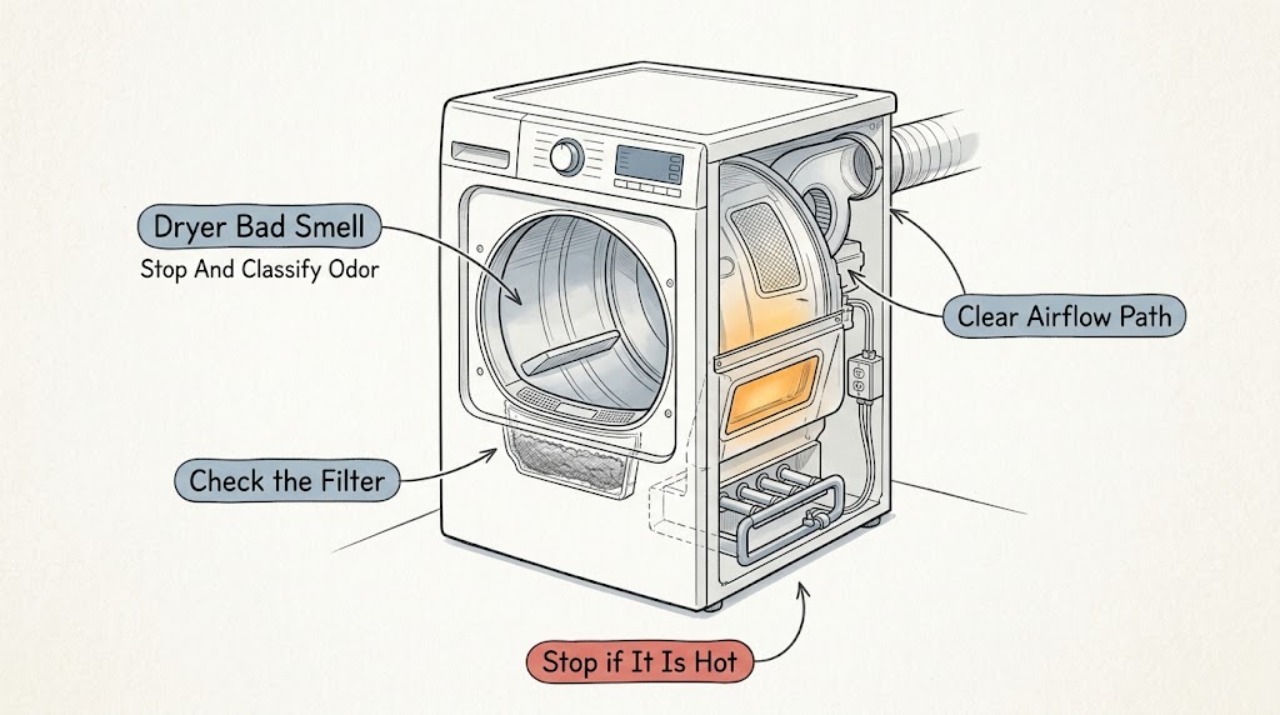
A bad smell from a Frigidaire dryer is a stop-and-identify problem, especially if it smells like burning plastic, wiring, gas, or scorching lint. Stop the cycle, switch the dryer off, unplug it from a dry position when safe, and do not run another load until the source is understood. After the dryer is cool, clean the lint filter and inspect the visible drum, door seal, lint path, and exhaust connection for lint, residue, melted material, or a foreign object. Frigidaire says lint buildup restricts airflow and recommends cleaning the lint screen after every load and having the cabinet interior and exhaust duct cleaned by qualified personnel on a regular schedule. If the odor returns, airflow is weak, clothes are unusually hot or damp, the vent is restricted, the cord or outlet is damaged, or a gas smell is present, leave the dryer off and arrange qualified service; never test a gas or electrical fault by repeated cycling.
Before you begin
Safety first
- A qualified professional may need to clean and inspect the cabinet and exhaust, test airflow, and diagnose the heater or burner, thermal protection, motor, wiring, outlet, and controls. This article does not authorize gas work, live electrical testing, cabinet disassembly, or safety-device bypass.
Work through in order
Diagnostic checks
Use only checks that match the exact appliance or system and its official guide.
-
Check 1
Stop the dryer, turn the controls off, and observe from a dry stable position for smoke, flame, sparks, a burning-plastic or electrical odor, a gas odor, a hot cord or outlet, or clothes that are unusually hot; unplug only from a dry position if safe and do not open the door into smoke.
Expected result: There is smoke, flame, gas odor, electrical damage, repeated breaker operation, intense scorching, or a mild odor with no visible hazard.
Next step: For smoke, flame, or gas odor, leave the area, avoid switches or flames, and follow local emergency or gas-safety procedures. For electrical damage or scorching, isolate the appliance if safe and arrange qualified service. Otherwise allow the dryer to cool fully before visible checks.
Stop if: Stop immediately for smoke, flame, gas odor, sparks, a hot or damaged cord, melting material, or a breaker that trips again.
Why this matters
Why: Fire, gas, and electrical symptoms are immediate stop conditions. A mild odor still needs identification because lint, residue, a foreign object, or a mechanical component can worsen under heat.
-
Check 2
When the dryer is completely cool and unplugged, remove the lint filter as the manual shows and inspect the screen, filter housing, drum, door seal, and visible lint path for a heavy lint layer, waxy film, residue, melted item, foreign object, or scorch mark; do not push tools into openings.
Expected result: The screen is heavily loaded, coated with residue, damaged or missing, lint is visible around the housing, a foreign or melted item is present, or the visible areas are clean.
Next step: Wash a reusable screen only as the Frigidaire guidance and exact manual allow, dry it completely, remove only a loose safe foreign item, and keep the dryer off for melting or scorch marks. Do not operate without a dry, intact filter.
Stop if: Do not scrape a heater, reach into the blower, use solvents or open flame, operate without the filter, or continue after finding melted material or scorch marks.
Why this matters
Why: Lint and waxy residue can reduce airflow and hold odor; a damaged or missing filter cannot protect the airflow path. A clean visible area does not rule out lint in the cabinet, exhaust, heater, burner, or wiring.
-
Check 3
From the dryer's exterior and a safe accessible vent outlet, inspect the visible exhaust connection for crushing, disconnection, lint accumulation, or a flap that cannot open; compare airflow during one supervised cool or no-heat check only if no odor or safety symptom remains.
Expected result: The exhaust hose is crushed or loose, the outlet is blocked, airflow is weak, the vent is clear and airflow is strong, or the vent route is hidden or inaccessible.
Next step: Correct only a loose external connection when the manual permits, keep the route free of crushing, and arrange qualified duct and cabinet cleaning for lint accumulation or an inaccessible path. Stop the dryer if odor returns during the check.
Stop if: Do not push rods or chemicals into the duct, operate with a disconnected exhaust, enter a roof or crawlspace route unsafely, or keep testing an odor under heat.
Why this matters
Why: Restricted exhaust can trap heat and odor and lengthen drying time. Strong airflow at the outlet does not prove the cabinet is clear, while a hidden or damaged route needs qualified cleaning rather than improvised probing.
-
Check 4
Review the last load and products used, and inspect cool, removable garments and the drum for a melted item, oily or waxy transfer, chemical residue, or a fabric that may have retained an outside odor; do not put an item back into the dryer to reproduce the smell.
Expected result: The odor is on the clothing or in the drum, a fabric-softener sheet or residue is present, a load was unusually large or contaminated, or no load-related source is visible.
Next step: Remove the affected load and follow the garment-care and product instructions; clean only the cool accessible drum and filter surfaces with an approved method. Keep the dryer off if the odor was scorching, chemical, or unexplained.
Stop if: Do not dry solvent-, oil-, gasoline-, or chemical-contaminated items, use flammable cleaners, or run a test load to mask a burning smell.
Why this matters
Why: Some odors originate in a product, melted item, or contaminated load rather than the dryer's heater. A load-related odor still warrants a cool lint and airflow check because residue can transfer to the screen and restrict air.
-
Check 5
Identify whether the dryer is electric or gas from its model manual and installation information; with the appliance off, observe only the external gas valve, cord, outlet, and ventilation area for damage or an obvious closed valve, and do not open burner, terminal, or control covers.
Expected result: A gas odor or damaged gas connection is present, the electric cord or outlet is hot or damaged, ventilation is blocked, or the external supply and installation look normal.
Next step: For gas odor, leave the area and use local gas-safety or emergency help; for electrical damage, isolate from a dry safe location and arrange qualified service. For a normal exterior, proceed only to service evidence rather than cabinet access.
Stop if: Do not relight, test a burner, handle gas fittings, remove terminals, measure live voltage, or use the dryer with blocked ventilation.
Why this matters
Why: Gas and electrical odor paths require different qualified trades and neither can be safely confirmed by a household heat test. Restricted ventilation can worsen overheating, while a normal external installation does not clear the burner, heater, wiring, or control.
-
Check 6
Record the model, odor description, cycle phase, load and product, lint-screen condition, exhaust airflow, clothes temperature, gas or electric type, breaker response, and any visible residue or scorch mark; do not run another heated cycle to see whether the smell returns.
Expected result: The odor stopped after a cool filter or load correction, it returns with the dryer, airflow remains weak, clothes overheat or stay damp, or a gas/electrical symptom appears.
Next step: Monitor only after a clear, safe correction with no return of the odor. Leave the dryer off and arrange qualified service for any recurrence, overheating, weak airflow, abnormal drying, or unexplained odor.
Stop if: Do not keep operating through a recurring odor, bypass a thermal safety, open the cabinet, or perform live electrical or gas testing.
Why this matters
Why: A corrected filter, residue, or load may explain a one-time odor, but recurrence indicates hidden lint, exhaust, heater/burner, motor, belt, wiring, or control diagnosis. A weak or abnormal heat result increases urgency even when no mark is visible.
Use your observations
Decision map
Find the observation that best matches what you see, then follow the next safe action.
-
PATH 01Safety boundary
What you see
Is there smoke, flame, gas odor, sparks, melting, a hot cord or outlet, or a breaker that trips again?
Do this next
Stop using the dryer, leave the area for smoke or gas danger, isolate power or gas only when safe, and obtain emergency or qualified service help.
Why this path and its safety boundary
Safety stop: No repeated heated tests, wet-plug handling, burner access, or exposed electrical work.
-
PATH 02Safety boundary
What you see
Is the lint screen loaded, waxy, damaged, missing, or surrounded by residue or melted material?
Do this next
Keep the dryer off, clean only the screen by the approved cool method, replace a damaged screen through the model-specific route, and arrange service for scorch or melting.
Why this path and its safety boundary
Safety stop: Continue with exhaust airflow and load/product checks; do not assume the cabinet is clear.
-
PATH 03Safety boundary
What you see
Is the exhaust route crushed, disconnected, blocked, or producing weak airflow?
Do this next
Stop use and arrange qualified vent or cabinet cleaning, correcting only a safe visible external connection if the manual permits.
Why this path and its safety boundary
Safety stop: Use the odor timing and component observations to decide whether service is needed after one cool check.
-
PATH 04Safety boundary
What you see
Is the smell confined to a load, fabric-softener residue, melted item, or contaminated garment?
Do this next
Remove the load, follow garment and product safety instructions, and clean only cool accessible surfaces; do not use the dryer to reproduce the odor.
Why this path and its safety boundary
Safety stop: Never dry solvent-, oil-, gasoline-, or chemical-contaminated items.
-
PATH 05Safety boundary
What you see
Does the smell return, or is drying accompanied by weak airflow, overheating, damp clothes, abnormal noise, or a code?
Do this next
Leave the dryer off and arrange qualified service with the model and complete observation record.
Why this path and its safety boundary
Safety stop: Do not bypass a safety device, open the cabinet, or keep operating through an unexplained odor.
Helpful context
Understand the symptom
Smell type changes the safety decision
A new-machine or clean-laundry odor may be temporary, but a burning, electrical, melting, gas, or scorching-lint smell is not a normal reason to keep testing. Stop the dryer and record when the odor appears: at startup, when heat begins, during tumbling, near the end of the cycle, or only after a heavy load. A gas smell requires leaving the area and following local gas-safety or emergency guidance without operating switches or flames.
Lint and residue can hide behind a normal-looking screen
Frigidaire notes that lint buildup on the filter restricts airflow and can reduce drying performance. Fabric-softener sheets can also leave a waxy film that needs washing with warm, soapy water and complete drying before the screen is replaced. Do not operate without the filter, use a damaged screen, or push tools into the blower or heater housing.
Recurring odor needs airflow and component service
An odor that returns after the cool, visible cleaning checks can indicate hidden lint in the cabinet or exhaust, a rubbing belt or roller, overheated wiring, a heater or burner issue, or another fault. Frigidaire's dryer guidance directs unresolved issues to support. A qualified technician can inspect the vent path and internal components without turning a safety symptom into a repeated live test.
Only after diagnosis
Potential parts
- dryer lint screen or filter housing
Consider this category only when the screen is damaged, missing, or cannot be cleaned and seated correctly after the odor and airflow inspection.
Confirm the complete model identifier and manufacturer's fit information before selecting a replacement screen or housing. - dryer exhaust duct or vent component
Consider this category only when a qualified inspection confirms a restricted, crushed, disconnected, or damaged exhaust route.
Confirm the installation instructions and route requirements; cabinet and concealed-duct cleaning should be handled by qualified personnel. - dryer heating or thermal-protection component
Consider this category only when the recurring odor or overheating is traced by qualified service to a heater, burner, thermal cutoff, wiring, or control fault.
Gas and electric designs differ by model; do not substitute or bypass a thermal or ignition component.
When checks do not resolve it
Need a professional?
Leave the Frigidaire dryer off and arrange qualified appliance service for a recurring or unexplained odor, scorch or melting mark, weak exhaust airflow, overheating clothes, abnormal drying, a hot cord or outlet, repeated breaker operation, or a suspected heater, burner, motor, wiring, or control fault. Use local emergency or gas-safety help for smoke, fire, or gas odor.
Safety scope: A qualified professional may need to clean and inspect the cabinet and exhaust, test airflow, and diagnose the heater or burner, thermal protection, motor, wiring, outlet, and controls. This article does not authorize gas work, live electrical testing, cabinet disassembly, or safety-device bypass.
Have this ready
- The complete Frigidaire model identifier and whether the dryer is gas or electric
- The exact odor description and the point in the cycle when it appears
- Lint-screen condition, waxy residue, visible lint, drum or seal residue, and any scorch or melt mark
- Exhaust route condition, airflow, clothes temperature, drying performance, and load or product used
- Any gas odor, hot cord or outlet, breaker response, unusual noise, or displayed code
Common questions
FAQ
Why does my Frigidaire dryer smell like burning?
Stop the dryer and wait for it to cool. Check only the lint screen, visible drum, seal, and exhaust connection from a safe dry position for lint, melted material, or scorch marks. If the odor returns or any electrical, gas, or overheating symptom appears, leave it off and arrange qualified service.
Can lint cause a bad smell in a Frigidaire dryer?
Lint buildup can restrict airflow and allow heat and odor to accumulate. Clean the lint screen after every load and keep the exhaust route clear; qualified personnel should clean the cabinet interior and concealed exhaust when buildup is suspected.
Can fabric-softener sheets make a dryer smell?
They can leave waxy or greasy residue on the lint screen or load. Clean a reusable screen with warm soapy water as the instructions allow and dry it completely. Do not run the dryer without the screen.
What should I do if my gas dryer smells like gas?
Stop using it, leave the area, avoid flames and electrical switches, and follow local gas-safety or emergency procedures. Do not relight or test the burner yourself; arrange qualified gas-appliance service.
When should a Frigidaire dryer with a bad smell be serviced?
Arrange service for a recurring or unexplained odor, scorch or melt mark, weak airflow, overheating clothes, poor drying, a hot cord or outlet, repeated breaker trips, or a suspected heater, burner, motor, wiring, or control fault. Stop immediately for smoke, fire, sparks, or gas odor.
Read the exact guide
Official sources
- My dryer is running, but does not seem to be heating. What should I do?Frigidaire · Frigidaire electric and gas dryers; use the exact installation instructions for the model.
- Laundry Centers - How do I care for and clean my Frigidaire Laundry Center?Frigidaire · Frigidaire laundry-center dryers; verify the exact model manual for access and cleaning details.
- What can cause greasy marks on items that have been dried?Frigidaire · Frigidaire dryers where residue or a product used with the load may contribute to odor or transfer.
- Dryers - How often do I need to clean my dryer or the lint screen/filter to optimize my drying performance?Frigidaire · Frigidaire dryers and lint-screen maintenance.
Community feedback
Share a repair observation
Share a plain-text repair observation. Accepted observations are published automatically; this page may take a moment to update.