
On this page
Start here
Quick answer
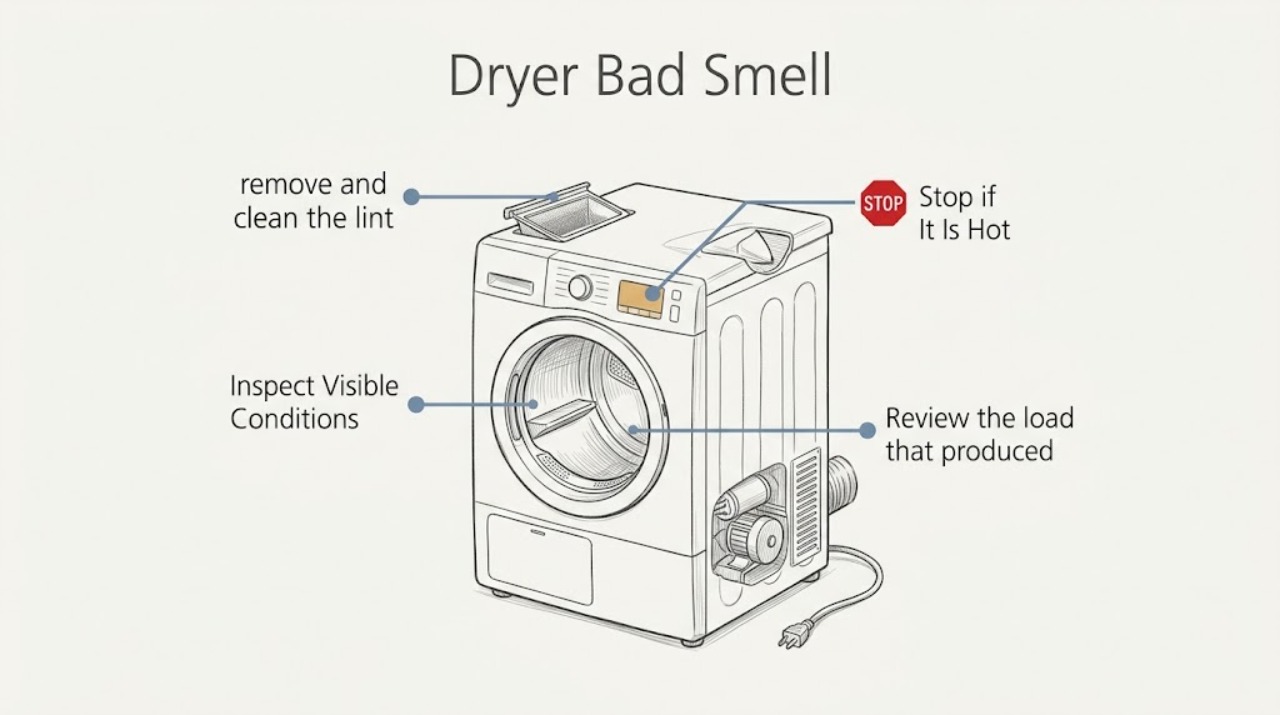
Stop the dryer and let it cool if the odor is burning, electrical, plastic-like, gas-like, or accompanied by smoke, sparks, or an unusually hot cabinet. With the power off and the dryer cool, clean the lint screen and inspect only the accessible exhaust tube and vent exit for lint, bends, or blockage. Reduce an overloaded load and allow an overheated dryer to cool before one supervised test. If the odor returns, the vent cannot be safely cleared, the dryer repeatedly stops, or the smell suggests gas or an electrical fault, stop using it and arrange qualified service.
Work through in order
Diagnostic checks
Use only checks that match the exact appliance or system and its official guide.
-
Check 1
Stop the cycle, switch the dryer off, and note whether the odor is smoky or burning, electrical or plastic-like, gas-like, or simply a mild stale/lint odor. Note any smoke, sparks, a very hot cabinet, a drum that stopped, and whether the dryer is electric or gas.
Expected result: A gas-like odor, smoke, sparks, an electrical/plastic smell, or a very hot cabinet is present; or the odor is mild and limited to lint or stale fabric.
Next step: For gas-like odor, smoke, sparks, electrical/plastic odor, or extreme heat, leave the dryer off, avoid further operation, and arrange qualified help; for a mild odor, continue only after the appliance is cool and safe to approach.
Why this matters
Why: The first group can indicate a fire, gas, wiring, or overheating hazard and cannot be safely diagnosed by repeated cycling. A mild odor without heat or smoke can justify the limited cool-down and accessible inspection below, but a recurring odor is still a fault symptom.
-
Check 2
After the dryer has cooled and is switched off, remove and clean the lint screen. Inspect the screen housing, the accessible exhaust tube, and the vent exit for accumulated lint, crushed or sharply bent tubing, debris, or a restriction. Do not disassemble the dryer or push tools into hidden ductwork.
Expected result: Lint, debris, a crushed tube, or a blocked vent exit is found, or the accessible path looks clear.
Next step: Clear only the accessible lint and debris and restore a free, gentle exhaust route. If the blockage is inaccessible, returns quickly, or cannot be cleared without opening the appliance, stop and arrange service rather than running more cycles.
Why this matters
Why: Electrolux identifies a ventilation blockage through the lint filter, exhaust tube, or vent exit as a condition to check and clear. A clear accessible path makes a restriction less obvious but does not rule out a concealed duct or internal fault.
-
Check 3
Review the load that produced the odor. Remove excess items and check whether the drum or motor had stopped after a heavy load; let the dryer cool for about 30 minutes before considering a test.
Expected result: The load was tightly packed, the dryer stopped, or the cabinet and motor area felt unusually hot; or the load was normal and the dryer did not stop.
Next step: For an overload-related event with no dangerous odor, reduce the load and perform at most one supervised test after cooling. If the odor or shutdown returns, stop using the dryer and seek service. If there was smoke, a gas-like odor, or an electrical/plastic smell, do not test it.
Why this matters
Why: Electrolux says an overloaded dryer can overheat the motor and that a thermal limiter may activate; reducing the load and allowing a 30-minute cool-down can distinguish a temporary overload response from a continuing fault. Normal loading does not make a burning or electrical odor safe to ignore.
-
Check 4
Identify the power type without opening anything. For an electric dryer, check only that the user-accessible plug and breaker or fuse show no obvious trip or damage; for a gas dryer, do not adjust gas fittings and note whether the odor is gas-like or the gas supply appears interrupted. Keep the ventilation space around a gas dryer clear of laundry, rugs, and other items.
Expected result: An electric supply concern, damaged-looking cord or receptacle, gas-like odor, suspected gas interruption, or blocked ventilation clearance is present; or none of these is apparent.
Next step: Do not operate with a damaged electrical connection or gas-like odor; use a qualified electrician or appropriate gas provider as applicable. If the accessible checks are normal, proceed only to one supervised test after the lint path is clear and the dryer is cool.
Why this matters
Why: Electrolux notes that an electric dryer can tumble with only one house circuit supplying power, while gas supply interruption belongs with the gas company. The manufacturer also calls for ventilation space around a gas dryer. These are supply and installation boundaries, not user repair steps.
-
Check 5
If there was no hazardous odor, smoke, or overheating and the accessible lint path has been cleared, run one short supervised cycle with a small, balanced load. Stay nearby and stop immediately if the smell, abnormal heat, unusual noise, smoke, or a shutdown returns.
Expected result: The odor stays absent and the dryer runs normally, or any odor, smoke, excessive heat, or stop returns.
Next step: If the symptom returns, keep the dryer off and arrange qualified Electrolux service. Do not repeat cycles to see whether the smell will disappear and do not open panels to inspect the heater, motor, wiring, or safety limiter.
Why this matters
Why: A clean, cool, lightly loaded cycle that remains odor-free supports lint, vent restriction, or overload as the immediate trigger, but it does not prove an internal part is healthy. A returning symptom means the cause is unresolved or the accessible correction was insufficient.
Use your observations
Decision map
Find the observation that best matches what you see, then follow the next safe action.
-
PATH 01Safety boundary
What you see
The odor is gas-like, electrical/plastic, smoky/burning, or accompanied by sparks, smoke, or a very hot cabinet.
Do this next
Stop operation immediately and keep the dryer out of service. Do not relight, adjust gas parts, open panels, or test live wiring; arrange the appropriate qualified emergency, gas, electrical, or appliance service.
Why this path and its safety boundary
Safety stop: Let the dryer cool, then perform the external lint and exhaust inspection.
-
PATH 02Safety boundary
What you see
Lint or a restriction is found in the accessible lint screen, exhaust tube, or vent exit.
Do this next
Clear the accessible obstruction and restore the exhaust route. If it cannot be cleared safely or returns, stop and arrange service.
Why this path and its safety boundary
Safety stop: Check the load and cooling history, then consider only one supervised test if no hazardous symptom occurred.
-
PATH 03Safety boundary
What you see
The odor returns after a cool, lightly loaded, supervised test, or the dryer stops again.
Do this next
Stop using the dryer and provide the model number, fuel type, odor description, timing, load, lint/vent findings, and any displayed code to qualified service.
Why this path and its safety boundary
Safety stop: Continue to monitor future cycles and keep the lint screen and exhaust route clear; seek service if the odor recurs.
Helpful context
Understand the symptom
A dryer odor is not something to mask with another cycle. Lint or a restricted exhaust path can make the appliance run hot, while an overloaded or overheated motor can trigger a thermal limiter. The odor category and what the dryer was doing when it appeared determine whether an accessible clean-out is reasonable or whether the appliance must remain out of service.
Keep every inspection external. Do not open electrical panels, reach into the heater or motor area, test live wiring, or adjust gas components. The Electrolux error guide treats wiring and power-supply faults as installation or electrical work, and its heating guidance directs gas-supply and voltage concerns to the appropriate qualified provider.
When checks do not resolve it
Need a professional?
Stop using the dryer immediately for a dangerous or persistent odor, smoke, sparks, extreme heat, repeated shutdown, suspected gas or electrical trouble, or an inaccessible vent restriction.
Have this ready
- Provide the model number, electric or gas type, odor description, when it begins, load size, lint and vent observations, any error code, and whether the drum turns or the dryer stops.
Common questions
FAQ
Can I keep running an Electrolux dryer if the smell is only mild?
Only after the dryer is cool and switched off for an external lint and exhaust check, and only one supervised test if there was no gas-like, electrical, burning, smoky, or overheating symptom. Stop if the odor returns.
Why can an Electrolux dryer smell hot after a large load?
An overloaded load can overheat the motor and activate a thermal limiter. Remove excess items and allow the dryer to cool; a recurring odor or shutdown requires qualified service.
What should I do if a gas dryer smells like gas?
Do not operate or adjust the gas components. Leave the dryer out of service and arrange the appropriate qualified gas or appliance help; a suspected supply interruption belongs with the gas provider.
Read the exact guide
Official sources
- What should I do if my dryer does not start?Electrolux · Official Electrolux support guidance for accessible dryer start and supply checks.
- What should I do if my dryer stops operating?Electrolux · Official Electrolux support guidance for dryers that stop during operation.
- My dryer is running, but does not seem to be heating. What should I do?Electrolux · Official Electrolux support guidance for dryer heating and installation-related checks.
- Laundry Dryer Error Code GuideElectrolux · Official Electrolux dryer error guide; exact code behavior varies by model.
Community feedback
Share a repair observation
Share a plain-text repair observation. Accepted observations are published automatically; this page may take a moment to update.