
On this page
Start here
Quick answer
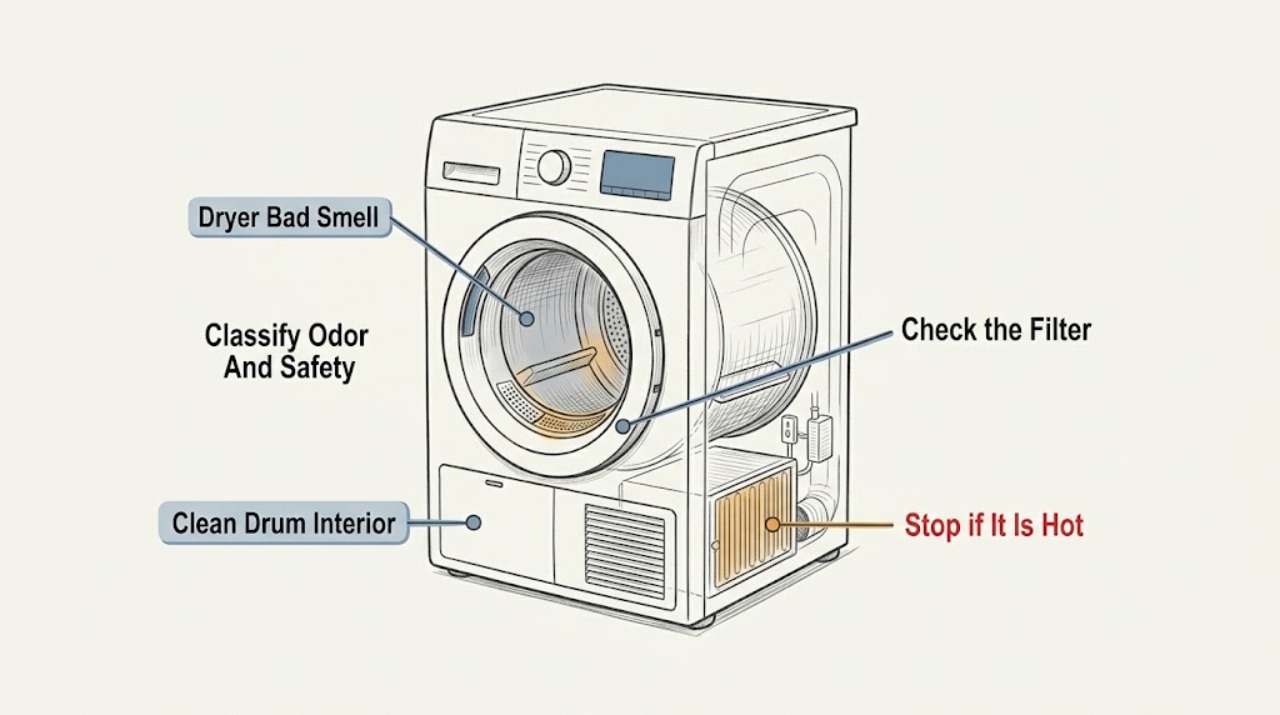
If your Bosch dryer smells bad, stop the cycle and let it cool, then identify whether the odor is musty or residue-like from the drum, lint filter, condenser, or moisture sensor, or is burning/electrical. Bosch recommends wiping the drum, cleaning and fully drying the lint filter, cleaning the condenser as the model manual directs, and wiping the moisture sensor with a damp cloth and a little white vinegar. A burning smell is a stop condition: Bosch says to seek support, so do not run another cycle, open the cabinet, or test live parts. If the odor remains after the safe cleaning checks, arrange qualified service.
Work through in order
Diagnostic checks
Use only checks that match the exact appliance or system and its official guide.
-
Check 1
Stop the program, remove the load if safe, and allow the dryer to cool. From outside the appliance, note whether the smell is musty/stale, detergent or fabric-softener-like, hot lint, burning/electrical, or only present on the laundry. Look for smoke, scorching, sparks, unusual heat, or a damaged cord.
Expected result: The odor is ordinary stale/residue-like without heat, or there is burning smell, smoke, scorching, sparks, abnormal heat, or visible electrical damage.
Next step: For burning odor, smoke, scorching, sparks, abnormal heat, or visible electrical damage, stop using the dryer, keep clear, and arrange qualified appliance or electrical service. If none is present and the dryer is cool, continue with the user-accessible checks.
Why this matters
Why: A stale or residue-like odor supports Bosch's drum/filter/condenser/sensor cleaning path. Burning odor or a physical hazard is not a cleaning diagnosis and can indicate a dangerous internal fault.
-
Check 2
With the dryer off and cool, wipe the inside of the drum and the accessible inside of the door with a damp soft cloth. Use only a mild cleaner permitted by the Owner's Manual; do not spray liquid into controls, vents, or openings.
Expected result: You remove visible film, lint, or residue and the odor decreases, or the drum is clean but the smell remains.
Next step: Dry accessible surfaces completely and continue to the lint-filter check. If the smell is hot/burning or returns immediately from an otherwise clean drum, stop use and request service rather than adding chemicals.
Why this matters
Why: A change after wiping supports a surface-residue source. No change means the odor may be held in the lint filter, condenser, sensor, exhaust path, or an internal component.
-
Check 3
When the dryer is cool, remove the lint filter, clear lint and debris, and rinse it under running water only if the Bosch manual permits. Let the filter dry completely and reinstall it before operating the dryer; do not run without the filter.
Expected result: The filter is packed with lint or coated with residue, the filter is clean, or a filter warning/poor airflow symptom remains after cleaning.
Next step: Reinstall the completely dry filter and continue to the condenser/sensor check if there was no hazardous symptom. If the filter warning remains, airflow is weak, or a burning odor appears, stop and arrange service.
Why this matters
Why: Lint and residue can restrict the intended air path and hold odor. A clean filter does not prove that the condenser, vent, blower, or heating circuit is clear.
-
Check 4
If the dryer is a condenser or heat-pump model, use the Owner's Manual to identify the user-accessible condenser and clean it only as directed. Wipe the moisture sensor near the lint-filter area with a damp cloth and the manual-permitted amount of white vinegar, then remove residue and dry accessible surfaces.
Expected result: The condenser or sensor has lint, scale, detergent residue, or moisture, or both areas are clean while the odor persists.
Next step: Reinstall every removable part securely and let it dry as the manual requires. Do not use solvents, bleach, mixed chemicals, pressure spray, or tools beyond the documented access. Escalate if the odor remains.
Why this matters
Why: Bosch identifies condenser and sensor residue as maintenance issues that can affect operation and smell. A clean accessible path with a persistent odor points toward concealed venting or an internal fault.
-
Check 5
Check only the visible, user-accessible air outlet or vent area identified by the model manual. Look for an obvious external blockage, lint accumulation, or a vent hose kink; do not push an object into the vent or remove the cabinet, blower, or heat exchanger unless the manual explicitly identifies a safe user procedure.
Expected result: The visible outlet/vent is obstructed, airflow is weak, lint is collecting outside the normal filter, or the visible path appears clear.
Next step: Clear only the external obstruction allowed by the manual and perform no more than one supervised test if there is no hazard. For weak airflow, recurring odor, smoke, or heat, stop using the dryer and request qualified inspection of the full air path.
Why this matters
Why: A restricted air path can retain heat and odor and reduce drying performance. Lint outside the normal serviceable area or a clear path with burning odor raises the professional boundary.
-
Check 6
Only after the dryer is cool, the drum/filter/condenser/sensor checks are complete, and there is no burning or electrical warning, run one short supervised cycle with a small suitable load. Stop immediately if the odor intensifies or the appliance becomes unusually hot.
Expected result: The odor is gone, returns as a musty/residue smell, returns as burning/electrical, or the dryer develops smoke, heat, unusual noise, a warning, or a power trip.
Next step: Do not repeat cycles to chase the smell. Stop using the dryer and arrange qualified service for a recurring odor, burning smell, heat, power issue, persistent warning, or suspected heating, sensor, control, blower, or wiring fault.
Why this matters
Why: An odor-free test supports an accessible maintenance cause but does not prove an internal component is healthy. A returning or changing odor indicates an unresolved source; hazardous signs require immediate stop.
Use your observations
Decision map
Find the observation that best matches what you see, then follow the next safe action.
-
PATH 01Next step
What you see
Burning/electrical odor, smoke, scorching, sparks, unusual heat, or visible cord/wiring damage
Do this next
Stop using the dryer and keep clear. Do not restart, open the cabinet, or test live parts; arrange qualified appliance or electrical service.
-
PATH 02Next step
What you see
Musty or stale smell is strongest at the drum or inside of the door
Do this next
Wipe the cool drum and accessible door area with a damp soft cloth, dry it, then clean the lint filter. Escalate if the odor returns.
-
PATH 03Next step
What you see
Lint filter is clogged or coated with residue
Do this next
Clean it as the manual directs, rinse only when permitted, let it dry completely, and reinstall it before a supervised test. Persistent filter warnings or burning odor require service.
-
PATH 04Next step
What you see
Condenser, moisture sensor, or visible vent area is dirty or obstructed
Do this next
Clean or clear only the user-accessible part using the model manual. Do not force access or use mixed chemicals; request service if airflow or odor remains abnormal.
-
PATH 05Next step
What you see
Accessible areas are clean but the odor returns, or a heating/electronics warning is displayed
Do this next
Stop using the dryer and arrange qualified service for the concealed air path, heating circuit, thermal protection, sensor, control, blower, or wiring.
Helpful context
Understand the symptom
Classify the odor before touching the dryer
A musty or stale smell that is strongest at the drum or filter points toward residue and moisture maintenance. A hot, burning, electrical, or melting-plastic smell is different: stop using the dryer and obtain qualified support. Do not try to mask a burning odor with cleaner or repeat cycles to see whether it clears.
Why accessible maintenance matters
Bosch identifies the drum, lint filter, condenser, and moisture sensor as odor or performance checkpoints. Lint or residue can hold smells and restrict the intended air path, while moisture left after drying can make a musty odor recur. The exact condenser access and cleaning method are model-dependent, so the Owner's Manual controls the procedure.
The professional boundary
A persistent odor after accessible cleaning can come from a concealed vent, blower, heating circuit, thermal protection, wiring, or another internal component. Bosch's support guidance directs users toward service for burning smells and technician-only faults. Keep the dryer out of operation until the cause is assessed when a warning sign remains.
When checks do not resolve it
Need a professional?
Call qualified service for any burning/electrical odor, smoke, scorching, sparks, unusual heat, damaged cord, or repeated power trip., Arrange service when the odor returns after Bosch's drum, filter, condenser, sensor, and visible air-path checks., Arrange service for a persistent filter or heating-circuit warning, weak airflow, lint in concealed areas, or an internal blower, heater, thermostat, sensor, control, or wiring concern.
Read the exact guide
Official sources
- Dryers | Error Codes | BoschBosch Home Appliances · Bosch dryer filter, heating-circuit, and electronics error-code service boundary
- Dryer drum smells badBosch Home Appliances · Bosch dryer drum odor cleaning: drum, lint filter, condenser, and moisture sensor
- Dryer smells burntBosch Home Appliances · Bosch dryer burning-odor stop and support boundary
- Dryer Cleaning & MaintenanceBosch Home Appliances · Bosch dryer cleaning and maintenance of exterior, drum, filters, condensers, heat exchangers, and moisture sensors
Community feedback
Share a repair observation
Share a plain-text repair observation. Accepted observations are published automatically; this page may take a moment to update.