
On this page
Start here
Quick answer
A Blomberg dryer smell needs to be classified before cleaning. A musty odor may come from damp laundry or residue, but a burning, hot-plastic, chemical, or scorching smell, scorch marks, smoke, unusually hot clothing, or a damaged cord is a stop condition: stop the dryer, keep clear, disconnect it only from a normally accessible point if safe, and arrange professional service. If the odor is mild and there are no danger signs, let the dryer cool, remove lint from the user-accessible filter and loading-door surfaces, check the load for items contaminated with oil, solvents, or other flammable substances, and clear only external ventilation obstructions. Use the exact model manual for any condenser or sensor access; do not open the cabinet or use solvents. If the smell returns after one supervised normal cycle, stop using the dryer and have it diagnosed.
Before you begin
Safety first
- This article covers cool, ordinary-access observation and model-approved cleaning of user-accessible parts only. A qualified technician must handle cabinet access, internal lint or ductwork, live electrical measurement, heater, fan, motor, wiring, and safety-device diagnosis.
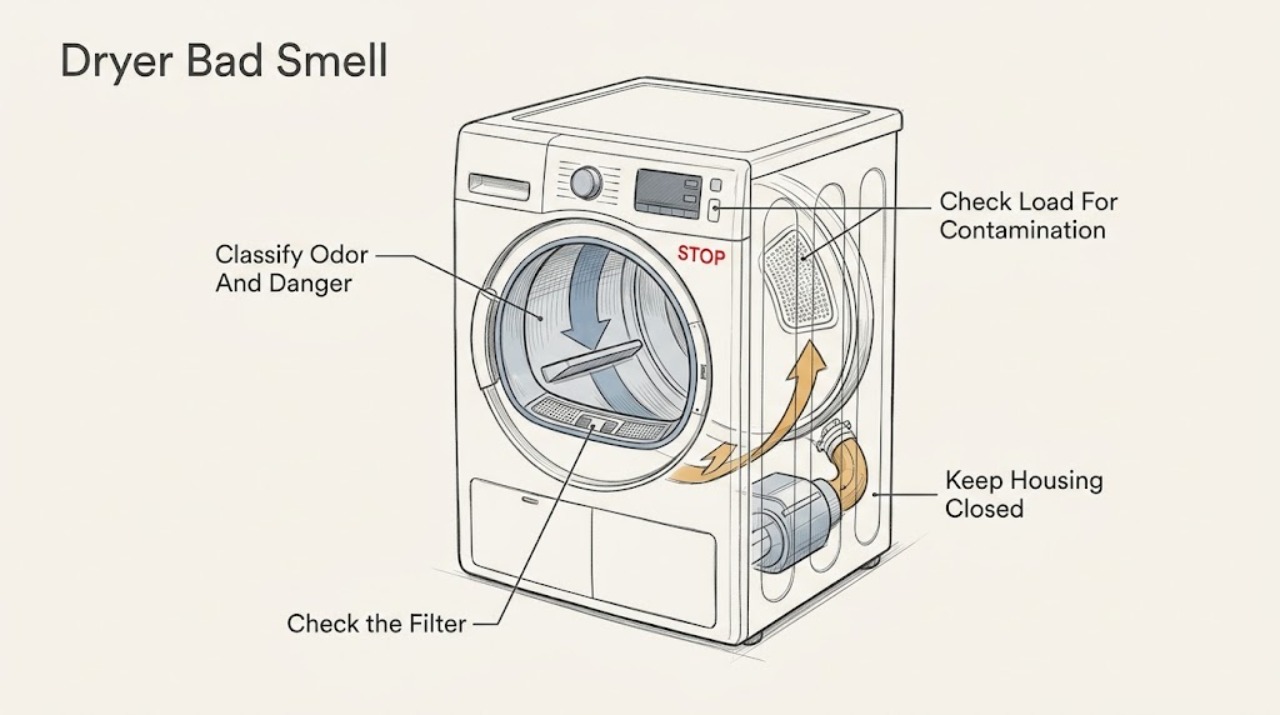
Work through in order
Diagnostic checks
Use only checks that match the exact appliance or system and its official guide.
-
Check 1
Stop the dryer and observe from a safe position whether the odor is musty or damp, or instead smells like burning, hot plastic, chemicals, or scorching; look for smoke, scorch marks, unusually hot clothing, a damaged cord, or a repeated electrical trip without touching hot surfaces.
Expected result: Record the odor category, when it begins, whether it strengthens during drying, and whether smoke, visible scorching, excessive heat, unusual noise, or an electrical protection trip is present.
Next step: For any danger sign, stop using the dryer, keep people away, disconnect it only through a normally accessible point if safe, and arrange professional service. If no danger sign exists, let it cool completely before continuing.
Stop if: Do not restart a dryer that smokes, scorches, smells of burning or hot plastic, becomes unusually hot, trips protection, or has a damaged cord; do not investigate inside the cabinet.
Why this matters
Why: A mild musty odor without danger signs supports a cool-down and user-accessible cleanliness check. Burning or chemical odor, smoke, scorching, unusually hot clothing, or electrical damage can indicate a fire or mechanical hazard and is not safe to troubleshoot by repeated cycles.
-
Check 2
When the dryer and laundry are cool enough to handle safely, inspect the load and care labels for items that are unsuitable for tumble drying or have absorbed oil, grease, solvent, dry-cleaning solution, alcohol-based solution, or another flammable substance.
Expected result: Record whether the odor is on one garment or in the empty drum, whether any item is marked unsuitable for tumble drying, and whether contamination or scorch marks are present.
Next step: Remove and isolate any unsuitable or contaminated item and follow its care or cleaning instructions; do not put it back in the dryer until it is confirmed suitable. If the empty drum or a suitable load still smells, continue with the cool user-level checks only if there are no danger signs.
Stop if: Do not dry items contaminated with oil, grease, solvents, dry-cleaning solution, or alcohol-based solution, and do not use a garment with scorch damage as a test load.
Why this matters
Why: A smell confined to a contaminated or unsuitable garment points to the load as a possible source, while an odor in an otherwise suitable load keeps the dryer itself in scope. Flammable contamination must not be dried by guesswork.
-
Check 3
With the dryer fully cool and off, remove only the lint filter the exact Blomberg model identifies as user-accessible; clear lint as the manual directs and wipe the inner loading-door surface and gasket with a soft damp cloth.
Expected result: Record whether lint or fiber buildup is heavy, whether filter pores are coated or blocked, whether the door surface has residue, and whether the filter is intact and can be seated without force.
Next step: If the manual permits washing the filter, dry it completely before reinstalling it; otherwise use the specified dry-cleaning method. Clear only loose external lint, then move to the ventilation check if the filter is secure and there is no danger sign.
Stop if: Do not run with a missing, wet, damaged, or loose filter, use a hard or sharp tool on filter media, or remove covers to reach hidden lint.
Why this matters
Why: Blomberg says lint is collected in the filter and requires regular cleaning; buildup can restrict airflow and increase heat or odor risk. A damaged, missing, or loose filter is not a reason to run the dryer.
-
Check 4
If the model has visible dampness sensor bars or a model-designated condenser or filter drawer, check the manual before touching it; after the dryer cools, clean only the accessible surface and method the manual permits, without using solvent, abrasive cleaner, metal tools, or force.
Expected result: Record whether the sensor surface has residue, whether the model's condenser or filter warning is active, whether the accessible part is clean and correctly seated, or whether access would require a panel or unfamiliar disassembly.
Next step: Complete only the model-approved accessible cleaning and dry or refit the part as directed. If the model manual is unavailable, access is uncertain, the smell is chemical or burnt, or the odor remains, stop and request service.
Stop if: Do not use solvents or unapproved cleaning agents, scrape sensor bars with metal, remove a heater or fan cover, or disassemble the condenser path without exact model instructions.
Why this matters
Why: Residue or a maintenance warning can affect drying performance and may contribute to extended heating, but a hidden obstruction or internal fault is not established by visual inspection. Blomberg warns against solvents and says to contact authorized service when the problem persists.
-
Check 5
From ordinary access, check that the front ventilation grilles, surrounding space, and any externally accessible vent hose are not blocked, crushed, kinked, covered by lint, or pressed against stored items; do not move a built-in dryer or open its rear cover.
Expected result: Record a clear airflow path, or an obstruction, crushed hose, closed external vent cover, excessive lint, or installation restriction that cannot be corrected safely without moving the appliance.
Next step: Remove only loose external obstructions while the dryer is cool and off. If the path requires moving a built-in machine, cleaning concealed ductwork, or opening a panel, stop and arrange qualified service.
Stop if: Do not cover grilles, wedge panels open, run with a crushed or disconnected vent, move a built-in dryer, or reach behind the machine near wiring without professional help.
Why this matters
Why: Blomberg's manual links blocked ventilation grilles or inadequate ventilation with prolonged drying, and fire-safety guidance warns that restricted venting can contribute to overheating. A clear external path with recurring odor points toward service diagnosis.
-
Check 6
Only after a mild, non-burning odor has cleared from the load, the dryer is cool, the suitable load is within the model instructions, and all permitted cleaning is complete, run one normal cycle while staying nearby and using the controls normally.
Expected result: Record no odor, the same mild odor, a returning burning or chemical odor, smoke, scorching, unusually hot clothing, abnormal noise, a stop, or an electrical trip.
Next step: Stop immediately for any danger sign. If the odor returns or the dryer behaves abnormally, leave it out of service and give a qualified technician the odor type, load, cycle, filter condition, and timing.
Stop if: Do not repeat cycles to reproduce a burning smell, run while away or asleep, or continue when clothing, the cabinet, or the cord becomes unusually hot.
Why this matters
Why: A one-time clear result supports the load or accessible residue as a possible contributor but does not prove the internal dryer is fault-free. Any recurring or escalating odor means the safe user checks have not resolved the issue.
Use your observations
Decision map
Find the observation that best matches what you see, then follow the next safe action.
-
PATH 01Safety boundary
What you see
The odor is burning, hot plastic, chemical, or scorching, or there is smoke, scorch marking, unusually hot clothing, a damaged cord, or a repeated electrical trip.
Do this next
Stop using the dryer, keep clear, disconnect it only through a normally accessible point if safe, and arrange professional diagnosis; if a fire has started, leave and contact emergency services.
Why this path and its safety boundary
Why it matters: This is a potential fire, electrical, or mechanical hazard rather than a safe cleaning problem.
Safety stop: Do not restart, open the cabinet, reach for internal lint, or perform live electrical or heater testing.
-
PATH 02Safety boundary
What you see
The smell is confined to a garment, and the item is unsuitable for tumble drying or may contain oil, grease, solvent, dry-cleaning solution, or alcohol-based residue.
Do this next
Remove the item, keep it out of the dryer, and follow its care or cleaning instructions. Inspect the drum and filter after cooling before using a suitable load.
Why this path and its safety boundary
Why it matters: The load may be the odor source and may present an ignition risk in a dryer.
Safety stop: Do not dry the contaminated or damaged item and do not use it as a test load.
-
PATH 03Safety boundary
What you see
There is no danger sign, but the lint filter, door surface, front ventilation grille, or externally accessible vent path has visible buildup or obstruction.
Do this next
Let the dryer cool, complete only the model-approved accessible cleaning, restore the filter and external path, and supervise one normal cycle. Stop if the odor returns.
Why this path and its safety boundary
Why it matters: Restricted airflow or residue may be contributing to the odor or prolonged heating, but this does not confirm that the internal dryer is safe.
Safety stop: Do not run without the filter, with a restricted or disconnected vent, or after cleaning if the smell is burning, chemical, or escalating.
-
PATH 04Safety boundary
What you see
The odor is mild and musty, there is no smoke, scorching, excessive heat, or electrical damage, and it clears after the suitable load and user-accessible surfaces are cleaned.
Do this next
Keep the filter and door surfaces clean, follow the model's maintenance instructions, and monitor future cycles while nearby.
Why this path and its safety boundary
Why it matters: Damp laundry or accessible residue may have contributed, but the result is not proof that hidden parts are fault-free.
Safety stop: Stop using the dryer if a burning, chemical, or recurring odor appears or clothes become unusually hot.
-
PATH 05Safety boundary
What you see
The smell remains or returns after suitable laundry, accessible filter and surface cleaning, and an unobstructed external airflow path.
Do this next
Leave the dryer out of service and arrange qualified or authorized diagnosis. Provide the odor description, timing, load, cycle, filter condition, and any unusual heat or noise.
Why this path and its safety boundary
Why it matters: The cause may be internal or installation-related and cannot be safely isolated by further user-level cleaning.
Safety stop: Do not keep repeating cycles, use solvents, remove panels, or replace a part by smell alone.
Helpful context
Understand the symptom
A musty smell is different from a burning smell
Odor alone does not identify a failed part. Damp or stale laundry and residue can create a musty smell, while lint, a contaminated garment, friction, a heating fault, or electrical damage can produce a hot, burning, or chemical odor. Smell the room and the load only from a safe distance; do not touch unusually hot clothing or the rear of the machine. Smoke, scorching, a hot-plastic smell, or an odor that becomes stronger during a cycle is a safety event, not a cleaning prompt.
Clean only the user-accessible drying surfaces
Blomberg's manual says lint is collected in the filter and instructs users to clean the filter and inner loading-door surfaces after drying. It also describes cool-down before sensor cleaning and warns against solvents, cleaning agents, or similar substances because of fire and explosion risk. The exact filter, sensor, condenser, and water-tank arrangement varies by model, so use the model manual and do not remove cabinet panels, reach into the heater or fan, or improvise a chemical treatment.
The next cycle is a controlled decision, not a repeated test
If the odor was mild and musty, the dryer is cool, the load is suitable and free of flammable contamination, and the user-accessible filter and surfaces are clean, one supervised normal cycle can show whether the odor has cleared. Do not run the dryer while away or asleep. If the smell returns, the dryer runs unusually hot, clothes scorch, the drum or motor behaves abnormally, or the appliance stops, leave it out of service and arrange qualified diagnosis.
Safety boundary
Stop conditions
- Stop immediately for smoke, scorch marks, burning or hot-plastic odor, chemical odor, unusually hot clothing or cabinet, a damaged cord, unusual mechanical noise, or repeated electrical protection trips.
- Do not dry garments contaminated with oil, grease, solvents, dry-cleaning solution, alcohol-based solution, or another potentially flammable substance unless the garment care guidance confirms it is safe.
- Do not run the dryer without a correctly fitted dry lint filter, with blocked or crushed ventilation, or while away or asleep.
- Do not use solvents, unapproved cleaning agents, metal tools, abrasive methods, or heat to clean the filter, sensor, condenser, or drum surfaces.
- Do not open the cabinet, reach into the heater, fan, wiring, or motor, perform live electrical tests, or continue repeated cycles after an odor returns.
Only after diagnosis
Potential parts
- lint filter or filter housing
Consider this category only if the exact model's filter is damaged, missing, or cannot seal after inspection and the technician confirms it is contributing to lint escape or airflow restriction.
Confirm the exact Blomberg model and manufacturer's fit information; do not run the dryer with a missing or loose filter. - airflow or ventilation assembly
Consider this category only after professional diagnosis finds an internal airflow restriction or failed airflow component after the accessible filter and external path are clear.
Confirm the exact model and assembly configuration with the service provider; internal airflow access is not a user troubleshooting step. - heating, motor, or wiring assembly
Consider this category only when a qualified diagnosis links a recurring burning odor, unusual heat, noise, or electrical symptom to a specific internal assembly.
Confirm the exact model and professional diagnosis before selecting any part; never bypass a thermal or electrical safety device.
When checks do not resolve it
Need a professional?
Arrange professional or authorized Blomberg service when a burning, chemical, or recurring odor remains; smoke, scorching, unusually hot clothes, unusual noise, a damaged cord, repeated stopping or electrical trips occur; the dryer smells after safe filter and ventilation checks; or any diagnosis would require cabinet access, concealed ductwork access, internal electrical measurement, or a heating, fan, motor, or safety-device inspection.
Safety scope: This article covers cool, ordinary-access observation and model-approved cleaning of user-accessible parts only. A qualified technician must handle cabinet access, internal lint or ductwork, live electrical measurement, heater, fan, motor, wiring, and safety-device diagnosis.
Common questions
FAQ
Is a musty smell from a Blomberg dryer always a failed part?
No. A mild musty smell can be related to damp laundry or accessible residue, but classify the odor first. Burning, chemical, scorching, smoke, or unusually hot clothing requires stopping use and professional service.
Can lint cause a bad smell in a tumble dryer?
Lint buildup can restrict airflow and increase fire or overheating risk. Let the dryer cool, clean the model-approved lint filter and door surface, and do not run without a correctly fitted filter.
Can I use solvent or strong cleaner to remove the smell?
No. Blomberg warns against solvents, cleaning agents, or similar substances because of fire and explosion risk. Use only the exact model manual's permitted cleaning method and stop if the odor persists.
Should I dry clothes that smell of oil or solvent?
Do not put items contaminated with oil, grease, solvent, dry-cleaning solution, or alcohol-based solution into the dryer unless their care guidance confirms they are safe. Remove the item and follow its cleaning instructions instead.
When should I stop using a Blomberg dryer with a bad smell?
Stop for burning or chemical odor, smoke, scorch marks, unusually hot clothing or cabinet, damaged cord, unusual noise, repeated stopping, or an odor that returns after safe filter and ventilation checks. Arrange professional diagnosis and do not open the cabinet.
Read the exact guide
Official sources
- Clothes Dryer Fire SafetyU.S. Fire Administration · U.S. Fire Administration general clothes-dryer fire-safety guidance; manufacturer instructions and local requirements control the particular installation.
- Electrical fire safety: Tumble dryersWarwickshire County Council · Warwickshire County Council home fire-safety guidance for tumble dryers; it is general safety advice, not a model-specific repair procedure.
- How to use and maintain your Tumble DryerBeko · Beko manufacturer safety guidance for tumble dryers; use the exact Blomberg model manual for model-specific controls and parts.
- Dryer / User ManualBlomberg · Blomberg dryer user manual; filter, condenser, sensor, and water-tank features vary by model, so the exact manual controls.
- Appliance safetyCheshire Fire and Rescue Service · Cheshire Fire and Rescue Service general household-appliance safety guidance; manufacturer instructions control model-specific operation.
Community feedback
Share a repair observation
Share a plain-text repair observation. Accepted observations are published automatically; this page may take a moment to update.