
On this page
Start here
Quick answer
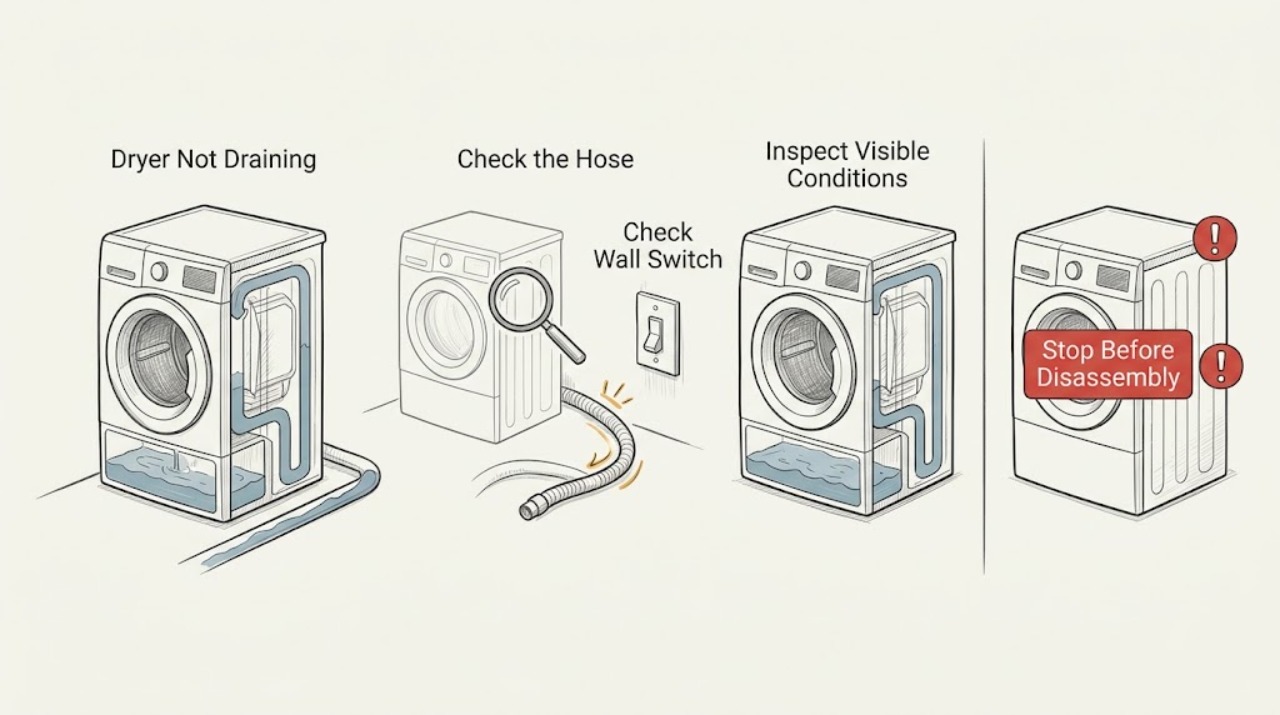
First determine whether this dryer has a water path. A standard vented dryer sends moist air through an exhaust duct and normally has no condensate tank to empty; if it has no tank, drain hose, or water alert, “not draining” may actually mean clothes remain damp and the venting guide is the safer match. A ventless condenser or heat-pump dryer may collect water in a removable tank or send it through a drain hose, while an all-in-one washer-dryer shares a drain system with the washer. Only after identifying that architecture should you empty and reseat a tank or inspect an accessible drain hose for kinks, clogs, and crushing. Do not open the cabinet or keep running a unit that is leaking onto the floor; use the model manual or service when the water path remains blocked.
Work through in order
Diagnostic checks
Use only checks that match the exact appliance or system and its official guide.
-
Check 1
With the dryer stopped, identify the appliance layout and the actual symptom. Look for an exhaust duct to the outside, a removable water tank or water-full symbol, a drain hose connected to plumbing, or washer controls on the same appliance. Also note whether there is standing water, a tank alert, a damp load, or water on the floor.
Expected result: The unit has an exhaust duct and no tank or drain hose; it has a tank or water-full alert; it has a direct drain hose; or it is an all-in-one washer-dryer.
Next step: Use the vented-dryer branch when there is no water path, the tank branch when a removable tank or alert is present, or the hose/shared-drain branch when a drain hose is installed.
Why this matters
Why: An exhaust-only unit does not use the same water path as a heat-pump or condenser dryer. A tank or water-full alert makes the condensate path relevant. A direct hose or all-in-one layout requires the exact hose and shared-drain instructions rather than a tank-only procedure.
-
Check 2
If the appliance has a removable condensate tank or shows a full-tank indication, switch it off and gently remove the tank using the handle and both hands. Empty it, check for an obvious obstruction at the tank opening, and push it fully back into its compartment as the model manual shows.
Expected result: The tank is full and the dryer resumes after it is reseated; the tank was nearly empty; the full indication remains; or water spills from a cracked or poorly seated tank.
Next step: Run only the model-approved short test when the tank is sound and fully seated. If the alert remains, the tank leaks, or the dryer stops again, keep it off and arrange service.
Why this matters
Why: A full tank or an incorrectly seated tank can stop a compact heat-pump dryer. If the tank was empty yet the alert persists, or it will not seat without force, the sensor, pump path, or tank fit remains unresolved; do not substitute a generic tank or operate with a leak.
-
Check 3
If a ventless dryer uses a direct drain hose, or the appliance is an all-in-one washer-dryer, inspect the accessible hose and its connection without opening the cabinet. Look for a kink, crushing behind the appliance, a clog at the visible end, a loose connection, or a hose that is not inserted and secured as the model installation instructions require.
Expected result: The hose is kinked or crushed; the visible connection is loose or blocked; the hose is routed correctly but water still does not leave; or the appliance shares the drain with the washer.
Next step: Correct only an obvious external kink or loose accessible connection, then run the model's short test. If the hose is damaged, the connection leaks, or the reservoir remains full, stop and request service; do not pull panels or test the pump live.
Why this matters
Why: A restricted or incorrectly installed hose can leave water in a heat-pump reservoir or keep condensate from reaching the drain. A correctly routed hose with continued no-drain behavior points beyond a simple external correction and may involve the pump or internal path. Shared washer-dryer units must follow the combo's single drain arrangement.
-
Check 4
If the dryer has an exhaust duct but no tank or drain hose, do not search for a condensate pump. If the concern is a damp load, clean the lint screen and check outside airflow during a brief normal run; the outside hood should move air, and a weak flow points to a restricted vent path.
Expected result: The load is damp but there is no water on the floor; outside airflow is weak; the exhaust path is clear and airflow is normal; or water is actually entering the room or cabinet.
Next step: Follow the model's vent-cleaning or drying-performance guidance for weak airflow. If water is leaking onto the floor or inside the cabinet, turn the dryer off, disconnect power if safe, and arrange service.
Why this matters
Why: A damp load with weak airflow is a venting or drying-performance issue, not proof that a drain is blocked. Normal airflow with persistent dampness needs the model's drying-performance checks. Actual water entering the room or cabinet is not a normal vented-dryer drain symptom and requires a stop decision.
-
Check 5
After one architecture-appropriate tank or hose correction, run only the model-approved short test while watching the tank alert, drain connection, and floor around the dryer. Do not continue testing if water leaks, the pump makes an abnormal sound, a protection alert returns, or the breaker trips.
Expected result: Water reaches the tank or drain normally and the cycle completes; the tank or reservoir fills again; water leaks from a connection or cabinet; or the dryer stops with the same alert.
Next step: Stop using the dryer and provide the technician with the model, architecture, alert, leak location, and result of the one test. Do not bypass a water-level sensor or run the dryer with water accumulating.
Why this matters
Why: A completed test after a clear external correction supports a routing or seating issue. Repeated filling, an unchanged alert, a cabinet leak, or an electrical interruption makes an internal pump, sensor, hose, or control fault more likely and cannot be identified safely from a generic dryer page.
Use your observations
Decision map
Find the observation that best matches what you see, then follow the next safe action.
-
PATH 01Next step
What you see
The appliance has no water tank or drain hose, only an exhaust duct, and the reported symptom is a damp load rather than standing water.
Do this next
Clean the lint screen and check outside exhaust airflow using the model's drying guide. Do not install a pump or route a drain hose to solve a vented dryer's damp-load complaint.
Why this path and its safety boundary
Why it matters: This pattern is less consistent with a blocked drain and more consistent with a drying-performance or restricted-airflow issue. A traditional vented dryer sends moist air outside rather than collecting condensate in a tank.
-
PATH 02Next step
What you see
A ventless or heat-pump dryer has a full tank or water alert, and the tank is visibly full or not fully seated.
Do this next
Empty the tank with both hands, reseat it completely, and run one model-approved test. If the alert returns with an empty, sound tank, request service.
Why this path and its safety boundary
Why it matters: A full or incorrectly inserted tank is a supported first explanation for a stopped condensate path. It does not establish that the pump or sensor has failed.
-
PATH 03Next step
What you see
A direct drain hose is installed and is kinked, crushed, visibly blocked, loose, or shared with an all-in-one washer-dryer drain.
Do this next
Restore only the obvious external routing or connection described by the model manual, then perform one short test. Stop when the hose leaks or the reservoir remains full.
Why this path and its safety boundary
Why it matters: The pattern makes an external routing or connection restriction more likely than an internal pump fault, but hose requirements differ by model and appliance type.
-
PATH 04Next step
What you see
The tank is empty and correctly seated or the hose is correctly routed, but water still accumulates, the alert returns, or water leaks from the cabinet.
Do this next
Keep the dryer off and arrange qualified service. Provide the model, dryer type, alert, water location, and what happened after the one external check; do not open the cabinet or bypass protection devices.
Why this path and its safety boundary
Why it matters: The remaining pattern is more consistent with an internal pump, sensor, seal, hose connection, or control fault than a user-correctable drain restriction. The generic symptom cannot safely identify the failed component.
Helpful context
Understand the symptom
Do not assume every dryer has a drain
A visible exhaust duct and no water tank usually indicate a traditional vented dryer: moist air leaves through the duct, so a report of “not draining” may be a damp-load or restricted-airflow complaint. A ventless condenser or heat-pump dryer instead turns moisture into water and may use a tank or drain hose. An all-in-one washer-dryer has yet another arrangement because its drying condensate uses the washer's drain hose. The first check below prevents applying a tank or pump procedure to a vented dryer.
Find the exact manual before changing hose routing
Tank position, drain connections, alerts, filters, and access points vary by model. Record the model number and use its manual before removing a tank, disconnecting a hose, or opening any filter cover. The checks here are limited to visible, user-accessible parts and do not identify a universal replacement pump or hose.
When checks do not resolve it
Need a professional?
Water is leaking from the cabinet, a tank, a connection, or onto the floor., A full-tank or reservoir alert returns after the tank is emptied and correctly seated, or a correctly routed hose still will not drain., The appliance type is unclear, the model manual is unavailable, or the repair would require opening the cabinet or bypassing a protection device.
Have this ready
- The complete model number and whether the appliance is vented, ventless, heat pump, or an all-in-one washer-dryer.
- The exact alert or symbol, whether a removable tank or direct drain hose is present, and where water was observed.
- Whether the tank was empty and reseated or the hose was externally corrected, and what happened during one short test.
Common questions
FAQ
Do all dryers have a drain hose or water tank?
No. A traditional vented dryer sends hot, moist air through an exhaust duct. Ventless condenser and heat-pump dryers condense moisture and may collect it in a removable tank or send it through a drain hose, depending on the model. Identify the appliance type before troubleshooting “not draining.”
What should I do when a heat-pump dryer says the tank is full?
Switch the dryer off, remove the tank gently with both hands, empty it, and push it fully back into place as the model manual shows. If the tank was not full, will not seat, leaks, or the alert returns, stop using the dryer and request service rather than forcing the tank or opening the cabinet.
Why does my dryer leave clothes damp if nothing is draining?
If the dryer has an exhaust duct and no tank or drain hose, damp clothes may indicate a dirty lint screen, restricted vent, weak outside airflow, load, or cycle issue—not a missing drain. Check the lint screen and outside exhaust airflow using the model's drying-performance guidance. Ventless units need their tank or drain hose checked instead.
Can I use a washer drain procedure on a dryer?
Not automatically. A ventless all-in-one washer-dryer can share a drain hose with the washer, while a standalone heat-pump dryer may use a tank or a different discharge arrangement. Follow the exact appliance manual and do not apply a washer pump-filter procedure to a standalone dryer without model-specific instructions.
When is a dryer drain problem a service issue?
Arrange service when water leaks from the cabinet or onto the floor, the tank or hose is damaged, the tank remains full after it is correctly seated, the reservoir alert returns, or a correctly routed hose still will not drain. Do not bypass sensors or open the cabinet as a shortcut.
Read the exact guide
Official sources
- Emptying the Water Tank - Compact Heat Pump DryerWhirlpool · Compact heat-pump models that use a removable water tank; not a universal procedure for vented dryers
- Not Starting, Not Operating, No Power - Compact Heat Pump DryerWhirlpool · Compact heat-pump dryer models with a water tank or discharge hose; model-specific installation still controls
- Dryer Not Drying or Long Dry Times- All-In-One Washer DryerWhirlpool · All-in-one washer-dryer architecture where condensate uses the washer drain hose; not a standalone vented dryer procedure
- Not DryingWhirlpool · Vented dryer damp-load and airflow symptoms when there is no condensate tank or drain hose
- What Is a Ventless Dryer?Whirlpool · Ventless dryer architecture and the distinction between condensate collection and traditional exhaust venting; model details vary
Community feedback
Share a repair observation
Share a plain-text repair observation. Accepted observations are published automatically; this page may take a moment to update.