
On this page
Start here
Quick answer
First identify whether the AEG dryer is vented, condenser, or heat pump: the water-removal path is different. A vented dryer sends moist air through a hose to the outside and does not use the condenser/heat-pump tank checks. A condenser or heat-pump dryer may collect water in a tank or send it through an external drain hose; empty and reseat the tank, or check that the external hose is not kinked or looped, only as the model manual permits. Clean the user-accessible filter and model-specific condenser, then stop and arrange AEG service for water under the machine, a tank that stays empty or full unexpectedly, a persistent warning, or a suspected blocked condensate pump.
Before you begin
Safety first
- This article supports model identification, ordinary-access tank emptying and reseating, visible hose and vent observation, and model-approved filter or condenser maintenance. It does not authorize casing removal, internal pump or overflow work, live electrical testing, building-vent alteration, or improvised hose modification.
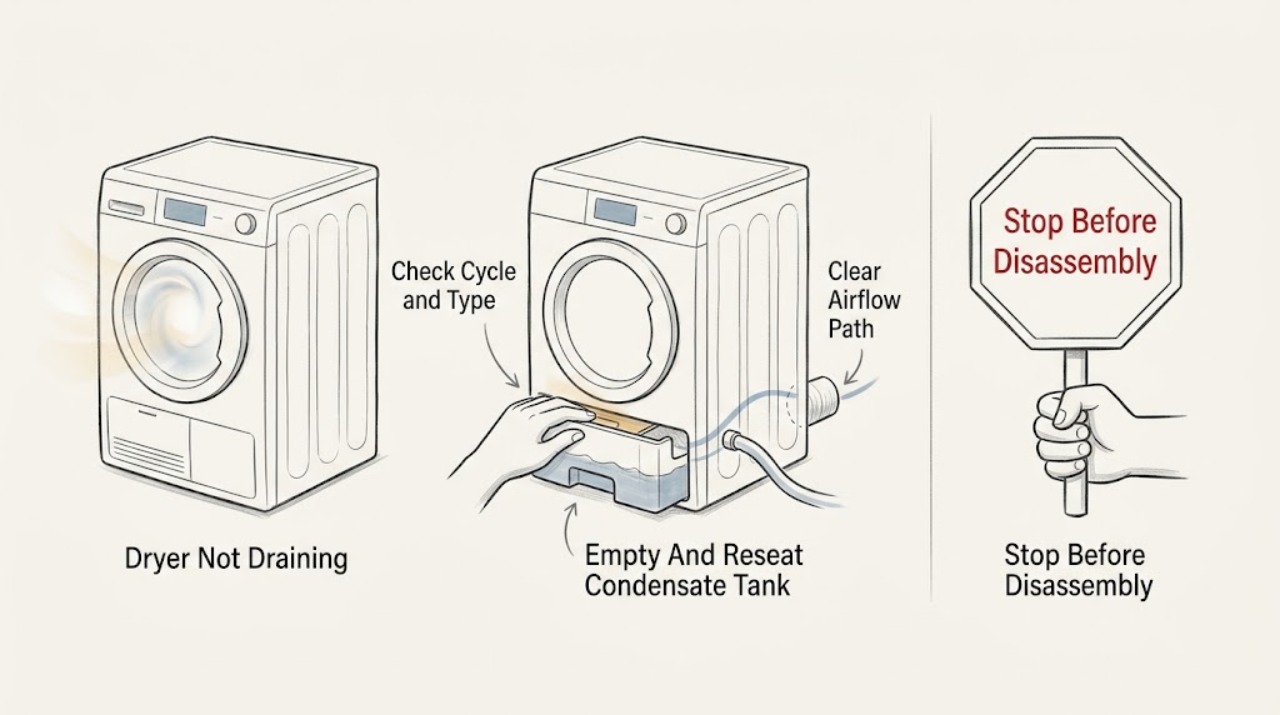
Work through in order
Diagnostic checks
Use only checks that match the exact appliance or system and its official guide.
-
Check 1
From the product label, controls, or exact AEG manual, classify the appliance as vented, condenser, or heat pump, and record what ‘not draining’ means: a full water tank, no water reaching a tank, a direct-drain warning, water on the floor, or moist air not leaving the room.
Expected result: There is an exhaust hose leading outdoors and no tank-related indication; there is a water tank or condenser/heat-pump warning; there is an external drain hose; or the type and symptom remain uncertain.
Next step: Use the vented branch for an outdoor exhaust path, or the condenser/heat-pump tank and drain branches for water collection. If the type cannot be established safely, stop and obtain the model manual or service assistance.
Stop if: Do not remove panels, guess the dryer type from its appearance, or test an unfamiliar drain connection while the machine is energized or wet.
Why this matters
Why: A vented dryer uses an air-and-vent path, while condenser and heat-pump dryers use a water-collection or condensate-drain path. The symptom and dryer type must be matched before a check can be interpreted.
-
Check 2
For a confirmed vented AEG dryer, inspect the visible vent hose, its connection to the dryer, and the outside outlet for a kink, crushing, lint blockage, detached section, closed damper, or a hose that does not follow the model installation instructions; do not inspect by reaching into the vent or wall.
Expected result: The hose is detached, sharply bent, obstructed, or too long; the outside outlet or damper is blocked; or the visible path is open and correctly connected but moisture still remains.
Next step: Restore only the visible connection and vent routing allowed by the exact manual, then monitor a normal cycle. AEG's general guidance limits the vent hose to no more than 2 metres and no more than two bends; if the path is inaccessible, damaged, or still ineffective, arrange service.
Stop if: Do not connect the hose to an extractor hood, chimney, boiler outlet, or another appliance vent, and do not drill or modify the hose or wall as a generic fix.
Why this matters
Why: A restricted vent can prevent moist air from leaving and can be mistaken for a drainage failure. A clear visible path makes an internal airflow, sensor, or heating issue more likely; it does not turn a vented dryer into a tank-based system.
-
Check 3
For a confirmed condenser or heat-pump AEG dryer using a water container, remove and empty the container into a suitable basin, check it for obvious damage or obstruction, and reseat it fully according to the model manual; do not open the dryer or access the internal collection area.
Expected result: The tank is full and the dryer stopped, the tank was empty but not seated correctly, the water-container indicator stays on at the start of a cycle, or the tank remains empty while water appears elsewhere.
Next step: If the tank was simply full or mis-seated, refit it and use the dryer only as the manual permits. If the indicator returns, the tank remains empty unexpectedly, or water is on the floor, stop and arrange authorized service.
Stop if: Do not tilt the appliance, reach into the tank cavity, bypass the water-container sensor, or continue operating with a leak or unexplained warning.
Why this matters
Why: AEG says these dryers can stop when the tank is full, and that an early or persistent water-container indication can mean water is in an overflow tank, the condenser needs cleaning, or a connected drain is incorrect. A tank that remains empty while water leaks elsewhere is not evidence that the dryer is draining normally.
-
Check 4
For a condenser or heat-pump AEG dryer fitted with an external drain kit, inspect the visible outlet hose and drain connection for a kink, loop, loose connection, blockage, or a hose arrangement that differs from the exact installation instructions; do not disconnect a wet hose over electrical parts.
Expected result: The hose is kinked, looped, loose, blocked, or incorrectly routed; the connection is visibly sound; or water leaks from the dryer while little reaches the drain.
Next step: With the appliance safe and cool, correct only the external connection and routing allowed by the exact model instructions, then observe the next permitted cycle. If water still does not reach the drain, the hose cannot be safely corrected, or water appears under the dryer, request service.
Stop if: Do not pull the dryer out across a wet floor, open the casing, force the hose, or disconnect and reconnect a pressurized or inaccessible fitting.
Why this matters
Why: AEG links a persistent water-container indication to an incorrectly connected drain hose or a loop, and identifies a kinked outlet hose as a cause of leakage. A sound visible hose with continued non-draining or leakage makes an internal blockage or condensate-pump fault more likely.
-
Check 5
After the matching type and water path are known, clean the lint filter after the cycle and clean the condenser or heat exchanger only where the exact AEG manual identifies it as user-accessible; for a heat-pump model, use the specified non-invasive method and do not remove a fixed condenser.
Expected result: The filter or accessible condenser is visibly blocked, a condenser symbol is lit or flashing, airflow improves after permitted cleaning, or the water symptom is unchanged.
Next step: Restore the filter or condenser exactly as instructed and monitor the next permitted cycle. If the warning, leak, or non-draining symptom returns, stop using the dryer and arrange an authorized service visit.
Stop if: Do not remove a condenser that the manual says is fixed, insert tools into the condensate path, wash electrical components, or use the dryer with a blocked condenser or unresolved leak.
Why this matters
Why: AEG says filters and condensers require regular cleaning and warns not to use a dryer with a blocked condenser. Unchanged water behavior after permitted maintenance makes an internal condensate path or pump fault more likely than ordinary lint buildup.
Use your observations
Decision map
Find the observation that best matches what you see, then follow the next safe action.
-
PATH 01Safety boundary
What you see
The AEG dryer is confirmed vented, there is no tank-based symptom, and the hose or outside outlet is detached, kinked, blocked, or otherwise not routed as instructed.
Do this next
Correct the visible vent connection and routing only under the exact model instructions, then monitor a normal cycle. Arrange service for an inaccessible wall blockage, damaged duct, persistent moisture, or any need to alter the building vent.
Why this path and its safety boundary
Why it matters: The air-exhaust path is more likely than a condensate tank or pump; moist air or condensation can remain when the vent cannot flow freely.
Safety stop: Do not connect the vent to a hood, chimney, boiler outlet, or another appliance, and do not drill or dismantle the wall vent as a user repair.
-
PATH 02Safety boundary
What you see
The dryer is a condenser or heat-pump model, the water container is full or not seated, and there is no water leak or persistent warning after permitted emptying and refitting.
Do this next
Empty and reseat the tank as the model manual shows, then use the dryer only as instructed. If the tank fills abnormally quickly, the warning returns, or water reaches the floor, arrange service.
Why this path and its safety boundary
Why it matters: A full or mis-seated tank can explain the stop, and this is a different path from a vented dryer that should not have tank troubleshooting applied to it.
Safety stop: Do not bypass a water-level sensor, operate with a leak, or access the internal tank or pump compartment.
-
PATH 03Safety boundary
What you see
The dryer is a condenser or heat-pump model connected directly to a drain, and the water-container warning persists or water leaks while the outlet hose is kinked, looped, loose, or poorly routed.
Do this next
Correct only the visible hose routing and connection allowed by the exact installation instructions. If water still does not reach the drain or appears under the dryer, stop and request authorized service.
Why this path and its safety boundary
Why it matters: The external condensate-drain arrangement is more likely than a full tank; AEG identifies incorrect hose connection, a loop, or a kink as relevant drain and leak conditions.
Safety stop: Do not pull the appliance across water, force the hose, open the casing, or treat a hidden pump blockage as an external hose problem.
-
PATH 04Safety boundary
What you see
A condenser or heat-pump dryer has an empty or correctly seated tank, a correctly routed direct-drain hose if fitted, and clean permitted filters or condenser, but water still does not reach the tank/drain or leaks underneath.
Do this next
Stop using the dryer, protect the floor and nearby electrical equipment from water, and arrange an authorized AEG service visit with the model, water path, warning lights, and observations.
Why this path and its safety boundary
Why it matters: An overflow tank, internal blockage, or condensate-pump fault is more likely; AEG identifies a blocked condensate pump as a service fault rather than a routine user check.
Safety stop: Do not remove panels, clean or replace an internal pump, bridge a sensor, or keep restarting the dryer to make water move.
-
PATH 05Safety boundary
What you see
The dryer type cannot be established, the user says ‘not draining’ but cannot identify a tank, vent, direct-drain hose, leak, or warning, or the visible path does not explain the symptom.
Do this next
Stop testing, obtain the exact model manual or ask AEG service to identify the appliance and water-removal system before further checks.
Why this path and its safety boundary
Why it matters: The evidence is insufficient to choose between vent airflow, water-container, direct-drain, condenser, overflow, and pump branches; applying the wrong procedure could damage the appliance or hide a leak.
Safety stop: Do not guess the dryer type, drill a hose, dismantle a condenser, or buy a pump or drain kit based only on the phrase ‘not draining.’
Helpful context
Understand the symptom
The dryer type determines what ‘not draining’ means
AEG's support guidance applies different checks to vented, condenser, and heat-pump dryers. A vented model removes moist air through a hose and outside vent. A condenser or heat-pump model collects condensed water in a container or can use an external drain hose. Use the exact model manual or product identification to classify the dryer before checking a tank, drain hose, condenser, or pump; do not substitute one type's procedure for another.
Check the matching path without opening the appliance
For a condenser or heat-pump dryer, a full water container can stop the machine, and an external drain connection can fail if its hose is kinked, looped, or connected incorrectly. For a vented dryer, look at the vent hose and outside outlet instead of searching for a condensate tank. A blocked condenser, filter, or internal condensate pump may require service; the pump is not a safe generic user repair.
Water under the dryer changes the decision
Water on the floor, a nearly empty tank despite normal drying, or a persistent water-container warning can point to an overflow or condensate-pump problem rather than a simple full tank. Stop using the dryer if water is reaching electrical parts or the floor, keep the area safe, and give the technician the dryer type, tank or hose arrangement, warning lights, and what was observed.
Safety boundary
Stop conditions
- Identify vented versus condenser versus heat-pump design before applying a drain, tank, condenser, or vent procedure.
- Stop for water under the dryer, water near electrical parts, a persistent warning, a tank that stays empty or full unexpectedly, or a suspected overflow or condensate-pump fault.
- Do not open the casing, access a pump or overflow tank, bypass a sensor, or perform live electrical or internal water-path testing.
- Do not use a vented-dryer procedure on a condenser or heat-pump model, or a tank/pump procedure on a vented model, without the exact model instructions.
- Do not drill, force, reroute through another appliance, or modify a vent or drain hose as a generic fix; arrange authorized AEG service when the visible checks do not resolve the problem.
When checks do not resolve it
Need a professional?
Arrange authorized AEG service when the dryer type or water path is uncertain, water remains under the appliance, a condenser or heat-pump tank stays empty or full unexpectedly, a direct-drain hose is sound but water does not move, a warning persists after permitted cleaning and reseating, or an internal condensate pump or overflow blockage is suspected. For a vented dryer, call when the visible vent path is clear but moisture still does not leave or the building vent requires alteration.
Safety scope: This article supports model identification, ordinary-access tank emptying and reseating, visible hose and vent observation, and model-approved filter or condenser maintenance. It does not authorize casing removal, internal pump or overflow work, live electrical testing, building-vent alteration, or improvised hose modification.
Common questions
FAQ
Does an AEG vented dryer have the same drain system as a condenser or heat-pump dryer?
No. A vented model sends moist air through an outdoor vent hose. Condenser and heat-pump models may collect water in a tank or use an external drain hose. Identify the model before checking a tank, condenser, or drain pump.
Why is my AEG condenser or heat-pump dryer not sending water to the tank?
After confirming the model type, check that the water container is correctly seated and that filters and the model-accessible condenser are maintained as instructed. If the tank stays empty while water leaks elsewhere, or a warning returns immediately, an overflow or condensate-pump fault may require service.
What should I check if my AEG dryer is connected directly to a drain?
Only on a condenser or heat-pump model with that installation, inspect the visible outlet hose for a kink, loop, loose connection, or incorrect routing under the exact manual. If the hose is sound but water still does not reach the drain, stop using the dryer and request service.
Can I remove an AEG dryer condensate pump to clear the blockage?
No. A blocked condensate pump is an internal service condition. Do not open the casing or keep restarting the dryer; arrange authorized AEG service, especially if water is leaking onto the floor.
Read the exact guide
Official sources
- Warning light(s) of tumble dryer cannot be switched offAEG · Official AEG UK support guidance for tumble-dryer warning lights; indicators and exact reset procedures vary by model.
- Moisture, condensation, water in tumble dryerAEG · Official AEG UK support guidance for tumble dryers; exact steps and access vary by model and the supplied user manual.
- Tumble dryer is leakingAEG · Official AEG UK support guidance for heat-pump and condenser tumble dryers; exact access and repair requirements vary by model.
- How to clean and maintain your AEG tumble dryerAEG · Official AEG UK maintenance guidance for AEG tumble dryers; the exact cleaning access and interval are model-dependent.
Community feedback
Share a repair observation
Share a plain-text repair observation. Accepted observations are published automatically; this page may take a moment to update.