
On this page
Start here
Quick answer
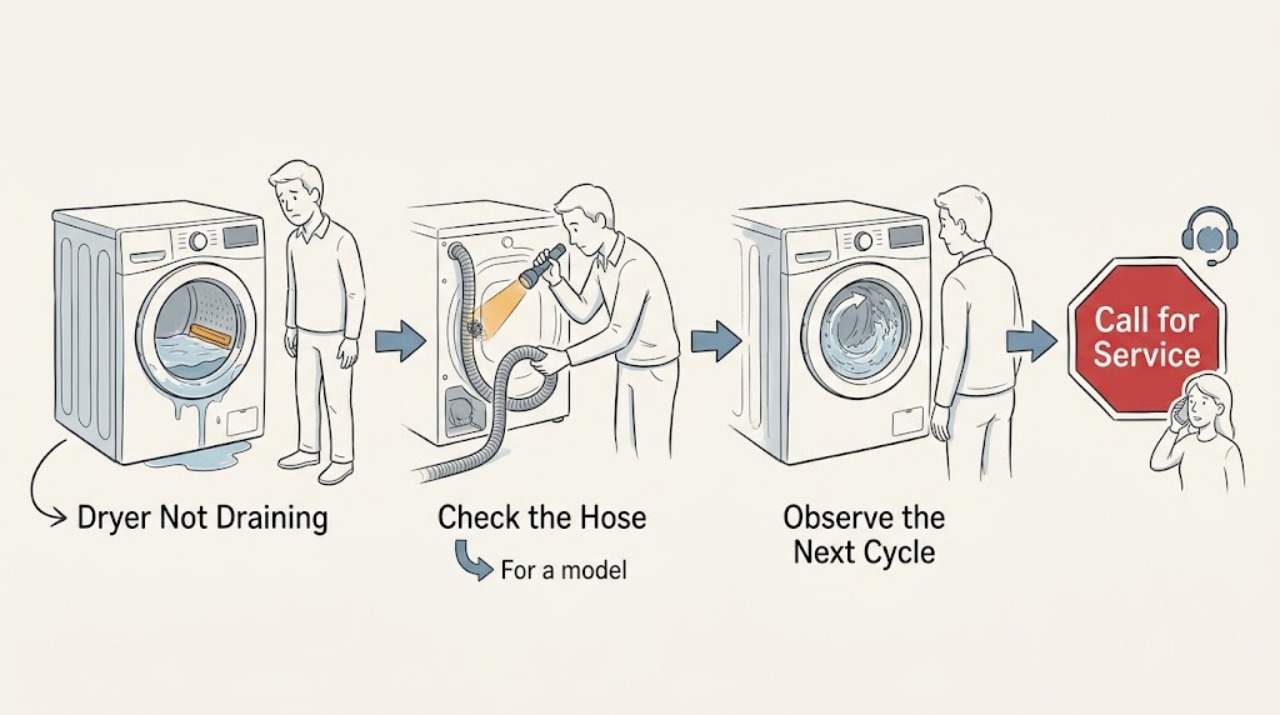
Candy dryer drainage depends on the model: a condenser or heat-pump dryer may collect condensed water in a tank, while a model fitted for direct drainage uses a hose. First identify which arrangement your dryer has, then empty and firmly reseat the accessible tank if fitted, check the visible drain hose for a kink or poor connection if your manual says direct drainage is installed, and clean the lint filter and any model-specific condenser or filter drawer. If the tank or indicator still shows a drainage problem after those checks, or water is leaking inside the cabinet, stop the dryer and arrange Candy service. Do not remove panels or guess at a pump part without the model number.
Work through in order
Diagnostic checks
Use only checks that match the exact appliance or system and its official guide.
-
Check 1
Record the model code and inspect the front, top, and lower access area for a removable condensate tank, a water-container indicator, or a direct-drain hose; do not remove covers that are not described in the manual.
Expected result: The dryer has an accessible tank, a direct-drain hose, both arrangements, or no identifiable water path without the manual.
Next step: Use the tank or hose branch below that matches the model manual; if the water path remains unknown, obtain the manual by model code before proceeding.
Why this matters
Why: A tank-based condenser arrangement requires tank seating and emptying checks. A direct-drain arrangement requires hose routing and connection checks. If the arrangement cannot be identified, model-specific guidance is missing and a generic internal-pump diagnosis would be unsafe.
-
Check 2
For a model with a removable condensate tank, remove it by its normal handle, empty the collected water, inspect the tank opening for loose lint, and slide it back until it is fully seated.
Expected result: The tank is full, the warning clears after reseating, the tank was nearly empty, or the warning remains and the tank will not seat correctly.
Next step: If the warning clears, run a short supervised cycle and check whether water reaches the tank. If it remains or the tank cannot seat, stop and arrange service; do not force the tank or pry inside its housing.
Why this matters
Why: A full tank can interrupt condensation handling, and a tank that is not seated can prevent the dryer from recognizing the water path. A persistent warning with an empty, correctly seated tank makes a blocked internal path, sensor, or pump issue more likely; the model is needed to distinguish them.
-
Check 3
If the model manual confirms a direct drain hose is installed, inspect only the visible hose and connection for a sharp bend, crushing behind the dryer, a loose end, or water escaping at the connection.
Expected result: The hose is straight and secure with no leak, or it is kinked, crushed, disconnected, or leaking.
Next step: Correct only a visible routing problem exactly as the manual describes and keep the hose supported. If the connection leaks, the hose cannot be safely accessed, or drainage still fails, stop using the dryer and arrange service.
Why this matters
Why: A visible restriction or loose connection can stop or divert condensate before it reaches the drain. A clear, secure hose makes an internal blockage or pump fault more likely, but it does not identify a replaceable part without model-specific testing.
-
Check 4
With the dryer switched off and cool, remove and clean the lint filter and any removable condenser or filter drawer that the model manual identifies; allow washable parts to dry fully before reinstalling them.
Expected result: The filter or drawer is visibly packed with lint, the dryer has a blocked-filter indication, or the removable paths are already clean.
Next step: Reinstall each part only when clean, dry, and correctly seated, then test a small load. If the drainage symptom or indicator returns with clean, seated filters, arrange model-specific service.
Why this matters
Why: Candy says lint and the filter or condenser drawer can compromise dryer performance. Heavy restriction can alter moisture handling, but a clean removable path does not prove that an internal drain pump, sensor, or condenser is sound.
-
Check 5
Run one short, supervised program after the matching tank, hose, and filter checks, and observe where condensate goes without opening the cabinet or reaching into moving parts.
Expected result: Water reaches the intended tank or drain, no water appears, the warning returns, or water leaks from inside or beneath the dryer.
Next step: If the path remains dry or leaks internally, stop the program, disconnect use, and provide the model and serial details to Candy support or an authorized service agent.
Why this matters
Why: Normal collection or discharge after the visible checks makes the original restriction more likely to have been resolved. No collection, a returning warning, or an internal leak leaves an internal pump, sensor, condenser, or hose fault possible and cannot be safely isolated from a generic Candy topic.
Use your observations
Decision map
Find the observation that best matches what you see, then follow the next safe action.
-
PATH 01Next step
What you see
The manual identifies a tank-based condenser dryer, the tank is full or not fully seated, and the warning clears after emptying and reseating it.
Do this next
Keep the tank seated and follow the model's emptying interval. If the warning returns while the tank is not full, move to service rather than repeatedly forcing the tank.
-
PATH 02Next step
What you see
A direct-drain hose is confirmed by the manual and is kinked, crushed, disconnected, or leaking, but the dryer itself has no other fault indication.
Do this next
Correct the visible hose placement only as the model manual permits and supervise the next short cycle. If the hose is clear and secure but no water reaches the drain, arrange service.
-
PATH 03Next step
What you see
The tank is correctly seated or the hose is clear, but the removable lint filter or condenser/filter drawer is heavily restricted; the symptom improves after cleaning.
Do this next
Keep the lint filter clean after each cycle and follow the model manual for the condenser or drawer interval. If the drain symptom returns with clean, dry, correctly seated parts, arrange service.
-
PATH 04Next step
What you see
No condensate reaches the intended tank or drain after the model-specific tank, hose, and removable-filter checks, or water leaks from inside the cabinet.
Do this next
Stop using the dryer and contact Candy support or an authorized service agent with the model and serial information. Do not open the cabinet, bypass a sensor, or continue cycles with an internal leak.
Helpful context
Understand the symptom
Start by identifying the drainage architecture
“Not draining” does not mean the same thing on every Candy dryer. Some condenser dryers collect water in a tank; Candy's EasyCase description applies only to some condenser models, and Candy product listings show that tank position can vary. Other models may use an optional direct drain arrangement. Find the model code and use its manual before opening a lower panel or changing a hose connection.
Use visible maintenance checks only
A full or poorly seated tank, a kinked visible hose, and restricted lint or condenser airflow can each interrupt normal moisture handling, but the same symptom can also come from an internal pump or sensor fault. The checks below stop at removable user-maintenance items. Do not infer a pump, valve, or control failure from the word “drain” alone.
When checks do not resolve it
Need a professional?
Arrange Candy or authorized service if drainage fails after the correct tank, direct-hose, and removable-filter checks, if the warning returns with an empty seated tank, if the hose connection leaks, or if water appears inside or beneath the cabinet.
Common questions
FAQ
Do all Candy dryers drain water into the same place?
No. Candy describes tank collection on some condenser dryers, and product listings show that the tank position can vary. Some models may also use a direct-drain arrangement. Use the manual for the exact model before checking or changing the water path.
Why is my Candy dryer not draining even though the tank is empty?
An empty tank does not prove that the tank is seated, the direct hose is clear, or the removable filter and condenser path are clean. Check the model-specific arrangement and those visible items first; if the warning or no-collection symptom remains, an internal service diagnosis is needed.
Should I replace the Candy dryer drain pump?
Not from “not draining” alone. Candy models differ in tank position and drainage arrangement, and the generic symptom cannot establish pump compatibility. Confirm the model, complete the visible checks, and let Candy support or an authorized agent identify any required part.
Read the exact guide
Official sources
- I have heard that your condenser tumble dryers have EasyCase tank for the collection of water. Can you explain how it works?Candy · Tank-based condensate collection and the fact that EasyCase applies only to some condenser models
- Product user manuals | CandyCandy · Model- and product-code-specific instruction lookup for Candy dryers
- Technical assistance for our appliances | CandyCandy · Candy support, model/serial information, authorized service, and compatible-parts assistance
- How to best maintain the dryerCandy · Load balance, lint filter, filter or condenser drawer, and removable-part cleaning guidance
- CSE C9DF-80 Smart DryerCandy · Concrete example of a Candy dryer listing with a bottom water tank; not a claim about every Candy model
Community feedback
Share a repair observation
Share a plain-text repair observation. Accepted observations are published automatically; this page may take a moment to update.