
On this page
Start here
Quick answer
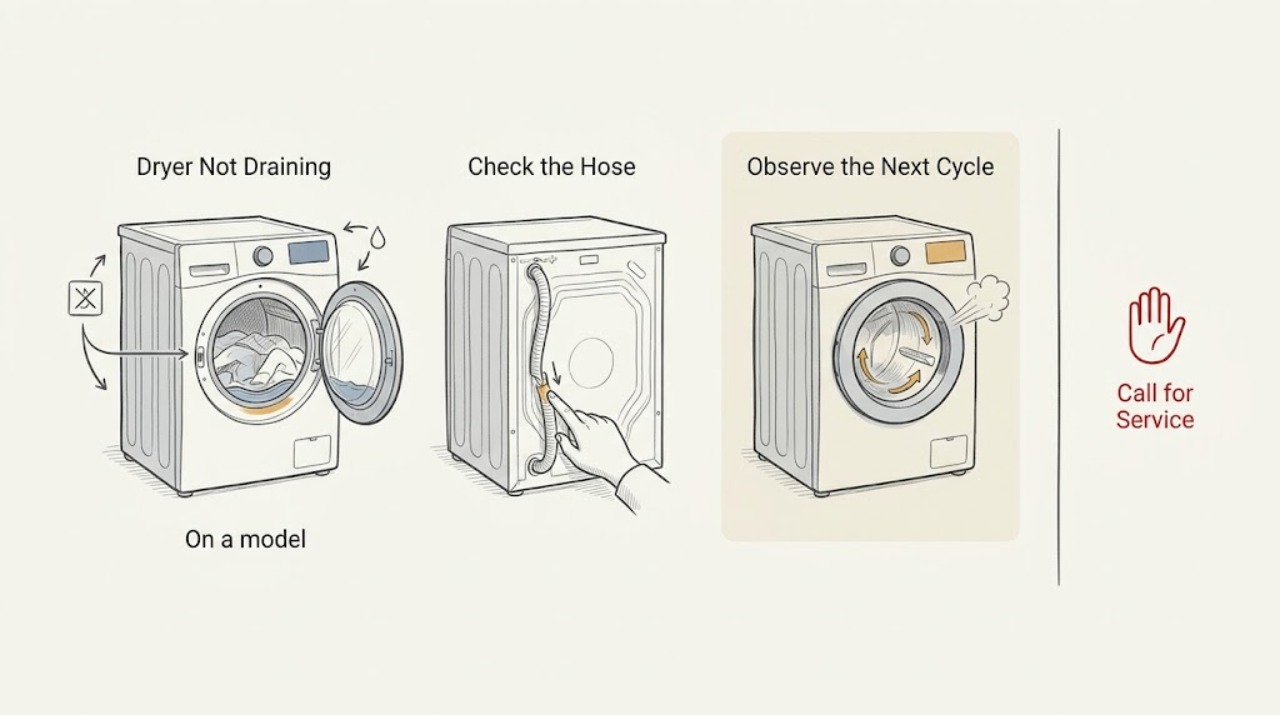
A GE dryer may be a vented model that exhausts moist air or a ventless condenser model that sends condensed water to a removable tank or a direct drain. Do not apply the tank procedure to a vented dryer. First identify the model and water path, then empty and firmly reseat a removable tank if your model has one, inspect a confirmed direct-drain hose for visible kinks or a poor connection, and check the accessible lint or vent path for restriction. If the tank remains empty but the warning persists, water does not reach the drain, or water leaks inside the cabinet, stop and arrange GE service. Do not open the cabinet or disconnect a gas-dryer vent for testing.
Work through in order
Diagnostic checks
Use only checks that match the exact appliance or system and its official guide.
-
Check 1
Find the GE model/serial tag or QR code and determine whether the dryer is vented or a ventless condenser model; note whether you see a removable water tank, a direct-drain hose, or neither.
Expected result: The model support page identifies a ventless condenser dryer with a tank, a ventless model with direct drainage, a conventional vented dryer, or an architecture that cannot be identified yet.
Next step: Follow the tank, direct-drain, or vent branch below that matches the GE model support material. If the architecture is unknown, stop before removing covers or hoses and retrieve the model instructions.
Why this matters
Why: Only a ventless condenser model should be expected to route condensed water to a tank or drain hose. On a vented model, “not draining” is not enough evidence that a tank or condensate pump exists; the relevant path may be airflow and outdoor exhaust.
-
Check 2
On a model with a removable condensate tank, remove the tank using its normal handle, empty it, inspect the opening for loose lint, and reinstall it fully according to the model instructions.
Expected result: The tank is full, was not seated fully, the warning clears after reseating, or the warning remains with an empty correctly seated tank.
Next step: If the warning clears, run a short supervised cycle and confirm that condensate reaches the tank. If it remains, stop using the dryer and arrange GE service; do not probe the tank housing or order a pump by symptom alone.
Why this matters
Why: A full or poorly seated tank can interrupt the water-removal path. A persistent warning with an empty tank makes an internal pump, sensor, or blocked path more likely, but the generic topic does not identify which one.
-
Check 3
On a ventless model whose manual confirms direct drainage, inspect the visible drain hose and its outlet for a kink, crushing behind the dryer, a loose connection, or water escaping at the connection.
Expected result: The hose is clear and secure, or it is kinked, crushed, disconnected, or leaking.
Next step: Correct only a visible routing problem exactly as the model manual permits and supervise the next cycle. If drainage still fails or the connection leaks, stop and arrange GE service rather than opening the cabinet.
Why this matters
Why: A visible hose restriction or poor connection can stop condensed water from reaching the drain. A clear hose makes a hidden blockage, pump, or sensor issue more likely, but not a specific compatible part.
-
Check 4
On a conventional vented dryer, inspect the accessible vent hose and the outside wall cap for a kink, collapse, lint obstruction, or weak airflow; do not disconnect the vent from a gas dryer for a test.
Expected result: The vent route is clear with strong outdoor airflow, or the hose/cap is restricted and the dryer is hot, humid, or collecting condensation.
Next step: Clear only accessible lint or an obvious outside-cap obstruction using safe maintenance methods and follow the installation instructions for the model. If airflow remains weak or the dryer is gas-fired, arrange qualified service or vent cleaning.
Why this matters
Why: GE says restricted airflow can retain heat and humidity, increase drying time, and cause water to condense around the door or on the door. A clear vent makes an internal dryer fault more likely than a simple vent restriction.
-
Check 5
After the matching tank, hose, or vent check, run one short supervised cycle and observe whether water follows the intended path without leaking, while keeping hands and tools out of the moving dryer.
Expected result: The tank fills or the direct drain carries water normally, no water appears where expected, the warning returns, or water leaks inside or beneath the cabinet.
Next step: If the water path still fails or leaks, stop the cycle and provide the exact model and serial details when scheduling GE service. Do not continue cycles to force water through a suspected internal blockage.
Why this matters
Why: Normal collection or discharge supports a resolved routing issue. No collection, a returning warning, or an internal leak leaves an internal pump, sensor, condenser, or hidden hose fault possible and cannot be safely isolated from a generic GE topic.
Use your observations
Decision map
Find the observation that best matches what you see, then follow the next safe action.
-
PATH 01Next step
What you see
The GE model is a ventless condenser dryer and the removable tank was full or not seated, then the warning clears after emptying and reseating it.
Do this next
Keep the tank fully seated and follow the model instructions for emptying it. If the warning returns while the tank is not full, arrange service.
-
PATH 02Next step
What you see
Direct drainage is confirmed by the model instructions and the visible hose is kinked, crushed, disconnected, or leaking.
Do this next
Correct the visible hose placement only as the model instructions allow and watch the next short cycle. If water still does not reach the drain, stop and arrange service.
-
PATH 03Next step
What you see
The dryer is vented and the outside airflow is weak, the vent hose is restricted, or heat and humidity are collecting around the door.
Do this next
Use the model's installation and vent-maintenance guidance, and arrange qualified vent or appliance service if airflow does not recover. Never disconnect a gas-dryer vent for a home test.
-
PATH 04Next step
What you see
The tank is empty and correctly seated, the confirmed hose or vent path is clear, but the warning returns, no water reaches the intended path, or water leaks inside the cabinet.
Do this next
Stop using the dryer and contact GE support or a qualified service technician with the model and serial information. Do not open the cabinet or bypass a sensor.
Helpful context
Understand the symptom
“Not draining” depends on the dryer architecture
A ventless condenser GE dryer has water that must be removed through a removable tank or an included drain hose. A conventional vented dryer normally sends moist air outdoors instead, so a complaint about water not draining may actually describe restricted venting or condensation. GE's support pages use the model number to select the correct instructions; identify that model before treating a tank, hose, or vent as present.
Stay with removable, visible checks
The checks below distinguish a full tank, a visible hose or vent restriction, and an internal pump or sensor problem. They do not establish a compatible replacement part. If the fault remains after the model-specific maintenance steps, GE recommends professional service rather than opening the appliance.
When checks do not resolve it
Need a professional?
Arrange GE or qualified service if a correctly identified tank or direct-drain path still does not move water, a tank warning persists after an empty seated tank, a vent remains restricted, or water leaks inside or beneath the cabinet.
Common questions
FAQ
Do all GE dryers have a water tank that can be emptied?
No. GE's tank-and-drain instructions apply to ventless condenser dryers. A conventional vented dryer sends moist air through an exhaust path instead. Confirm the model before looking for a tank or condensate pump.
Why is my GE dryer not draining even though the tank is empty?
The tank may not be seated, the model may use a direct hose, or a hidden pump, sensor, or condenser path may be blocked. Check only the model-confirmed removable and visible paths; a recurring warning or internal leak requires service.
Could a vent problem look like a GE dryer drainage problem?
Yes, on a vented dryer. GE says restricted airflow can retain heat and humidity and cause water to condense around the door or on the door. Inspect the accessible vent route and outside cap, but do not disconnect a gas-dryer vent for testing.
Read the exact guide
Official sources
- Dryer - Things To Check For A Venting IssueGE Appliances · Vented dryer airflow, hose and outside-cap restrictions, condensation, and gas-dryer safety boundary
- Ventless Condenser Dryer - How It DrainsGE Appliances · Removable water tank and direct-drain hose options for ventless condenser dryers
- GE Appliances Service and Support by Product LineGE Appliances · Model-specific support, manuals, maintenance, filters and parts lookup
- Support for GE Washers and DryersGE Appliances · Dryer troubleshooting routing and qualified service support
Community feedback
Share a repair observation
Share a plain-text repair observation. Accepted observations are published automatically; this page may take a moment to update.