
On this page
Start here
Quick answer
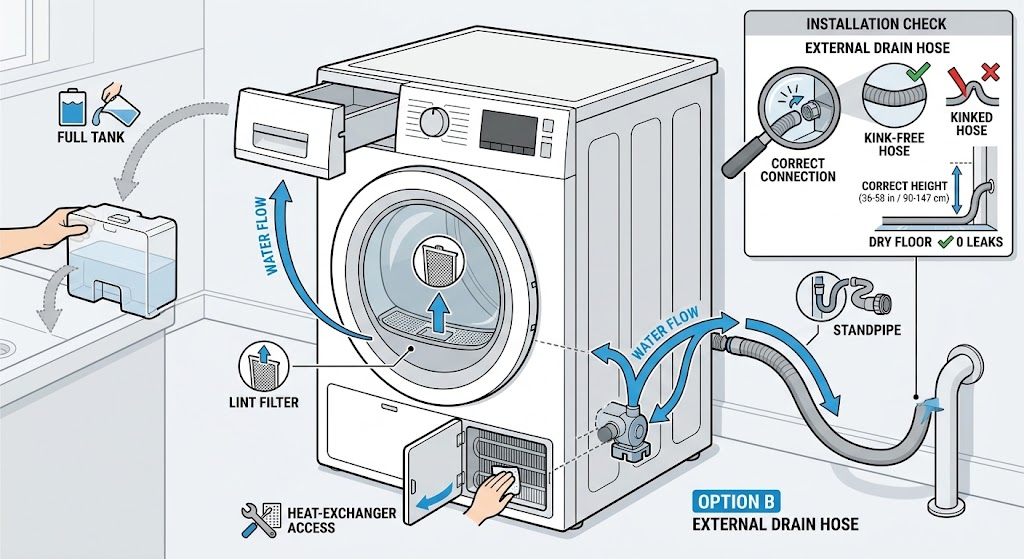
A Bosch dryer that is not draining needs an architecture check first. Condenser and heat-pump dryers remove moisture from the load and send it either to a condensation container or, on models equipped for it, through a drain hose; a vented dryer instead exhausts moist air and does not use that same water path. For a condenser or heat-pump model, empty and reseat the container, inspect the accessible drain hose for a kink or blockage, and clean only the lint filter or condenser area that the exact manual identifies as user-serviceable. Bosch identifies a blocked or kinked condensation drainage hose as E03 on applicable models and warns that heat-pump heat exchangers may not be for do-it-yourself cleaning. If water leaks, the tank fills immediately, the drain path is clear but the dryer still will not drain, or any check requires opening the cabinet, stop and arrange Bosch-authorized service.
Before you begin
Safety first
- This article supports ordinary-access identification, container emptying, lint-filter care, and model-approved external hose checks only. It does not authorize cabinet removal, heat-pump exchanger or pump work, energized testing, or improvised drainage changes.
Work through in order
Diagnostic checks
Use only checks that match the exact appliance or system and its official guide.
-
Check 1
With the dryer off and cool, read the model label and identify from the manual whether the appliance is vented, condenser, or heat pump; note whether it has a removable condensation container, a direct drain hose, a heat-exchanger access flap, or an external exhaust hose.
Expected result: The manual identifies a container-based condenser or heat-pump system, a direct condensation drain, a vented system, or a feature layout that cannot be identified without moving the appliance or opening a panel.
Next step: Photograph the model label and water-path components, then follow only the matching manual section for the identified architecture.
Stop if: Stop if the label is missing, the appliance is damaged, or identifying the path requires removing a cabinet panel or reaching energized parts.
Why this matters
Why: A container or direct-drain system can explain a not-draining symptom through the condensate path. A vented dryer does not collect condensate in that way, so a tank-focused check would be irrelevant; unknown architecture means model-specific service information is required before disassembly.
-
Check 2
On a condenser or heat-pump model with a removable condensation container, pull the container out horizontally only after the dryer is cool, empty it into a suitable drain, inspect its visible seating area for lint or damage, and push it back until the manual's normal locked or clicked position is reached.
Expected result: The container is full, partly full, unexpectedly empty, not fully seated, visibly cracked, or absent because the dryer is configured for direct drainage; note whether a tank-full indicator was displayed.
Next step: Reseat the intact container and continue only with the manual's safe test. Do not operate the dryer without the specified container or with a damaged container.
Stop if: Do not remove the container while a programme is running, force a drawer, drink or reuse condensate water, or continue if water reaches the electrical connection.
Why this matters
Why: A full or poorly seated container can stop a subsequent drying programme and can allow water to escape. An empty container with a not-draining symptom makes the container itself less likely and shifts attention to the direct hose, internal condensate path, or model-specific sensor or pump; a crack is a service or exact-model replacement question.
-
Check 3
If the exact model uses direct condensation drainage, switch off and unplug the dryer, then inspect the visible hose from the dryer to the waste connection for kinks, crushing, disconnection, an unsecured end, or a blocked siphon connection; do not pull internal hoses or improvise a new route.
Expected result: The hose is kinked or crushed, detached from the appliance or siphon, blocked at an accessible connection, routed normally, or inaccessible without moving a heavy appliance or opening the cabinet; note any E03 code if displayed.
Next step: Correct only a visible kink or a clearly loose external connection as the manual allows, secure the hose so it cannot slip, and perform a cautious test only after confirming the waste connection accepts water.
Stop if: Do not disconnect a pressurized or inaccessible connection, use a sharp tool to clear an internal blockage, or run the dryer when the hose leaks or the waste connection backs up.
Why this matters
Why: Bosch identifies E03 on applicable models as a blocked or kinked condensation drainage hose. A direct-drain hose that is clear and correctly connected makes a pump, internal channel, sensor, or installation issue more plausible; E03 is model-dependent and does not diagnose every Bosch dryer.
-
Check 4
After the dryer has cooled, clean the lint or fluff filter as the manual directs and inspect the condenser or heat-exchanger access only if the exact manual identifies it as user-serviceable; keep sharp tools and force away from fins, seals, and the water path.
Expected result: The lint filter is visibly loaded, the model has a non-self-cleaning condenser with a documented access procedure, the heat-pump exchanger is marked for service rather than user cleaning, or the access cover or seal is damaged or cannot be secured.
Next step: Replace the fully dry filter and secure any permitted condenser cover exactly as the manual shows. If the manual excludes user cleaning or the path remains blocked, record the result and request service.
Stop if: Do not remove a heat-pump heat exchanger, scrape fins, spray water into the cabinet, operate without a complete filter or secured cover, or continue with a damaged seal.
Why this matters
Why: Bosch says dirty filters restrict airflow and says its water-rinse condenser procedure applies to a non-self-cleaning condenser. A heat-pump model may have different service boundaries; a cover that will not lock or a damaged seal can cause water leakage and is not a reason to operate the dryer open.
-
Check 5
Once the correct container or external drain hose is intact and all permitted access covers are secured, run only the shortest model-approved test while staying nearby and watching the first place water appears; stop before a full load if drainage is abnormal.
Expected result: The dryer completes the test with no water outside and the expected tank or drain behavior, water appears at the container or condenser cover, water backs up at the waste connection, the tank-full indicator returns immediately, or an error code returns.
Next step: Stop the test, photograph the first wet location, preserve the code and model number, and arrange Bosch-authorized service for any recurrence or unresolved drainage failure.
Stop if: Stop immediately for active leaking, smoke, burning odor, unusual electrical noise, water near the plug, or any need to access internal components.
Why this matters
Why: A dry test after emptying or correcting an external hose supports a simple seating or routing issue. A leak at a cover or immediate tank-full condition points to a seal, condensate channel, pump, sensor, or model-specific fault; a waste backup may be outside the dryer. A recurring code after the documented checks needs professional diagnosis.
Use your observations
Decision map
Find the observation that best matches what you see, then follow the next safe action.
-
PATH 01Safety boundary
What you see
The dryer is a condenser or heat-pump model, the container is full or not seated, and no crack or electrical wetness is visible.
Do this next
Empty and reseat the intact container as the manual shows, then run only a short monitored test; escalate if the indicator returns immediately or water reappears outside the container.
Why this path and its safety boundary
Why it matters: The container path is the leading accessible explanation for a tank-full or water-escape symptom, but a recurring full indicator after emptying can indicate a downstream condensate problem.
Safety stop: Do not run with a cracked container, missing seal, or water near electrical parts.
-
PATH 02Safety boundary
What you see
The model has direct condensation drainage and the visible hose is kinked, detached, blocked at the connection, or accompanied by E03.
Do this next
Restore only the documented external routing or connection, verify that the waste outlet drains, and retest briefly. Request service if E03 or water leakage persists.
Why this path and its safety boundary
Why it matters: Bosch associates E03 on applicable dryers with a blocked or kinked condensation drainage hose; a corrected external hose may restore drainage, but the code is not universal across all models.
Safety stop: Do not force the siphon, probe the hose with a rigid object, or operate if the hose or waste connection leaks.
-
PATH 03Safety boundary
What you see
Water begins at the condenser or heat-exchanger cover, the cover will not secure, or lint is visible around its seal.
Do this next
Keep the dryer off, clean only the exact manual-approved surfaces, secure the cover if it is intact, and request service for a damaged seal, heat-pump exchanger, or recurring leak.
Why this path and its safety boundary
Why it matters: A cover, seal, or permitted cleaning issue is more likely than a simple full container, but the correct access and cleaning boundary depends on whether the condenser is self-cleaning or user-serviceable.
Safety stop: Do not remove heat-pump components, spray or pour water into the cabinet, or operate with an unsecured cover.
-
PATH 04Safety boundary
What you see
The model is vented and has no condensation container or designated condensate drain, but the report says it is not draining.
Do this next
Do not add a tank or hose based on another Bosch model; inspect only the visible exhaust route and request model-specific service for any water or moisture where it should not be.
Why this path and its safety boundary
Why it matters: A tank or condensate-pump diagnosis does not fit a vented architecture. Moisture escaping indoors, a blocked exhaust, or a separate leak location must be identified from the vent installation and model manual.
Safety stop: Stop for water inside the cabinet, overheating, a damaged exhaust, smoke, or any need to open the dryer.
-
PATH 05Safety boundary
What you see
The container is empty and seated, permitted filters and external hoses are clear, but the tank fills immediately, water still leaks, or the dryer still reports a drainage fault.
Do this next
Stop using the dryer and give the technician the model number, type, container or drain configuration, code, first wet location, and checks already completed.
Why this path and its safety boundary
Why it matters: The remaining possibilities include an internal condensate channel, pump, sensor, seal, or installation problem that cannot be identified safely from ordinary access.
Safety stop: Do not open the cabinet, bypass a tank sensor, or replace a pump or control based only on a generic Bosch dryer symptom.
Helpful context
Understand the symptom
Separate the dryer design before checking drainage
Not every Bosch dryer has the same water route. Bosch describes condenser dryers as collecting moisture in a tank, while vented dryers expel damp air through an external vent. Heat-pump dryers also remove moisture into a tank or designated drain path, but their heat exchanger and cleaning access can differ from a conventional condenser. Find the model number and owner's manual before disconnecting a hose or opening a service flap; a tank-full symptom on a vented dryer points to a wrong assumption about the appliance, not automatically to a blocked condensate pump.
Use only the maintenance access Bosch documents
The safe first checks are external and model-specific: let the dryer cool, switch it off, and disconnect power before maintenance. Empty the condensation container and push it back until it is seated, or inspect the designated condensation drain hose if the model is connected directly to waste. Clean the lint filter as directed. Bosch's cleaning guidance says its condenser access instructions apply to dryers with a non-self-cleaning condenser and says not to clean a heat-pump heat exchanger on your own; do not turn a general cleaning page into permission to remove panels or reach a pump.
A leak changes the decision
Water outside the tank or at a condenser cover is not proof that the tank is simply full. A mis-seated container, kinked or disconnected drain hose, lint around a seal, blocked condenser path, incorrect installation, or an internal pump or connection can produce different symptoms. Record where the water first appears and whether it occurs only during a cycle or also while the dryer is idle. Keep the appliance out of service for a persistent leak, water near the power connection, or any damage that cannot be checked from ordinary access.
Safety boundary
Stop conditions
- Let the dryer cool and disconnect power before any permitted maintenance; never handle the plug with wet hands.
- Do not operate a dryer with active leakage, a wet power connection, a damaged container, hose, seal, filter, cover, or cabinet.
- Do not remove panels, reach a pump or internal channel, bypass a sensor, or use a heat-pump heat-exchanger procedure from another model.
- Do not spray or pour water into the cabinet, use sharp tools on fins or drainage paths, or force a drawer, hose, cover, or siphon connection.
- Request Bosch-authorized service when external checks do not restore drainage, a code returns, water reaches the floor or electrics, or the dryer architecture cannot be identified.
Only after diagnosis
Potential parts
- Bosch condensation drain hose
Consider this category only if the exact model uses direct condensation drainage and inspection or service confirms that the hose is damaged, permanently kinked, or leaking.
Confirm the exact Bosch model, connector, routing, waste connection, and manual requirements before ordering; do not assume a hose from another dryer fits. - Bosch condensation container or container seal
Consider this category only if the exact model uses a removable container and the container or its seal is visibly cracked, distorted, or unable to seat after service assessment.
Confirm the exact model and container design; do not operate with a damaged or missing seal and do not infer compatibility from appearance.
When checks do not resolve it
Need a professional?
Arrange Bosch-authorized appliance service when the dryer still will not drain after the exact model's container, filter, and external hose checks; when the tank fills immediately; when a leak comes from a condenser cover, internal area, damaged seal, pump, or inaccessible connection; when E03 or another drainage fault returns; or whenever the heat-pump or cabinet area would need to be opened.
Safety scope: This article supports ordinary-access identification, container emptying, lint-filter care, and model-approved external hose checks only. It does not authorize cabinet removal, heat-pump exchanger or pump work, energized testing, or improvised drainage changes.
Common questions
FAQ
Does every Bosch dryer have a condensation tank that needs draining?
No. Bosch distinguishes vented dryers, which exhaust damp air, from condenser and heat-pump dryers, which collect moisture in a container or send it through a designated drain hose. Confirm the exact model before troubleshooting a tank or condensate path.
What does E03 mean on a Bosch dryer?
On Bosch models that use this code, E03 indicates that the condensation drainage hose is blocked or kinked. Check the visible hose and siphon connection only as the model instructions allow; a recurring code needs service.
Can I clean the Bosch heat-pump exchanger myself?
Do not assume so. Bosch's cleaning guidance says its condenser procedure is for dryers with a non-self-cleaning condenser and says it does not recommend cleaning a heat-pump heat exchanger on your own. Use the exact manual or request authorized service.
Read the exact guide
Official sources
- Bosch Dryers Troubleshooting & RepairBosch Home Appliances · Official Bosch dryer support hub; model selection is required for model-specific instructions.
- Tumble dryerBosch Home Appliances · Official Bosch user-manual example; it is illustrative only and must not be generalized to an unidentified model.
- Bosch Dryers Troubleshooting & Repair | Bosch - Owner Support – Error Codes, Parts, Cleaning & MaintenanceBosch Home Appliances · Official Bosch troubleshooting guide; exact dryer construction and controls vary by model.
- Dryer Error Code E03Bosch Home Appliances · Official Bosch troubleshooting page for applicable dryer models; code availability and controls vary by model.
- How to clean your tumble dryerBosch Home Appliances · Official Bosch maintenance guidance; the condenser instructions are limited to dryers with a non-self-cleaning condenser and the exact owner's manual controls.
- Bosch Dryer Error CodesBosch Home Appliances · Official Bosch U.S. error-code overview; codes and resolution steps vary by dryer model and region.
Community feedback
Share a repair observation
Share a plain-text repair observation. Accepted observations are published automatically; this page may take a moment to update.