
On this page
Start here
Quick answer
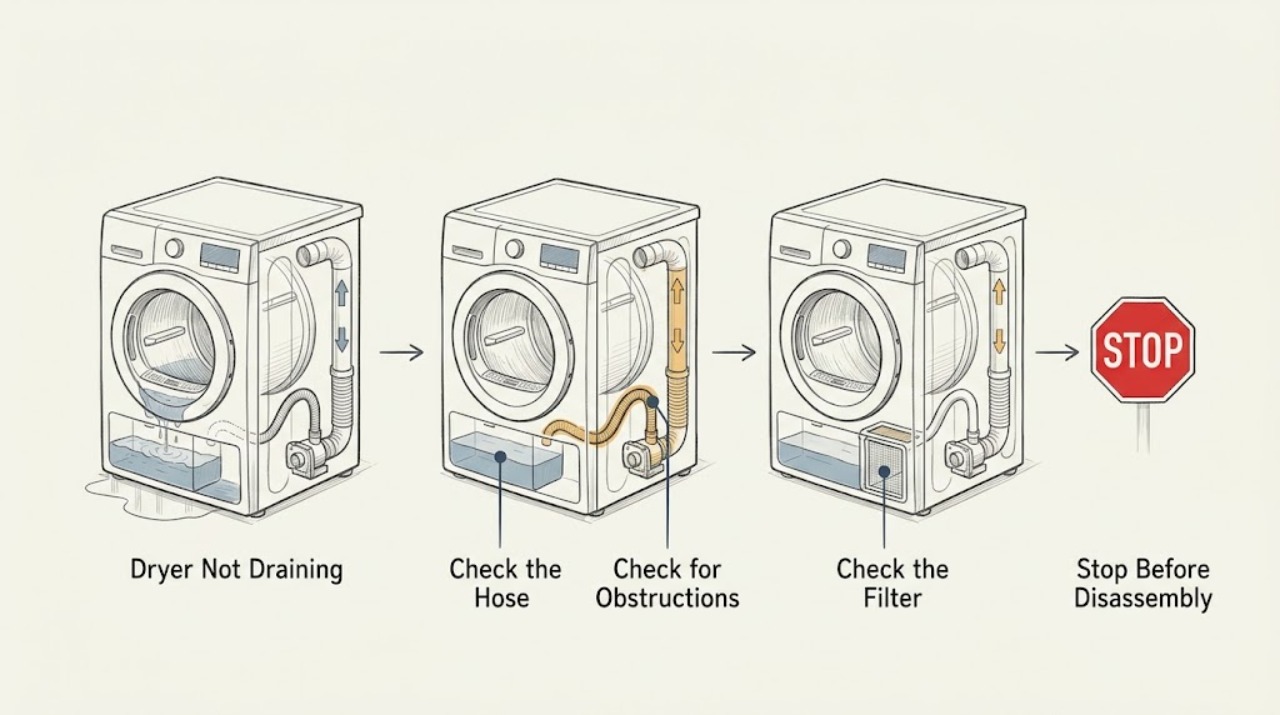
First identify whether the Electrolux dryer is vented, condenser, or heat pump. A vented dryer normally sends moist air through a vent hose, so inspect that hose and the outside vent rather than looking for a water tank or drain pump. A condenser or heat-pump dryer may collect water in a tank or send it through an optional external drain hose: empty and reseat the tank, check the hose for twists, loops, or blockage, and clean the filter and condenser only as the model manual allows. If the dryer leaks, the pump area is blocked, a drainage code returns, or water still will not move after the accessible checks and one reset, unplug it and arrange authorized service.
Work through in order
Diagnostic checks
Use only checks that match the exact appliance or system and its official guide.
-
Check 1
Use the model manual or product label to identify the dryer architecture, and record whether it has an exhaust vent, a water tank, an external drain hose, or a condenser symbol.
Expected result: The dryer is vented with an outside air hose; it is a condenser or heat-pump model with a tank; or it has a condenser/heat-pump model connected directly to a drain.
Next step: Follow the vented path in the next action for an exhaust model, or the tank, hose, filter, and condenser checks for a condenser or heat-pump model.
Why this matters
Why: A vented dryer needs an airflow and outside-vent check. A condenser or heat-pump dryer can have a tank, internal condensate path, or optional external drain hose. The correct water path cannot be inferred from the Electrolux name alone.
-
Check 2
For a condenser or heat-pump dryer, switch it off and let it cool, then empty and firmly reseat the water tank. If an external drain hose is fitted, inspect its full accessible length for twists, kinks, loops, blockage, or a loose connection; do not change the routing beyond the manual's instructions.
Expected result: The tank was full, not seated, or the hose was kinked/looped; water drains after correction; or the same drainage code or warning remains.
Next step: If the tank or hose correction restores drainage, run the model-approved test program and monitor for another warning. If water leaks, the hose is damaged, or the warning returns, stop and arrange service.
Stop if: If the tank is not part of this dryer, do not improvise a drain connection; continue with the vented path or consult the exact manual.
Why this matters
Why: A full or poorly seated tank can stop the program, while a twisted or looped external hose can cause a drainage error or leak. A persistent warning after the accessible route is clear makes a pump, software, or internal restriction more likely.
-
Check 3
For a condenser or heat-pump dryer, with the appliance cool and unplugged, clean the lint filter after each cycle and clean the condenser only if it is accessible and the manual permits it. Refit every filter or cover fully before testing.
Expected result: The filter or condenser is visibly blocked, the condenser symbol clears after cleaning, or the water symptom remains despite clean accessible components.
Next step: Let washed parts dry as directed, reinstall them, and run a model-approved test. If water still does not move, do not remove the pump or base panels; request service.
Why this matters
Why: Electrolux links clean filters and condensers with proper drying and warns not to operate a dryer with a blocked condenser. Cleaning can restore the intended moisture path, but it does not prove that an internal condensate pump is clear.
-
Check 4
For a vented dryer, inspect the vent hose from the appliance to the outside for crushing, excessive bends, disconnection, or visible blockage, and confirm that the outside vent and damper can open. Do not connect the hose to an extractor hood, chimney, or boiler outlet.
Expected result: Air cannot move freely outside, the hose is kinked or blocked, or moisture has collected in a long hose in a cool room; otherwise the vent path looks open.
Next step: Correct only accessible hose routing and clear the outside vent safely. If the vent is concealed, damaged, or inaccessible, use a qualified vent professional; if there is a separate water leak, stop and arrange appliance service.
Why this matters
Why: A restricted or incorrectly routed vent can trap moist air and make the dryer appear unable to drain, while condensation in a long hose can leave water that is not a failed internal drain pump. A clear vent means the vented architecture does not explain a separate floor leak or pump symptom.
-
Check 5
If the dryer shows E20 or C2, or emits two beeps/two flashes, photograph the display or record the pattern, verify the applicable drain hose is clear, and then perform only the documented reset: unplug for 30 seconds, reconnect, and select a program.
Expected result: The code or pattern clears and the next program drains normally, or it returns immediately or after the same stage.
Next step: Do not repeatedly reset or erase the evidence. If the indication returns, unplug the dryer and request an authorized service visit with the model number and recorded code.
Why this matters
Why: Electrolux classifies that indication as a drainage, pump, or software problem. A single successful restart does not establish that an underlying hose or pump restriction is fixed; a returning indication needs service diagnosis.
-
Check 6
If water is leaking onto the floor or the condensate container has only a small amount after drying, stop the dryer, unplug it, and check only for an obvious external hose or container seating issue; do not open the base or attempt to clear an internal pump.
Expected result: The leak stops after correcting an external connection, or water still leaks and the container remains unusually low.
Next step: Keep the appliance unplugged and the external water route off or secured, then contact an authorized service center. Do not run another cycle to see whether the pump clears itself.
Why this matters
Why: An external connection may be the immediate cause, but Electrolux identifies a blocked condensate pump as a service fault when leakage is paired with little water in the container. Continued use risks more water damage.
Use your observations
Decision map
Find the observation that best matches what you see, then follow the next safe action.
-
PATH 01Next step
What you see
The dryer is vented, has no condensate tank, and the symptom is damp air or water in the exhaust hose rather than a floor leak.
Do this next
Inspect accessible hose routing and the outside vent; use a qualified vent professional for concealed or damaged ductwork. Do not add a water drain or connect to another appliance's exhaust.
Why this path and its safety boundary
Why it matters: The external air path is more likely than a tank or condensate-pump fault. A long hose in a cool room can collect condensation, and a restricted outside vent can trap moist air.
-
PATH 02Next step
What you see
The dryer is condenser or heat pump, the tank is full or mis-seated, or an attached drain hose has a twist, loop, blockage, or loose connection.
Do this next
Empty and reseat the tank or correct the hose only as the manual allows, then run one monitored program. Escalate if the warning returns or the hose leaks.
Why this path and its safety boundary
Why it matters: The collection or external drainage path is the most plausible accessible cause. If correcting it restores normal water movement, an internal pump fault is less likely, though recurrence still matters.
-
PATH 03Next step
What you see
E20, C2, or the two-beep/two-flash indication returns after the applicable hose is clear and one reset.
Do this next
Stop using the dryer and arrange authorized service. Provide the exact model, the displayed code or light pattern, whether a tank or external hose is fitted, and what changed after the hose check.
Why this path and its safety boundary
Why it matters: A persistent indication is less consistent with a simple routing error and remains compatible with the drainage, pump, or software fault Electrolux names.
-
PATH 04Next step
What you see
Water is on the floor, the condensate container remains unusually low, or the pump area appears blocked while the external route is sound.
Do this next
Unplug the dryer, keep it out of use, and request service. Do not remove panels, probe wiring, or continue cycles with a leak.
Why this path and its safety boundary
Why it matters: Electrolux treats this pattern as a possible blocked condensate pump requiring support service, not as a user-accessible part replacement.
Helpful context
Understand the symptom
Why dryer type changes the diagnosis
“Not draining” is not the same physical problem on every Electrolux dryer. A vented model exhausts moist air through a hose to the outside. A condenser or heat-pump model removes moisture into a water container or, when fitted, an external drain. Check the model manual or product label before looking for a tank, hose, filter, or condenser; do not apply a condenser-dryer check to a vented appliance.
Record the symptom before changing anything
Note whether water is on the floor, whether the tank is full or unexpectedly empty, whether a water or condenser symbol is lit, and whether the display shows a code or a beep pattern. Electrolux lists E20, C2, and two beeps/two flashes as a drainage, pump, or software symptom, but a code should be treated as model-specific evidence rather than guessed when it is not displayed.
Keep internal pump work out of a home check
External hose routing, the water container, the lint filter, and an accessible condenser may be user checks when the manual permits them. A condensate pump blocked inside the dryer, a leak from underneath, or a need to open the cabinet is a service boundary. Unplug before cleaning, keep the dryer cool, and do not probe the pump or wiring.
Only after diagnosis
Potential parts
- external condensate drain hose or connector
Consider this category only if the exact manual confirms an external drain arrangement and the existing hose or connector is visibly damaged or cannot maintain a secure, correctly routed connection.
Confirm the full model and the manufacturer's routing and connection requirements before ordering; vented dryers may not use this part. - condensate pump
Consider this category only after an authorized technician confirms an internal pump fault following a clear tank, hose, filter, and condenser path; a blocked-pump symptom is not proof that a replacement is needed.
The pump is architecture- and model-specific and may require professional installation; do not assume a universal fit or attempt cabinet-level replacement.
When checks do not resolve it
Need a professional?
Water is leaking under the dryer or the condensate container remains unusually low., A drainage code or warning returns after the external hose, tank, filter, and model-approved condenser checks., The next step would require removing a cabinet or base panel, clearing an internal pump, or touching wiring.
Have this ready
- The full model number and whether the dryer is vented, condenser, or heat pump.
- The code, warning light, beep pattern, water location, and whether a tank or external drain hose is fitted.
- What happened after reseating the tank, correcting the accessible hose, cleaning permitted filters, and performing one reset.
Common questions
FAQ
Do all Electrolux dryers have a drain hose or water tank?
No. Electrolux distinguishes vented dryers from condenser and heat-pump dryers. Vented models use an exhaust hose to the outside; condenser and heat-pump models may collect water in a tank or use an optional external drain. Check the exact manual before connecting or searching for a part.
What does E20 or C2 mean on an Electrolux dryer?
Electrolux describes E20, C2, or two beeps/two flashes as indicating a drainage, pump, or software problem. Check the applicable external drain hose for twists, loops, or blockage, then perform the documented 30-second unplug reset once. If the indication returns, arrange service rather than repeatedly resetting.
Why is water leaking from under my Electrolux dryer while the tank has little water?
After ruling out an obvious external connection or container-seating issue, treat this as a service symptom. Electrolux identifies a blocked condensate pump as a possible cause when water leaks onto the floor and little water reaches the condensate container. Unplug the dryer and do not open the base to clear the pump yourself.
Can cleaning the filter or condenser fix a drainage problem?
It can help on condenser and heat-pump models when lint or residue is restricting the intended moisture path, and Electrolux instructs owners to clean the filter and accessible condenser as directed. It does not establish that an internal pump is clear; if water still does not move after permitted cleaning, stop and request service.
Read the exact guide
Official sources
- Water leakage from under the dryerElectrolux · Electrolux tumble dryers with water leakage and little water in the condensate container
- How to clean and maintain your Electrolux tumble dryerElectrolux · Electrolux tumble dryer maintenance; condenser access and cleaning vary by model
- Tumble dryer displays error message E20, C2 or emits 2 beeps / 2 flashesElectrolux · Electrolux tumble dryers displaying E20/C2 or the specified beep/light pattern; external hose is model-dependent
- Moisture, condensation, water in tumble dryerElectrolux · Electrolux tumble dryers; exact steps vary by dryer type and model
- Warning light(s) of tumble dryer cannot be switched offElectrolux · Electrolux tumble dryers; water-container and condenser indicators apply to condenser and heat-pump models
Community feedback
Share a repair observation
Share a plain-text repair observation. Accepted observations are published automatically; this page may take a moment to update.