
On this page
Start here
Quick answer
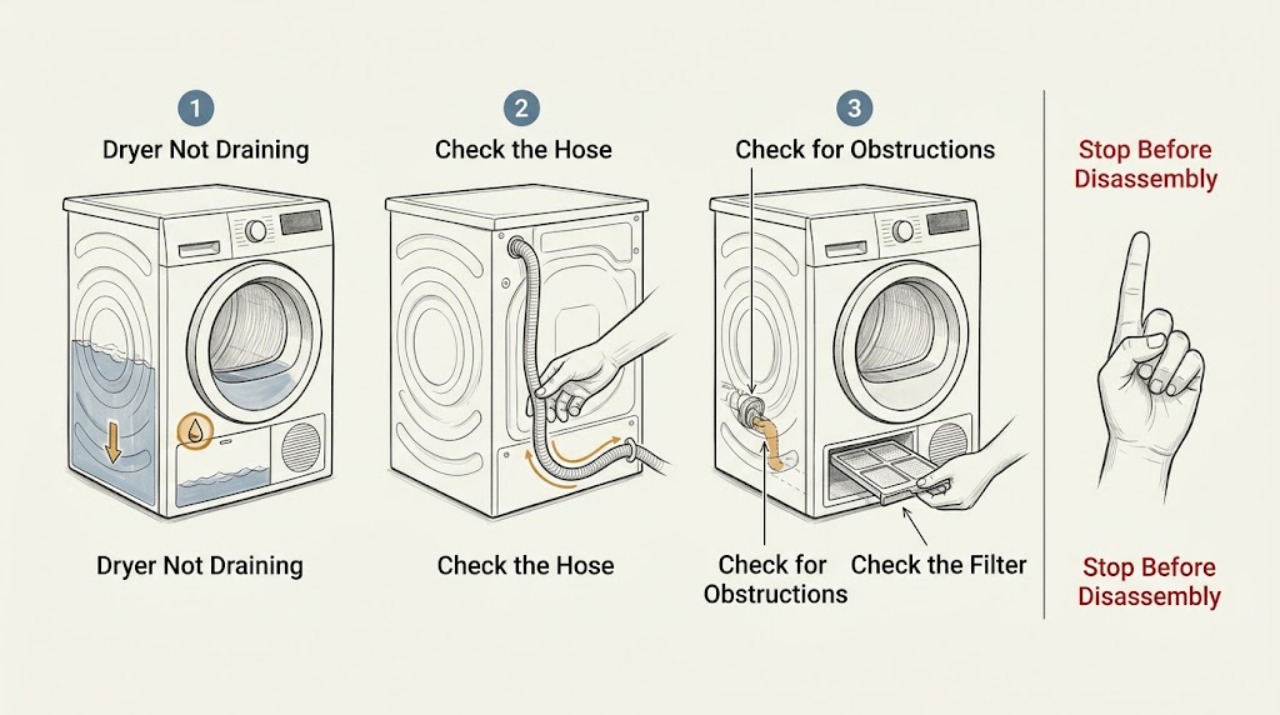
Start by identifying the Haier dryer architecture. A heat-pump or condenser dryer collects moisture in a water tank and may use an external drain hose; empty and reseat the tank, then check the applicable hose for a kink, clog, or incorrect connection. A washer/dryer combo may instead show Err2 and use a bottom-access drain-pump filter or button trap. A vented dryer normally has no condensate tank or pump, so a supposed “drain” problem may actually be a blocked exhaust path or a different symptom. If water leaks underneath, the internal pump appears blocked, or the drainage indication returns after the accessible checks, unplug the dryer and arrange authorized service.
Work through in order
Diagnostic checks
Use only checks that match the exact appliance or system and its official guide.
-
Check 1
Use the model label and owner's manual to classify the appliance as a vented dryer, condenser or heat-pump dryer, or washer/dryer combo, and record whether it has a water tank, external drain hose, exhaust hose, or bottom service flap.
Expected result: The appliance has a condensate tank or external water hose; it is a combo with a bottom filter/trap; or it has only an exhaust hose and no condensate collection parts.
Next step: Follow the tank and external-hose check for condenser or heat-pump models, the combo filter/trap check for a washer/dryer combo, or the vent-path check for a vented dryer.
Why this matters
Why: The first pattern points to a tank, hose, and condensate path. The second points to the combo drain-pump filter or button trap. The third does not support a standalone condensate-drain diagnosis and shifts attention to the exhaust path or a different symptom.
-
Check 2
For a condenser or heat-pump dryer, switch it off, let it cool, empty the water tank, and reseat it fully. If an external drain hose is fitted, inspect the accessible hose and its connection for a twist, clog, loose join, or routing that does not match the manual.
Expected result: The tank was full or not seated, the hose was visibly restricted, or the dryer still gives the same drainage symptom after the route is clear.
Next step: If reseating the tank or correcting the accessible hose restores drainage, run one model-approved test program and watch for a repeat. If the hose leaks, is damaged, or the symptom returns, stop and arrange service.
Stop if: If this dryer has no tank or external water hose, do not add one; return to the architecture check and use the vented or combo path.
Why this matters
Why: A full or incorrectly seated tank can prevent normal water collection, while a twisted or blocked external hose can stop water reaching the drain. A persistent symptom after those checks makes an internal pump or other fault more likely.
-
Check 3
For a washer/dryer combo, if Err2 or a clear not-draining symptom is displayed, unplug the appliance and follow the model manual to access the bottom drain-pump filter or button trap. Place a shallow pan and towel before releasing any residual water, then remove only visible debris and reseat the trap or plug securely.
Expected result: The trap or pump filter contains buttons, coins, lint, or other debris; water drains after cleaning; or the filter area is clear but the combo still cannot drain.
Next step: Close and secure the service flap, run only the model-approved test, and stop if Err2 returns, water leaks, or the filter cannot be removed without force. Do not open the cabinet or probe the pump.
Why this matters
Why: Debris can restrict the combo drain path, and a successful drain after cleaning supports a local obstruction. A clear filter with persistent no-drain behavior makes a pump, hose, or control fault more likely; it is not proof that a replacement pump is needed.
-
Check 4
For a vented dryer, inspect the exhaust hose and outside termination for crushing, disconnection, lint blockage, or a closed flap. Confirm the hose leads to the intended outside vent rather than treating the appliance as a tank-and-pump dryer.
Expected result: The exhaust route is restricted or disconnected, moisture is collecting in the hose, or the vent is open and clear.
Next step: Correct only accessible hose routing and clear the outside termination safely. Have concealed or damaged ductwork handled by a qualified vent professional; use appliance service for a leak or internal water path.
Why this matters
Why: A vented dryer removes moist air through this route, so a restriction can look like a drainage problem even though there is no condensate tank. A clear vent means a separate water leak or tank symptom does not fit the vented architecture.
-
Check 5
Inspect the floor and the condensate container after a cycle, without removing panels. If water is leaking underneath or the container has only a small amount despite a water symptom, switch the dryer off and unplug it.
Expected result: There is no leak and the tank or drain path behaves normally, or there is an under-dryer leak with little water in the container.
Next step: Keep a leaking appliance unplugged and arrange authorized service. Do not tilt the dryer, open the base, or attempt to clear an internal pump.
Why this matters
Why: A leak or unexpectedly low water collection shows that the water path is not behaving as intended, but it does not identify a replaceable part. A dry floor does not rule out a hose, filter, or internal restriction.
-
Check 6
After the correct tank, hose, filter, or vent checks, run one short, model-approved test program while observing where water or moist air is directed. Stop immediately if the same code returns, water appears on the floor, or the appliance makes an abnormal sound.
Expected result: The test completes with water collected or routed as designed, or the drainage symptom repeats despite a clear accessible path.
Next step: Use the dryer only if the test completes without a leak or warning. Otherwise unplug it, preserve the code or symptom details, and request authorized service.
Why this matters
Why: Normal collection or exhaust during the test supports a corrected external restriction. A repeat failure with a clear path is more consistent with an internal pump, sensor, control, or concealed duct fault than with a user adjustment.
Use your observations
Decision map
Find the observation that best matches what you see, then follow the next safe action.
-
PATH 01Next step
What you see
The appliance is vented, has no water tank or external drain, and moisture or damp air is found in the exhaust route.
Do this next
Inspect accessible hose routing and the outside termination; use a qualified vent professional for concealed or damaged ductwork. Do not retrofit a condensate hose based on this symptom alone.
Why this path and its safety boundary
Why it matters: The exhaust path is more likely than a condensate pump because this architecture removes moisture as air.
-
PATH 02Next step
What you see
A condenser or heat-pump dryer has a full or mis-seated tank, or its external drain hose is twisted, clogged, loose, or incorrectly routed.
Do this next
Empty and reseat the tank or correct the hose exactly as the manual allows, then run one monitored program. Stop if the hose leaks or the symptom returns.
Why this path and its safety boundary
Why it matters: The accessible collection or external drain path is the most likely cause. If correction restores water movement, an internal pump fault becomes less likely but recurrence still matters.
-
PATH 03Next step
What you see
A washer/dryer combo displays Err2 or retains water, and the bottom-access filter or button trap contains debris.
Do this next
Run one model-approved test and monitor for leaks. If Err2 returns or the clear trap does not restore drainage, stop and request service rather than opening the pump housing.
Why this path and its safety boundary
Why it matters: A local obstruction is plausible, especially if drainage improves after the model-approved cleaning and the trap is securely reseated.
-
PATH 04Next step
What you see
Water leaks under the dryer, the condensate container stays unusually low, or the clear external path still will not drain.
Do this next
Unplug the appliance and arrange authorized service. Do not tilt it, remove the base, bypass the pump, or continue cycles with a leak.
Why this path and its safety boundary
Why it matters: A clear external route with continuing drainage failure makes an internal drainage fault more likely than a simple tank-emptying mistake, but the specific failed part still needs service diagnosis.
Helpful context
Understand the symptom
Drainage depends on the dryer architecture
Do not assume every Haier dryer has a water tank or a drain pump. Heat-pump and condenser dryers turn moisture into water that is collected in a tank or routed to a drain. A vented dryer sends moist air through an exhaust path instead. A washer/dryer combo can have a bottom-access drain-pump filter or button trap that is not the same as a standalone dryer's lint filter. Use the model manual to identify the configuration before removing any filter or hose.
Record what is actually happening
Note whether water is in the tank, on the floor, or still inside a washer/dryer combo; whether an external hose is fitted; and whether the display shows a code or light. Err2 is a Haier combination washer/dryer code for not draining, but a code should not be inferred on a standalone dryer or when no code is displayed.
Safe boundary
Keep checks to the tank, accessible hose, model-approved filter or trap, and visible connections. Unplug before opening a service flap or cleaning. A leak from underneath, a suspected internal pump restriction, damaged wiring, or any need to open the cabinet belongs with an authorized service technician.
Only after diagnosis
Potential parts
- external condensate drain hose or connector
Consider this category only when the exact model supports an external drain and the existing hose or connector is visibly split, damaged, or unable to maintain the documented connection after routing is corrected.
Confirm the full model and architecture before ordering; a vented dryer or washer/dryer combo may use a different water path. - condensate or drain pump
Consider this category only after an authorized technician confirms an internal pump fault following clear tank, hose, filter, and trap checks; a no-drain symptom alone does not prove pump failure.
Pumps are model- and architecture-specific and may require professional installation; do not assume a universal fit. - combo drain-pump filter or button trap
Consider this category only if the model manual identifies the component and it is cracked, missing, or unable to seal after permitted debris removal; debris alone calls for cleaning first.
This category applies to applicable washer/dryer combos, not automatically to standalone dryers; match the full model and manual.
When checks do not resolve it
Need a professional?
A dryer leaks underneath or the condensate container remains unusually low., A washer/dryer combo continues to show Err2 after the documented filter, trap, and hose checks., The next step would require removing a cabinet or base panel, clearing an internal pump, or touching wiring.
Have this ready
- The complete model number and whether the appliance is vented, condenser, heat pump, or a washer/dryer combo.
- The exact code or light pattern, where water was found, and whether a tank or external hose is fitted.
- What changed after emptying and reseating the tank, correcting the accessible hose, cleaning the permitted filter or trap, and running one test.
Common questions
FAQ
Does every Haier dryer need a drain hose?
No. A vented dryer normally sends moist air through an exhaust hose. Heat-pump and condenser dryers may collect water in a tank or use an optional external drain hose. A washer/dryer combo has its own drain-pump and trap arrangement, so use the exact model manual before adding or removing a hose.
What does Err2 mean on a Haier washer/dryer combo?
Haier's U.S. combination washer/dryer support page labels Err2 as “Not draining” and directs the owner to check the drain-pump filter and drain hose for incorrect insertion, kinks, or crimps. If the code remains after the model-approved accessible checks, stop and request service.
Why is my Haier dryer leaking while little water reaches the container?
After checking only obvious external tank or hose seating, treat an under-dryer leak or continuing no-drain symptom as a service condition. Keep the appliance unplugged and do not open its base or attempt to clear an internal pump.
Is a combo dryer lint filter the same as a standalone dryer's lint filter?
Not necessarily. Haier says some washer/dryer combos have a button trap and do not have a traditional dryer lint filter; lint can collect in the condenser tank instead. Do not apply a standalone-dryer filter procedure unless the exact combo manual identifies that part.
Read the exact guide
Official sources
- How to empty the water tank of Tumble Dryer-Haier South AfricaHaier South Africa · Haier tumble dryers in the referenced regional product family; tank location and procedure may vary by model
- How to connect the drain hose of Heater Pump DryerHaier Saudi Arabia · Haier heat-pump dryer guidance for the referenced regional product family; verify the exact model manual
- Haier Combination Washer/Dryer - Error CodesHaier Appliances · Haier combination washer/dryer models covered by the U.S. support page; do not generalize combo codes to standalone dryers
- Haier - Washer/Dryer Combo Button Trap / Lint FilterHaier Appliances · Haier combination washer/dryer models covered by the U.S. support page; not a universal standalone-dryer procedure
Community feedback
Share a repair observation
Share a plain-text repair observation. Accepted observations are published automatically; this page may take a moment to update.