
On this page
Start here
Quick answer
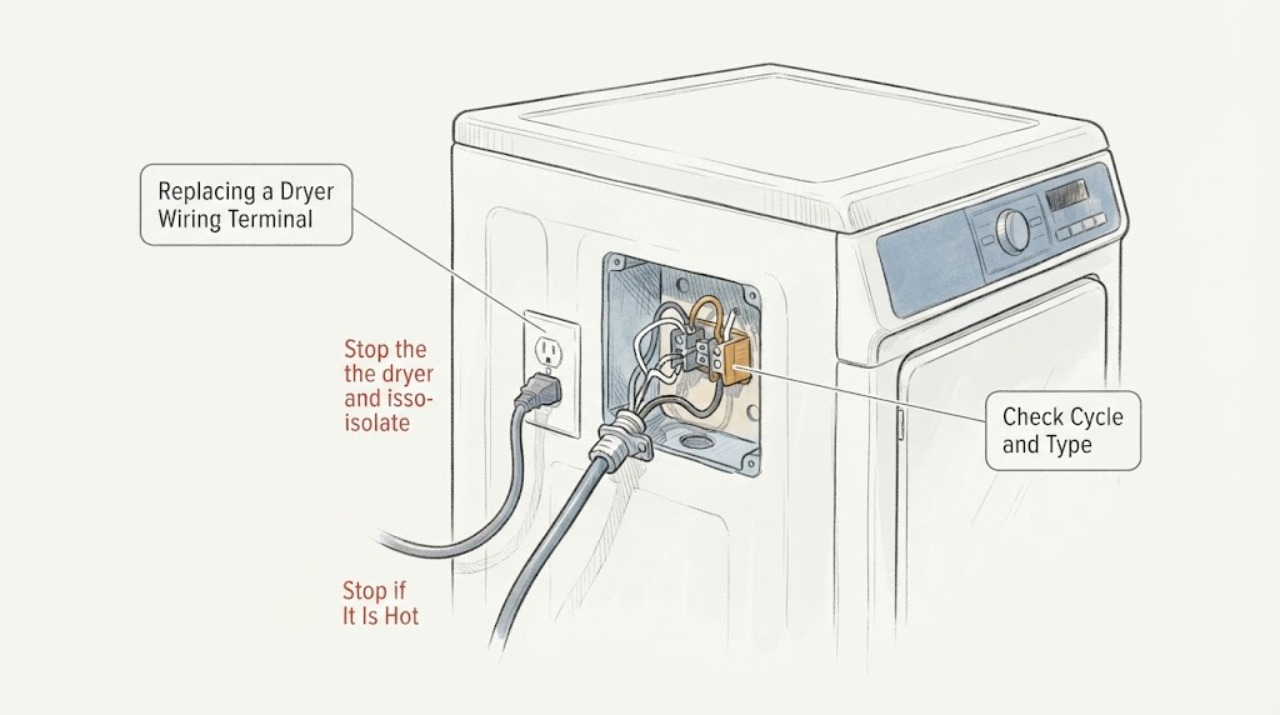
A loose, burned, broken or frayed dryer wiring connection is a stop-use electrical and fire-safety issue, not a good first DIY repair. Turn the dryer off and isolate power only from a safe, dry location; do not remove the terminal cover, tighten a live connection, test voltage, or guess a three-wire/four-wire arrangement. GE's manufacturer guidance says damaged terminal connections and wires may require replacement together and that the dryer installation instructions are model-specific. A localized repair may be possible after a qualified appliance technician or electrician identifies the damaged cord, terminal block, harness and outlet, so the visible terminal problem alone does not prove that the entire dryer must be replaced.
Work through in order
Diagnostic checks
Use only checks that match the exact appliance or system and its official guide.
-
Check 1
Stop the dryer and isolate it from power without touching a hot, wet, scorched or sparking plug. If the plug and receptacle are cool, dry and safely reachable, unplug it; otherwise use the dryer circuit breaker from a safe location and keep the appliance out of service.
Expected result: The cord, plug or outlet is cool and intact, or there is heat, scorching, smoke, arcing, melting, looseness, water or a repeated breaker trip.
Next step: Leave the dryer disconnected and arrange qualified appliance/electrical service for any heat, damage, arcing, water exposure or breaker trip. Do not open the terminal cover.
Stop if: If smoke or active fire is present, leave the area and contact emergency services; do not handle the dryer.
Why this matters
Why: A damaged or loose power connection can create shock or fire risk. It is not safe to re-energize the dryer to learn whether the terminal is still loose.
-
Check 2
From outside the appliance, record the dryer type if known (electric or gas), the full rating-label model, the cord/plug shape, and whether the concern is at the wall outlet, cord entry or rear terminal area. Do not remove the rear cover or move the dryer to expose hidden wiring.
Expected result: The model and installation type are available, or the identity and connection arrangement remain unknown.
Next step: Give the exact model, region, cord type and symptom history to the manufacturer or qualified technician. If the model cannot be read, stop at external safety observations rather than selecting a terminal or cord by appearance.
Why this matters
Why: GE states that power-cord type and electrical requirements vary with the dryer and local wiring, including three-wire versus four-wire arrangements. Without identity, a generic terminal diagram or replacement cord is unsafe to choose.
-
Check 3
Without opening the dryer, inspect only the accessible plug, outlet face, cord jacket and nearby wall area for looseness, discoloration, melted plastic, fraying, crushed insulation or an outlet that does not hold the plug firmly. Do not insert probes, tighten screws or use an adapter or extension cord.
Expected result: The external connection is visibly damaged or loose, or it looks intact but the dryer still has a wiring concern reported by a prior inspection.
Next step: Keep the dryer off and have a qualified electrician inspect the receptacle/circuit and a qualified appliance technician inspect the dryer-side connection. Do not buy a cord or terminal solely from a visual match.
Why this matters
Why: A sound-looking exterior does not clear the hidden terminal block, strain relief, harness or outlet. USFA says major appliances should use a direct wall connection and damaged or loose cords should be replaced; GE directs users to model-specific instructions for the terminal connection.
-
Check 4
Ask the technician to identify which part is actually damaged—cord, terminal block, strain relief, harness, receptacle or internal back-panel wiring—and whether heat has spread beyond the visible terminal. Do not authorize a terminal replacement before the power source and model-specific wiring arrangement are identified.
Expected result: The professional finds localized cord/terminal damage with sound surrounding wiring, or finds burned/frayed wiring, a damaged receptacle, harness/back panel or unresolved supply problem.
Next step: Use the technician's model-specific repair recommendation. If wiring, insulation, the receptacle or the cabinet has heat damage, keep the dryer disconnected until the full repair and electrical inspection are complete.
Why this matters
Why: GE says burned, broken or frayed wires and terminal connections may require replacement of both, while correct cord and circuit requirements are model-specific. A localized repair decision depends on the inspection; the topic does not prove that a new dryer is required.
-
Check 5
Before any return to service, have the professional confirm the correct model-specific cord/connection, strain relief, grounding arrangement, receptacle/circuit and reinstalled protective cover. Keep the lint screen and visible exhaust path maintained, but do not use vent cleaning as a substitute for electrical repair.
Expected result: The professional documents a completed compliant repair and no remaining heat/damage, or the connection remains questionable or the dryer still trips/heats abnormally.
Next step: Do not operate until the electrical repair is accepted by the qualified professional. If the dryer still has abnormal heat, odor, arcing or trips, request further service rather than replacing parts or testing repeatedly.
Stop if: Stop for any renewed odor, heat, smoke, arcing, damaged cord or breaker trip.
Why this matters
Why: Proper electrical connection and qualified installation are prerequisites for safe operation. Dryer-fire guidance separately identifies lint and restricted exhaust as fire contributors, but those checks cannot make a damaged terminal safe.
Use your observations
Decision map
Find the observation that best matches what you see, then follow the next safe action.
-
PATH 01Next step
What you see
The plug, outlet, cord or terminal area is hot, scorched, melted, smoking, sparking, wet or associated with a breaker trip.
Do this next
Leave the dryer off, isolate power only from a safe location and call qualified electrical/appliance service; use emergency services for active smoke or fire.
Why this path and its safety boundary
Why it matters: This is an electrical/fire stop-use condition, not a loose screw that can be tightened while the dryer is connected.
-
PATH 02Next step
What you see
The external cord and outlet look intact, but the issue was reported at the rear terminal or the dryer has a history of intermittent power, partial heating or repeated trips.
Do this next
Keep the appliance disconnected and have a qualified technician inspect the dryer-side terminal and an electrician inspect the receptacle/circuit as appropriate. Do not remove the cover or test live wiring.
Why this path and its safety boundary
Why it matters: The visible exterior does not clear hidden terminal, harness, strain-relief or supply damage, and partial operation does not prove the connection is safe.
-
PATH 03Next step
What you see
A qualified professional confirms only a model-matched cord/terminal component is damaged and surrounding wiring, insulation, receptacle and grounding are sound.
Do this next
Follow the professional's model-specific repair and inspection plan. Do not use a generic cord, adapter or terminal based on appearance.
Why this path and its safety boundary
Why it matters: A localized repair may be reasonable; the symptom alone does not require replacing the whole dryer.
-
PATH 04Next step
What you see
The inspection finds burned/frayed wiring beyond the terminal, a damaged receptacle, heat-damaged insulation/back panel, uncertain grounding or a wrong cord/circuit arrangement.
Do this next
Keep the dryer disconnected until qualified appliance and electrical work is completed. Compare repair cost and appliance condition only after the safety scope is known; do not decide “new dryer” from the initial terminal photo.
Why this path and its safety boundary
Why it matters: The repair scope extends beyond a simple terminal replacement and may involve both appliance and premises wiring.
-
PATH 05Next step
What you see
The connection is repaired and the dryer is returned to service, but it develops heat, odor, arcing, abnormal breaker trips or longer drying with poor exhaust.
Do this next
Stop using it again and request immediate professional reassessment. Dryer vent and lint maintenance do not replace electrical diagnosis.
Why this path and its safety boundary
Why it matters: The repair is not verified safe; electrical and airflow hazards may remain.
Helpful context
Understand the symptom
Why a loose terminal is not a normal adjustment
The task supplies no brand, model, dryer type or region. A dryer may be electric or gas, and cord, grounding, terminal and circuit requirements vary by model and local code. GE's public support pages use the terminal block as an example of a power connection that can be burned, broken, frayed or loose, while also directing owners to the model-specific installation instructions. The symptom does not tell you whether the cord, terminal block, harness, outlet or upstream circuit is damaged.
Treat heat or arcing as a stop-use condition
Do not run the dryer to see whether the connection heats again. If there is smoke, burning odor, melted insulation, sparking, a hot plug or outlet, or a tripped breaker, keep the dryer off and keep combustible items away. If the plug or outlet is wet or damaged, do not touch it; isolate power from a safe location and use qualified electrical help.
When checks do not resolve it
Need a professional?
Provide the complete model/rating label, electric or gas type, region, cord/receptacle type, what was observed at the connection, any heat or odor, breaker history and whether the dryer was recently installed or moved.
Common questions
FAQ
Does a loose dryer terminal mean I need a new dryer?
No. The terminal symptom does not establish the repair scope. A qualified professional must determine whether damage is limited to a model-matched cord/terminal or has spread to wiring, insulation, the receptacle, grounding or the back panel. Keep the dryer off until that inspection is complete.
Can I remove the terminal cover and replace the wire myself?
Do not use this article as DIY terminal instructions. Dryer connections vary by model, dryer type, local code and three-wire/four-wire arrangement, and the rear terminal can remain hazardous if power is not safely isolated. Have qualified appliance/electrical service perform the inspection and repair.
Can I keep using the dryer if it still runs?
No if there is any suspected loose, burned, frayed or hot connection, unusual odor, arcing or breaker trip. Partial operation does not prove a high-current dryer connection is safe; leave it disconnected until professionally checked.
Read the exact guide
Official sources
- Appliance and Electrical Fire SafetyU.S. Fire Administration · The opened USFA page applies to major household appliances and supports direct wall connection, no extension cords and replacing cracked, damaged or loose cords; it does not diagnose a dryer terminal or specify wiring repair.
- Dryer - Power CordsGE Appliances · The opened GE support article states that cord type varies with electrical supply and three-wire/four-wire arrangements and directs owners to installation instructions; it does not authorize a generic cord choice.
- Dryer - Electrical Requirements and Breaker SizeGE Appliances · The opened GE support article gives typical circuit examples and emphasizes that the exact dryer installation instructions control; it is used only to prevent cross-model electrical generalization.
- Topical Fire Report Series: Clothes Dryer Fires in Residential BuildingsU.S. Fire Administration · The opened USFA report supports qualified installation, correct electrical plug/outlet and professional servicing boundaries; it does not provide terminal wiring instructions.
- Dryer - Will Not Run or StartGE Appliances · The opened GE support article states that electric dryers with burned, broken or loose rear connections require attention and that installation instructions are model-specific; it is not evidence for an unidentified dryer's exact terminal arrangement.
- Electric Dryer - Runs But Does Not HeatGE Appliances · The opened GE support article is used as a manufacturer example that burned, broken, frayed or loose cord/terminal connections require repair and may require replacement of both; it does not provide a universal wiring method for unidentified models.
- Overheated Clothes Dryers Can Cause FiresU.S. Consumer Product Safety Commission · The opened CPSC safety alert supports stopping unsafe operation and qualified service for dryer chassis/vent maintenance; it does not establish the cause of a particular terminal failure.
Community feedback
Share a repair observation
Share a plain-text repair observation. Accepted observations are published automatically; this page may take a moment to update.