
On this page
Start here
Quick answer
Use the small dryer as the capacity limit: split the large washer load into smaller dryer loads, and do not pack the drum. Keep heavy towels, bedding and jeans separate from light fabrics, use an appropriate heated or sensor cycle, and choose the highest washer spin that the load and care labels allow. Clean the lint screen each load and verify strong air at the outside vent. If a load is warm but damp, drying times are suddenly longer, outside airflow is weak, or the laundry area becomes hot and humid, stop repeating cycles and clean or professionally inspect the exhaust path; lint restriction is a safety issue, not an efficiency setting.
Before you begin
Safety first
- Do not operate with weak/blocked exhaust, excessive heat, burning smell or visible lint accumulation. Do not bypass thermal protection or open the dryer cabinet; use qualified vent/appliance service for internal or restricted-path work.
Work through in order
Diagnostic checks
Use only checks that match the exact appliance or system and its official guide.
-
Check 1
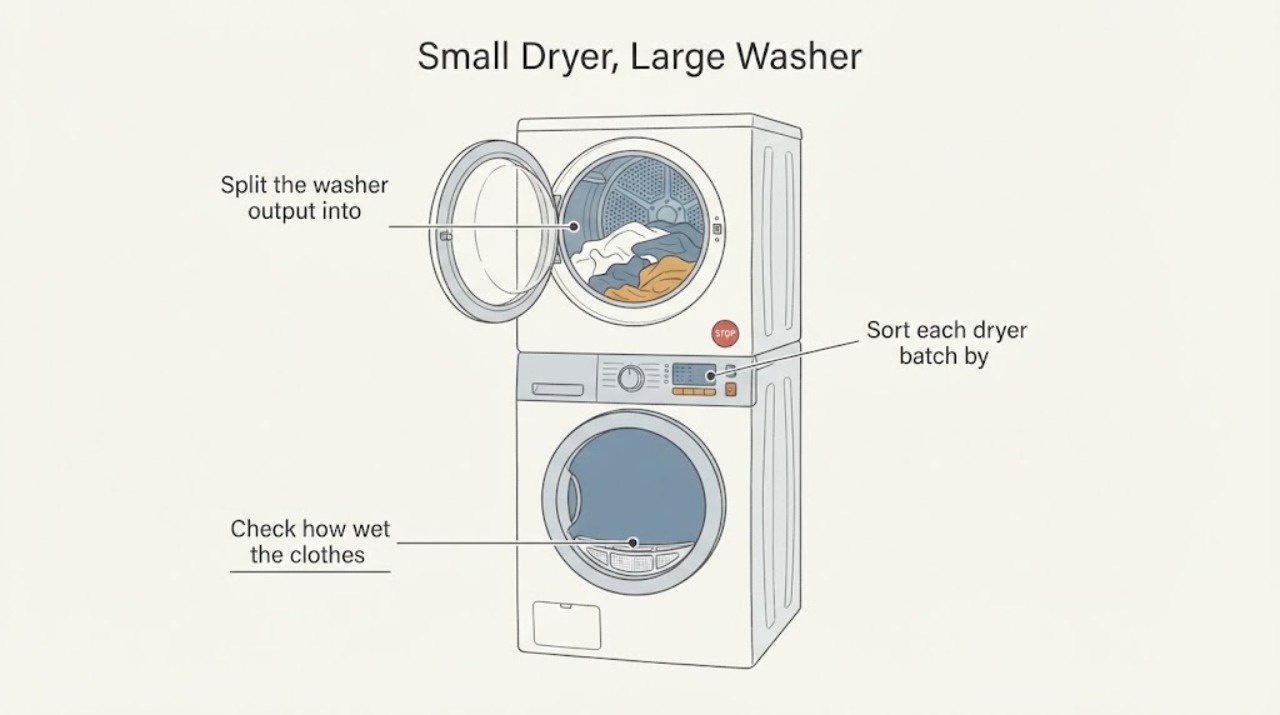
Split the washer output into dryer-sized batches. Load the drum loosely so the clothes can tumble, using the dryer manual as the capacity limit; as a general manufacturer example, a large load is about three-quarters full, not tightly packed.
Expected result: Clothes lift and fall freely, or the drum is packed and items form a heavy ball or remain pressed against the wall.
Next step: Remove enough laundry to restore free tumbling and dry the remainder as a separate batch. Do not extend the cycle repeatedly with a packed drum.
Why this matters
Why: Free movement allows air and heat to reach the fabrics. Overloading a small dryer is a direct reason for long or uneven drying, even when the washer handled the full load.
-
Check 2
Sort each dryer batch by fabric weight and untangle items before loading. Keep towels, jeans, bedding and other heavy pieces together only when the dryer’s capacity allows; keep light garments separate when they would otherwise finish at different times.
Expected result: Heavy items are still wrapped around light garments, or the batch contains fabrics with similar weight and care requirements.
Next step: Separate the heavy or bulky pieces, follow their care-label heat limits and dry bulky items alone when the manual calls for it.
Why this matters
Why: Maytag says mixed/heavy loads can extend drying time and tangled items take longer because air cannot reach all surfaces evenly.
-
Check 3
Check how wet the clothes are when they leave the washer. Use the highest suitable spin setting for the fabric and load, and avoid an unbalanced or overloaded washer that prevents full spin; do not exceed care-label limits.
Expected result: Clothes are dripping or can be wrung out, or they are wet but not drenched after a normal final spin.
Next step: Correct the washer load/cycle or drain issue first. If clothes remain unusually wet after a balanced suitable spin, arrange washer service instead of compensating with repeated dryer cycles.
Why this matters
Why: Maytag says low spin, overload/unbalance, wrong cycle and drain problems can leave excess water in clothes. The dryer will need more heat and time when the washer did not remove that water.
-
Check 4
Clean the lint screen before or after every load and, if dryer-sheet residue is present, wash the screen with warm water and a soft brush and dry it fully. During a normal safe cycle, check from outside that the exhaust flap opens and moist air escapes.
Expected result: The screen is coated or airflow outside is weak/absent, lint gathers around the opening, or airflow is strong and the laundry area stays normal.
Next step: Stop using the dryer for a weak or blocked vent and have the exhaust path cleaned or inspected; reconnect any duct before use. Keep the area clear and use qualified service for interior chassis lint.
Why this matters
Why: Lint or a restricted exhaust path reduces airflow, extends dry times and can create excessive heat. Strong exhaust makes a load/setting issue more likely, but does not prove the dryer is fault-free.
-
Check 5
Choose a cycle that matches the batch: an automatic/sensor cycle for ordinary loads when available, a timed or heavy cycle only when the manual and fabric allow it, and a small-load/rapid cycle for genuinely small batches. Do not use air-only when heat is required.
Expected result: The selected cycle matches the load and care label, or the cycle is air-only/low heat or intended for a different load size.
Next step: Use the matching documented cycle and reassess after the load size and airflow are correct. If the dryer still leaves clothes damp or takes much longer than normal, schedule service.
Why this matters
Why: Maytag says cycle selection affects dryness; air-only adds no heat, rapid cycles are designed for smaller loads, and sensor termination can prevent over-drying.
Use your observations
Decision map
Find the observation that best matches what you see, then follow the next safe action.
-
PATH 01Next step
What you see
The small dryer is packed, clothes cannot lift and fall freely, or the load mixes towels/bedding with light fabrics.
Do this next
Split the batch, separate heavy fabrics and run the appropriate documented cycle for each smaller load.
Why this path and its safety boundary
Why it matters: The load is too large or uneven for the dryer’s airflow and tumbling capacity, even if it fit in the washer.
-
PATH 02Next step
What you see
Clothes enter the dryer dripping wet after an unbalanced, overloaded, low-spin or interrupted washer cycle.
Do this next
Correct the washer load balance, drain or suitable spin setting and reassess the dryer with a properly extracted batch.
Why this path and its safety boundary
Why it matters: The washer has left excess water for the dryer to remove; the apparent dryer inefficiency may begin upstream.
-
PATH 03Next step
What you see
Clothes are warm but damp, drying takes longer than normal, the outside vent airflow is weak or the laundry area becomes unusually hot/humid.
Do this next
Stop ordinary use, clean only the accessible filter and arrange qualified vent/exhaust inspection before more drying cycles.
Why this path and its safety boundary
Why it matters: A restricted lint filter or exhaust path is likely affecting airflow and can create excessive heat; CPSC treats lint restriction as a fire hazard.
-
PATH 04Next step
What you see
Loads are split, balanced, correctly cycled and the vent airflow is strong, but the dryer still leaves clothes damp or needs repeated unusually long cycles.
Do this next
Gather the dryer model/serial, load type, cycle, times, vent length and observations and schedule qualified dryer service. Do not bypass a thermal device or open the cabinet to chase heat faults.
Why this path and its safety boundary
Why it matters: The remaining performance problem is not explained by the simple capacity, load or airflow checks and may require model-specific service.
Helpful context
Understand the symptom
The washer size does not set the dryer load
The larger washer can produce two or three batches of wet laundry for a compact dryer, but putting them together defeats airflow and tumbling. ENERGY STAR says a load that is too large takes longer because the drum needs space for clothes to tumble freely and hot air to circulate; it also notes that a very small load may not tumble efficiently. Use the dryer’s manual as the controlling capacity guidance and split the washer output accordingly.
Reduce the water before the dryer starts
Separate heavy items from lightweight fabrics and untangle clothing as it enters the dryer. If clothes are dripping wet, check the washer result first: Maytag identifies overloaded or unbalanced loads, low spin, wrong cycle and drain problems as reasons laundry can leave the washer wetter than expected. A suitable higher spin removes more water without asking the small dryer to do that work with heat.
Treat weak exhaust as a fire and performance warning
A clean lint filter and a clear exhaust path let the dryer move moist air out. ENERGY STAR recommends cleaning the filter after every load, while CPSC warns that lint in the filter or exhaust duct restricts airflow and increases heat. Check the outside vent for escaping air only during normal safe operation; if airflow is weak, the vent flap does not open, lint accumulates or the room becomes unusually hot, stop ordinary use and have the vent path cleaned or serviced.
When checks do not resolve it
Need a professional?
Safety scope: Do not operate with weak/blocked exhaust, excessive heat, burning smell or visible lint accumulation. Do not bypass thermal protection or open the dryer cabinet; use qualified vent/appliance service for internal or restricted-path work.
Have this ready
- Provide dryer model/serial, compact drum capacity if known, washer load size, fabric mix, cycle/heat setting, time to dryness, lint-filter condition, outside airflow and vent length/configuration.
Common questions
FAQ
Can I put the entire large-washer load into the small dryer?
No. Use the dryer’s own capacity limit and split the washer output until clothes tumble freely. ENERGY STAR says an oversized load takes longer because air cannot circulate; Maytag’s general guidance uses about three-quarters full for a large load, not a tightly packed drum.
Should I run the dryer hotter to finish clothes faster?
Do not use extra heat as a substitute for capacity or airflow. Match the cycle to the fabric and manual, clean the lint filter and resolve weak exhaust first. Excess heat with restricted airflow raises fire risk.
Why are clothes still very wet before they reach the dryer?
Maytag identifies low spin, an overloaded or unbalanced washer, wrong cycle and drain problems as possible reasons. Correct the washer result before asking a compact dryer to remove the extra water.
How do I know whether the vent is causing long drying times?
Clean the lint screen every load and observe the outside vent during a normal safe cycle. Weak or absent exhaust, damp clothes after a full cycle, lint around the opening or unusual laundry-room heat points to restricted airflow; stop and have the vent path inspected.
Read the exact guide
Official sources
- Clothes DryersENERGY STAR · Opened ENERGY STAR guidance. It explains that oversized loads take longer because the drum needs free tumbling and hot-air circulation, recommends sensor/low-heat efficiency features and cleaning the lint filter after each load.
- Why are My Clothes Soaking Wet After Washing?Maytag · Opened Maytag guidance on soaking-wet clothes. It distinguishes wrong cycle, overloaded/unbalanced load, drain problems and low spin as upstream causes of excess moisture before drying.
- Dryer is not Drying or Experiencing Long Dry TimesMaytag Product Help · Opened Maytag’s general long-dry guide. It covers load size/mix, lint, vent kinks/restriction, outside airflow, cycle selection and service escalation. Model-specific limits take priority.
- How to properly load a Maytag dryerMaytag Product Help · Opened Maytag’s general dryer-loading guide. It states clothes should move freely, gives small/medium/large load examples and warns against overloading and tangled/mixed loads. Exact dryer manual remains controlling for a compact model.
- Overheated Clothes Dryers Can Cause FiresU.S. Consumer Product Safety Commission · Opened CPSC Safety Alert. It links damp/long drying to blocked lint/exhaust, recommends filter/vent cleaning and warns to use qualified service for interior chassis lint.
Community feedback
Share a repair observation
Share a plain-text repair observation. Accepted observations are published automatically; this page may take a moment to update.