
On this page
Start here
Quick answer
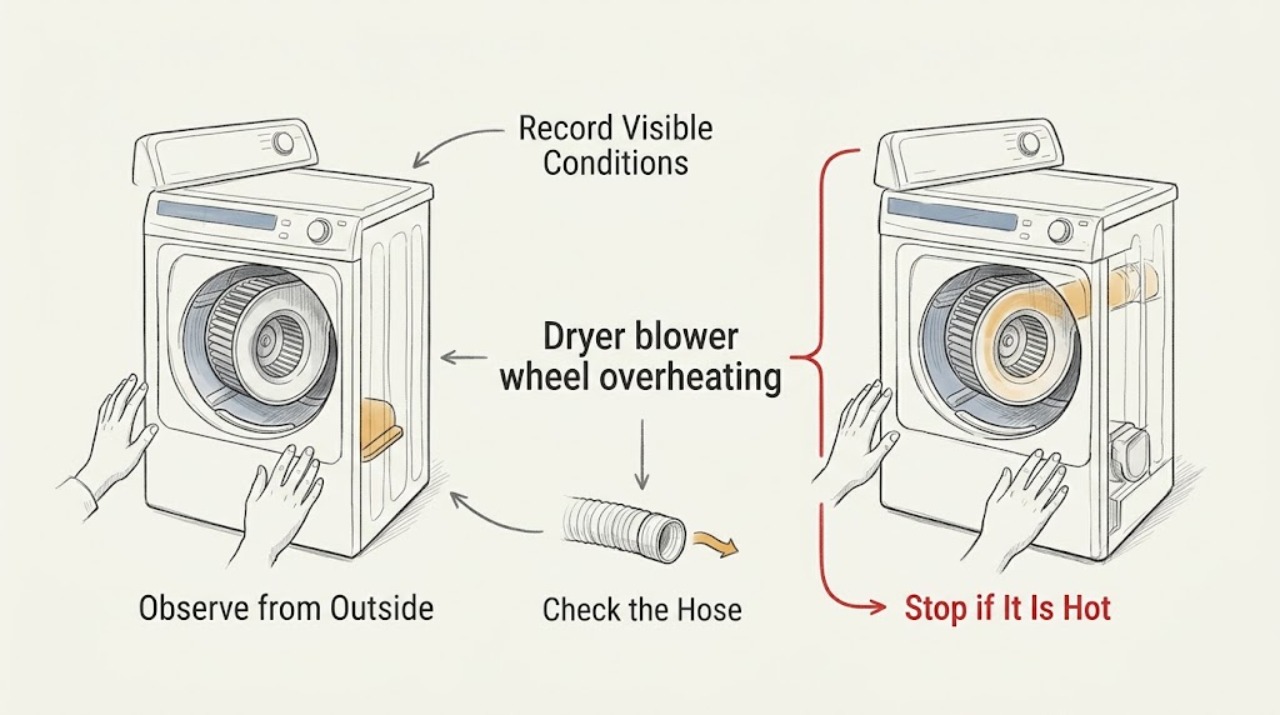
A dryer blower wheel can contribute to overheating when it is loose, off-balance, obstructed, or unable to move air, but the same symptom can come from a blocked exhaust path, heating-control fault, motor problem, or lint near a heat source. Stop the dryer and leave it off if the cabinet or clothes become intensely hot, a burning smell appears, smoke is visible, drying time suddenly increases, or a thermal safety device opens. With power off, check only the lint screen, the accessible exhaust hose for crushing, and the outside vent area for lint or a flap that cannot open; do not remove panels or reach into the blower housing. A high-pitched or rumbling noise that changes with drum speed makes the blower wheel or its motor/housing more plausible, while overheating without that noise keeps airflow and heat-control faults in play. Have a qualified appliance technician inspect the blower wheel, motor, vent path, heating system, wiring, and safety devices before replacing a part; gas dryers also require gas-appliance boundaries.
Before you begin
Safety first
- The provider should inspect the blower wheel, motor, housing, lint path, exhaust duct, heater or gas heat system, thermal fuse/thermostat, wiring, and installation. The repair should identify and correct the cause of overheating and verify airflow and safe operation, not simply silence the noise.
Work through in order
Diagnostic checks
Use only checks that match the exact appliance or system and its official guide.
-
Check 1
Stop the dryer and record the safety symptom before any further cycle. Note whether there was a burning smell, smoke, visible lint ignition, unusually hot cabinet, clothes that are too hot to handle, a mid-cycle shutdown, or only a warmer-than-usual exterior.
Expected result: Classify the event as odor/smoke or possible ignition, intense abnormal heat, repeated thermal shutdown, or heat without an odor. Record whether the smell was electrical/plastic-like, scorched lint-like, or associated with a gas concern without trying to identify it by continued operation.
Next step: Leave the dryer off, keep combustible items clear, and seek urgent qualified help for smoke, fire, electrical damage, or a gas concern. Do not restart it to see whether the smell returns.
Stop if: If there is smoke or fire, leave the area and contact emergency services; do not open the dryer or use water on an energized appliance. If a gas odor is suspected, avoid flames, switches, and electrical operation and contact the gas utility or emergency service from a safe location.
Why this matters
Why: A burning smell, smoke, visible flame, or intense heat can indicate lint, wiring, heating, or motor damage and makes continued use unsafe. A single warm exterior without odor is less specific, but persistent overheating still requires diagnosis before normal use.
-
Check 2
Describe the blower-related sound without opening the cabinet. Record whether the noise is a high-pitched whine, rumble, scraping, rattling, or vibration; whether it begins with the motor, changes as the drum turns, and continues after the dryer stops heating.
Expected result: Compare the noise with the overheating, longer drying, or shutdown event. A high-pitched or loud vibrating sound paired with heat is different from a loose object rattling in the drum or a normal gas-valve click.
Next step: Write down the sound and timing and provide it to a technician. Do not insert a tool through the lint chute, remove the lint housing, or run the dryer with a suspected rubbing or scraping wheel.
Stop if: Stop immediately for scraping metal, a rapidly worsening vibration, a burning smell, smoke, a loose cabinet, or a drum that stops while the motor continues.
Why this matters
Why: A blower wheel that is loose, off-balance, or obstructed can produce loud rumbling, while a malfunctioning blower can also cause high-pitched noise or longer drying times. Sound alone cannot distinguish the wheel from its motor, housing, belt, rollers, or a foreign object.
-
Check 3
With the dryer unplugged or otherwise safely isolated according to its manual and fully cool, inspect only the lint screen, the visible exhaust hose for crushing or sharp kinks, and the outside vent opening. Do not move a gas dryer, detach ducting, or reach inside the cabinet as part of this check.
Expected result: Record a lint screen coated with residue, lint around accessible vent areas, a crushed or sharply bent hose, no visible exhaust opening, or an outside flap that is blocked by lint or debris. Do not infer that a clear exterior proves the internal vent or blower housing is clear.
Next step: Clean only the user-maintenance items identified by the exact owner manual and arrange professional vent or appliance service for internal blockage, a crushed duct that requires disconnection, or persistent heat. Reconnect any ducting before any future use if a qualified person disconnects it.
Stop if: Do not operate the dryer with the exhaust disconnected, do not probe the vent with improvised tools, and stop for a gas connection, damaged cord, melted duct, smoke, or heat damage.
Why this matters
Why: Restricted exhaust can prevent heat and moisture from leaving and can make the dryer run hot or dry slowly. A clear accessible path with continuing overheating leaves blower, motor, heater, thermal control, wiring, or internal lint as unresolved possibilities.
-
Check 4
Compare the drying-time change and heat pattern with load size, fabric type, cycle setting, lint-screen condition, and recent vent or appliance movement. Do not use a deliberately oversized or chemically soiled load as a test.
Expected result: Note whether the problem appears with ordinary loads, only on heated cycles, after the dryer was pushed against the wall, or after work on the vent. Record whether clothes remain damp, become unusually hot, or the appliance shuts down before the cycle finishes.
Next step: Give the technician the load and cycle pattern, dates, and any recent installation or vent changes. Keep the dryer out of service if the abnormal heat repeats rather than changing temperature settings to mask it.
Stop if: Stop for scorch marks, melted fabric or ducting, an electrical odor, a gas concern, repeated shutdown, or any need to remove panels or alter the gas or electrical connection.
Why this matters
Why: Longer drying or damp clothes support an airflow problem but do not identify whether the restriction is at the lint path, vent, blower wheel, or exhaust termination. Overheating on ordinary loads or repeated shutdown raises concern for heat-control, blower, motor, wiring, or lint-related faults.
-
Check 5
Prepare a model-specific service request for the blower wheel and the complete heat-and-air path. Provide the model tag, gas or electric type, sound recording, odor and heat description, drying-time change, photos of accessible vent conditions, and all observed shutdowns.
Expected result: Ask the technician to verify the blower wheel for looseness, cracks, rubbing, obstruction, or wrong fit; the motor and housing; the vent path; heater or gas heat components; thermal fuse/thermostat; wiring; and lint accumulation before naming a replacement part.
Next step: Use qualified appliance service for cabinet access, gas work, electrical testing, thermal-device diagnosis, or blower replacement. Request a repair plan that restores airflow and verifies safe operation under the model's instructions.
Stop if: Do not bypass a fuse or thermostat, splice wiring, work on a gas burner, or run repeated cycles after a burning smell or overheating event.
Why this matters
Why: A wheel defect may explain noise plus overheating, but a vent restriction, heating element, thermal control, motor, or lint near heat may be the primary fault or a contributing hazard. A thermal fuse opening is a protective event, not permission to bypass it.
Use your observations
Decision map
Find the observation that best matches what you see, then follow the next safe action.
-
PATH 01Next step
What you see
Overheating is paired with high-pitched noise, loud rumbling or vibration, and longer drying, while the accessible lint and vent areas do not explain the change.
Do this next
Leave the dryer off and have a technician inspect the blower wheel and motor assembly together with the complete exhaust and heat path. Do not order a wheel by appearance or model family alone.
-
PATH 02Next step
What you see
The dryer is hot or slow with little unusual noise, and the lint screen, hose, outside flap, or exhaust route is visibly restricted or crushed.
Do this next
Keep the dryer off and arrange safe vent cleaning or repair under the owner manual and local requirements. Do not operate it with ducting disconnected or use an improvised internal cleaning method.
-
PATH 03Next step
What you see
A burning smell, smoke, scorch mark, melted material, repeated thermal shutdown, exposed wiring, or a gas concern accompanies the heat.
Do this next
Stop use, keep clear, and obtain urgent qualified appliance or emergency assistance as appropriate. Do not restart the dryer to reproduce the symptom or bypass a safety device.
-
PATH 04Next step
What you see
The noise is a loose object in the drum, a normal gas-valve click, or a belt/roller sound, and overheating persists separately.
Do this next
Document the separate sound and heat timelines and have a technician diagnose the overheating rather than replacing the blower wheel solely because the dryer is noisy.
Helpful context
Understand the symptom
Overheating is a symptom; the noise and odor change the decision
The blower wheel is part of the dryer's air path: it pulls air through the cabinet and sends hot, damp air toward the exhaust. A loose or obstructed wheel can rumble, vibrate, or whine, but a restricted vent can also make the appliance run hot without making the wheel itself the cause. A burning odor, smoke, intense cabinet heat, or unusually hot clothes moves this out of routine noise troubleshooting and into a fire-safety stop.
Check airflow only from the user-accessible side
With the dryer off and cool, clean the lint screen and look for a crushed or kinked exhaust hose and lint around the accessible rear or outside vent area. Do not open the cabinet to clean the blower housing, disconnect a gas dryer, defeat a thermal device, or run repeated test cycles while it is overheating. CPSC identifies lint and blocked exhaust as causes of excessive heat, and manufacturers direct unknown blower or heating repairs to qualified service.
Do not let a replacement blower hide a vent or heat-control fault
A replacement wheel may be appropriate only if inspection finds a cracked, loose, warped, obstructed, or otherwise incompatible wheel. The technician should also verify the motor, shaft or housing, vent path, heating element or gas heat system, thermal fuse or thermostat, wiring, and lint accumulation. One quiet cycle after a part change is not proof that the airflow and safety problem is resolved.
Safety boundary
Stop conditions
- Do not run the dryer again after smoke, visible flame, a burning smell with abnormal heat, scorch marks, melted materials, or a gas concern.
- Do not bypass or jumper a thermal fuse, thermostat, door switch, or other safety device, and do not defeat an overheat shutdown.
- Do not remove cabinet panels, reach into the blower housing, probe the heater, open gas components, or perform live electrical tests as a homeowner check.
- Do not operate with the exhaust duct disconnected, crushed, or venting into the room; keep lint and combustible clutter away from the dryer.
- If smoke or fire is present, leave the area and contact emergency services; do not use water on an energized appliance.
Only after diagnosis
Potential parts
Only after model-specific inspection confirms a loose, cracked, obstructed, rubbing, or otherwise failed wheel and verifies the exact fit with the motor shaft and housing.
Only when inspection confirms a crushed, kinked, blocked, damaged, or incompatible exhaust path and the replacement follows the dryer's installation requirements.
Only after a qualified technician identifies the failed component and checks why the dryer overheated; never bypass a thermal safety device or select a part from the symptom alone.
When checks do not resolve it
Need a professional?
Stop using the dryer and arrange qualified service for overheating, a blower-related noise, longer drying, repeated shutdown, or any need to open the cabinet. Treat smoke, fire, a burning smell with intense heat, exposed wiring, melted parts, or a gas concern as urgent.
Safety scope: The provider should inspect the blower wheel, motor, housing, lint path, exhaust duct, heater or gas heat system, thermal fuse/thermostat, wiring, and installation. The repair should identify and correct the cause of overheating and verify airflow and safe operation, not simply silence the noise.
Have this ready
- Exact model and serial information if available, and whether the dryer is gas or electric
- Sound recording or description: high-pitched, rumbling, scraping, rattling, vibration, or normal gas-valve click
- When overheating starts, whether the cabinet or clothes become unusually hot, and whether a thermal shutdown occurs
- Any burning, electrical, plastic, scorched-lint, or suspected gas odor; smoke, scorch marks, melted ducting, or visible lint
- Drying-time change, load/cycle pattern, lint-screen condition, and accessible vent observations
- Recent movement, vent work, repair, or parts change, and what panels, wiring, gas fittings, or safety devices were not touched
Common questions
FAQ
Can a bad blower wheel make a dryer overheat?
It can contribute if the wheel is loose, off-balance, obstructed, or not moving air correctly. A high-pitched noise, loud vibration, or longer drying alongside overheating makes blower diagnosis relevant, but a blocked vent, heater, thermal control, motor, or lint accumulation can produce similar heat.
Is a burning smell from an overheated dryer normal?
No. Manufacturers say a dryer should not produce a burning smell, and CPSC warns that lint or blocked exhaust can cause excessive heat and fire. Stop the dryer, keep clear, and obtain qualified help instead of running another cycle to confirm it.
What does a loud rumbling noise mean if the dryer is also hot?
A loose, off-balance, or lint-obstructed blower wheel is one possibility, but the motor, housing, belt, rollers, or another object can also create noise. Record where and when the sound occurs and have the rotating assembly and airflow path inspected together.
Can I replace the blower wheel myself?
Do not start with cabinet disassembly when the dryer has overheated. The wheel must match the exact model and its cause must be distinguished from a vent, motor, heater, thermal-device, wiring, or lint hazard. Use qualified service for internal access, gas work, electrical testing, and safety-device diagnosis.
What should I check before calling about dryer overheating?
With the dryer off and cool, record the model, gas/electric type, sound and odor, drying-time change, and shutdown history. Inspect only the lint screen, accessible hose for crushing, and outside vent area without disconnecting the dryer or opening panels. Provide those observations to the technician.
Read the exact guide
Official sources
- Overheated Clothes Dryers Can Cause FiresU.S. Consumer Product Safety Commission · This CPSC page is the official landing page for the safety alert; the linked alert supplies the detailed maintenance points.
- 6 Reasons a Dryer is Making Loud NoisesWhirlpool · Whirlpool's noise descriptions support symptom differentiation but do not identify the correct part for another brand or model.
- Overheated Clothes Dryers Can Cause FiresU.S. Consumer Product Safety Commission · CPSC's safety alert applies broadly to household gas and electric clothes dryers; the owner's manual and local service requirements control the exact maintenance method.
- How Hot Does a Dryer Get?Maytag · Maytag's guidance is general appliance information; exact temperature, component layout, and repair procedure depend on the dryer model and whether it is gas or electric.
- What are The Parts of a Dryer?Whirlpool · This is a general Whirlpool parts overview; exact component locations and compatibility vary by model and brand.
Community feedback
Share a repair observation
Share a plain-text repair observation. Accepted observations are published automatically; this page may take a moment to update.