
On this page
Start here
Quick answer
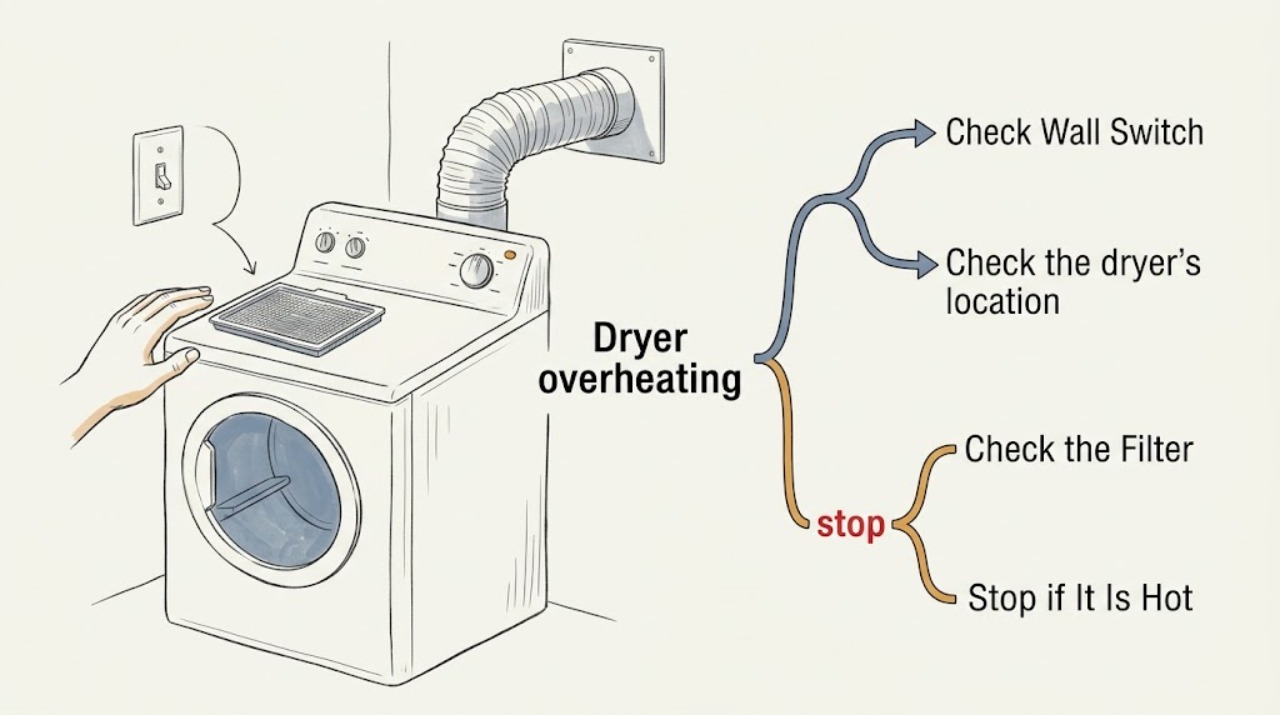
Stop a GE dryer that is excessively hot, shutting off from heat, producing a burning smell, or making smoke. Let it cool, then clean the lint filter and visually check the exhaust duct and outside wall cap for lint, crushing, kinks, or blockage. Keep clothing and other items away from the dryer's floor-level air intake and use the correct heat setting and load size. If airflow is clear but the dryer still overheats, or if there is smoke, a damaged cord, flame, or repeated shutdown, leave it disconnected and arrange qualified appliance service. Never operate a gas dryer without its vent because combustion fumes can enter the room.
Work through in order
Diagnostic checks
Use only checks that match the exact appliance or system and its official guide.
-
Check 1
Stop the cycle if the cabinet is excessively hot, the dryer shuts down, or you notice smoke, flame, or a burning smell. Switch the dryer off and allow it to cool completely; if smoke or flame is present, leave the area and contact emergency services. Once cool, note whether the symptom was heat at the cabinet, moisture or sweating around the door, a long dry time, or an automatic shutdown.
Expected result: The dryer is hot and damp around the door, runs longer than usual, shuts off, or has smoke, flame, odor, or visible damage.
Next step: For smoke, flame, or damage, keep the dryer disconnected and use the urgent service branch. For heat and moisture without an emergency, continue only after the dryer is cool with the external airflow checks.
Why this matters
Why: Heat plus sweating or long drying points toward restricted airflow or load/setting conditions. Smoke, flame, damaged wiring, or repeated shutdown indicates a fire or equipment fault that should not be reproduced.
-
Check 2
After the dryer is cool and disconnected as directed by the model instructions, clean the lint filter. Visually inspect the accessible exhaust duct from the back of the dryer to the wall for crushing, kinks, collapse, excessive length, or plastic flexible material; check the outside wall cap for lint, snow, ice, or another obstruction. Do not run a gas dryer with the vent disconnected.
Expected result: The lint filter or duct is blocked/damaged, the wall cap is obstructed, or the external airflow path appears open and correctly installed.
Next step: Clean the filter and clear only safe, accessible lint or outside-cap obstruction. Replace crushed or unsuitable ducting through a qualified installer if needed; then arrange service if the dryer still overheats.
Why this matters
Why: A blocked filter, duct, or wall cap prevents hot humid air from leaving and can make the dryer hot to the touch. A clear external path makes a thermal, heating, motor, or control fault more likely if overheating continues.
-
Check 3
Check the dryer's location and load from the outside: keep clothing, boxes, and other items off the floor directly in front of the dryer, verify that the dryer is on a flat stable surface, and compare the load and fabric with the selected heat setting. Separate a large, heavy load instead of extending a hot cycle.
Expected result: The floor-level intake is blocked, the dryer is unstable, the heat setting does not match the fabric, or the load is large/heavy; alternatively, the location and load are reasonable.
Next step: Clear the intake area and use a suitable smaller load and heat setting according to the care labels. If overheating returns with a reasonable load and clear intake, leave the appliance off and arrange service.
Why this matters
Why: GE says the dryer draws air in along the front at floor level and that heat setting, load size, and fabric type affect drying. Restricted intake or a heavy load can prolong heating and worsen heat buildup, but should not explain smoke or repeated thermal shutdown on its own.
-
Check 4
After the external airflow and load checks, decide whether the dryer remains unusually hot, shuts down, smells of burning, or shows a fault while the vent path is clear. For a gas model, note any ignition or gas-related symptom without adjusting the gas train; for an electric model, note whether the drum tumbles while heat stops or whether the breaker trips.
Expected result: The symptom resolves after airflow or load correction, or overheating persists with a clear path and appropriate load, possibly with a power, gas, odor, or fault symptom.
Next step: If overheating persists, keep the dryer disconnected and provide the model, fuel type, cycle, load, and observed behavior to a qualified appliance professional. For any gas odor, leave the area and follow local gas-emergency guidance.
Why this matters
Why: Resolution after airflow or load correction supports an external performance cause. Persistent overheating or a thermal/power/gas symptom points to an internal heater, thermostat, thermal limiter, motor, ignition, wiring, or control issue that cannot be identified safely from the symptom alone.
Use your observations
Decision map
Find the observation that best matches what you see, then follow the next safe action.
-
PATH 01Safety boundary
What you see
The dryer is hot to the touch, sweats around the door, or takes longer to dry, and the lint filter, duct, or outside wall cap is blocked or restricted.
Do this next
Stop until cool, clean the filter and safe accessible vent obstructions, and have crushed or unsuitable ducting corrected. Do not run a gas dryer without its vent.
Why this path and its safety boundary
Safety stop: Stop and arrange service if the dryer remains hot after airflow is restored or if clearing the duct requires wall, roof, or cabinet disassembly.
-
PATH 02Safety boundary
What you see
The dryer intake at floor level is blocked or the load is too large/heavy for the selected heat and fabric setting.
Do this next
Clear the floor-level intake, separate the load, and use the correct heat setting and care-label guidance after the appliance has cooled.
Why this path and its safety boundary
Safety stop: Do not keep operating if the cabinet remains excessively hot, the dryer shuts down, or a burning smell appears.
-
PATH 03Safety boundary
What you see
Overheating, automatic shutdown, or a burning smell continues after the external airflow and load checks, or a breaker/gas/ignition symptom is present.
Do this next
Leave the dryer disconnected and arrange qualified appliance service. Provide the exact model, fuel type, cycle, load, and timing of the overheating.
Why this path and its safety boundary
Safety stop: Do not open the cabinet, bypass thermal protection, adjust the gas train, or repeatedly reset the dryer or breaker.
-
PATH 04Safety boundary
What you see
There is smoke, flame, a strong gas odor, exposed wiring, a damaged cord, or an active fire.
Do this next
Leave the area, keep others away, and contact emergency services or the appropriate gas emergency service. Only isolate power from a safe external location if it can be reached without entering smoke or touching wet/damaged equipment.
Why this path and its safety boundary
Safety stop: Do not use water on an electrical or dryer fire and do not return to restart the appliance.
Helpful context
Understand the symptom
A GE dryer that feels unusually hot, sweats around the door, takes longer to dry, or shuts down from heat is often not getting rid of air and humidity. Lint restriction, a crushed or blocked duct, an obstructed wall cap, a covered floor-level intake, or an unsuitable heat/load combination can all change the temperature inside the drum.
Treat smoke, flame, a strong burning odor, a damaged cord, or repeated heat shutdown as a stop-use condition. Airflow cleaning is an external maintenance check; heating, thermal protection, motor, gas ignition, and control components require qualified service when the safe checks do not resolve the problem.
Only after diagnosis
Potential parts
- thermal limiter or thermostat
Consider this only after a qualified technician confirms a thermal-control failure rather than an airflow restriction or load problem.
Confirm the complete model number, fuel type, and manufacturer fit information before ordering; do not bypass or substitute a safety device. - heating element or gas ignition component
Consider this only when service identifies the failed heating or ignition component and confirms that airflow and controls are correct.
Use the exact model and technician diagnosis to verify compatibility; overheating alone does not identify an element or gas part. - exhaust duct or wall-cap component
Consider this only if inspection confirms crushed, unsuitable, or damaged ducting or a defective wall-cap path that restricts airflow.
Confirm the installation requirements and local code before replacing or rerouting the exhaust path.
When checks do not resolve it
Need a professional?
Arrange qualified service if a GE dryer remains excessively hot after the lint filter, vent path, wall cap, intake area, load, and heat setting are corrected; if it repeatedly shuts down, smells of burning, trips power, or has a gas/ignition symptom; or if diagnosis would require opening the cabinet. For smoke, flame, exposed wiring, or gas odor, stop immediately and use emergency or gas-emergency guidance.
Have this ready
- GE model and serial information
- Whether the dryer is electric or gas
- Cycle, heat setting, load type and size, and when the overheating starts
- Whether the case is hot, the door sweats, the dryer shuts off, or the drum tumbles without heat
- Whether the lint filter, duct, wall cap, floor-level intake, breaker, cord, or gas connection showed a problem
Common questions
FAQ
Why is my GE dryer getting too hot?
Restricted airflow is a leading check. Clean the lint filter and inspect the exhaust duct and outside wall cap for blockage, kinks, crushing, or unsuitable material. Keep the floor-level intake clear and use the correct load and heat setting.
Can I run a GE gas dryer with the vent hose disconnected to check airflow?
No. GE warns that a gas dryer must not be operated without its vent because carbon monoxide fumes could enter the room. Have a qualified professional inspect the vent path safely.
What if my GE dryer overheats and then shuts off?
Stop using it and let it cool. If airflow, load, and heat-setting checks do not resolve the problem, repeated shutdown can indicate an internal thermal, heating, motor, gas, or control issue that needs service.
Is a hot dryer cabinet always a failed heater?
Not necessarily. GE links excessive heat and moisture buildup to restricted venting, but smoke, burning odor, damaged wiring, or persistent overheating is not a condition to diagnose by repeated cycles. Leave the dryer disconnected and arrange service.
Read the exact guide
Official sources
- Dryer - Things To Check For A Venting IssueGE Appliances · GE dryer venting, airflow, location, heat setting, and service checks
- 49-90051GE Appliances · GE dryer operating, venting, safety, and troubleshooting guidance
- Dryer - Hot to the Touch or SweatsGE Appliances · GE dryer overheating, sweating, airflow, heat setting, and service guidance
Community feedback
Share a repair observation
Share a plain-text repair observation. Accepted observations are published automatically; this page may take a moment to update.