
On this page
Start here
Quick answer
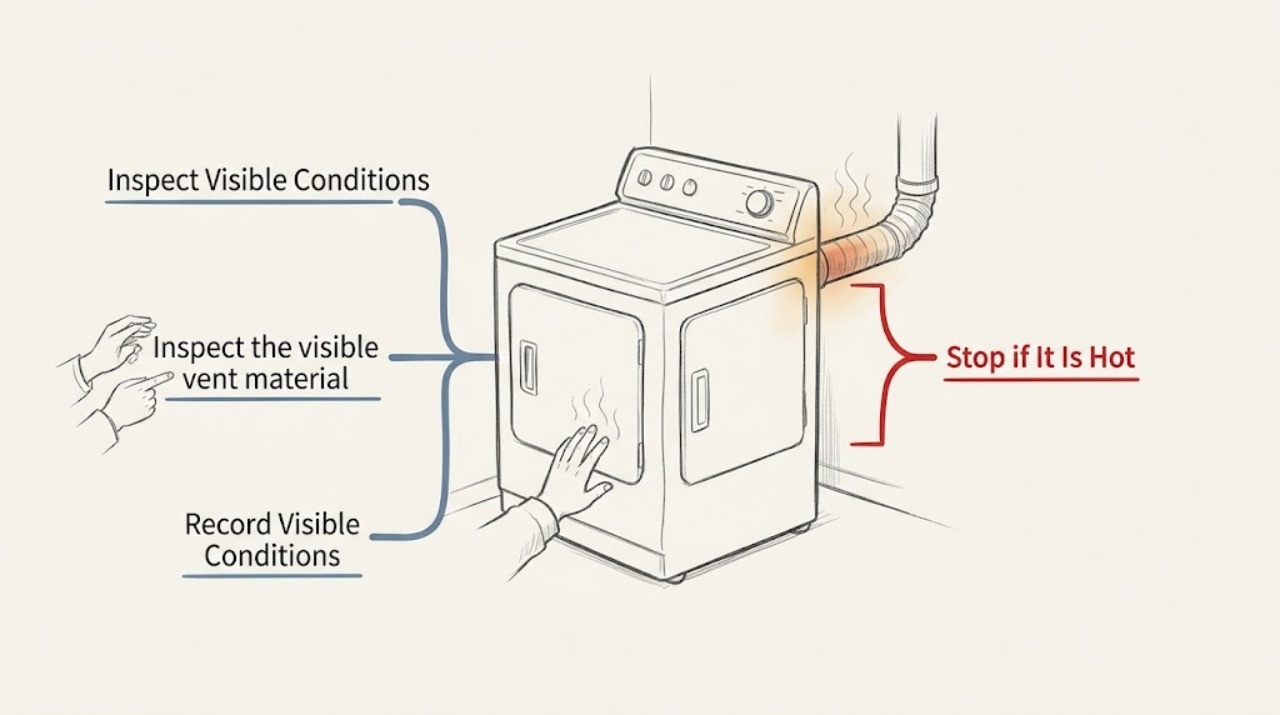
If a dryer is overheating and the exhaust vent is the suspected component, first stop use for any burning odor, smoke, scorching, unusually hot cabinet, or gas or electrical warning. When there is no active hazard, use prior safe-cycle information or a brief normal observation from outside to record hood opening and airflow, then photograph the visible vent material and path without moving the dryer or deep-cleaning the duct. Compare the last safe load and cycle history with cabinet heat, odor, drying time, and any warning. Weak exterior airflow supports vent restriction; normal airflow with persistent overheating shifts concern toward the heater, cycling control, blower, sensor, wiring, or gas system. Do not disassemble, reach deep into the vent, move a gas dryer, or bypass a safety control; request qualified appliance or vent service.
Before you begin
Safety first
- Safe exterior observation and documented prior-cycle information only: no repeated overheating cycles, disassembly, panel removal, deep vent cleaning, moving a gas dryer, gas-line or duct disconnection, energized testing, or safety-control bypass.
Work through in order
Diagnostic checks
Use only checks that match the exact appliance or system and its official guide.
-
Check 1
If the dryer is currently overheating, has a burning odor, smoke, scorching, or an unusually hot cabinet, stop the cycle with its normal control and leave it off. From a safe position, record where the heat or odor was noticed without opening the door repeatedly or touching hot surfaces.
Expected result: Note whether the symptom was hot clothing, a hot cabinet or laundry area, a burning or musty odor, smoke, an error indication, or heat that continued after the cycle stopped. Record whether the dryer is electric or gas without moving it.
Next step: Keep the dryer off and photograph the model label, control display, vent connection area, and any visible damage from a safe position.
Stop if: Do not restart the dryer, unplug it behind the appliance, move a gas dryer, open panels, or continue if there is smoke, flame, burning insulation, gas odor, or a hot electrical connection.
Why this matters
Why: A heat or odor hazard overrides vent testing. An exhaust restriction is one possibility, but an internal heater, cycling control, blower, wiring, or gas-appliance fault can look similar and needs appliance service.
-
Check 2
From outside at ground level, observe the exhaust hood only during a previously safe, brief normal cycle when there is no active overheating, smoke, or burning odor; otherwise use prior observations and do not run the dryer for this check.
Expected result: Record whether the hood flap opens, whether warm moist air is moving, whether airflow is weaker than usual, and whether lint, snow, a nest, vegetation, or another obstruction is visible. Do not put a hand into the outlet or use a tool to clear it.
Next step: Stop use if airflow is weak or the hood does not open, and request qualified vent or appliance service rather than deep-cleaning the run yourself.
Stop if: Do not climb, enter a roof or attic space, reach into the hood, remove a guard, or run a dryer that is already overheating to obtain a reading.
Why this matters
Why: Little or no exterior airflow supports a crushed, kinked, blocked, disconnected, or deeply restricted exhaust path. Normal-looking airflow does not rule out an intermittent restriction or an internal heat or control fault.
-
Check 3
Inspect the visible vent material and path at the dryer and wall only from an accessible position, without pulling the dryer, disconnecting the duct, or opening the wall.
Expected result: Look for a crushed or sharply kinked connector, detached joint, sagging section, non-metallic or damaged material, lint at a visible opening, an unusually long or turning route, or no visible defect. Record whether the dryer is against the wall and whether a gas line or rigid connection would prevent safe movement.
Next step: Photograph the path and ask a qualified venting or appliance professional to assess the full route and material; do not deep-clean, replace, or reroute it as a user repair.
Stop if: Do not move a gas dryer, disconnect a gas line or duct, use a rod or vacuum deep in the run, remove wall finishes, or reach behind hot equipment.
Why this matters
Why: A damaged or restrictive visible path can explain overheating and long drying, while no visible defect leaves hidden lint, exterior blockage, blower performance, heater control, or sensor faults unresolved.
-
Check 4
Record the load and cycle context from the last safe use instead of repeating a suspected overheating event: load size and fabric mix, automatic or timed cycle, heat setting, drying time, and whether clothing remained damp.
Expected result: Note whether overheating occurred only with a heavy or dense load, a timed high-heat cycle, every cycle, or with an empty or small load; record any change in drying time or a cycle that stopped early.
Next step: Provide the cycle history to service and do not repeat a high-heat or timed cycle to reproduce overheating.
Stop if: Do not keep using the dryer to compare loads, override a sensor or cycle, or continue after heat, odor, smoke, or abnormal stopping.
Why this matters
Why: A load- or cycle-specific pattern can point toward operating conditions or restricted airflow, while overheating across cycles or with a small load makes an internal heater, blower, thermostat, sensor, or control fault more concerning.
-
Check 5
From the exterior, compare the cabinet, drum, control display, and nearby laundry area after the dryer is safely off; do not open panels or touch internal parts.
Expected result: Record a cabinet that remains unusually hot, a normal-looking exterior with a vent warning, a blower or drum sound that changed, a repeated error, a heater that appears not to cycle, or no abnormal sign after cooling.
Next step: Send the symptom, airflow observation, load and cycle history, model label, and error information to qualified appliance service before selecting a thermostat, blower, or vent part.
Stop if: Do not remove panels, test energized parts, bypass a thermostat or thermal fuse, access a gas burner, or restart the dryer to check internal cycling.
Why this matters
Why: Heat or control behavior without weak exterior airflow shifts the concern toward internal heat regulation, blower, sensor, wiring, or control diagnosis rather than an exhaust-only repair. A cool exterior cannot certify internal safety.
Use your observations
Decision map
Find the observation that best matches what you see, then follow the next safe action.
-
PATH 01Next step
What you see
The outside hood has little or no airflow, does not open, or shows lint, a nest, snow, vegetation, or another obstruction during a safe observation.
Do this next
Keep the dryer off and request qualified vent or appliance service for the full exhaust route; do not reach into the hood or deep-clean the duct yourself.
-
PATH 02Next step
What you see
The visible connector is crushed, sharply kinked, detached, damaged, sagging, or made of a questionable material, or the route appears unusually restrictive.
Do this next
Request professional assessment of the connector and complete vent path without moving a gas dryer or disconnecting the duct. Do not treat a visible short section as proof the hidden run is clear.
-
PATH 03Next step
What you see
Airflow appears normal, but the cabinet overheats, the heater does not cycle normally, the blower sound changes, or a warning or error repeats.
Do this next
Treat an internal heater, cycling thermostat, blower, sensor, wiring, or control fault as unresolved and request appliance service; do not open panels or bypass a safety device.
-
PATH 04Next step
What you see
The problem appears only with a dense load, timed high heat, long cycle, or unusually wet clothing, while no active heat or odor hazard is present.
Do this next
Give the cycle history to service and follow the model manual's load and cycle guidance without repeating a suspected overheating event. If heat or odor returns, stop use immediately.
-
PATH 05Next step
What you see
The dryer has smoke, a burning odor, scorching, flame, damaged wiring, a hot receptacle, gas odor, or an unsafe gas-line or exhaust connection.
Do this next
Leave the dryer off, keep people clear, and seek prompt appliance, electrical, or gas service as appropriate. Do not operate controls near a gas odor, move the dryer, or investigate behind it.
-
PATH 06Next step
What you see
The vent route or internal cause cannot be judged without moving the dryer, deep-cleaning, removing panels, reaching an attic or roof outlet, or testing energized parts.
Do this next
Treat the cause as unknown and request qualified appliance or venting service. Do not use a vent kit, vacuum, rod, bypass, or improvised test to extend the inspection.
Helpful context
Understand the symptom
Exhaust airflow is the first component-specific question
A dryer exhaust vent can restrict the removal of hot, moist air, but overheating can also come from the heater, cycling control, blower, sensor, wiring, or gas system. Observe the outside hood and visible connector only when the dryer is not presenting an active heat or odor hazard; normal airflow does not prove internal safety.
Use the exterior hood and vent path as evidence
A hood that does not open, weak airflow, lint, a nest, a crushed connector, a sharp kink, or a detached section supports an exhaust-path investigation. Do not put a hand into the outlet, deep-clean the duct, move the appliance, or enter an attic or roof area to trace the route.
Load and cycle history separates operating context from a persistent fault
Record whether the issue occurred with a dense load, timed high heat, every cycle, or a small load, and whether drying time changed. A cycle-specific pattern can guide the next question, while heat or odor across cycles increases concern for an internal heater, blower, thermostat, sensor, control, or wiring issue. Do not rerun a suspected overheating cycle.
Stop use when heat or odor is abnormal
If there is smoke, burning odor, scorching, flame, damaged wiring, a hot receptacle, or gas odor, leave the dryer off and request prompt qualified service. The U.S. Fire Administration recommends professional dryer installation and service and checking that the vent is not damaged, crushed, or restricted and that the outside cover opens during operation.
Only after diagnosis
Potential parts
- dryer cycling thermostat
Consider this only after qualified diagnosis finds a heat-cycling control fault and separates it from restricted airflow, blower, sensor, wiring, and gas-system causes.
Match the exact dryer model, thermostat type and temperature behavior, mounting, wiring, and manufacturer requirements; do not install or bypass it yourself. - dryer blower wheel
Consider this only when professional inspection links weak airflow or abnormal blower behavior to the wheel rather than the vent route, motor, lint accumulation, or control system.
Confirm exact dryer model, wheel design, shaft fit, rotation, housing clearance, and safe service requirements before purchase or installation. - dryer vent cleaning kit
Consider this only if a qualified vent professional confirms the route and kit are appropriate; do not use a kit for deep cleaning, roof or attic access, a gas dryer move, or active overheating.
Confirm the vent material, route, outlet access, cleaning method, manufacturer guidance, and professional safety plan before use.
When checks do not resolve it
Need a professional?
Call promptly for any overheating, burning odor, smoke, scorching, weak or absent exterior airflow, damaged or crushed vent, repeated warning, abnormal cabinet heat, gas or electrical concern, or any diagnosis requiring appliance movement, deep cleaning, disassembly, or energized testing.
Safety scope: Safe exterior observation and documented prior-cycle information only: no repeated overheating cycles, disassembly, panel removal, deep vent cleaning, moving a gas dryer, gas-line or duct disconnection, energized testing, or safety-control bypass.
Have this ready
- Provide the exact dryer model and fuel type, heat or odor location, exterior hood airflow and opening, visible vent material and path, load and cycle history, drying-time change, warnings, photos, and any smoke, scorching, gas odor, hot receptacle, or access limitation.
Common questions
FAQ
Does weak outside airflow prove the exhaust vent is the only problem?
No. It supports a restriction, crushed connector, blockage, or disconnected route, but a blower, heater, sensor, or control fault can also contribute. Keep the dryer off and have the full path and appliance assessed.
What can I safely check at the outside dryer vent?
From ground level, observe whether the hood opens during a previously safe brief cycle and whether warm moist air moves, or use a prior observation if the dryer is overheating. Look for visible lint, nests, snow, vegetation, or damage without reaching into the hood or using tools.
How does the load or cycle help distinguish a vent issue?
Record whether heat occurred with a dense load, timed high heat, every cycle, or a small load, along with drying time and dampness. This pattern can guide service, but do not rerun a high-heat or timed cycle to reproduce overheating.
Should I move the dryer to inspect the exhaust hose?
No. Do not move a gas dryer or disconnect a gas line or duct. Photograph the visible connection from a safe position and have qualified appliance or venting service inspect the inaccessible section.
Can I keep using the dryer if the cabinet is hot but there is no smoke?
Do not continue if the heat is abnormal, worsening, accompanied by odor, or associated with long drying or a warning. Leave it off and request service; absence of smoke does not clear an exhaust restriction or internal control fault.
Read the exact guide
Official sources
- Appliance and Electrical Fire SafetyU.S. Fire Administration · Supports the stop-use and vent-safety boundary; exact dryer cycle behavior and internal diagnosis remain model-specific.
- Safety AlertsU.S. Consumer Product Safety Commission · Supports stopping and escalating an overheating dryer; it does not diagnose an internal component or authorize deep cleaning.
Community feedback
Share a repair observation
Share a plain-text repair observation. Accepted observations are published automatically; this page may take a moment to update.