
On this page
Start here
Quick answer
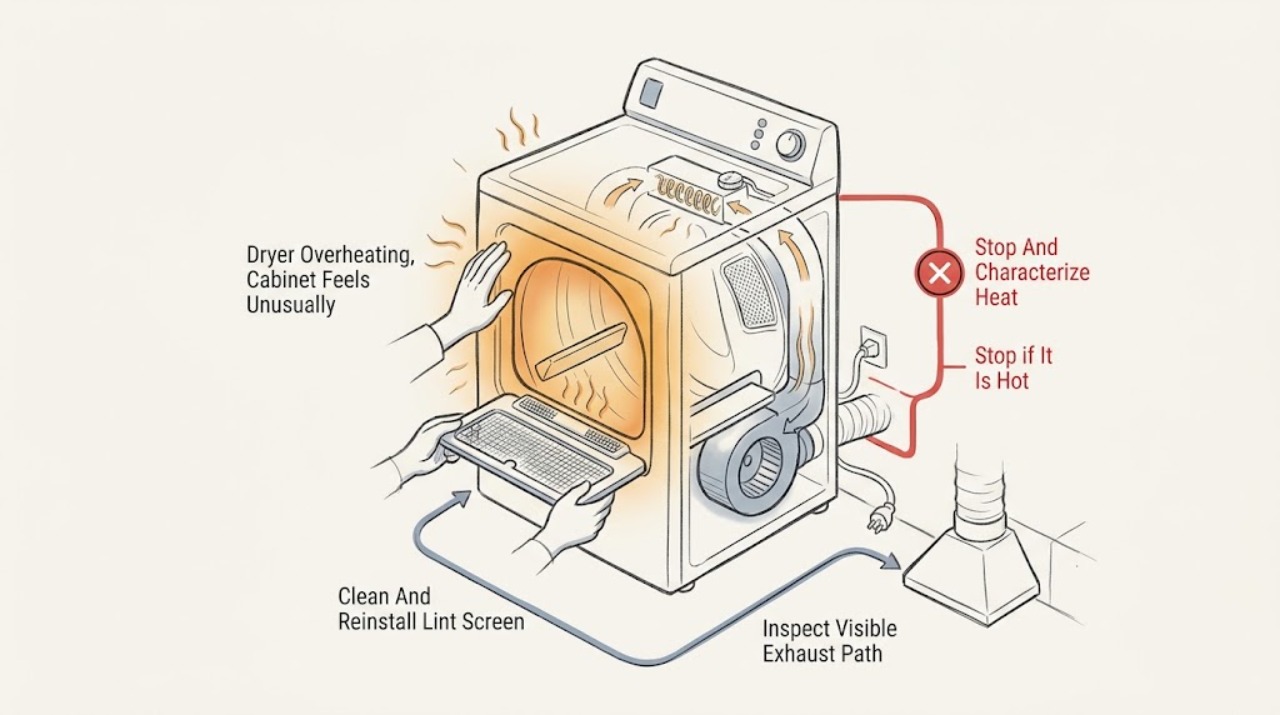
A dryer should feel warm while operating, but an unusually hot cabinet, very hot clothes, steam, long dry times, weak outside airflow, a burning odor, or repeated shutdown is a warning to stop using it until the airflow and appliance are evaluated. Manufacturer guidance links heat staying inside the dryer to a clogged or kinked exhaust path, lint buildup, a blocked outside hood, or a failed blower; a loose, damaged, blocked, or missing lint screen can also cause overheating. Let the dryer cool, clean and reinstall the lint screen exactly as the model manual requires, and inspect the visible hose and outside hood for crushing, lint, debris, or a nest without opening the cabinet. Do not run through smoke or a burning smell, bypass a thermal control, remove panels, or clean cabinet lint yourself. Arrange qualified appliance or vent service if the cabinet remains unusually hot, airflow is weak, drying takes longer, a sensor alert returns, or the issue is not clearly resolved.
Work through in order
Diagnostic checks
Use only checks that match the exact appliance or system and its official guide.
-
Check 1
Stop the cycle and let the dryer cool before touching the cabinet, clothes, screen, hose, or hood. Note whether the heat is mild or intense, whether the cabinet is hot on one side or throughout, whether clothes are unusually hot or damp, whether steam or moisture is present, and whether the dryer stopped by itself.
Expected result: There is a burning smell, smoke, scorching, a hot electrical odor, melted material, a carbon-monoxide concern on a gas dryer, intense heat, or only ordinary warmth with normal dry performance.
Next step: Keep the dryer off until it is cool and choose the safety branch. Do not restart it simply to see whether the cabinet gets hotter.
Stop if: Leave the area and seek emergency help for fire or heavy smoke; stop using the dryer immediately for a burning smell, sparking, melted parts, or a gas odor.
Why this matters
Why: Smoke, scorching, odor, or intense heat is a fire or equipment-safety concern. Steam, long dry time, and very hot clothing make restricted exhaust more likely. Ordinary warmth without changed performance is less conclusive but does not rule out a developing airflow issue.
-
Check 2
With the dryer cool, remove the lint screen and inspect it for a mat of lint or invisible fabric-softener residue. Clean and dry it only by the exact model instructions, then push it firmly back into its holder. Do not run the dryer with the screen loose, damaged, blocked, or missing.
Expected result: The screen is loaded with lint or residue; lint falls into the screen housing; the screen is damaged or does not seat; or it looks clean and seats correctly.
Next step: Leave the dryer off while checking the visible exhaust path. Replace a damaged screen only after confirming the exact model and fit; do not reach into the cabinet to retrieve fallen lint.
Stop if: Stop if the screen cannot seat, the housing is damaged, lint is packed inside the cabinet, or cleaning requires removing a panel or energized component.
Why this matters
Why: A loaded or poorly seated screen can reduce airflow and contribute to overheating or longer drying. A clean, correctly seated screen makes a restriction in the hose, wall duct, outside hood, blower, heating system, or temperature control more likely.
-
Check 3
After the dryer is cool and disconnected from power when the exact inspection requires moving it, inspect the visible hose from dryer to wall for crushing, kinks, excessive sag, or lint. From outside, inspect the exhaust hood for lint, debris, or a nest and confirm the flap is not visibly stuck. Do not disassemble the dryer or enter the wall duct.
Expected result: The hose is crushed or kinked; the outside hood is blocked or its flap cannot move; the hose and hood look clear; or the vent path cannot be reached safely.
Next step: Do not operate with a blocked or damaged vent. Arrange vent cleaning or appliance service for a concealed restriction, nest, damaged duct, or any path that requires tools or wall access.
Stop if: Stop for a damaged vent, lint cloud, nest, water accumulation, hot duct, gas line disturbance, or any need to move a gas dryer or disconnect a duct without the model-specific procedure.
Why this matters
Why: A restricted vent prevents hot, moist air from leaving and can make the cabinet hot, increase dry time, and create a lint and fire hazard. A clear visible section cannot rule out a hidden wall restriction or internal blower problem.
-
Check 4
Without restarting an overheated dryer, review the last load and selected cycle: note whether it was tightly packed, unusually heavy, mixed with items that retain moisture, or run on a high-heat setting. Record any Check Vent, airflow, temperature, or shutdown alert and whether dry times recently increased.
Expected result: The load was packed or unusually heavy; a high-heat cycle was selected; dry times increased across loads; an airflow alert appeared; or the same heat occurs with small loads and lower settings.
Next step: Do not compensate by selecting higher heat or repeatedly restarting. After the vent path is confirmed clear by the appropriate service or manual procedure, use the exact model cycle guidance; persistent heat needs appliance diagnosis.
Stop if: Stop for repeated automatic shutdown, an alert that returns, clothes that scorch, smoke, burning odor, or a cabinet too hot to touch safely.
Why this matters
Why: A packed load or high setting can change drying performance, but increased dry time, a vent alert, moisture in the laundry area, or hot cabinet points more strongly to restricted airflow. Heat that persists regardless of load or setting makes a blower, heater, sensor, thermal cutoff, or control issue more likely.
-
Check 5
Record the dryer make and complete model, electric or gas type, cabinet and clothing heat, cycle and load, lint-screen condition, visible hose and hood findings, outside airflow if safely observed, alerts, dry time change, noises, odors, and whether the dryer shut down. Photograph only labels and cooled, visible conditions.
Expected result: The cabinet remains unusually hot after the accessible screen and vent checks; airflow remains weak; the blower is noisy or vibrating; a thermal or sensor alert returns; or the issue requires cabinet access.
Next step: Keep the dryer off and arrange qualified appliance repair and, when indicated, professional dryer-vent cleaning. Provide the model and the recorded pattern so the correct manual and safety procedure can be used.
Stop if: Do not remove panels, test live wiring, bypass a thermal control, open a gas system, vacuum inside the cabinet, or continue operating a dryer that overheats or smells burnt.
Why this matters
Why: The remaining possibilities include hidden lint, blower failure, heating-system fault, temperature sensor or thermal cutoff, control problem, or concealed vent restriction. A symptom does not identify a safe replacement part or prove that the vent is clear.
Use your observations
Decision map
Find the observation that best matches what you see, then follow the next safe action.
-
PATH 01Next step
What you see
Do this next
Keep the dryer off, clean and reinstall the lint screen per the manual, inspect visible hose and hood conditions, and arrange vent service if airflow is not clearly restored.
Why this path and its safety boundary
Why it matters: Restricted exhaust is more likely. Lint, a crushed or kinked hose, a blocked hood, a nest, excessive turns, or a hidden wall restriction can keep heat and moisture inside.
-
PATH 02Next step
What you see
Do this next
Do not continue testing with heated cycles. Arrange qualified appliance and vent diagnosis; internal lint removal and component testing are service work.
Why this path and its safety boundary
Why it matters: A concealed vent restriction or internal blower, heater, temperature sensor, thermal cutoff, or control issue becomes more likely than a simple screen blockage.
-
PATH 03Next step
What you see
Do this next
Stop heated operation, inspect only accessible screen, hose, and hood conditions, and have the full vent run cleaned or tested when the restriction is not plainly accessible.
Why this path and its safety boundary
Why it matters: Low exhaust airflow is likely. The restriction may be at the screen, hose, wall run, hood, or internal blower; an alert does not locate the obstruction.
-
PATH 04Next step
What you see
Do this next
Let the dryer cool, clean the screen, review the exact cycle guide, and inspect the visible exhaust path. Do not use a higher setting to compensate for slow drying.
Why this path and its safety boundary
Why it matters: Load size or cycle selection may have increased heat retention, but an unusually hot cabinet is still a reason to verify airflow rather than assume the load was the only cause.
-
PATH 05Next step
What you see
Do this next
Stop using the dryer, disconnect power only if it is safe and accessible without approaching smoke or fire, close the gas shutoff only if the exact appliance procedure and situation allow it, and contact emergency or qualified service from a safe location.
Why this path and its safety boundary
Why it matters: A fire, electrical, fuel, heating, or safety-control hazard is possible. This is not a lint-screen troubleshooting situation.
Helpful context
Understand the symptom
Warm is expected; intense cabinet heat is a different symptom
Heat is part of a drying cycle, but the cabinet should not become intensely hot or produce a burning smell. When moist, heated air cannot leave efficiently, heat and humidity remain in the dryer and drying takes longer. Note whether the cabinet is hot everywhere or near the exhaust side, whether clothes are unusually hot, and whether the dryer stops and later restarts. Those observations distinguish an airflow problem from a component or control fault without requiring cabinet access.
Airflow checks begin with the screen and visible vent path
Let the dryer cool and remove lint from the screen using the procedure in the exact manual. Reinstall it firmly and do not operate without it. Then inspect the accessible hose for crushing or kinks and the outside hood for lint, debris, or a flap that cannot move. A clear screen does not prove the entire vent is clear: lint can accumulate inside the cabinet or the full exhaust run, and manufacturer manuals assign deeper cleaning to qualified service.
Internal heat controls and blower faults need service
A dryer that remains too hot after the accessible airflow path is corrected may have a blower, heating element or gas-heating fault, temperature sensor, thermal cutoff, control, or internal lint restriction. A blower problem may also cause high-pitched noise, vibration, or long dry times. Do not remove panels, test live parts, bypass a thermal device, or vacuum inside the cabinet as a homeowner repair; provide the model and symptom history to a qualified technician.
Safety boundary
Stop conditions
- Stop the dryer immediately for fire, heavy smoke, sparking, scorching, a strong burning or gas odor, or a cabinet that is dangerously hot; leave the area and seek emergency help when appropriate.
- Do not run with a loose, damaged, blocked, or missing lint screen, and do not operate a gas dryer without the required venting and model-specific installation conditions.
- Do not remove panels, vacuum internal cabinet lint, test live wiring, open a gas system, bypass a thermal cutoff or thermostat, or move a connected gas dryer without the exact procedure.
- Stop for weak or absent outside airflow, steam, water behind the dryer, a blocked hood, a crushed duct, repeated automatic shutdown, or a returning vent alert.
- Arrange qualified appliance or vent service when safe screen, load, and visible hose or hood checks do not restore normal heat and drying, or when internal diagnosis is required.
Only after diagnosis
Potential parts
- Dryer blower wheel or blower motor
Consider this part class only after qualified testing confirms weak airflow or abnormal noise is caused by a worn, obstructed, or failed blower assembly after the vent path is addressed.
Blower geometry, motor, wiring, mounting, and airflow requirements vary by dryer model and gas or electric configuration; identify the complete model before selecting a part. - Dryer thermal cutoff, thermostat, or temperature sensor
Consider this part class only when qualified diagnosis confirms that the dryer is heating incorrectly or a temperature-protection component is failing after airflow and lint causes are ruled out.
Ratings, locations, reset behavior, terminals, and control logic are model-specific; do not bypass or substitute a thermal device. - Dryer lint screen, exhaust duct, or outside hood component
Consider this part class only when inspection confirms a damaged screen, crushed duct, failed hood flap, or other model-appropriate vent component is restricting airflow.
Screen fit, duct material, routing, diameter, hood design, and local installation requirements vary; match the appliance and installation documentation before replacement.
When checks do not resolve it
Need a professional?
Call qualified service when the cabinet remains unusually hot after safe screen and visible vent checks, dry times increase, airflow is weak, an alert returns, the blower is noisy, the dryer shuts down, or diagnosis requires moving the appliance, opening the cabinet, cleaning hidden lint, or testing a heating or safety component. Seek emergency help for fire, heavy smoke, sparking, or a strong gas odor.
Have this ready
- Complete dryer model and electric or gas configuration
- Cabinet and clothing heat, cycle, load size, and recent change in dry time
- Lint-screen condition and whether it seats correctly
- Visible hose, outside hood, airflow, moisture, lint, and vent-alert observations
- Any burning or gas odor, smoke, scorching, vibration, noise, repeated shutdown, or water near the dryer
Common questions
FAQ
Should a dryer cabinet feel hot while it runs?
Some warmth is expected, but intense cabinet heat, very hot clothes, steam, a burning smell, or changed dry performance is not something to ignore. Let the dryer cool and check the lint screen and visible exhaust path according to the exact manual.
Can a blocked vent make a dryer cabinet unusually hot?
Yes. Whirlpool and GE explain that restricted exhaust keeps hot, moist air inside, which can make the dryer hot to the touch, increase drying time, and reduce outside airflow. A clear screen does not prove the wall vent or hood is clear.
What should I do if my dryer has a Check Vent alert?
Stop heated operation, let the dryer cool, and follow the exact model instructions. GE says supported models use the alert to indicate low airflow and recommends power isolation before duct inspection, along with checking the outside hood for blockage or a nest.
Can I vacuum lint from inside the dryer cabinet?
Do not open the cabinet as a routine homeowner fix. The cited Whirlpool manual assigns accumulated cabinet-lint removal to a qualified servicer. You can clean the accessible screen and inspect visible vent conditions, then arrange service for internal lint or component diagnosis.
When should I stop using an overheating dryer?
Stop for intense heat, a burning or gas smell, smoke, scorching, sparking, repeated shutdown, weak exhaust airflow, steam, a returning vent alert, or clothes that are unusually hot. Arrange qualified appliance or vent service; seek emergency help for fire, heavy smoke, or a strong gas odor.
Read the exact guide
Official sources
- Dryer Vent may be Blocked or Restricted - Product HelpWhirlpool · Official Whirlpool dryer guidance used for general vent-restriction signs such as a hot cabinet, long dry times, steam, and weak airflow; the exact dryer manual controls procedure.
- How Hot Does a Dryer Get? | MaytagMaytag · Official Maytag consumer guidance used for the distinction between normal warmth and intense heat, obstructed vents, blower symptoms, and professional diagnosis; exact model instructions control.
- Dryer - Check Vent Sensor AlertGE Appliances · Official GE guidance used for supported models' Check Vent alert and general exhaust behavior; apply the cleaning steps only when the exact dryer model and installation permit them.
- Dryer MaintenanceWhirlpool · Official Whirlpool owner manual for the documented dryer family; used narrowly for the lint-screen and vent-maintenance boundary, not as a universal manual for every dryer.
Community feedback
Share a repair observation
Share a plain-text repair observation. Accepted observations are published automatically; this page may take a moment to update.