
On this page
Start here
Quick answer
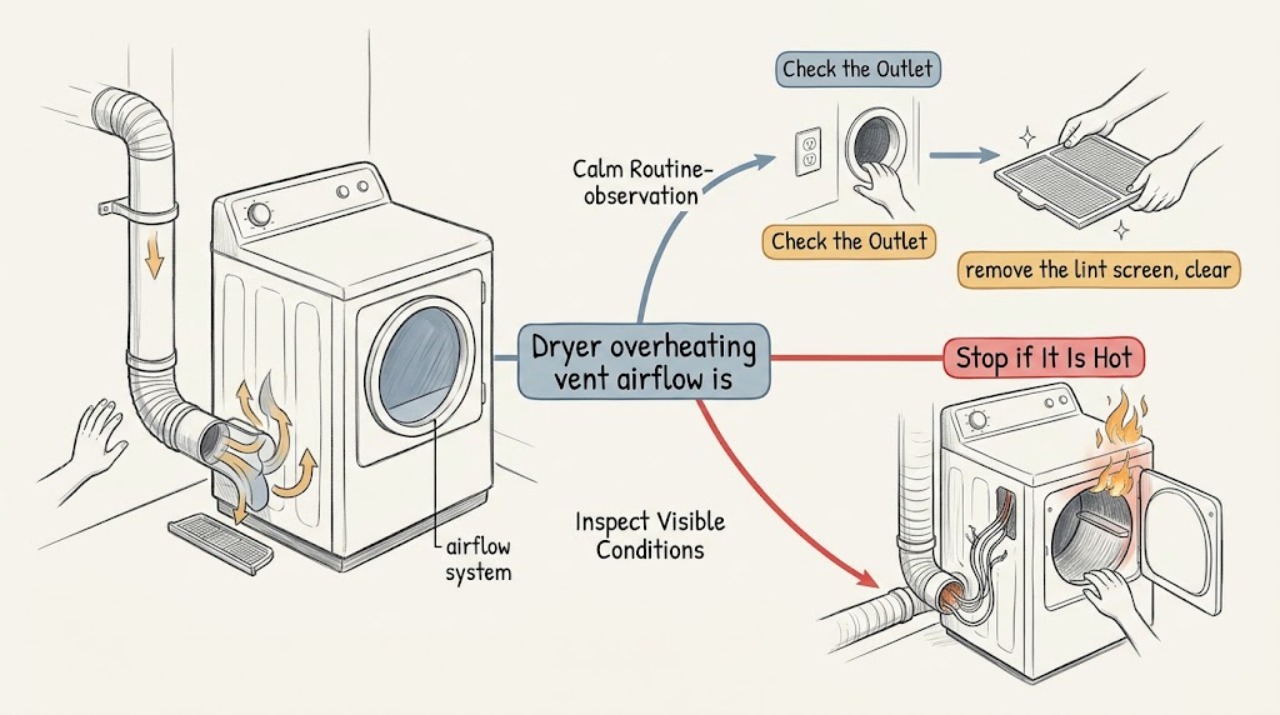
Stop using a dryer that is overheating until its airflow is checked. Unplug it before inspecting the lint screen, the reachable vent hose, and the outside hood; look for a crushed or kinked duct, lint or debris, a stuck hood flap, weak exhaust flow, or a vent run with excessive length and bends. Clean the lint screen as directed and correct only an obvious, accessible obstruction without reaching into the cabinet. A hot laundry area, warm but damp loads, lint around the door or lint housing, a check-vent warning, burning odor, smoke, sparks, or a hot plug makes continued operation unsafe. Whirlpool says restricted airflow can result from a crushed vent, blocked exterior hood, or obstructed house venting, and LG identifies a clogged exhaust duct as a cause of clothing becoming too hot. If airflow remains weak, the duct is concealed or damaged, the dryer still overheats, or any electrical or burning symptom appears, keep the dryer off and arrange qualified appliance or dryer-vent service. Do not run the dryer with the vent disconnected, bypass a thermal safety, or open the cabinet to clean hidden lint yourself.
Before you begin
Safety first
- Homeowner checks should remain limited to a cool, unplugged lint screen, reachable hose and hood observations, load and cycle documentation, and safe exterior airflow observations. A qualified professional should clean or test concealed ducts and inspect the blower, heater, thermistor or thermostat, thermal safeties, internal lint, wiring, and controls.
Work through in order
Diagnostic checks
Use only checks that match the exact appliance or system and its official guide.
-
Check 1
Stop the dryer and disconnect power from a safe, dry position if there is smoke, a burning odor, sparks, a hot or discolored plug or outlet, a repeated breaker trip, visible lint fire, or heat that seems abnormal; keep the area clear and do not restart it.
Expected result: The dryer is merely warmer than expected with no smoke, odor, electrical heat, or fire sign, or one of those danger signs is present.
Next step: For smoke or fire, leave and use emergency help. For a burning or electrical symptom, leave the dryer disconnected and arrange qualified appliance or electrical service. Continue only with a cool, safe appliance and no hazard signs.
Why this matters
Why: Lint and restricted exhaust can create overheating and fire risk, while electrical or burning symptoms may indicate a separate hazard that cannot be diagnosed by vent cleaning.
-
Check 2
With the dryer cool and unplugged, remove the lint screen, clear lint from its surface, and check for a sticky film or damage; clean it only as the owner instructions allow, then dry it completely before reinstalling.
Expected result: The screen is packed with lint, coated with residue, torn or warped, missing, or clean and seated correctly.
Next step: Replace a damaged screen with the model-correct part and reinstall it fully. If the screen is clean and overheating continues, do not compensate with a hotter or longer cycle; inspect the external vent path next.
Why this matters
Why: Lint or residue can reduce the screen's effective airflow, while a missing or damaged screen allows lint into the dryer. A clean screen does not rule out a blocked duct or internal fault.
-
Check 3
Inspect the reachable duct behind the dryer without moving a stacked, gas, or tightly installed unit beyond its instructions; look for crushing, kinks, holes, lint buildup, excessive slack, or a hose pressed against the wall.
Expected result: The hose is crushed or kinked, visibly clogged or damaged, made of an unsuitable material, sharply bent, or appears open and unobstructed.
Next step: Keep the dryer off until a damaged or crushed duct is repaired with model-appropriate venting. Do not tape over a hole as a lasting fix, reach into the cabinet, or pull the unit out if doing so strains gas or electrical connections.
Why this matters
Why: A restriction close to the dryer can reduce exhaust flow and make the dryer run hot. An apparently open short section does not clear the wall duct, termination, or hidden lint.
-
Check 4
From outside, check the dryer exhaust hood while one short, supervised test is permitted by the owner instructions and no danger sign is present; observe whether the flap opens and whether airflow is strong and steady, then stop the cycle.
Expected result: The hood flap stays closed, airflow is weak or intermittent, lint or a nest blocks the hood, landscaping obstructs it, or the hood opens with strong airflow.
Next step: Stop using the dryer and arrange qualified vent cleaning or repair for weak flow, a blocked hood, or a concealed run. Clear only loose debris that is safely reachable from outside; do not enter the duct or run with it disconnected.
Why this matters
Why: A stuck hood or weak exhaust supports a restriction in the termination or house duct. Strong airflow outside makes a severe external blockage less likely but does not rule out internal airflow, temperature-control, or heater problems.
-
Check 5
Record performance with a normal, correctly sized load: note drying time, whether clothing is warm but damp, laundry-room heat or humidity, lint around the door or lint housing, and any check-vent or airflow warning.
Expected result: Loads stay warm but damp, cycles lengthen, the room becomes hot or humid, lint appears around seals, or the appliance reports restricted airflow.
Next step: Keep the dryer off until the full exhaust path is cleaned or tested. If performance remains abnormal after qualified vent work, request appliance diagnosis rather than replacing a heater or thermostat by guesswork.
Why this matters
Why: These combined signs support restricted ventilation even when the dryer still produces heat. Repeated overheating can also damage clothing or trigger an internal safety response.
-
Check 6
Check the selected cycle and load against fabric-care instructions, and note whether the dryer was stopped before its cool-down phase; do not use a hotter setting to compensate for poor drying or an airflow warning.
Expected result: The load was removed early, the cycle was inappropriate, or the dryer overheats during the correct cycle and complete cool-down.
Next step: Use the model-approved cycle for the load only after the vent is confirmed safe. If the dryer is still too hot, fails to cool, or has weak airflow, stop use and arrange service.
Why this matters
Why: Early removal and unsuitable settings can leave items hot, but persistent overheating during an appropriate cycle keeps restricted exhaust or an appliance temperature-control fault in consideration.
-
Check 7
Gather the exact model, fuel type, warning or error text, lint-screen and vent observations, hood airflow, duct length and bends if known, load and cycle, heat or humidity symptoms, recent move or repair, and what was cleaned or tested.
Expected result: The restriction is hidden, airflow is weak despite an apparently clear hose, overheating returns after vent cleaning, or the dryer shows an error or electrical symptom.
Next step: Provide the record to qualified dryer-vent or appliance service and request a complete exhaust-flow and appliance safety evaluation. Do not order a thermal or heating part solely from the overheating symptom.
Why this matters
Why: This pattern can involve the wall or roof duct, blower, heater, thermistor or thermostat, internal lint, control, or another model-specific fault. The vent condition and appliance condition may coexist.
Use your observations
Decision map
Find the observation that best matches what you see, then follow the next safe action.
-
PATH 01Next step
What you see
The vent warning is on, outside airflow is weak, or the hood flap barely opens, especially with long dry times and a hot laundry area.
Do this next
Keep the dryer off and arrange qualified vent cleaning or repair. Do not continue cycles to test whether the restriction clears itself.
Why this path and its safety boundary
Why it matters: A restriction in the hood, wall duct, crushed hose, lint-filled run, or excessive bends is more likely than a cycle-setting issue.
-
PATH 02Next step
What you see
The lint screen is clean and the reachable hose looks open, but the room is still hot, clothes remain warm and damp, or lint collects around the door or lint housing.
Do this next
Stop use and request a full vent-path flow test or cleaning. If airflow is confirmed adequate, move to qualified appliance diagnosis rather than replacing a heater or thermostat by guesswork.
Why this path and its safety boundary
Why it matters: A concealed house-duct restriction, termination problem, internal lint accumulation, or blower/airflow fault remains possible; a short visible section cannot clear the whole path.
-
PATH 03Next step
What you see
Outside airflow is strong but the dryer overheats, fails to cool down, shows a temperature or error warning, or heats abnormally on the correct cycle.
Do this next
Keep the dryer off and arrange qualified appliance service for internal airflow and temperature-control testing. Do not bypass a thermal device or open the cabinet.
Why this path and its safety boundary
Why it matters: A severe external vent blockage is less likely, while an internal temperature-sensing, heating, blower, control, or lint problem remains possible.
-
PATH 04Next step
What you see
The load was removed before cool-down or the cycle did not match the fabric, but the duct has strong airflow and the dryer is normal on the appropriate cycle.
Do this next
Allow the full cool-down and follow the fabric-care and model-cycle guidance. Recheck promptly if heat, humidity, weak airflow, or long drying returns.
Why this path and its safety boundary
Why it matters: The perceived heat is more likely related to the interrupted cool-down or cycle selection than an airflow restriction.
-
PATH 05Next step
What you see
Overheating is accompanied by burning odor, smoke, sparks, a hot plug or outlet, a breaker trip, visible fire, or a damaged exhaust duct.
Do this next
Disconnect only from a safe position, leave the appliance off, and use emergency help for fire. Arrange qualified appliance or electrical service before any further use; do not restart to reproduce the symptom.
Why this path and its safety boundary
Why it matters: A fire, electrical, lint, or mechanical hazard is more likely than a routine airflow-maintenance issue.
Helpful context
Understand the symptom
Overheating is an airflow and fire-safety symptom
A dryer needs a clear path from the lint screen and drum through the exhaust duct to the outside. When that path is restricted, hot humid air and lint do not leave efficiently; the dryer may run hot, take longer, or leave heat in the laundry area. Whirlpool notes that lint in the drum or venting can obstruct airflow and lead to overheating. Treat unusual heat as a reason to stop and inspect from a safe, unplugged position, not as a reason to select a hotter cycle.
Check the lint screen without creating another restriction
Clean the lint screen after each load and inspect it for a film from fabric softener or detergent that could reduce airflow. Use the model instructions for washing and drying the screen if residue is present. Never operate the dryer without the screen, and do not push a brush, vacuum hose, or tool deep into the dryer where it could contact the heater, wiring, or moving parts.
The hidden house duct is often the real bottleneck
A hose can look clear near the dryer while the wall duct, roof or wall termination, and exterior hood remain blocked by lint, debris, nests, or a stuck flap. Whirlpool identifies crushed venting, blocked hoods, excessive length, and too many elbows as airflow problems. A concealed or long run may need a qualified vent-cleaning professional; do not pull a stacked or gas dryer away beyond what the installation instructions allow.
Use the symptom pattern to separate vent trouble from an appliance fault
Weak outside airflow, long drying, elevated humidity, or a vent warning points toward the exhaust path. Strong outside flow with a still-hot cabinet, an error code, a failed cool-down, a burning smell, or a repeated thermal shutdown keeps internal lint, blower, temperature-sensing, heating, or control faults in consideration. A clear visible hose does not prove the entire system is clear.
Cool-down and load settings still matter
LG explains that the final cool-down tumbles with airflow and no heat, and that settings should match the fabric care label. Removing a load before cool-down or using an unsuitable high-heat cycle can make clothing feel excessively hot, but it does not explain weak exhaust or a dryer that overheats repeatedly. Do not use a lower setting as a workaround for a restricted vent.
Keep vent cleaning and cabinet repair separate
A homeowner can clean the lint screen and inspect reachable external duct and hood conditions with power disconnected. Hidden vent cleaning, moving a heavy or stacked dryer, repairing a crushed duct, and opening the dryer cabinet require the appropriate qualified service. Thermal fuses, thermostats, thermistors, heaters, blower wheels, and internal lint are not identified by a hot symptom alone.
Safety boundary
Stop conditions
- Stop immediately for smoke, fire, burning odor, sparks, a hot or discolored plug or outlet, a repeated breaker trip, or visible lint ignition; leave and use emergency help for active fire, and do not restart the dryer.
- Do not operate with the lint screen removed, the exhaust disconnected, a severely restricted or damaged duct, a blocked hood, or persistent overheating. Keep the dryer off until the path is cleaned or repaired and the cause is checked.
- Do not open the cabinet, reach past the lint-screen or drum opening, touch the heater, blower, wiring, or thermal controls, bypass a fuse or thermostat, or move a stacked or gas dryer beyond its installation instructions.
- Arrange qualified vent or appliance service when outside airflow is weak, the restriction is concealed, overheating returns after cleaning, the dryer has a warning or code, or warm damp loads and excessive heat persist despite a clear visible hose.
Only after diagnosis
Potential parts
- dryer exhaust duct or exterior hood
Consider replacement only when inspection confirms a crushed, punctured, incompatible, or blocked duct or hood; overheating alone does not identify which vent component is at fault.
Match the dryer model, approved duct material and diameter, routing, termination, clearances, and local installation requirements; do not use a product URL or substitute by appearance. - dryer lint screen
Consider this only when the screen is torn, warped, missing, or cannot seat correctly after cleaning; a clean intact screen does not prove the vent is clear.
Match the exact dryer model and screen location, dimensions, mesh, and seating arrangement; never operate without the approved screen. - dryer blower wheel or airflow component
Consider only after qualified testing confirms a damaged, obstructed, loose, or unbalanced blower or related airflow part after the exhaust path is verified.
Match the exact model, wheel design, rotation, motor interface, and approved access procedure; cabinet disassembly and internal lint removal are service work. - dryer temperature-sensing or thermal safety component
Consider only when a technician confirms a failed thermistor, thermostat, thermal fuse, or control; a hot dryer does not prove that component is defective.
Match the exact model, component rating, mounting, wiring, and safety sequence; never bypass or substitute a thermal safety device.
When checks do not resolve it
Need a professional?
Safety scope: Homeowner checks should remain limited to a cool, unplugged lint screen, reachable hose and hood observations, load and cycle documentation, and safe exterior airflow observations. A qualified professional should clean or test concealed ducts and inspect the blower, heater, thermistor or thermostat, thermal safeties, internal lint, wiring, and controls.
Common questions
FAQ
Can a dryer overheat even if the lint screen looks clean?
Yes. The wall or roof duct, exterior hood, crushed hose, excessive bends, blower, or internal lint can still restrict airflow. Check the full exhaust path rather than assuming a clean screen proves the dryer is safe.
Should I run the dryer with the vent hose disconnected to test it?
Do not use a disconnected exhaust as a normal workaround. A qualified technician can perform an appropriate airflow test; until then, keep the dryer off if it overheats or outside airflow is weak.
Could removing clothes before cool-down make them feel too hot?
Yes. Cool-down normally tumbles with airflow and no heat, so interrupting it can leave a load hot. If the dryer remains hot on the correct cycle, has weak airflow, or repeatedly overheats, stop using it and arrange service.
Do I need a new heating element or thermostat when the dryer overheats?
Not necessarily. A restricted vent is common, but an internal blower, temperature sensor, heater, control, or lint problem is also possible. Verify the exhaust path and have the appliance tested before selecting a part.
Read the exact guide
Official sources
- Cleaning the Dryer DrumWhirlpool Product Help · Whirlpool states that lint in the drum or venting can obstruct airflow and lead to overheating and potentially dangerous situations, and gives power-off cleaning guidance.
- Dryer is not Drying or Experiencing Long Dry TimesWhirlpool Product Help · Whirlpool connects poor ventilation with warm damp loads, elevated laundry-room heat or humidity, visible lint, and weak outside airflow, and advises unplugging before inspection.
- Dryer - Clothing Too HotLG USA Support · LG describes cool-down as tumbling with airflow and no heat, identifies a clogged or restricted exhaust as a cause of excessive heat, and directs owners to repair when the condition persists.
- Check Vent Light on DryerWhirlpool Product Help · Whirlpool identifies a Check Vent indication as restricted airflow and lists crushed venting, blocked hoods, excessive length, and multiple bends as causes to investigate.
Community feedback
Share a repair observation
Share a plain-text repair observation. Accepted observations are published automatically; this page may take a moment to update.