
On this page
Start here
Quick answer
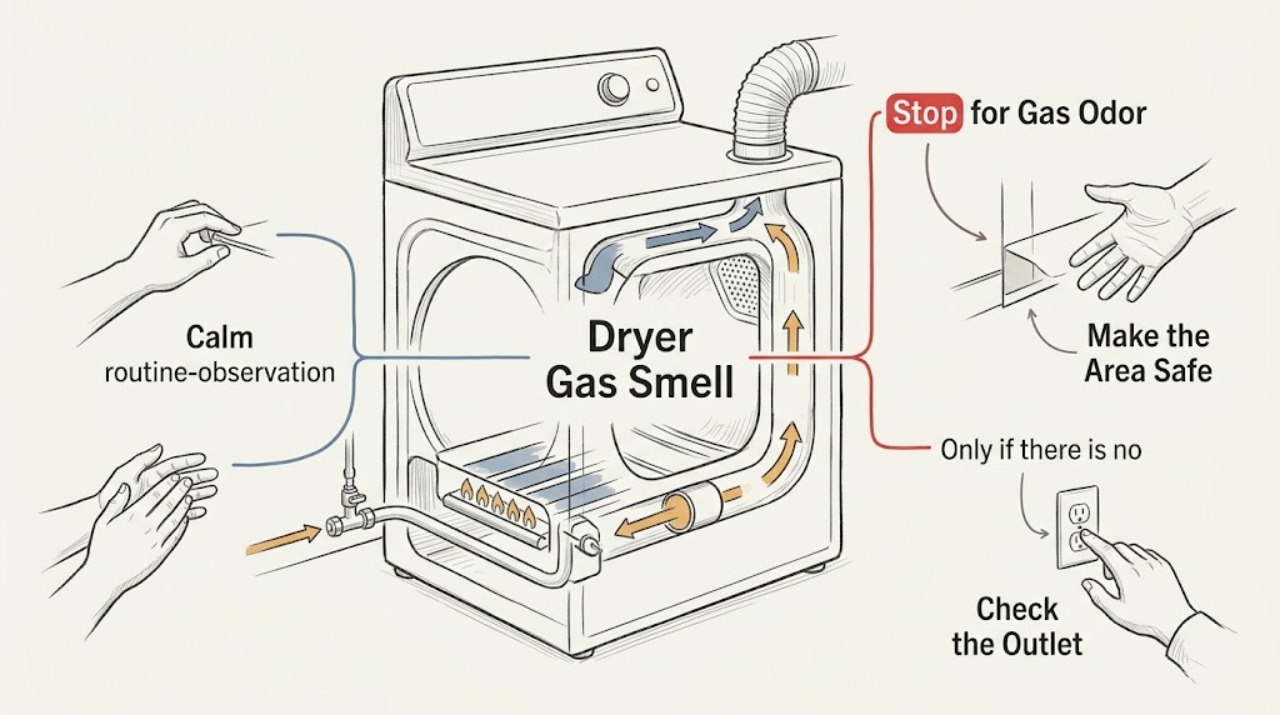
Treat a strong, persistent, or uncertain gas smell as a possible gas leak: stop using the dryer, do not light anything or operate electrical switches, leave the area, and contact your local gas emergency service from a safe location. If it is safe to do so without returning to a hazardous area, the gas supply may be isolated at the meter; do not search for a leak, remove panels, or restart the dryer to test it. A new dryer can have a brief oily or semi-burning manufacturing smell, and lint or room fumes can also be drawn into the drum, but those explanations do not make a sulfur-like gas odor safe to ignore. If the smell returns, the flame appears abnormal through a normal viewing path, the carbon-monoxide alarm sounds, or you are unsure whether the odor is gas, keep the dryer off and arrange qualified gas-appliance service.
Before you begin
Safety first
- Keep the dryer off until cleared. The technician must perform gas-path, combustion, leak, and internal electrical work; the user should not bypass controls, adjust gas components, remove panels, or repeat a heat test to reproduce the smell.
Work through in order
Diagnostic checks
Use only checks that match the exact appliance or system and its official guide.
-
Check 1
If you smell gas strongly, continuously, outside the dryer, or cannot confidently identify the smell, stop the cycle and leave the area without operating switches, lights, plugs, flames, or the dryer controls.
Expected result: The smell remains, becomes stronger, is accompanied by hissing, or more than one person notices it; alternatively, the odor disappears quickly after everyone is safely away.
Next step: From a safe location, contact the local gas emergency service or fire service as appropriate and follow its instructions. Do not re-enter or restart the dryer until the area and appliance have been declared safe.
Why this matters
Why: A persistent or uncertain odor must be treated as a possible gas escape. Odor fading does not prove that the appliance or gas line is safe.
-
Check 2
Only if there is no active odor in the area and it is safe to inspect the appliance identity, read the rating label or model manual to confirm whether the dryer is gas, electric, or another design; do not open the cabinet or disconnect a gas fitting.
Expected result: The documentation identifies a gas dryer, an electric dryer, or does not clearly identify the fuel type.
Next step: For a gas dryer, keep gas-appliance service in scope. For an electric or unidentified dryer, keep the appliance off and have the gas source and surrounding appliances checked rather than trying to prove the dryer caused the odor.
Why this matters
Why: A confirmed gas dryer can have a burner, gas valve, and combustion-air path, but an electric or unidentified dryer does not rule out a nearby gas leak. Fuel type changes the service diagnosis, not the emergency response to an unexplained gas smell.
-
Check 3
After the area has been cleared by the gas-safety responder or no gas emergency is present, classify when the odor occurs: only on first use, only when heat starts, during the whole cycle, at the vent outlet, or even when the dryer is off.
Expected result: The odor is a short-lived oily or semi-burning smell on first use; a musty smell follows damp laundry; or the smell is sulfur-like, recurring, or present while the dryer is off.
Next step: Do not run another heat cycle to confirm an uncertain odor. Record the timing and location for the technician; use only the model's documented first-use procedure after the fuel and gas-safety concern has been cleared.
Why this matters
Why: First-use oils and room or laundry odors can be drawn into a dryer, but a recurring sulfur-like smell or an odor present while off points away from a harmless break-in odor and toward a gas supply, appliance, or nearby-source investigation.
-
Check 4
With the dryer off and cool, make only a visual, external check of the lint screen, vent outlet, and accessible vent hose for heavy lint, a crushed section, or a blockage; do not remove panels or disturb the gas connection.
Expected result: Airflow is visibly restricted, lint is accumulating, the hose is crushed, or the odor seems to be coming from a room or vent rather than a burner area.
Next step: Leave the dryer off if a gas odor was present. Arrange qualified vent and gas-appliance inspection; only perform user-level lint care described by the model manual after the safety concern is cleared.
Why this matters
Why: Restricted exhaust or room fumes can create burning, musty, or chemical odors and can worsen combustion conditions, but clearing a vent does not prove that a gas smell is resolved.
-
Check 5
If the identified model provides a normal viewing method for the burner flame, observe it only from that intended position during a qualified service check; never remove the front, rear, burner cover, or other guard to see the flame.
Expected result: The flame is not visible through the intended viewing path, is yellow or unstable, or the gas odor returns when the burner operates.
Next step: Stop the dryer and schedule a licensed or otherwise locally qualified gas-appliance technician. Do not adjust the burner, gas valve, regulator, vent, or air shutter yourself.
Why this matters
Why: A yellow or unstable flame or returning gas odor requires professional combustion and gas-path diagnosis. A flame that looks normal for a moment does not clear a recurring odor or a carbon-monoxide risk.
-
Check 6
Check whether a carbon-monoxide alarm is sounding or anyone has headache, dizziness, nausea, confusion, or breathing trouble while the dryer or another gas appliance is operating.
Expected result: The alarm sounds or anyone feels unwell; alternatively, no alarm or symptoms are present.
Next step: Leave immediately, get into fresh air, and contact emergency services or the local gas authority from a safe location. Do not return or use any gas appliance until professionals clear the property.
Why this matters
Why: Carbon monoxide cannot be relied on by smell, and an alarm or symptoms make this an urgent exposure concern rather than a routine odor diagnosis.
Use your observations
Decision map
Find the observation that best matches what you see, then follow the next safe action.
-
PATH 01Next step
What you see
The smell is strong, persistent, sulfur-like, accompanied by hissing, or present while the dryer is off.
Do this next
Avoid ignition sources and electrical switches, leave, and contact local gas-emergency help from a safe location. Do not search for the leak or restart the dryer.
Why this path and its safety boundary
Why it matters: Possible unburned gas or a nearby gas leak takes priority over appliance troubleshooting.
-
PATH 02Next step
What you see
The dryer is confirmed electric or the fuel type cannot be confirmed, but the room still smells like gas.
Do this next
Keep the dryer off and use the same gas-emergency response. Do not use the dryer to sample the odor again.
Why this path and its safety boundary
Why it matters: The dryer may be an innocent bystander; a supply line, another gas appliance, or an external source remains possible.
-
PATH 03Next step
What you see
A faint oily or semi-burning odor occurs only during first use, with no gas odor, no alarm, and no smoke or abnormal heat.
Do this next
Ventilate normally, keep combustible materials away, and consult the model manual before any further use. Stop if the smell persists, changes to sulfur-like gas odor, or returns after the initial use.
Why this path and its safety boundary
Why it matters: A temporary manufacturing or dust odor is possible, but the unbranded appliance's model instructions still control any first-use procedure.
-
PATH 04Next step
What you see
The odor is musty or chemical and follows damp laundry, paint, stain, varnish, or solvents near the dryer, with no gas indicators.
Do this next
Stop using the nearby chemicals, ventilate when safe, remove the affected load, and clean only as the model manual directs. Treat any uncertainty as a possible gas odor instead.
Why this path and its safety boundary
Why it matters: The dryer can pull surrounding air into the drum, so the source may be the load or room rather than the burner.
-
PATH 05Next step
What you see
The odor returns with heat, the flame is yellow or unstable through the intended viewing path, the carbon-monoxide alarm sounds, or anyone feels unwell.
Do this next
Stop the dryer, leave if gas or combustion exposure is possible, and arrange qualified gas-appliance service after the emergency response has cleared the area.
Why this path and its safety boundary
Why it matters: Combustion, venting, or gas-supply safety cannot be established by a user-level check.
Helpful context
Understand the symptom
First separate gas odor from other dryer smells
A gas smell is often described as sulfurous or like rotten eggs, while a new appliance can give off a temporary oily or semi-burning odor. Damp laundry can create a musty smell, and paint, stain, solvents, or another room source can be pulled into the drum by the dryer airflow. Descriptions are not a reliable leak test: if the smell is strong, persistent, appears outside the dryer, or cannot be identified confidently, use the gas-emergency path.
Why an unbranded dryer needs model confirmation
Do not assume that every dryer has a gas burner. Confirm the fuel type from the rating label, installation record, or model manual only when there is no active gas emergency. An electric dryer can still be near a leaking gas line or another gas appliance, so the same evacuation rule applies when the source is uncertain. Exact burner, vent, and shutoff instructions belong to the identified model and local gas code.
Safety boundary
Stop conditions
- For a strong, persistent, or uncertain gas smell, do not light anything, operate electrical switches or appliances, restart the dryer, or search for a leak; leave and get gas-emergency help from a safe location.
- Stop immediately for hissing, smoke, fire, a yellow or unstable flame, a carbon-monoxide alarm, headache, dizziness, nausea, confusion, or breathing trouble.
- Do not remove panels, loosen gas fittings, adjust a burner or regulator, bypass a safety device, or perform an energized electrical or gas-leak test.
- Do not resume drying after a gas odor until the gas source, appliance, and venting have been cleared by the appropriate qualified professional.
Only after diagnosis
Potential parts
- gas valve or burner control assembly
Only consider this after qualified testing identifies a gas-valve or burner-control fault; an odor alone does not identify a failed part.
Confirm the exact model, fuel conversion status, local requirements, and manufacturer fit information before ordering. - burner ignition or flame-sensing assembly
Consider this only if service diagnosis links delayed or abnormal burner operation to the ignition or flame-sensing circuit after gas safety has been established.
Part fit and fuel configuration are model-specific; do not substitute a part based only on a similar appearance. - exhaust vent or combustion-air service
Consider vent or airflow work when inspection finds a crushed, blocked, or incorrectly installed exhaust path or inadequate combustion air; it is not a substitute for gas-leak diagnosis.
Use the installation instructions and local code requirements for the identified dryer; internal vent cleaning may require qualified service.
When checks do not resolve it
Need a professional?
Request qualified gas-appliance service when the odor returns during heat, persists after the area is declared safe, the flame is abnormal, the fuel type or installation is uncertain, or the dryer has a gas-path, vent, or combustion concern.
Safety scope: Keep the dryer off until cleared. The technician must perform gas-path, combustion, leak, and internal electrical work; the user should not bypass controls, adjust gas components, remove panels, or repeat a heat test to reproduce the smell.
Common questions
FAQ
Is a gas smell from a dryer ever normal?
A new dryer may briefly emit an oily or semi-burning manufacturing odor, but a sulfur-like, persistent, or uncertain gas odor is not something to validate by repeated operation. Stop and use the gas-safety response.
What should I do first if my dryer smells like gas?
Stop using it, avoid flames and electrical switches, leave the area, and contact local gas-emergency help from a safe location. Do not search for the leak or restart the dryer.
What if the dryer is electric but the room smells like gas?
Treat the odor as a possible nearby gas leak anyway. Keep the dryer off, leave safely, and have the gas source investigated rather than using the dryer to test the smell.
Can a blocked vent cause a gas smell in a dryer?
Restricted venting can contribute to burning odors and unsafe combustion conditions, but vent cleaning does not rule out a gas leak. Keep the dryer off after a gas odor and have gas and venting checked by qualified service.
Can I check the burner flame myself?
Only observe a flame through the model's intended viewing path, if one exists, and never remove panels or guards. A yellow or unstable flame or a returning odor requires qualified gas-appliance service.
Does a carbon-monoxide alarm detect a gas leak?
No. Carbon monoxide is not detectable by smell, and a gas leak can be dangerous before an alarm responds. If an alarm sounds or anyone feels unwell, leave immediately and seek emergency help.
Read the exact guide
Official sources
- Heating your home with gasEnergy Safe Victoria · General gas-safety information; emergency action and service requirements vary by location.
- GE Appliances Dryer Owner's ManualGE Appliances · Manual for specified GE dryer models, used here only for general safety principles applicable to gas dryers; do not infer model compatibility.
- GIS 58: Type A appliance service – the quality and adequacy of air supplyEnergy Safe Victoria · Regulator guidance illustrating why combustion air and ventilation need qualified assessment; local codes differ.
- Problems with your gas supply and heatingOxford City Council · General household gas-safety response; local emergency arrangements vary by jurisdiction.
- Dryer - OdorGE Appliances · Representative manufacturer guidance for dryer odor; exact unbranded model instructions take precedence.
- Removing Odors or Smells - DryerWhirlpool · Representative manufacturer odor guidance; do not use it to dismiss an uncertain gas smell on another model.
- What to do if you smell gasCity of York Council · General gas-odor precautions; follow the gas emergency process for the reader's location.
- GAS DRYER OWNER'S MANUALWhirlpool · Representative gas-dryer manual; exact model and local code control the installation and service details.
Community feedback
Share a repair observation
Share a plain-text repair observation. Accepted observations are published automatically; this page may take a moment to update.