
On this page
Start here
Quick answer
If the odor is gas-like, stop using the Beko dryer and treat it as a gas-safety event: do not create flames or operate switches near the odor, leave if it persists, and contact the local gas emergency service from a safe location. If the odor is instead lint, fuel residue, or hot plastic, keep the dryer off until the load, filter, venting, and installation can be checked; do not open the cabinet or gas train.
Before you begin
Safety first
- Gas-system, combustion, internal heater, wiring, thermostat, control, and safety-device work is not a do-it-yourself procedure. Use emergency gas guidance for an active gas-like odor and qualified authorised service for the appliance.
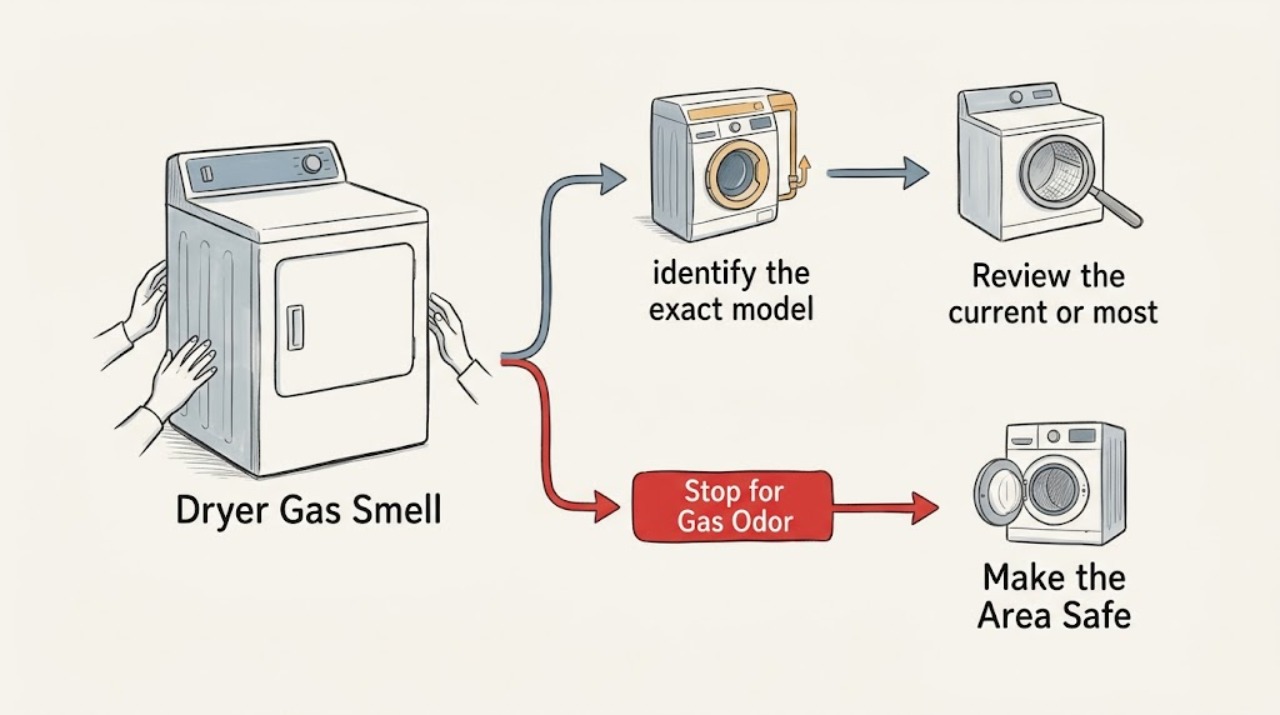
Work through in order
Diagnostic checks
Use only checks that match the exact appliance or system and its official guide.
-
Check 1
Stop the dryer and classify the odor from a safe position without switching the appliance back on.
Expected result: A rotten-egg or sulfur-like odor is present in the room, at the back of the dryer, or continues after the cycle; alternatively the odor is hot plastic, scorched lint, solvent, fuel, or limited to one load of clothing.
Next step: For a gas-like or fuel-like odor, keep people away, avoid flames and nearby switches, move to a safe location, and contact the local gas emergency service. For a non-gas odor, keep the dryer off and continue only with the external checks below.
Stop if: Stop all appliance troubleshooting and leave the area if the gas-like odor persists, becomes stronger, or anyone feels unwell.
Why this matters
Why: The first pattern can indicate unburned gas and an ignition hazard. The other patterns can point to a contaminated load, lint or airflow heating, or an electrical/mechanical fault, but none justifies an immediate restart.
-
Check 2
Once there is no active gas hazard, identify the exact model and whether the dryer has a gas supply connection, using the rating label and the model manual.
Expected result: The installation or manual identifies a gas connection, or the appliance has only an electrical supply and no gas connection; the model identity may still be uncertain.
Next step: If the fuel type is gas or uncertain, do not loosen, tighten, or remove any gas component; arrange qualified appliance service after the area is safe. If it is confirmed electric, keep power isolated only by a safe, normal means away from any gas odor and proceed to the load and lint checks.
Why this matters
Why: Fuel type changes the safe fault boundary. A gas connection makes the hose, connector, valve, burner, ignition and combustion path professional-only checks; an electric dryer cannot be cleared merely because it has no gas line, since an electrical or lint fault can still create a burning odor.
-
Check 3
Review the current or most recent load and its care instructions without putting it back into the dryer.
Expected result: A garment was exposed to gasoline, gas, oil, dry-cleaning solvent, alcohol-based solution, stain remover, or another flammable chemical, or the odor follows that load rather than the empty drum.
Next step: Remove the suspect load only when the area is safe, keep it away from ignition sources, and follow the garment-care and local hazardous-material guidance before any further drying. If no contamination is found, continue to the filter and vent inspection.
Stop if: Do not run the suspect load again to see whether the odor clears.
Why this matters
Why: Beko warns that contaminated laundry can release flammable or explosive vapors during drying. The source may be the load rather than a dryer gas system, but it is still a fire hazard.
-
Check 4
With the dryer off and no gas odor present, inspect only the user-accessible lint filter, vent outlet or hose, and surrounding clearance; do not remove panels.
Expected result: The filter or outlet has heavy fluff, the vent is kinked or obstructed, airflow at the outlet is weak, the dryer is crowded by a wall or cabinet, or nearby lint is warm or scorched.
Next step: Clean the accessible filter as the model manual directs, clear only lint that can be removed without tools, and restore the manual-specified clearance. If the odor, heat, smoke, or weak airflow remains, leave the dryer off and arrange service rather than running a confirmation cycle.
Why this matters
Why: Restricted airflow and accumulated fluff can retain heat and create a fire risk. This finding can explain a hot or scorched odor, but it does not prove that an internal heater, wiring, thermostat, or gas component is safe.
-
Check 5
Record the timing and location of the odor from memory or from a safe observation; do not recreate a dangerous condition.
Expected result: The odor began after installation or reconnection, appears only when heat starts, comes from the exhaust or rear connection, occurs after the drum stops, or returns on multiple loads.
Next step: Give the model, fuel type, odor description, timing, recent move or installation, load details, and filter/vent findings to an authorised appliance service provider. Keep the appliance out of service until that provider gives a safe-use determination.
Why this matters
Why: An installation-linked or heat-linked odor raises concern about the connection, combustion, heater, temperature control, wiring, or airflow. A repeated odor is not normalised by the fact that the dryer still completes a cycle.
-
Check 6
Prepare a service handoff instead of opening the dryer or replacing a gas or electrical component yourself.
Expected result: The gas-like odor persists, the appliance is gas-connected or its type is uncertain, there is smoke/scorching, a damaged cord or connector, abnormal heat, or the odor returns after the accessible filter and load checks.
Next step: Keep the dryer out of service and request an authorised appliance repair assessment. Include the exact model, installation region, fuel type, odor timing, any visible lint or damage, and whether the odor was in the room, exhaust, rear connection, drum, or clothing.
Stop if: Do not remove the rear panel, bypass a safety device, adjust a gas valve, or substitute a part based only on appearance.
Why this matters
Why: These symptoms cross the user-maintenance boundary. Internal gas and electrical faults can remain hazardous even when the visible filter is clean and the machine powers on.
Use your observations
Decision map
Find the observation that best matches what you see, then follow the next safe action.
-
PATH 01Safety boundary
What you see
The odor is gas-like, strongest near the rear or a gas connection, or persists after the dryer is stopped.
Do this next
Treat it as a possible gas leak: avoid flames and nearby electrical switches, move people to a safe location, and contact the local gas emergency service from there.
Why this path and its safety boundary
Safety stop: Stop troubleshooting and do not re-enter until the relevant emergency or gas authority says it is safe if the odor persists.
-
PATH 02Safety boundary
What you see
The manual or installation shows a gas connection, or the fuel type cannot be confirmed.
Do this next
Do not touch the connector, hose, regulator, valve, burner, or ignition system; use qualified appliance service after the area is safe.
Why this path and its safety boundary
Safety stop: Do not infer that an unknown model is electric or gas from the odor, plug, or control panel alone.
-
PATH 03Safety boundary
What you see
The smell follows clothing that may contain fuel, oil, solvent, alcohol-based product, or another flammable residue.
Do this next
Keep that load out of the dryer and follow the garment-care and local safety guidance before cleaning or disposing of it.
Why this path and its safety boundary
Safety stop: Never use a drying cycle as a test for whether flammable residue has gone away.
-
PATH 04Safety boundary
What you see
The filter or exhaust path is visibly packed with lint, restricted, kinked, or surrounded by warm/scorched fluff.
Do this next
Clean only the accessible filter and lint, restore the manual-specified clearance, and keep the appliance off if any odor or excessive heat remains.
Why this path and its safety boundary
Safety stop: Stop if there is smoke, scorching, abnormal heat, or a repeat odor; do not run another cycle for proof.
-
PATH 05Safety boundary
What you see
The smell started after the dryer was moved, installed, converted, or reconnected.
Do this next
Leave the dryer off and have the installation and any gas connection checked by an authorised, appropriately qualified service professional.
Why this path and its safety boundary
Safety stop: Do not tighten or alter a gas fitting or electrical connection as a home test.
-
PATH 06Safety boundary
What you see
The odor returns on more than one load, occurs when heating begins, or is accompanied by smoke, scorching, unusual heat, or a damaged cable.
Do this next
Keep the dryer out of service and request an authorised appliance repair assessment; provide the exact model and the recorded symptoms.
Why this path and its safety boundary
Safety stop: Any gas-like odor, smoke, or worsening smell overrides all other branches and requires immediate safety handling.
Helpful context
Understand the symptom
First separate a gas emergency from an ordinary dryer odor
A dryer can be electric even when the odor is described as gas, and the assigned identity does not establish the fuel type. Do not diagnose by smell alone or assume that a Beko dryer has a gas burner. A rotten-egg or sulfur-like odor in the room, at the rear of the appliance, or around a gas connection must be handled as a possible leak. A hot-plastic, scorched-lint, solvent, or odor-on-clothes report follows a different path, but the dryer should remain off until the safe external checks below are complete.
What not to do
Do not light a match, smoke, use a flame to search for a leak, operate nearby electrical switches, or open the cabinet. Do not test a gas connection by repeatedly starting the dryer. If a cycle was interrupted while clothes are very hot, handle the load cautiously and separate it only when doing so is safe; Beko warns that interrupted drying can leave laundry hot.
Only after diagnosis
Potential parts
Only when the dryer is confirmed safe, there is no gas-like odor, and the filter or vent is visibly damaged or obstructed; a replacement must match the exact model.
Professional-only and only if the exact model and installation require it; do not loosen, tighten, or test the connection yourself.
Professional diagnosis and exact-model confirmation required; never bypass or substitute a safety component.
When checks do not resolve it
Need a professional?
Contact the local gas emergency service immediately for a gas-like odor, especially if it persists or anyone feels unwell. For a confirmed or possible gas dryer, a smell during heating, a post-installation odor, smoke, scorching, excessive heat, a damaged cord or connector, or any odor that returns after the accessible load and filter checks, keep the dryer off and arrange authorised appliance service. Do not open the cabinet, adjust gas controls, bypass a safety device, or replace internal parts as a trial.
Safety scope: Gas-system, combustion, internal heater, wiring, thermostat, control, and safety-device work is not a do-it-yourself procedure. Use emergency gas guidance for an active gas-like odor and qualified authorised service for the appliance.
Common questions
FAQ
Can I keep using the dryer if the gas smell disappears after I stop it?
No. A gas-like odor that disappears does not establish that the source is safe. Do not restart the dryer; follow local gas-emergency guidance and have a possible gas connection or appliance fault assessed.
Could the smell be from clothes rather than the Beko dryer?
Yes, especially if it follows a load exposed to fuel, oil, solvent, alcohol-based product, or another flammable chemical. Do not dry that load again; Beko warns that such items can release flammable vapors during drying.
Is a little hot-plastic smell the same as a gas smell?
Not necessarily. The odor description and location must be separated, but a hot-plastic or scorched odor still warrants keeping the dryer off while checking the load, lint filter, exhaust path, clearance, and installation history. Smoke, scorching, unusual heat, or recurrence requires service.
Can I replace a gas valve, hose, or thermal part myself?
Do not do so based on a symptom alone. Beko states that installation and repair should be handled by authorised service and that components should not be changed unless the manual clearly permits the operation; gas and safety-device work requires qualified assessment.
Read the exact guide
Official sources
- How to use and maintain your Tumble DryerBeko UK · Beko UK tumble-dryer maintenance and fire-safety guidance for lint, load contamination, and interrupted drying.
- Safety InstructionsBeko · Beko safety boundary requiring authorised service for installation and repair and cautioning against unapproved component replacement.
- Kurutma Makinesi Koku YapıyorBeko Türkiye · Beko dryer odor-maintenance article; used for model-manual-based filter cleaning, ventilation/clearance, and distinguishing ordinary dryer odor from a hazard.
- I can smell gas but all hob burners are off?Beko UK · Beko UK gas-odor emergency guidance for an appliance known to be off; used for immediate gas-safety handling, not as evidence that this dryer uses gas.
- Drying SafetyBeko · Beko washer-dryer drying safety guidance for flammable or solvent-contaminated laundry, hot interrupted cycles, and lint accumulation.
- Safety when working with gasBeko · Beko gas-appliance manual guidance for handling a gas odor and restricting gas-system work to qualified persons; apply only if the dryer is gas-connected or the fuel type is uncertain.
Community feedback
Share a repair observation
Share a plain-text repair observation. Accepted observations are published automatically; this page may take a moment to update.