
On this page
Start here
Quick answer
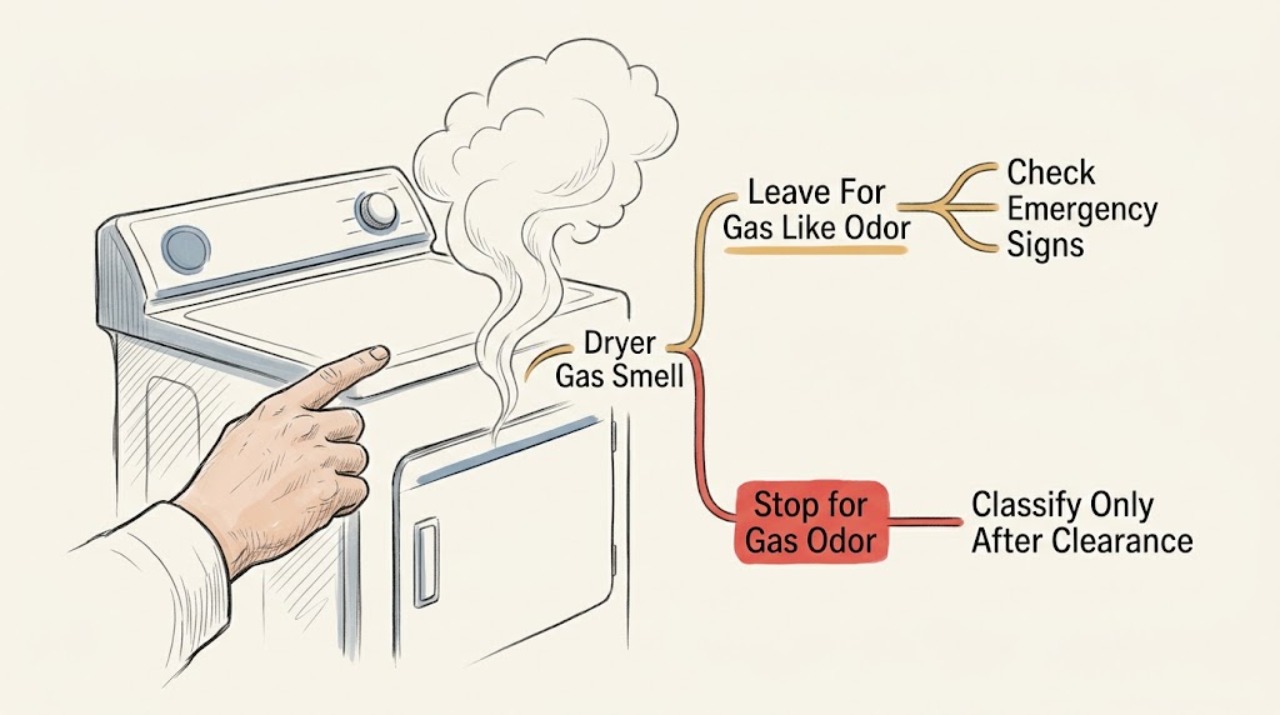
If an odor near an AEG dryer resembles fuel or rotten eggs, or you hear hissing, treat it as a possible gas leak: leave immediately, warn others only without creating a hazard, and contact emergency services and the gas utility from a safe location. Do not operate switches, unplug the dryer, use flames, start a vehicle, open panels, test for leaks, adjust a valve or burner, or re-enter to find the source. A lint, laundry, or new-appliance odor is a different possibility, but never sniff closely or delay evacuation to classify a gas-like smell. Once the area is cleared by the responsible emergency or gas professional, have the exact dryer model, gas installation, venting, and any alarm or symptom checked by a qualified technician.
Before you begin
Safety first
- This article permits evacuation, safe-location reporting, documentation after clearance, and model-directed care of accessible non-gas odor sources only. A qualified professional must assess gas connections, combustion, burners, valves, regulators, ignition, venting, and safety controls.
Work through in order
Diagnostic checks
Use only checks that match the exact appliance or system and its official guide.
-
Check 1
If the odor resembles fuel or rotten eggs, or you hear hissing near the dryer, leave the building or affected area immediately on foot; warn other occupants only if doing so does not delay exit or create a spark hazard.
Expected result: From outside the affected area, record only whether the odor or hissing was present and where it was first noticed; do not go back to confirm, sniff closer, or search for a source.
Next step: From a safe location, contact emergency services and the gas utility, describe the suspected gas odor near an AEG dryer, and follow their instructions.
Stop if: Do not re-enter, operate switches, use flames, start a vehicle, unplug the dryer, or attempt a valve or leak test until the responsible professional says the area is safe.
Why this matters
Why: A gas-like odor or hissing is sufficient to treat the situation as a suspected leak, even if the dryer is off or the odor later becomes less noticeable.
-
Check 2
From a safe location, determine whether there is smoke, fire, a carbon-monoxide alarm, or anyone with headache, dizziness, nausea, weakness, confusion, or breathing difficulty; do not enter to inspect the dryer.
Expected result: Record any alarm, smoke, flame, or symptoms and whether people have reached fresh air; do not silence an alarm or wait for symptoms to resolve indoors.
Next step: Keep everyone out, move to fresh air when safe, and contact emergency services; tell responders about the dryer, the odor, any alarm, and symptoms.
Stop if: Do not re-enter for belongings, reset an alarm, extinguish a gas-fed fire, or investigate the appliance yourself.
Why this matters
Why: An alarm, symptoms, smoke, or flame raises the urgency beyond ordinary odor troubleshooting and may indicate carbon-monoxide exposure or an active fire or gas emergency.
-
Check 3
Only after emergency or gas professionals have cleared the area, and only from ordinary safe access with the dryer unpowered, document whether the reported odor was clearly lint, laundry, or new-appliance odor rather than fuel-like; do not sniff the appliance or remove a cover.
Expected result: Record the odor description, whether it appeared only during drying, whether the dryer was new, and whether the accessible lint filter or heat exchanger maintenance noted in the AEG manual is due; do not infer that a clean filter proves the gas system is safe.
Next step: For a clearly non-gas odor, follow the exact AEG model instructions for accessible lint-filter or heat-exchanger care and stop using the dryer if the odor becomes fuel-like, burning, electrical, or persistent.
Stop if: Do not resume use when the smell is uncertain, returns, resembles gas, accompanies smoke or an alarm, or would require opening panels or disturbing gas or vent components.
Why this matters
Why: A clearly non-gas odor can support an ordinary dryer-care question, while a recurring fuel-like odor, uncertain description, or odor that returns during operation still requires qualified gas-appliance service.
-
Check 4
Without opening the appliance or changing its installation, record the exact AEG model, whether it is gas or electric according to its rating information or manual, installation date, whether the odor began after installation or service, and whether the dryer was running.
Expected result: Classify the record as model and installation known, partly known, or unknown; note any prior service, venting concern, alarm, or odor recurrence observed from a safe position.
Next step: Give the record and any safe exterior observations to the gas utility, emergency responder, AEG support channel, or qualified appliance technician handling the case.
Stop if: Do not remove a rating panel, disconnect tubing, alter venting, bypass a safety device, or use a generic gas-appliance procedure when the model or installation is uncertain.
Why this matters
Why: Known model and installation details help a qualified technician select the correct safety and venting checks; an unknown or recently altered installation increases the need for professional assessment and does not justify guessing the appliance type.
-
Check 5
Arrange qualified appliance or gas-appliance service after the immediate hazard response, and provide the model, odor description, timing, operating state, installation history, and any emergency or alarm information.
Expected result: Ask the technician to state whether the appliance is approved and installed for its fuel type, whether the gas path, combustion, venting, and safety controls are sound, and whether the area is safe to resume use; do not perform those checks yourself.
Next step: Keep the dryer out of service until the qualified technician or responsible gas authority provides a clear safe-use decision and any required repair is completed according to the exact model documentation.
Stop if: Do not relight, adjust, replace, bypass, or test a burner, valve, regulator, ignition part, gas tube, or safety control yourself.
Why this matters
Why: A professional finding identifies whether the cause is an installation or gas-path fault, combustion or venting problem, or a non-gas dryer odor; no single external odor observation can identify a failed component.
Use your observations
Decision map
Find the observation that best matches what you see, then follow the next safe action.
-
PATH 01Safety boundary
What you see
The odor is fuel-like or rotten-egg-like, or hissing is heard near the dryer.
Do this next
Leave immediately and contact emergency services and the gas utility from a safe location.
Why this path and its safety boundary
Why it matters: Treat this as a suspected gas leak regardless of whether the dryer is running or the odor later fades.
Safety stop: Do not re-enter, operate electrical equipment, use flames, start a vehicle, unplug the appliance, or attempt a valve or leak test until cleared.
-
PATH 02Safety boundary
What you see
A carbon-monoxide alarm sounds, someone has compatible symptoms, or smoke or flame is present.
Do this next
Keep people out, reach fresh air when safe, and contact emergency services with the alarm, symptom, smoke, or fire details.
Why this path and its safety boundary
Why it matters: This may be an exposure, fire, or active gas emergency rather than an odor nuisance.
Safety stop: Do not silence alarms, investigate indoors, or attempt to extinguish a gas-fed fire.
-
PATH 03Safety boundary
What you see
The area has been cleared, there was no fuel-like odor or hissing, and the odor is clearly lint, laundry, or new-appliance odor.
Do this next
Follow the exact AEG model care instructions for accessible cleaning only, then stop and request service if the odor persists, becomes burning or electrical, or returns during operation.
Why this path and its safety boundary
Why it matters: AEG identifies accessible lint-filter or heat-exchanger care, laundry odor, and a new-appliance smell as possible ordinary tumble-dryer odor contexts, but this does not authorize gas-component work.
Safety stop: Do not use this branch when the smell is uncertain or gas-like, or when cleaning would require a panel, gas connection, burner, vent, or safety-device intervention.
-
PATH 04Safety boundary
What you see
The odor cannot be confidently classified, returns, follows installation or service, or the model or fuel type is unknown.
Do this next
Keep the dryer out of service and arrange qualified gas-appliance assessment; if the odor becomes fuel-like or hissing occurs, use the immediate evacuation branch.
Why this path and its safety boundary
Why it matters: Uncertainty leaves a possible gas, combustion, venting, or installation hazard unresolved.
Safety stop: Do not guess the fuel type, repeat a smell test, relight the appliance, or continue operating it to see whether the odor clears.
Helpful context
Understand the symptom
A gas-like odor is an evacuation decision, not a dryer troubleshooting step
A fuel-like or rotten-egg odor near a dryer can indicate a gas hazard even when the appliance is not running. AEG's gas-appliance guidance calls for urgent investigation, and PHMSA's suspected-leak guidance prioritizes leaving the area and contacting help from a safe location. Do not stay to identify the leak, operate controls, or open the dryer. The AEG page used here concerns gas cookers; it supports the safety boundary for an AEG gas appliance, not a model-independent dryer repair procedure.
Do not confuse ordinary dryer odors with permission to investigate a gas smell
AEG notes that unpleasant tumble-dryer odors can be associated with lint-filter or heat-exchanger maintenance, laundry odor carried into drying, or a new-appliance smell that fades after cycles. Those possibilities apply only when the odor is clearly not fuel-like and there are no leak, hissing, smoke, alarm, or health-warning signs. Do not return to a potentially contaminated area merely to compare smells; let emergency or gas professionals clear it first.
Model and installation details belong with a qualified technician
AEG dryer designs and installations vary, and CDC guidance says gas appliances should be properly vented and serviced by a qualified technician; an odor from a gas appliance should be checked by an expert. Give the technician the exact model, installation type, when the odor began, whether the dryer was running, any visible lint or vent concern observed only from a safe location, and any alarm or symptom. Do not open panels or work on gas tubing, valves, burners, regulators, ignition, or safety devices.
Safety boundary
Stop conditions
- Leave immediately for a fuel-like or rotten-egg-like odor, hissing, smoke, flame, a carbon-monoxide alarm, or concerning symptoms; contact emergency help from a safe location.
- Do not operate switches, unplug the dryer, use flames, start a vehicle, open panels, or return indoors to locate or confirm a suspected gas leak.
- Do not test for leaks, adjust or replace gas tubing, valves, burners, regulators, ignition parts, or safety controls, and do not bypass an appliance safety device.
- Do not relight or resume the dryer after a gas-like odor until the responsible emergency, gas, or qualified appliance professional has cleared the area and given a safe-use decision.
- If the odor is uncertain, recurring, burning, electrical, or associated with an unknown model or installation, keep the dryer out of service and arrange qualified assessment.
When checks do not resolve it
Need a professional?
Contact emergency services and the gas utility immediately from a safe location for a fuel-like odor, rotten-egg odor, hissing, smoke, flame, carbon-monoxide alarm, or concerning symptoms. After the immediate response, arrange qualified appliance or gas-appliance service for any unresolved, recurring, post-installation, burning, electrical, or uncertain odor. Do not attempt gas-component or venting repairs yourself.
Safety scope: This article permits evacuation, safe-location reporting, documentation after clearance, and model-directed care of accessible non-gas odor sources only. A qualified professional must assess gas connections, combustion, burners, valves, regulators, ignition, venting, and safety controls.
Common questions
FAQ
What should I do first if I smell gas near an AEG dryer?
Leave the area immediately and warn others only if it is safe to do so. Do not operate switches, unplug the dryer, use flames, start a vehicle, or search for the source. Contact emergency services and the gas utility from a safe location, and do not re-enter until the responsible professional clears it.
How can I tell a gas smell from a normal dryer odor?
Do not sniff closely or return to a suspected leak to compare odors. A fuel-like or rotten-egg-like smell, hissing, smoke, an alarm, or uncertainty takes the emergency path. Only after clearance, a clearly non-gas odor may fit AEG's lint-filter, heat-exchanger, laundry, or new-appliance odor guidance.
Can I relight or adjust the gas parts on an AEG dryer?
No. Do not relight, test, adjust, replace, bypass, or disconnect a burner, valve, regulator, ignition part, gas tube, or safety control. Give the exact model and installation details to a qualified gas-appliance technician after the immediate hazard response.
What if a carbon-monoxide alarm sounds or someone feels ill?
Keep everyone out, move to fresh air when safe, and contact emergency services. Tell responders about the dryer, the odor, the alarm, and symptoms. Do not silence the alarm or re-enter to investigate.
Read the exact guide
Official sources
- Pipeline Leak Recognition and What to DoPipeline and Hazardous Materials Safety Administration · PHMSA emergency guidance for suspected gas leaks, including leaving immediately and avoiding ignition or electrical hazards.
- Cookers: Smell of gas, potential gas leakAEG Support · AEG's cooker guidance is used for the immediate gas-odor safety response; it does not establish a model-independent dryer repair procedure.
- Carbon Monoxide Poisoning BasicsCenters for Disease Control and Prevention · CDC safety information for carbon monoxide and fuel-burning appliances; it supports emergency escalation and professional service, not DIY appliance repair.
- Tumble dryer emits unpleasant smellsAEG Support · AEG support guidance for unpleasant odors on heat-pump and condenser tumble dryers; the exact model's manual controls any care procedure and it does not override gas-emergency guidance.
Community feedback
Share a repair observation
Share a plain-text repair observation. Accepted observations are published automatically; this page may take a moment to update.