
On this page
Start here
Quick answer
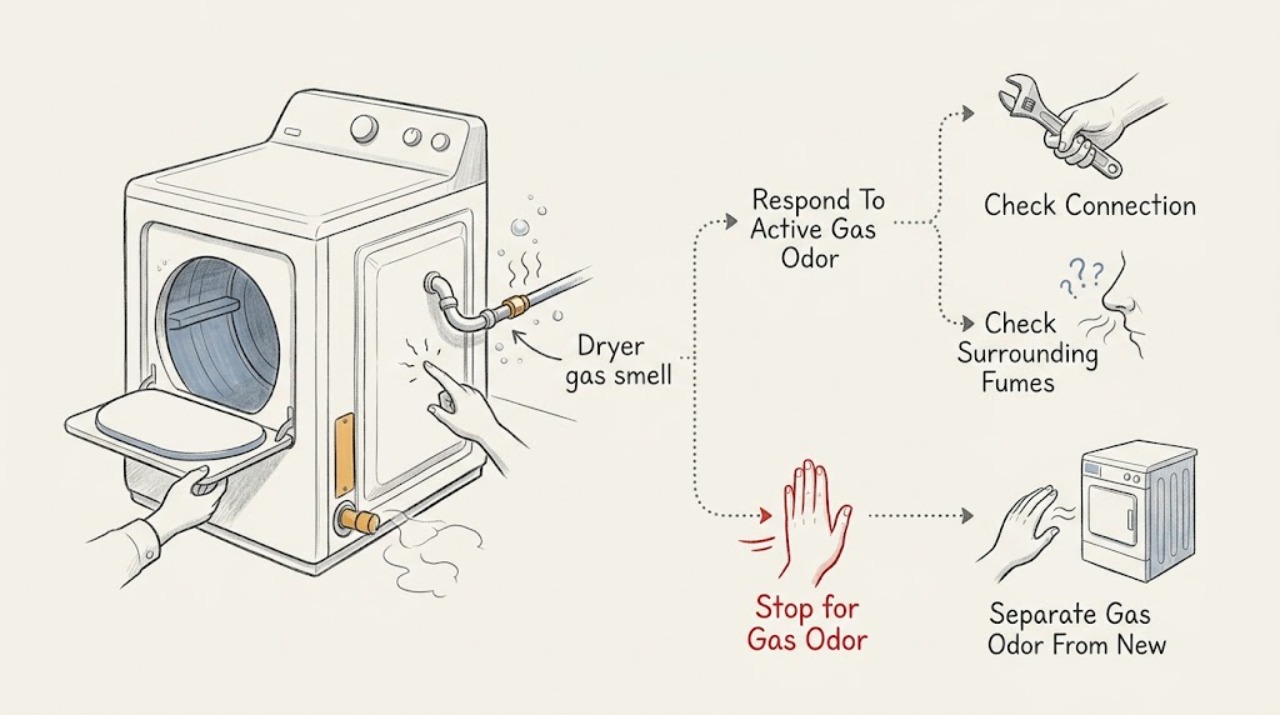
If you smell gas around an Amana gas dryer now, do not start the dryer, light anything, touch electrical switches, or use a phone inside the building. Leave the area and contact the gas supplier or fire department from a safe location, following their instructions. Only after the area has been declared safe should you distinguish a new-dryer oily smell, paint or varnish fumes, a musty load odor, or a visible dryer problem; a recurring gas-like odor needs qualified gas-appliance service, not a test cycle or a guessed part.
Work through in order
Diagnostic checks
Use only checks that match the exact appliance or system and its official guide.
-
Check 1
If the smell is present now or seems gas-like, stop the dryer only if you can do so without touching a switch or creating a spark; otherwise leave immediately. Do not light an appliance, smoke, touch electrical switches, or use a phone inside the building. Clear people and pets from the area.
Expected result: The odor is strong or spreading, anyone feels unwell, or the source cannot be confidently identified; alternatively, the area has been cleared and the gas supplier or emergency responders have given further instructions.
Next step: From outside or another safe location, contact the gas supplier or fire department and follow their instructions. Do not re-enter or restart the dryer until the responsible professional says it is safe.
Stop if: This is already a stop condition whenever the odor is active, gas-like, worsening, or accompanied by hissing, flames, smoke, dizziness, or breathing symptoms.
Why this matters
Why: An active or uncertain gas odor must be treated as a possible gas leak, not as an appliance smell to test. Amana directs occupants to leave and contact the gas supplier from a neighbor’s phone, or the fire department if the supplier cannot be reached.
-
Check 2
Only after the area has been cleared as safe, note whether the dryer is new and whether the smell was described as semi-burning or oily during initial use rather than as fuel gas. Do not use this distinction to dismiss an active gas-like odor.
Expected result: The smell occurred only during initial use, is fading, and has been cleared by the responsible safety professional; or it is recurring, fuel-like, or not clearly classifiable.
Next step: If it is the documented new-dryer odor and the area is safe, follow the model instructions and Amana’s unheated empty-run guidance only as permitted. If it recurs or remains fuel-like, do not run the dryer; arrange qualified service.
Stop if: Stop and return to the gas-safety response if the smell resembles fuel gas, returns when the dryer is off, or anyone is unsure what it is.
Why this matters
Why: Amana says a new gas or electric dryer may emit a semi-burning or oily smell. That guidance does not establish that a gas-like odor from an older dryer is normal.
-
Check 3
After professional clearance, check the surrounding room history without operating the dryer: was paint, stain, varnish, or refinishing work done nearby, or were chemicals stored close to the air intake? Ventilate only as directed by the responsible professional.
Expected result: The odor began after nearby finishing work and is present in the room or on the load, or no such work occurred and the odor is localized to the dryer or gas connection.
Next step: Keep the dryer off until fumes are gone and the area is safe; rewash affected items only after the fumes have cleared. For a localized or unexplained odor, escalate to gas-appliance service.
Stop if: Do not run the dryer while painting, varnishing, or refinishing nearby, and stop if fumes cause irritation or the odor is fuel-like.
Why this matters
Why: Amana explains that a dryer pulls surrounding room air through the load, so paint, stain, or varnish fumes can transfer an odor. A localized or recurring fuel-like odor is not explained by that branch.
-
Check 4
After the area is safe and the dryer remains off, check whether the smell is confined to clothes or came after damp laundry was left in the washer or dryer for a long time. Do not heat a load to mask an unexplained odor.
Expected result: The odor is musty and limited to a stale load, or the drum, room, or gas connection also smells abnormal.
Next step: Rewash the load and remove it promptly only when there is no unresolved gas concern. If the drum or room remains abnormal-smelling, keep the dryer off and arrange service.
Stop if: Stop if the odor is sharp, fuel-like, present with the dryer off, or accompanied by smoke, heat damage, or unusual burner behavior.
Why this matters
Why: Amana says a wet load left too long can develop a mildew odor. That does not account for a fuel-like smell from the appliance or room.
-
Check 5
With the dryer off and the area professionally cleared, observe from a safe standing position whether the visible gas-supply area, connector, shutoff area, exhaust opening, or cabinet shows damage, soot, scorch marks, lint buildup, or a disconnected-looking component. Do not move the dryer or touch fittings.
Expected result: Visible damage, soot, scorching, lint accumulation, or a displaced connection is present; or nothing abnormal is visible.
Next step: Photograph the observation from a safe location and give it to the gas supplier or qualified appliance technician. Do not attempt to tighten, reconnect, clean internally, or relight anything yourself.
Stop if: Stop immediately for any gas odor, hissing, soot, scorching, heat damage, exposed wiring, or a connector that appears loose or damaged.
Why this matters
Why: A visible defect supports keeping the dryer out of service, but a clean-looking exterior does not rule out a leak, combustion problem, or internal fault. Amana requires qualified personnel for installation and service, and says the interior and exhaust duct should be cleaned periodically by qualified service personnel.
-
Check 6
Record what happened before service without recreating the problem: whether the smell appeared when the burner would normally cycle, whether the drum turned, whether heat was absent, whether the smell continued after shutdown, recent installation or gas-supply work, and the full model number.
Expected result: The odor is linked to a recent installation or gas work, appears only during operation, continues while off, or is paired with no heat, unusual noise, soot, or repeated shutdown.
Next step: Keep the dryer off and provide the record, model number, and any photos to the gas supplier or qualified appliance service. Use the model-specific manual for any additional safety instructions.
Stop if: Do not restart the dryer to reproduce the odor or perform a flame, leak, voltage, or combustion test as a homeowner.
Why this matters
Why: Timing and accompanying symptoms help a professional separate the gas supply, connector, burner/combustion, exhaust, and controls. They do not prove which part has failed.
Use your observations
Decision map
Find the observation that best matches what you see, then follow the next safe action.
-
PATH 01Next step
What you see
A gas-like odor is active, worsening, unexplained, or present when the dryer is off
Do this next
Leave the area, avoid flames and electrical switches, and contact the gas supplier or fire department from a safe location.
Why this path and its safety boundary
Why it matters: Treat it as a possible gas leak; the appliance is not ready for another cycle.
-
PATH 02Next step
What you see
The odor was cleared as safe and occurred only during first use as a semi-burning or oily smell
Do this next
Follow the model instructions and only the manufacturer’s permitted empty-run guidance; stop if the smell persists or changes.
Why this path and its safety boundary
Why it matters: This can match Amana’s new-dryer odor guidance, but it is not the same as approving a fuel-gas odor.
-
PATH 03Next step
What you see
Recent paint, stain, varnish, or refinishing work occurred nearby
Do this next
Keep the dryer off while fumes remain, ventilate as safely directed, and rewash affected items after the odor clears.
Why this path and its safety boundary
Why it matters: The dryer may have drawn surrounding fumes into the load or cabinet air path.
-
PATH 04Next step
What you see
The odor is musty and limited to laundry left damp for a long time
Do this next
Rewash the load only after any gas concern is resolved; escalate if the appliance or room also smells abnormal.
Why this path and its safety boundary
Why it matters: A stale load can produce mildew odor, which is different from a fuel-gas odor.
-
PATH 05Next step
What you see
Visible gas-supply, connector, cabinet, soot, scorch, or exhaust damage is present
Do this next
Do not touch or repair the area; provide photos and the model number to qualified service or the gas supplier.
Why this path and its safety boundary
Why it matters: The dryer should remain out of service and the observation should be treated as a professional handoff.
-
PATH 06Next step
What you see
No safe explanation is established or the odor returns after clearance
Do this next
Keep the dryer off and arrange qualified gas-appliance service; do not buy a part based on odor alone.
Why this path and its safety boundary
Why it matters: A normal external observation cannot rule out a leak or combustion fault.
Helpful context
Understand the symptom
Treat the odor before troubleshooting the appliance
A gas-like odor is not a normal invitation to run another cycle. Amana’s safety guide says to avoid flames and electrical switches, clear the area, and contact the gas supplier from a neighbor’s phone; if the supplier cannot be reached, contact the fire department. This article therefore separates emergency response from low-risk odor observations that are appropriate only after the area is cleared as safe.
Not every dryer smell is gas
Amana also describes non-gas odors: a new gas or electric dryer can have a semi-burning or oily smell during initial use; paint, stain, or varnish fumes can be pulled in by the dryer; and damp laundry left too long can develop a mildew odor. Those possibilities do not overrule a gas-like smell. If you cannot confidently separate the odor, use the gas-safety response.
What not to diagnose at home
Do not remove panels, loosen a gas connector, test a valve with a flame, bypass an ignition or door safety, or probe wiring. Amana’s guide places installation and service with a qualified installer, service agency, or gas supplier. A visual note about a damaged hose or fitting is useful; touching or repairing it is not an ordinary-user check.
Safety boundary
Stop conditions
- For an active or uncertain gas odor, do not start the dryer, light anything, touch electrical switches, or use a phone inside the building; leave and contact the gas supplier or fire department from a safe location.
- Do not remove panels, loosen or reconnect gas fittings, move the dryer to inspect behind it, test for leaks with a flame, bypass safety devices, or perform combustion or electrical tests.
- Keep the dryer off for smoke, soot, scorching, hissing, unusual flame or burner behavior, exposed wiring, a damaged connector or cord, symptoms of exposure, or an odor that returns after the area is cleared.
Only after diagnosis
Potential parts
- gas connector or shutoff component
Only consider this category if a qualified professional confirms a supply-side component fault after a gas-safety response.
Do not select or install a gas component from the odor alone; confirm the complete model, fuel type, local requirements, and professional diagnosis. - burner or ignition component
Only consider this category if qualified testing confirms an ignition, burner, or combustion fault after ruling out the gas supply and venting.
A gas smell is not proof of a failed burner part; verify model-specific fit and diagnosis before any replacement. - exhaust or vent component
Only consider this category if professional inspection finds a damaged or restricted exhaust path contributing to unsafe operation or odor.
Vent requirements vary by model and installation; have the complete route inspected rather than choosing a part by symptom.
When checks do not resolve it
Need a professional?
Use the gas supplier or emergency responders for an active or uncertain gas odor. Use qualified gas-appliance service for a returning odor, operation-linked odor, visible damage, soot, abnormal burner behavior, or unresolved no-heat symptoms.
Common questions
FAQ
Is a gas smell from an Amana dryer ever normal?
Do not assume a fuel-gas smell is normal. Amana says a new gas or electric dryer may emit a semi-burning or oily smell during initial use, but an active or uncertain gas-like odor requires the gas-safety response and professional clearance before operation.
What should I do first if my Amana dryer smells like gas?
Do not start the dryer, light anything, touch electrical switches, or use a phone inside. Leave the area and contact the gas supplier or fire department from a safe location, following their instructions.
Can I check the gas shutoff valve myself?
Amana explains the shutoff’s role in gas-dryer heating, but an active gas odor changes the priority to evacuation and professional direction. Do not move the dryer, loosen fittings, or attempt a repair; provide a safe visual observation to qualified service.
Could paint or varnish make my Amana dryer smell?
Yes, Amana says the dryer can pull surrounding paint, stain, or varnish fumes into the air path and load. Keep it off while fumes remain, but use gas-leak precautions whenever the odor is fuel-like or uncertain.
Should I run an empty cycle to test an Amana dryer gas smell?
Not while the odor is active or unexplained. Only after the area is cleared as safe and the odor is identified as the manufacturer-described new-dryer oily smell should you consider the model-appropriate first-use guidance; a returning or fuel-like odor needs service.
Read the exact guide
Official sources
- Removing Odors or Smells - DryerAmana Product Help · Amana dryer first-use, paint/varnish, and damp-load odor guidance
- Dryer is Not HeatingAmana Product Help · Amana dryer heated-cycle and gas-supply context
- Checking the Gas Supply and the Shutoff ValveAmana Product Help · Amana gas dryer supply connection and shutoff function
- Use & Care GuideAmana · Amana dryer gas-safety warnings, installation/service boundary, and lint/exhaust safety
Community feedback
Share a repair observation
Share a plain-text repair observation. Accepted observations are published automatically; this page may take a moment to update.