
On this page
Start here
Quick answer
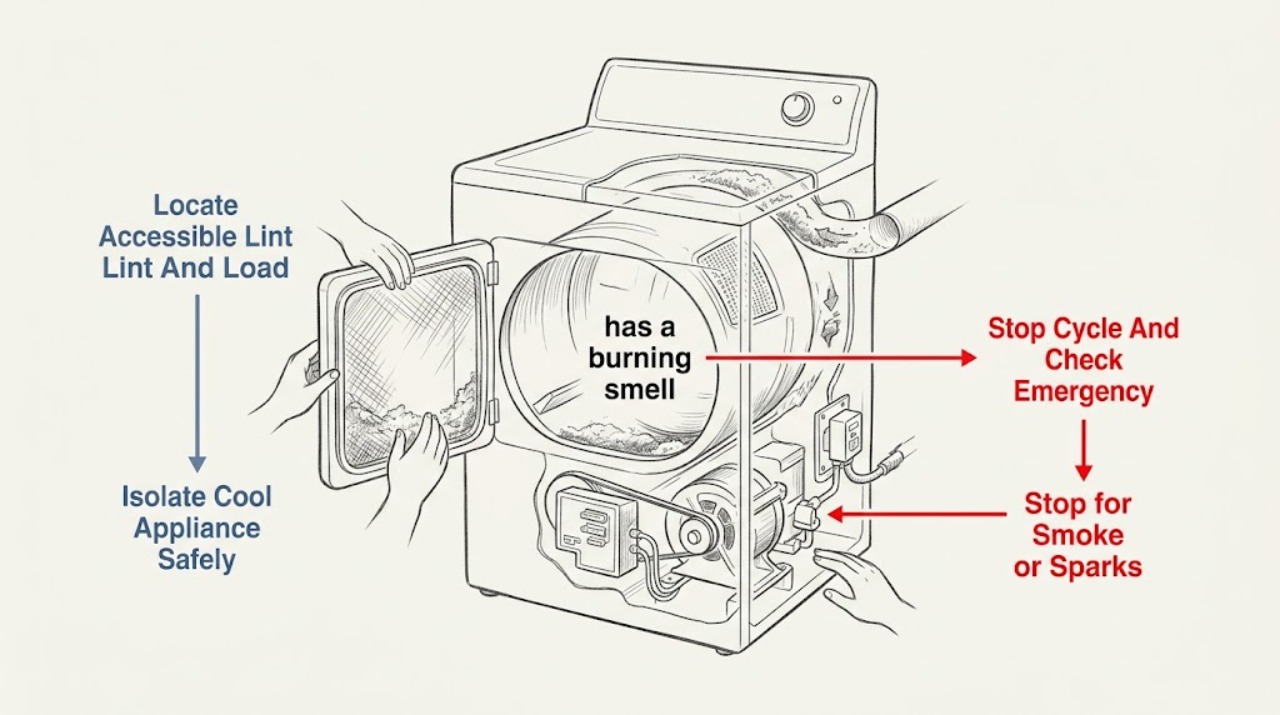
A burning smell plus visible lint is a stop-using symptom, not a normal lint-cleaning reminder. End the cycle, keep the dryer off, and do not restart it to see whether the smell clears. If there is smoke, flame, sparking, a rapidly worsening odor, or a gas smell, leave the area and contact emergency or gas utility help as appropriate. Once the dryer is cool and safe to approach, clean only the lint screen and loose lint that is plainly accessible without opening the cabinet; inspect the outside vent for a visible obstruction, but do not run the machine for an airflow test. CPSC warns that lint in the dryer or exhaust duct can restrict airflow, raise heat, and cause a fire, while manufacturer guidance identifies lint buildup, vent restriction, a load contaminated with volatile substances, and internal components as different service paths. Arrange qualified dryer service before using the appliance again when lint is inside the cabinet, the smell returns, airflow is poor, the vent is blocked, or the source is not clearly limited to loose surface lint.
Before you begin
Safety first
- This article covers stopping operation, emergency recognition, safe external documentation, removable-screen cleaning, and non-operating vent observations only. Do not open the chassis, test energized parts, bypass thermal or gas safety controls, handle hidden lint near a heat source, or reproduce the odor.
Work through in order
Diagnostic checks
Use only checks that match the exact appliance or system and its official guide.
-
Check 1
Stop the dryer cycle and keep the controls Off. From a safe position, look and listen for smoke, flame, glowing material, sparking, a sharp electrical odor, a rapidly worsening smell, or a gas odor. Do not open the door repeatedly or reach into a hot drum.
Expected result: There is smoke, flame, sparking, a strong electrical or gas odor, heat spreading outside the dryer, or only a residual smell with no visible emergency sign.
Next step: For smoke or flame, leave the area, close doors if safe, call emergency services, and do not re-enter until cleared. For gas odor, avoid switches, flames, and anything that can ignite gas, leave immediately, and contact the gas utility or emergency services from a safe location. Otherwise, keep the dryer off and continue only after it has cooled and can be approached safely.
Stop if: Stop immediately for smoke, flame, sparking, an expanding hot area, gas odor, breathing irritation, or any need to move a burning appliance.
Why this matters
Why: Smoke, flame, sparking, spreading heat, or gas odor indicates an active fire, electrical, or gas hazard, not a routine lint check. A residual odor without those signs still leaves overheating or an internal fault possible because lint is visible.
-
Check 2
Once there is no active fire or gas emergency and the dryer is cool enough to approach, leave it disconnected from use. If the power plug is visible, dry, and reachable without moving the machine or touching hot or damaged parts, unplug it; otherwise leave the breaker or gas supply work to a qualified person.
Expected result: The plug and cord are cool and intact, the cord or receptacle is discolored or hot, the machine cannot be safely isolated, or the dryer is gas-fired and a gas-side control would need to be handled.
Next step: Keep the appliance out of service and arrange qualified appliance or electrical service for any cord, receptacle, control, or gas-side abnormality. Do not move the dryer to reach a connection if doing so could crush the vent or expose hot parts.
Stop if: Do not touch a hot, melted, wet, sparking, or damaged plug, receptacle, cord, gas fitting, or control. Do not restore power to investigate the odor.
Why this matters
Why: A cool, intact, accessible plug supports simple electrical isolation, but discoloration, heat, melting, damage, or an inaccessible connection suggests a wiring, receptacle, or appliance fault. A gas-side smell or shutoff issue requires trained handling rather than an improvised adjustment.
-
Check 3
With the dryer cool and isolated, remove the lint screen and note where lint is visible: on the screen, around the screen housing, at the door seal or drum edge, behind the dryer, or inside a panel or cabinet gap. Also record whether the last load contained oily, solvent-like, chemical, or unusually hot items.
Expected result: Lint is limited to the removable screen; lint is around the door, screen housing, rear, or cabinet gap; the last load had volatile residue; or the source cannot be seen safely.
Next step: Clean only the removable screen and loose lint that is plainly reachable without tools or panel removal. Keep chemical- or oil-contaminated items out of the dryer and follow the product-label and CPSC washing or air-drying guidance. Arrange service for lint in a cabinet gap, around a seal, or behind the machine.
Stop if: Do not vacuum or probe inside the cabinet, pull seals, scrape hot residue, or handle chemical-contaminated clothing near ignition sources.
Why this matters
Why: Lint only on the screen can be routine accumulation, but the burning smell still requires a vent and appliance assessment. Lint outside the normal screen path suggests airflow leakage, a seal or duct issue, or hidden accumulation. Volatile residue creates a separate ignition concern even after the appliance cools. Hidden or inaccessible lint cannot be safely judged from the outside.
-
Check 4
Inspect the visible exhaust duct behind the dryer and the outside vent hood without restarting the appliance. Look for a crushed or kinked duct, lint at the outlet, a closed flap, nesting or debris, or a duct that has separated. Do not pull the dryer out or disconnect ducting if doing so could damage the connection or expose hidden lint.
Expected result: The duct is crushed or kinked, the outside hood is blocked or has no clear outlet path, lint is accumulating around the connection, the duct is disconnected, or the visible vent path looks open.
Next step: Keep the dryer off and have the vent system cleaned or repaired before reuse when any restriction, disconnection, or heavy lint is visible. Have a qualified service person inspect internal lint accumulation; do not use a live dryer as an airflow test after an odor event.
Stop if: Do not restart the dryer to test airflow, insert tools into the duct, use a damaged flexible duct, or move the machine across a crushed or hot connection.
Why this matters
Why: A restricted, crushed, disconnected, or obstructed exhaust path can reduce airflow, trap heat, and contribute to lint accumulation. A visibly open hood does not prove the entire duct or internal dryer path is clear, especially after a burning smell.
-
Check 5
Write down when the burning smell began, whether it occurred on heat or air-only operation, whether clothes were unusually hot or damp, whether drying times increased, whether the dryer was new or recently serviced, and whether the smell came from the load, the vent outlet, the drum, or the rear of the machine. Do not run another cycle to reproduce it.
Expected result: The smell followed a new installation or first use; drying times increased or clothes stayed damp; the load had chemical or oil residue; the odor was strongest at the rear or vent; or it recurs without a clear load cause.
Next step: Give the timeline and odor location to the service technician. Keep the dryer out of use until the vent, lint path, load history, and internal components have been assessed; do not treat first-use guidance as permission to operate a lint-visible dryer with a recurring smell.
Stop if: Do not reproduce the smell, bypass a thermal control, open panels, or continue testing a dryer that smells hot, smokes, sparks, or overheats.
Why this matters
Why: GE notes that a first-use odor can come from oils or dust, but a burning smell on an installed dryer should prompt a vent-lint check. Longer drying and damp clothes support restricted airflow, while a rear or recurring odor makes an internal heater, motor, belt, wiring, or exhaust issue more likely. A chemical load can remain hazardous independently of the appliance.
-
Check 6
Before service, photograph the lint location, vent hood or duct condition, cord or receptacle if safely visible, model and serial label, and any affected load or residue. Record whether the dryer is electric or gas and preserve the sequence of events without restoring power or gas operation.
Expected result: The source is clearly limited to loose external lint with no odor recurrence, the lint is inside the cabinet or vent, an electrical or gas abnormality is visible, or the source remains uncertain.
Next step: Arrange qualified dryer service, vent cleaning, or electrical or gas evaluation as indicated. Provide the photos, timeline, visible lint location, drying history, and any prior repair information; leave the dryer out of service until cleared.
Stop if: Do not reinstall panels, reconnect a damaged duct, reset a tripped breaker repeatedly, relight or alter gas components, or run a test load before service when a burning smell occurred.
Why this matters
Why: A cleanable surface does not prove the heating path is safe after a burning smell. Lint inside the cabinet or vent, an abnormal connection, or an uncertain source requires professional inspection before use. Appliance type and model determine safe testing and parts.
Use your observations
Decision map
Find the observation that best matches what you see, then follow the next safe action.
-
PATH 01Safety boundary
What you see
Smoke, flame, sparking, rapidly spreading heat, a sharp electrical odor, or a gas odor is present.
Do this next
Leave the area and call emergency services for smoke or flame. For gas odor, avoid switches and flames, leave immediately, and contact the gas utility or emergency services from a safe location. Do not attempt to move or repair the dryer.
Why this path and its safety boundary
Why it matters: This is an active fire, electrical, or gas emergency, not a lint-maintenance issue.
Safety stop: Do not re-enter to retrieve laundry, restore power, operate controls, or investigate the source while the hazard is active.
-
PATH 02Next step
What you see
Lint is visible beyond the normal screen path, the vent is crushed or blocked, outside airflow was poor during prior use, or drying times increased with a burning smell.
Do this next
Keep the dryer off. Clean only the removable screen and plainly accessible loose lint, and arrange qualified vent cleaning and internal dryer inspection before reuse. Do not restart to confirm airflow.
Why this path and its safety boundary
Why it matters: Restricted airflow and lint accumulation are more likely contributors to overheating and fire risk.
-
PATH 03Safety boundary
What you see
The smell began with clothing contaminated by gasoline, cooking oil, cleaning agents, finishing products, or another volatile substance.
Do this next
Keep the contaminated items out of the dryer, follow the substance and garment-care instructions, and prefer washing again and air-drying where CPSC guidance applies. Have the appliance checked if the smell reached the dryer or recurs.
Why this path and its safety boundary
Why it matters: The load itself may present an ignition risk even if the dryer has no visible component damage.
Safety stop: Do not run or store contaminated items in the dryer, pile them near heat, or use an ignition source while vapors may be present.
-
PATH 04Safety boundary
What you see
The smell is strongest at the rear or cabinet, recurs with ordinary loads, the cord or receptacle is discolored, or lint is inaccessible inside the chassis.
Do this next
Leave the dryer disconnected from use and arrange qualified appliance service plus electrical evaluation when the cord or receptacle is abnormal. Provide the model, type, timeline, photos, and odor location; do not open the cabinet.
Why this path and its safety boundary
Why it matters: A heater, motor, belt, wiring connection, thermal component, seal, or hidden lint path is more likely than a screen-only issue, and the user cannot identify it safely from odor.
Safety stop: Do not remove panels, bypass thermal protection, reset a breaker repeatedly, or operate a dryer with a hot or damaged connection.
-
PATH 05Next step
What you see
The dryer is genuinely new or recently installed, there was no visible lint beyond the normal screen, no emergency sign occurred, and the odor does not recur after the appliance is professionally or manufacturer-guidedly cleared.
Do this next
Follow the exact model's first-use instructions only after confirming the vent, lint screen, connections, and surrounding area are safe. Stop and arrange service if the burning smell returns, lint accumulates abnormally, or the dryer becomes unusually hot.
Why this path and its safety boundary
Why it matters: A first-use oil or dust odor is possible according to GE, but the presence of visible lint and any recurrence prevents assuming this explanation without an appropriate safety check.
Helpful context
Understand the symptom
Treat the combination as a heat and fire warning
A visible lint screen is expected after drying, but a burning smell means the dryer should not be treated as safe simply because the lint is visible and removable. Lint can be present in the screen, around the door, behind the dryer, or inside the chassis, and a restricted exhaust path can keep heat inside the appliance. The first decision is whether there is an active emergency, not whether to run another load.
Separate accessible lint from hidden lint or a component fault
Clean the lint screen and loose lint that can be reached without opening panels, but do not infer that the screen was the only source. CPSC recommends periodic vent and exhaust-duct cleaning and says the interior chassis should be cleaned by a qualified service person. A belt, motor, heater, wiring connection, drum seal, or other internal component can also produce an odor and cannot be identified safely from the smell alone.
Do not overlook the load or a gas-related warning
Oil, gasoline, cleaning agents, and other volatile residues on clothing can remain a fire concern even when the dryer itself has no obvious damage. CPSC advises special care with such items and recommends washing again and preferably air-drying them. For a gas dryer, a gas odor is a different emergency signal from hot lint: avoid switches or flames, leave the area, and contact the gas utility or emergency services according to local guidance.
Safety boundary
Stop conditions
- Do not run the dryer again to reproduce or clear a burning smell when lint is visible; keep it out of service until the cause and safe airflow are assessed.
- Do not open the cabinet, bypass thermal protection, reach near a heater or motor, or vacuum hidden internal parts as an ordinary-user check.
- Stop immediately for smoke, flame, sparking, a gas odor, a hot or damaged cord or receptacle, rapidly spreading heat, or water near electrical equipment; leave and seek emergency help as appropriate.
- Do not use the dryer for clothing contaminated with gasoline, oils, cleaning agents, or other volatile substances; follow product and garment-care guidance and prefer air-drying when appropriate.
- Do not reconnect a crushed or disconnected exhaust duct, use a damaged duct material, repeatedly reset a breaker, or alter gas components before qualified service.
Only after diagnosis
Potential parts
- dryer lint screen or screen housing
Consider this category only when the screen is damaged, missing, warped, or no longer seats correctly and the exact dryer documentation confirms it as the cause of abnormal lint escape.
Confirm the exact dryer model, screen shape, housing, and airflow requirements before ordering; a new screen does not address hidden lint or a blocked exhaust path. - dryer exhaust duct or vent component
Consider this category only when qualified inspection confirms a crushed, disconnected, damaged, or incorrectly configured exhaust path contributing to the odor or restricted airflow.
Confirm the dryer installation instructions, duct material, length, termination, and local requirements; do not select a duct from appearance alone. - dryer heater, motor, belt, or thermal component
Consider this category only after qualified diagnosis isolates an internal heat, drive, or thermal-control fault rather than lint, venting, load contamination, or an electrical connection.
Confirm the exact dryer model, gas or electric type, component ratings, safety controls, and manufacturer fit information before ordering or replacing. - dryer power cord or receptacle
Consider this category only when an electrician or qualified technician confirms heat damage, discoloration, looseness, or a connection fault at the cord or receptacle.
Confirm the dryer's electrical requirements, connection type, ratings, and local code through qualified service; do not replace a connection based on odor alone.
When checks do not resolve it
Need a professional?
Arrange qualified appliance and vent service before reuse for any burning smell accompanied by visible lint outside the normal screen path, longer drying, poor airflow, unusual heat, a recurring odor, lint inside the cabinet, or an uncertain source. Arrange electrical evaluation for a hot, discolored, melted, or damaged cord or receptacle, and gas utility or emergency help for gas odor. A first-use odor can have a limited explanation on a new dryer, but it does not justify operating a dryer with recurring odor or abnormal lint accumulation.
Safety scope: This article covers stopping operation, emergency recognition, safe external documentation, removable-screen cleaning, and non-operating vent observations only. Do not open the chassis, test energized parts, bypass thermal or gas safety controls, handle hidden lint near a heat source, or reproduce the odor.
Common questions
FAQ
Is a burning smell from a dryer with visible lint safe to ignore?
No. Keep the dryer off and do not restart it to see whether the smell clears. CPSC warns that lint in the dryer or exhaust duct can restrict airflow, raise heat, and contribute to fire risk; visible lint outside the normal screen path or a recurring odor needs qualified inspection.
What should I do first when a dryer smells like it is burning?
Stop the cycle and check from a safe position for smoke, flame, sparking, spreading heat, or gas odor. Leave and seek emergency or gas-utility help for those signs. If there is no active emergency, keep the dryer out of use and only clean the cool, removable lint screen or plainly accessible loose lint without opening the cabinet.
Can a blocked dryer vent cause a burning smell?
It can contribute to overheating and odor. CPSC and Whirlpool identify lint, crushed or kinked ducting, and blocked exhaust as airflow problems, with longer drying, damp clothes, unusual heat, and poor air movement as warning signs. Do not run the dryer to test airflow after a burning smell; arrange vent and appliance service.
What if the lint is visible only on the lint screen?
Lint on the screen can be routine, but it does not explain away a burning smell. Clean the screen only after the dryer is cool and isolated, keep the appliance off, and have the vent, hidden lint path, load history, and internal components assessed if the odor recurs or the dryer ran unusually hot or slowly.
Could clothes cause a burning smell in the dryer?
Yes. CPSC advises special care with clothing soiled by gasoline, oils, cleaning agents, finishing products, and similar volatile substances. Keep such items out of the dryer, follow the substance and garment-care instructions, and prefer washing again and air-drying when appropriate.
Can a new dryer have a burning smell?
GE says a first-use dryer can emit an oily or burning odor from assembly oils or dust, but that limited explanation does not cover a recurring smell, visible abnormal lint, smoke, unusual heat, a damaged connection, or gas odor. Keep the dryer off and follow the exact model instructions or arrange service when any warning sign is present.
Read the exact guide
Official sources
- Overheated Clothes Dryers Can Cause FiresU.S. Consumer Product Safety Commission · U.S. CPSC general safety alert for household clothes dryers; manufacturer installation instructions and local emergency guidance also apply.
- Dryer Vent may be Blocked or Restricted - Product HelpWhirlpool · Whirlpool consumer guidance on dryer venting; model installation instructions control duct access and cleaning.
- Owners ManualWhirlpool · Whirlpool owner manual for the identified model family; it is used here for general manufacturer examples, not as a universal dryer procedure.
- Dryer - OdorGE Appliances · GE Appliances consumer support guidance; an unidentified dryer model may differ, and recurring odor or abnormal lint still requires service.
Community feedback
Share a repair observation
Share a plain-text repair observation. Accepted observations are published automatically; this page may take a moment to update.