
On this page
Start here
Quick answer
Treat a burning smell from an Electrolux dryer as a stop-use symptom, not an odor to test away. Stop the cycle, keep the dryer off, and disconnect it from power only when that can be done safely; Electrolux directs users to contact an authorized service center for a burning smell from a tumble dryer. Do not open the cabinet, run another load, or replace a belt, heater, motor, or fuse based only on the smell. Record when the smell began, whether there was smoke or unusual heat, what cycle and load were present, and any display or breaker change. If the smell was only a mild new-appliance plastic odor and the exact manual describes it as expected, that is a separate situation, but a sudden, strong, electrical, or recurring burning smell still requires professional inspection.
Before you begin
Safety first
- Keep the dryer off for burning odor, smoke, scorching, unusual heat, sparking, or electrical damage. Do not open the cabinet, bypass a safety device, or restart it to reproduce the smell.
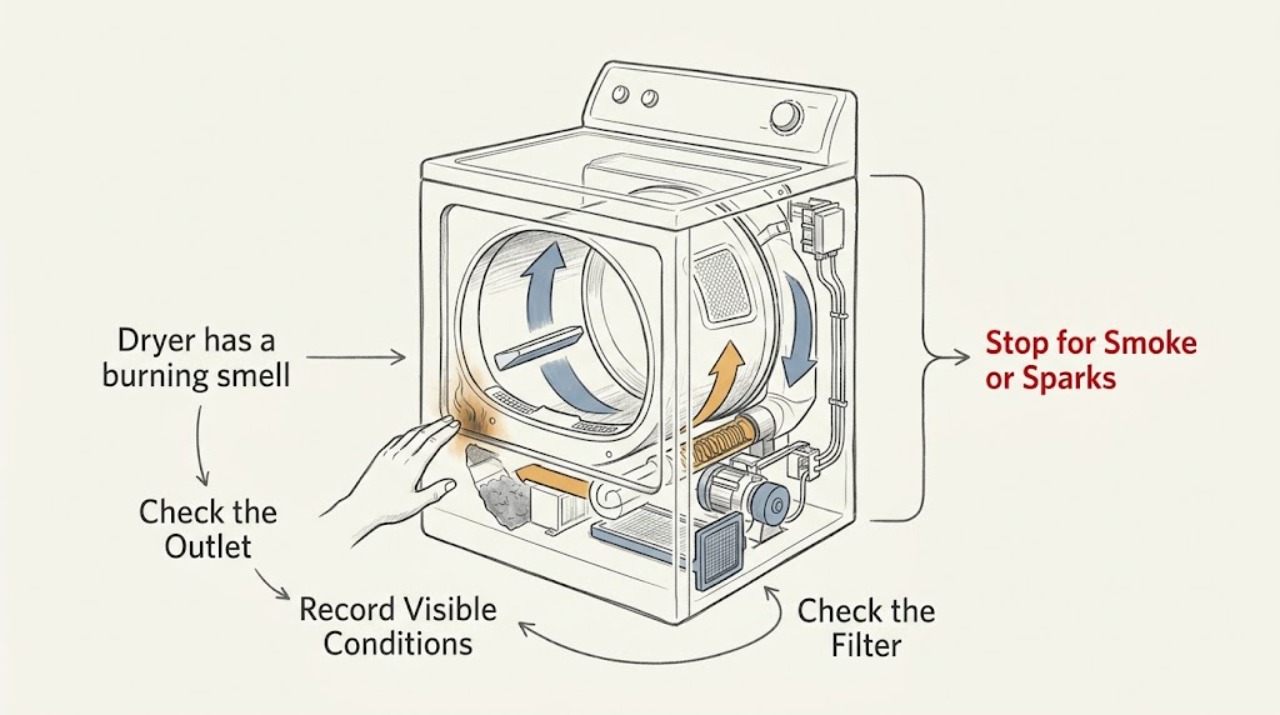
Work through in order
Diagnostic checks
Use only checks that match the exact appliance or system and its official guide.
-
Check 1
Stop the cycle, keep people away from the dryer, and note whether the smell is burning, electrical, rubber-like, or only a mild new-plastic odor. Look from a safe position for smoke, sparks, glowing material, unusual heat, a hot plug or outlet, or a breaker that has opened.
Expected result: There is smoke, sparking, visible scorching, strong or sudden burning odor, unusual heat, a hot or damaged connection, or only a faint new-appliance odor without a safety symptom.
Next step: For a burning smell or any safety sign, leave the dryer off and disconnect power only from a safe location; contact an authorized Electrolux service center. Do not restart it to compare odors.
Why this matters
Why: Smoke, heat, scorching, electrical signs, or a strong burning smell make continued operation unsafe. A mild odor on a new appliance may be a separate manufacturer-described break-in condition, but it cannot be assumed when the odor is strong or recurring.
-
Check 2
Record the exact model or PNC from the rating plate, the selected cycle, load type and approximate size, where the odor was noticed, and whether it began at start-up, during heating, while tumbling, or after the cycle ended. Preserve any display message or flashing indicator.
Expected result: The odor follows a particular cycle or load, began after a change in performance, coincided with a stop or error, or cannot be tied to a time or location.
Next step: Give these observations to the authorized technician and do not run a confirmation cycle while the burning smell remains unresolved.
Why this matters
Why: Cycle stage, load, timing, and model identity help separate a load or maintenance clue from a heating, motor, drive, airflow, or electrical fault. The smell alone is not enough to identify a component.
-
Check 3
After the dryer is fully cool and isolated, inspect only the accessible lint filter, door area, and model-documented condenser or heat exchanger for obvious lint or residue. Do not remove cabinet panels, reach near the heater or motor, scrape internal deposits, or operate the dryer without its required filter.
Expected result: The accessible filter or heat exchanger is visibly restricted, lint or residue is present, the surfaces are clear, or the model has no user-accessible heat exchanger.
Next step: Perform only cleaning expressly described in the exact owner manual and only when no burning or electrical symptom remains. If the odor was burning, report the findings to service instead of restarting to test.
Why this matters
Why: Electrolux links ordinary unpleasant odors and performance problems with filter, heat-exchanger, residue, or airflow maintenance, but a true burning smell still requires the stop-use and service boundary. Clear external surfaces do not rule out an internal fault.
-
Check 4
Review the load and recent operating history without starting another cycle: note overloading, a very small load, trapped fabric, scorching, unusually damp clothes, longer drying, a motor stop, or new noise. Do not use a larger or smaller load as a test while the burning smell is present.
Expected result: The odor followed an overloaded or unusual load, the motor stopped or the dryer became unusually hot, drying had been taking longer, or no load or performance change explains it.
Next step: Keep the dryer out of service and tell the technician the load, heat, stop, and performance history. Do not reset a limiter, open the cabinet, or substitute a component yourself.
Why this matters
Why: Electrolux identifies overload-related motor overheating and thermal-limiter operation as possible reasons a dryer stops, while restricted airflow and heating faults can change performance. These are clues for diagnosis, not permission to keep operating.
-
Check 5
With the dryer disconnected only as the exact manual permits, inspect the visible plug, cord, outlet, and nearby installation for looseness, scorching, melted material, or heat; do not remove an outlet cover or perform an energized electrical test.
Expected result: The cord, plug, or outlet is damaged or hot, the breaker opened, the installation is loose or unusual, or the visible connection appears normal.
Next step: Leave the appliance disconnected and call a qualified electrician for damaged, loose, or hot electrical connections; also arrange Electrolux appliance service for the burning smell. Do not restore power for another test.
Why this matters
Why: A damaged or hot connection is an electrical service issue, not a dryer-part diagnosis. A normal-looking exterior connection does not clear internal heating, motor, drive, or control components.
-
Check 6
Prepare the service request with the model or PNC, serial information, purchase or installation timing, cycle and load, odor description and location, display or breaker behavior, visible lint or scorching, and whether the dryer stopped or made a new noise.
Expected result: The same odor recurs, the dryer stopped, an error returns, the appliance has unsafe heat or damage, or the issue cannot be reproduced because it is being kept off.
Next step: Request authorized service and keep the dryer off until it has been assessed. Do not select a replacement heater, belt, motor, roller, or control from the symptom alone.
Why this matters
Why: Electrolux service guidance treats burning smells, unusual heat, electrical issues, repeated interruptions, and major performance changes as professional-repair conditions. A complete history is more useful than an unsafe repeat run.
Use your observations
Decision map
Find the observation that best matches what you see, then follow the next safe action.
-
PATH 01Next step
What you see
The smell is strong or sudden, or there is smoke, scorching, a hot connection, sparking, or unusual heat.
Do this next
Stop the dryer, disconnect power only from a safe location, keep clear, and contact an authorized Electrolux service center. If there is active fire or smoke that cannot be controlled safely, leave and contact emergency services.
Why this path and its safety boundary
Why it matters: This is a stop-use safety event rather than an odor-maintenance question.
-
PATH 02Next step
What you see
The appliance is brand new and the odor is mild, non-burning, and steadily diminishing, with no smoke, unusual heat, damage, or electrical symptom.
Do this next
Follow only the exact manual's first-use guidance and monitor without ignoring a change. Stop using the dryer and request service if the odor becomes burning, strong, persistent, or is joined by heat, smoke, or electrical signs.
Why this path and its safety boundary
Why it matters: Electrolux says some plastic elements in brand-new appliances can produce an unpleasant smell that decreases after several drying cycles; that description does not cover a strong or persistent burning odor.
-
PATH 03Next step
What you see
The dryer had progressively longer drying, restricted accessible filters or heat-exchanger surfaces, or a changed airflow symptom before the odor.
Do this next
When cool and isolated, perform only manual-directed accessible cleaning. Keep the dryer off and arrange service for a burning odor, recurring restriction, unsafe heat, or any internal inspection.
Why this path and its safety boundary
Why it matters: Lint, residue, condenser or heat-exchanger restriction, or installation airflow may be contributing, but a burning smell still cannot be cleared by cleaning alone.
-
PATH 04Next step
What you see
The odor appeared with an overloaded load, motor stop, unusual noise, or overheating, and the dryer no longer behaves normally.
Do this next
Keep the appliance off and request authorized service. Do not reduce the load and run another cycle while a burning smell remains, and do not reset or replace an internal part yourself.
Why this path and its safety boundary
Why it matters: Electrolux identifies motor overheating and thermal-limiter operation as possible stop-operating conditions; drive, heating, airflow, or control faults remain possible and cannot be selected by odor alone.
-
PATH 05Next step
What you see
There is no burning smell after all, only an unpleasant laundry or stale odor, and the dryer has no unusual heat or electrical symptom.
Do this next
Follow the exact model manual for cleaning the accessible filter or heat exchanger. If the odor is actually burning, sudden, strong, or returns during operation, stop and obtain service.
Why this path and its safety boundary
Why it matters: This is a different odor category from the assigned burning-smell problem and may relate to laundry residue or accessible filter and heat-exchanger care.
Helpful context
Understand the symptom
A burning smell changes the troubleshooting boundary
A warm fabric, stale, or new-plastic odor is not automatically the same as burning. Electrolux distinguishes routine odor and accessible maintenance from a sudden or strong burning smell. Once the odor is genuinely burning, the goal is to stop heat and motion, preserve the evidence, and obtain service rather than use another load as a diagnostic test.
Lint and airflow still matter, but they are not a license to run the dryer
Lint, residue, a restricted filter or heat exchanger, an overloaded load, and a heating or drive fault can produce different symptoms. The exact filter and heat-exchanger access varies by Electrolux design. Only clean or inspect accessible areas when the dryer is cool, isolated, and the owner manual describes the task; do not dismantle the cabinet or disturb internal wiring.
Use the cycle history to help the technician
Write down whether the smell appeared at start-up, once heat was present, while the drum was turning, after a long cycle, or after the dryer stopped. Note load size, fabric, any visible lint or scorching, unusual noise, a stopped motor, an error, or a tripped breaker. These observations narrow the service inspection without requiring another run.
Do not choose a part from the odor alone
A burning odor does not identify a heater, belt, motor, roller, control, or connection. Electrolux's U.S. guidance notes that an overheated motor or activated thermal limiter can stop a dryer, but a technician must determine whether that explanation fits this model and event. Parts remain conditional until diagnosis and exact model fit are confirmed.
Safety boundary
Stop conditions
- Stop immediately for a burning smell, smoke, sparks, scorching, a hot or damaged plug, cord, or outlet, unusual heat, or a breaker that opens. Keep the dryer off and obtain qualified appliance or electrical help.
- Do not run an empty cycle or a different load to test the odor, do not operate without the required lint filter, and do not use a reset to conceal a recurring safety symptom.
- Do not open cabinet panels, reach toward the heater or motor, bypass a thermal or door safety device, alter wiring, or perform an energized electrical test.
- Use the exact Electrolux owner manual for filter, condenser, heat-exchanger, and first-use care. Stop user-level troubleshooting when the odor is strong, recurring, unexplained, or accompanied by a performance change.
Only after diagnosis
Potential parts
- lint filter, condenser, or heat-exchanger assembly
Consider this category only when manual-directed accessible cleaning or qualified inspection identifies a damaged or restricted component connected to the odor or airflow evidence.
Filter, condenser, and heat-exchanger designs vary by Electrolux model and dryer type. Confirm the exact model and diagnosis before selecting a part. - thermal limiter or temperature-protection component
Consider this category only after qualified diagnosis links an overheating or motor-stop event to the model's thermal protection circuit.
Do not reset, bridge, or replace thermal protection based on odor alone; confirm the exact model and service diagnosis. - heating system component
Consider this category only after a qualified inspection confirms a heating or temperature-control fault rather than lint, airflow, motor, drive, or wiring causes.
Heating parts are model-specific and can involve fire and electrical hazards. Confirm exact fit and professional diagnosis. - motor, drive belt, idler, or drum support
Consider this category only when qualified inspection connects a burning rubber or mechanical odor with abnormal noise, resistance, motor overheating, or drive failure.
Drive and support components vary by model and require cabinet access. Do not order by appearance or symptom alone.
When checks do not resolve it
Need a professional?
Arrange authorized Electrolux appliance service for any true burning smell, especially when it is sudden, strong, recurring, accompanied by unusual heat, smoke, noise, a motor stop, an error, or a change in drying performance. Call a qualified electrician for a hot, scorched, damaged, loose, or incorrectly installed plug, cord, or outlet. Keep the dryer off until the cause is assessed.
Safety scope: Keep the dryer off for burning odor, smoke, scorching, unusual heat, sparking, or electrical damage. Do not open the cabinet, bypass a safety device, or restart it to reproduce the smell.
Common questions
FAQ
What should I do first if my Electrolux dryer smells like burning?
Stop the cycle and keep the dryer off. Electrolux's warning covers tumble dryers and directs the user to unplug the appliance immediately and contact an Authorized Service Center. Do not run another load to see whether the smell clears.
Could a new Electrolux dryer have a temporary plastic smell?
Electrolux says some plastic elements in a brand-new appliance may create an unpleasant smell that decreases after several cycles. That does not make a sudden, strong, smoky, electrical, or recurring burning smell safe to ignore; stop use and request service for those signs.
Should I clean the lint filter when my dryer smells burnt?
Do not restart a dryer that has a true burning smell just to clean or test it. Once it is cool and safely isolated, inspect or clean only the accessible filter or heat exchanger if the exact manual describes that task, then report the findings to service rather than assuming maintenance solved the hazard.
Can an overloaded load cause a burning smell in an Electrolux dryer?
Electrolux identifies overload-related motor overheating as one possible reason a dryer stops, but an overload clue does not prove that the motor is the cause of a burning smell. Keep the dryer off and let a qualified technician diagnose the load, airflow, heating, motor, and drive evidence.
When does a dryer burning smell require an electrician?
Call a qualified electrician for a hot, scorched, melted, loose, or damaged plug, cord, or outlet, or an installation that appears incorrect. Also arrange Electrolux appliance service for the burning smell itself, and do not restore power for another test.
Read the exact guide
Official sources
- Washing machine emits a burning smellElectrolux · Electrolux UK safety warning explicitly extending to tumble dryers; local model documentation controls power-isolation details.
- What should I do if my dryer stops operating?Electrolux · Electrolux U.S. dryer support guidance; exact model, fuel type, and service instructions control.
- Expert insights: answers to common questions about your Electrolux tumble dryerElectrolux · Electrolux UK manufacturer guidance; use the exact owner manual and local service process for the appliance's model and region.
- Tumble dryer emits unpleasant smellsElectrolux · Electrolux UK support article for heat-pump and condenser tumble dryers; use the exact model manual for dryer type and accessible maintenance.
Community feedback
Share a repair observation
Share a plain-text repair observation. Accepted observations are published automatically; this page may take a moment to update.