
On this page
Start here
Quick answer
Stop the Amana dryer and do not keep testing a burning smell until you rule out smoke, heat, sparks, a hot plug, a gas odor, or a visible fire or wiring problem. A brand-new dryer can have a mild oily or semi-burning smell during initial operation, but a persistent or strong smell on an established dryer is a stop-and-service symptom. With power isolated from a safe location, clean the lint screen, inspect the accessible vent and outside hood for blockage, look for a load or loose object rubbing the drum, and check whether the smell comes from the room rather than the dryer. Do not open the cabinet to inspect lint, belt, pulley, heater, burner, blower, or wiring. Arrange qualified service for a smell that returns, a restricted vent, a rubbing or binding drum, damaged parts, or any electrical or gas symptom; use a vent-cleaning professional when the home vent run is blocked.
Before you begin
Safety first
- Keep the dryer off for smoke, flame, gas odor, burning or electrical odor, unusual heat, sparks, a hot plug, damaged wiring, or a scorched load. Do not open the cabinet, bypass safety controls, or repeat powered tests in a hazardous condition.
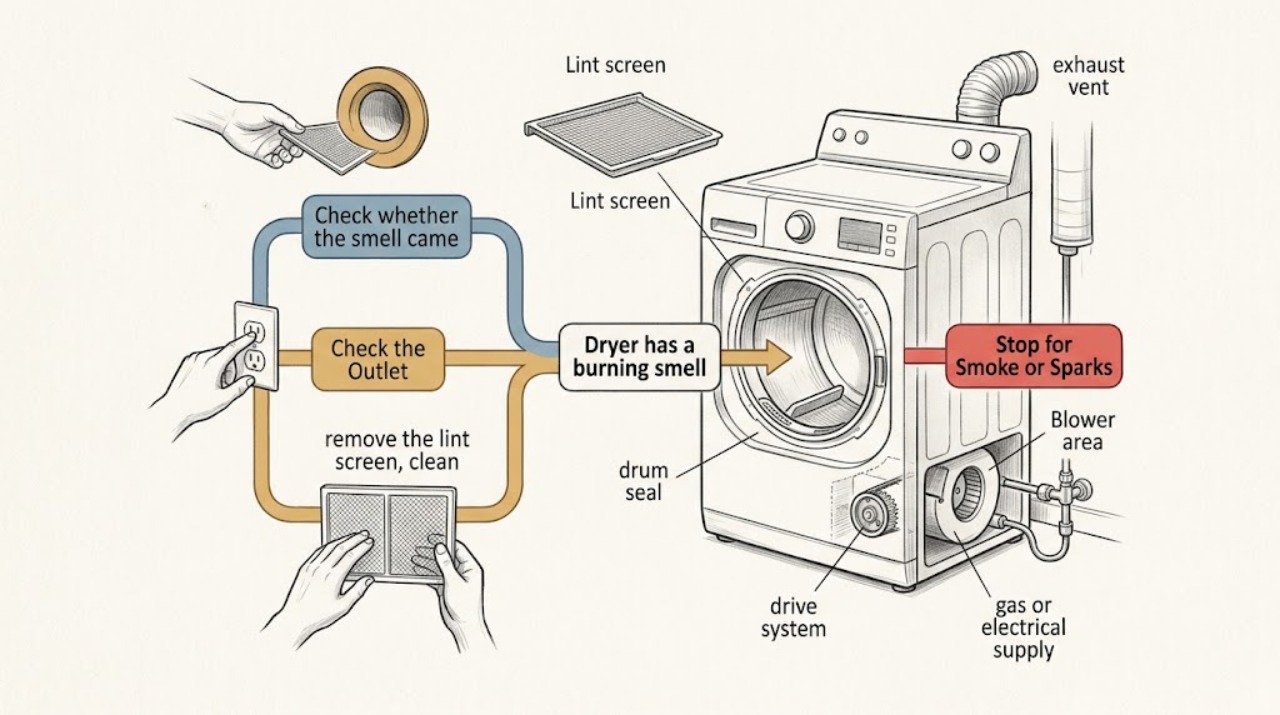
Work through in order
Diagnostic checks
Use only checks that match the exact appliance or system and its official guide.
-
Check 1
Stop the dryer, remove the load only when the drum is stationary and safe, and note whether the smell is electrical, rubber-like, lint-like, oily, gas-like, or from an outside source. Look without touching for smoke, flame, charring, sparks, a hot plug or outlet, damaged cord, or unusual cabinet heat.
Expected result: Smoke, flame, sparks, charring, a hot connection, damaged wiring, strong gas odor, or an otherwise mild smell only on a brand-new dryer is present.
Next step: For smoke, flame, electrical signs, or a gas odor, keep clear, isolate power only from a safe location, do not operate switches or ignite anything, leave the area for gas concerns, and obtain qualified or emergency help. For a mild first-use odor without hazards, follow the exact model manual and continue only if the smell does not persist or intensify.
Stop if: Do not restart to test smoke, a strong burning or electrical odor, gas odor, visible fire, unusual heat, or a hot plug.
Why this matters
Why: Smoke, heat, electrical damage, or gas odor is an immediate fire, shock, or gas-safety event. A mild first-use oily smell is a limited manufacturer-described exception only when no hazard is present.
-
Check 2
Check whether the smell came from the room or load rather than the dryer. Note recent paint, stain, varnish, solvent, or refinishing work near the appliance, and whether clothes were left damp for a long time or contain cooking oil, gasoline, or another flammable substance; do not place a contaminated load back in the dryer.
Expected result: The room was recently refinished, the odor is strongest in room air or on the load, damp clothing was stored, or a load has oil, gasoline, or another flammable residue.
Next step: Ventilate and keep the dryer off until room fumes are gone. Rewash damp clothing as appropriate. Do not dry items contaminated with oil or flammable material; follow the care and disposal guidance for the substance and arrange help if the odor source is uncertain.
Stop if: Never run a load that has gasoline, solvent, cooking oil, or another flammable residue, even if it was washed.
Why this matters
Why: Amana says the dryer draws surrounding air into the load and that nearby coating fumes can transfer odors; damp loads can develop mildew odor. Flammable or oil-contaminated items are a fire hazard independent of the dryer.
-
Check 3
With the dryer cool and power safely isolated, remove the lint screen, clean it according to the model manual, and inspect only the accessible screen housing for heavy lint or a loose object. Reinstall the screen fully before any later operation.
Expected result: The screen is clogged or coated with residue, lint has fallen into the housing, a coin or other object is visible, or the screen and accessible housing are clear.
Next step: Clean and fully dry the screen as the manual directs and remove only a loose object that is plainly reachable without probing. Arrange service for internal lint, a damaged or loose screen, a blower-area object that cannot be safely removed, or a smell that remains.
Stop if: Do not operate with a loose, damaged, blocked, or missing lint screen, and do not push objects deeper into the housing.
Why this matters
Why: Amana states that a blocked or residue-coated lint screen reduces airflow and that objects can fall into the lint chute and contact the blower wheel. Lint inside the cabinet is not an ordinary screen-cleaning task.
-
Check 4
Inspect the accessible vent from the back of the dryer to the wall, the exterior exhaust hood, and the area around the dryer for crushing, kinks, lint, blocked discharge, or items obstructing airflow. Do not remove a heavy dryer or disconnect gas or electrical connections to reach hidden venting.
Expected result: The vent is crushed or kinked, lint or debris blocks the hood, airflow is weak, the unit displays a Check Vent or AF indication, or the visible vent path is clear.
Next step: Leave the dryer off for a burning smell and have the vent run and hood cleaned by a qualified vent professional if blockage is suspected. Correct only a safe, visible crushed section according to the installation manual; service the dryer if airflow or odor remains abnormal.
Stop if: Do not run a heated cycle to test a suspected fire-risk vent restriction, use plastic or foil venting, or reach into hidden ductwork from an unsafe position.
Why this matters
Why: Amana links restricted airflow and AF or Check Vent indications with a clogged screen or vent, crushed or kinked duct, too many turns, or an obstructed hood. A clear accessible path does not rule out a blocked internal or house vent run.
-
Check 5
With the dryer empty, cool, and safely isolated, inspect the front and rear drum edges for a coin, pin, screw, nail, or other hardware caught where the drum meets the cabinet. Check the drum for a rough edge or displaced seal, but remove only a loose object that is safely reachable.
Expected result: A foreign object is at the drum seam, the seal is torn or displaced, the drum has a rough edge, or no object or damage is visible.
Next step: Remove a plainly loose object and keep the dryer off if the seal or drum edge is damaged. Arrange service for a wedged object, damaged seal, persistent rubbing, or any odor that continues after the accessible check.
Stop if: Do not probe the seam with a knife or screwdriver, remove panels, or operate with a torn seal or metal contact.
Why this matters
Why: Amana identifies small hardware at the drum seam as a scraping source; a rough seam or damaged seal can create friction and heat. A clear seam makes an internal support, drive, or blower problem more likely.
-
Check 6
Check that the dryer is stable on all installed feet, is not rocking, and has clearance from nearby appliances or stored items. If the drum can be turned by hand, do so only with power safely isolated and stop if it catches, rubs, wobbles, or requires unusual force; do not remove the belt or panels.
Expected result: The cabinet rocks, a foot is missing, another object touches the dryer, the empty drum catches or rubs, or the dryer is stable and the drum turns smoothly.
Next step: Correct only a safe, visible clearance or leveling issue using the model installation guidance. Leave the dryer off and arrange qualified service for drum drag, wobble, severe vibration, or persistent burning odor.
Stop if: Do not move a heavy dryer alone, drag it with gas or electrical connections attached, or force a binding drum.
Why this matters
Why: An unstable cabinet can add vibration, while repeatable empty-drum drag points toward a seal, glide, roller, bearing, belt, pulley, or alignment fault rather than a load issue.
-
Check 7
Do not open the cabinet or perform energized checks. Instead, document whether the smell returns with no load, whether the drum rotates freely by hand when isolated, whether the vent warning remains, and whether the odor is accompanied by scraping, squealing, long dry times, heat, smoke, or a gas symptom.
Expected result: The smell is gone after an external correction, returns with an empty drum, accompanies a scraping or squealing sound, returns with long dry times or a vent warning, or persists without an identifiable external cause.
Next step: Use the dryer only when the smell and any hazard are gone and the model guidance permits operation. For a recurring or unexplained smell, leave it off and arrange qualified Amana service; request vent service separately for a blocked house vent.
Stop if: Do not continue operating to narrow down an unexplained burning smell, and do not open panels or bypass thermal, door, gas, or electrical safety controls.
Why this matters
Why: A resolved external lint, vent, room, or load source is different from persistent empty-drum odor or noise, which may involve internal belt, pulley, roller, seal, blower, heater, burner, motor, or wiring components.
Use your observations
Decision map
Find the observation that best matches what you see, then follow the next safe action.
-
PATH 01Next step
What you see
The dryer is new and has only a mild oily or semi-burning smell, with no smoke, unusual heat, electrical sign, gas odor, or damaged load.
Do this next
Follow the exact model instructions and monitor without a load only if the appliance is otherwise safe. Stop and arrange service if the odor persists, intensifies, or is accompanied by smoke, heat, sparks, or abnormal noise.
Why this path and its safety boundary
Why it matters: Amana describes a limited first-use odor for new gas or electric dryers; this does not cover a strong or worsening smell.
-
PATH 02Next step
What you see
The room was recently painted, stained, varnished, or refinished, and the smell is strongest in the room or on the load.
Do this next
Ventilate the area and do not operate the dryer until fumes are gone. Rewash and dry affected clothing only after the air is safe; service the dryer if its own odor remains.
Why this path and its safety boundary
Why it matters: The dryer may be drawing surrounding fumes into clothing rather than producing the smell internally.
-
PATH 03Next step
What you see
The load contains oil, gasoline, solvent, or another flammable residue, or the load is unusually hot or scorched.
Do this next
Do not put the load back in the dryer. Keep it away from ignition sources and obtain substance-specific safety guidance; arrange service if the dryer was exposed to smoke or residue.
Why this path and its safety boundary
Why it matters: The load itself can create a fire hazard; washing does not necessarily remove oil or flammable contamination.
-
PATH 04Next step
What you see
The lint screen is blocked, lint is visible in the housing, the Check Vent or AF indication appears, or the outside hood has weak airflow.
Do this next
Clean the screen and have the vent run and hood cleaned as needed. Keep the dryer off for an active burning smell, and do not remove cabinet panels as a homeowner vent repair.
Why this path and its safety boundary
Why it matters: Restricted airflow is more likely and can increase heat and drying time; internal lint requires qualified cleaning.
-
PATH 05Next step
What you see
The smell changes with drum rotation, a hard object is trapped at the seam, the seal is damaged, or scraping or squealing accompanies the odor.
Do this next
Remove only a loose seam object that is safely reachable. Otherwise leave the dryer off and arrange qualified service for the rubbing or noise; do not keep running it to identify the part.
Why this path and its safety boundary
Why it matters: Friction from an object, seal, glide, roller, belt, pulley, blower, or other internal part is more likely than a room odor.
-
PATH 06Next step
What you see
The dryer is gas-fired and the smell resembles gas, or the odor occurs near a gas connection rather than only during normal tumbling.
Do this next
Do not light an appliance or operate electrical switches. Leave the area and contact the gas supplier or emergency services from a safe location according to local gas-safety instructions; arrange qualified dryer service after the area is declared safe.
Why this path and its safety boundary
Why it matters: A gas-safety event cannot be diagnosed by a homeowner dryer cycle or smell comparison.
-
PATH 07Next step
What you see
Smoke, sparks, a hot plug, unusual cabinet heat, charring, damaged wiring, or a burning odor returns with an empty drum.
Do this next
Stop immediately, isolate power only from a safe dry location, keep clear, and arrange qualified or emergency help. Do not open the cabinet or restart for another test.
Why this path and its safety boundary
Why it matters: Continued operation could cause fire, shock, or mechanical injury; an internal heater, motor, control, belt, blower, or wiring fault is possible.
-
PATH 08Next step
What you see
The smell disappears after a safe external lint, vent, room, or load correction and does not return during normal use.
Do this next
Maintain the lint screen and vent system and avoid contaminated loads or nearby fumes. Stop and arrange service if the smell, heat, noise, or vent warning returns.
Why this path and its safety boundary
Why it matters: The corrected external source is more likely than a failed internal component, but recurrence changes the decision.
Helpful context
Understand the symptom
Treat a burning smell as a safety symptom first
The smell alone cannot tell you whether lint is heating, a belt or support is rubbing, a load contains oil or another flammable substance, or an electrical or gas fault is present. Stop the dryer, let it cool, and record whether the smell came from the drum, rear vent, plug, outlet, room, or gas connection. Smoke, visible charring, sparks, unusual heat, or gas odor ends the homeowner check immediately.
Airflow and lint are separate from internal repairs
Amana's guidance requires a clean lint screen and unobstructed vent system. A crushed or blocked vent can reduce airflow and extend heating, while lint inside the cabinet can require a qualified servicer to remove panels. Inspect only the screen, accessible venting, and outside hood; do not use a burning-smell report as a reason to vacuum or probe energized internal parts.
New-dryer and room odors need a narrow exception
Amana says a new gas or electric dryer may emit a semi-burning or oily smell during initial operation, and fumes from nearby paint, stain, or varnish can be drawn into the dryer. This does not make smoke, a strong electrical smell, a hot connection, or a gas odor normal. Ventilate the room and follow the exact model instructions only when no safety sign is present; otherwise leave the dryer off and obtain help.
Safety boundary
Stop conditions
- Stop immediately for smoke, flame, sparks, charring, a hot plug or outlet, unusual cabinet heat, damaged wiring, or a strong burning or electrical odor. Isolate power only from a safe location, keep clear, and arrange qualified or emergency help.
- For a gas-like odor, do not light an appliance or operate electrical switches. Leave the area and follow local gas-supplier or emergency instructions from a safe location.
- Do not dry gasoline-, solvent-, cooking-oil-, or other flammable-contaminated items. Do not restart a load that has scorched or produced smoke.
- Do not open the cabinet, remove panels, probe the blower or heater, remove a belt, bypass thermal or door safety devices, or perform energized tests as a homeowner check.
- Do not operate with a blocked, loose, damaged, or missing lint screen, a crushed or unsafe vent, a damaged cord, a torn drum seal, a binding drum, or persistent metal contact.
Only after diagnosis
Potential parts
- dryer lint screen
Consider this only if the lint screen is damaged, loose, or cannot be cleaned and seated correctly after inspection; a burning smell alone does not prove the screen needs replacement.
Lint-screen location and fit vary by Amana dryer model. Confirm the exact model and safe installation before selecting a replacement. - dryer drive belt
Consider this only when qualified diagnosis confirms belt wear, slippage, heat damage, or drive friction after vent, load, and accessible-object causes are excluded.
Drive belts are model-specific and require cabinet access. Confirm the exact model and service diagnosis before ordering or fitting one. - dryer vent cleaning kit
Consider this only when a visible or measured restriction points to lint in the vent run or outside hood; use a vent professional when the run is hidden, long, or unsafe to access.
A vent tool does not replace correction of a crushed or incorrectly installed vent. Confirm the kit's intended use and follow the dryer installation guidance.
When checks do not resolve it
Need a professional?
Request service for any unexplained or recurring burning smell, a restricted vent that is not safely accessible, internal lint, drum friction, damaged seals, drive noise, an electrical symptom, or a gas-dryer odor after emergency gas precautions are complete.
Safety scope: Keep the dryer off for smoke, flame, gas odor, burning or electrical odor, unusual heat, sparks, a hot plug, damaged wiring, or a scorched load. Do not open the cabinet, bypass safety controls, or repeat powered tests in a hazardous condition.
Common questions
FAQ
Why does my Amana dryer smell like something is burning?
Stop it first. A new dryer can have a mild oily smell, but an established or strong odor may involve restricted vent airflow, lint, a contaminated load, drum friction, or an electrical, gas, heater, or drive fault. Smoke, heat, sparks, or gas odor require immediate safety action.
Is a burning smell normal on a new Amana dryer?
Amana says a new gas or electric dryer may emit a semi-burning or oily smell during initial operation. Treat that as a limited exception only when there is no smoke, unusual heat, electrical sign, gas odor, scorched load, or worsening smell; follow the exact model guidance and stop if it persists.
Can a blocked dryer vent cause a burning smell?
Restricted airflow can increase drying time and heat, and Amana links a Check Vent or AF indication with lint, crushed or kinked venting, too many turns, or an obstructed hood. Keep the dryer off for a burning smell and have the vent path inspected or professionally cleaned.
Can oily or gasoline-stained clothes cause a dryer fire smell?
Yes. Amana warns not to dry items that have had flammable material or oil on them, even after washing, because a dryer can ignite remaining residue. Do not put a contaminated or scorched load back in the dryer.
What if the burning smell comes with scraping?
Turn the dryer off and inspect the front and rear drum seams for a loose coin, pin, screw, nail, or other hardware. If the drum rubs or binds when empty, or the seal is damaged, do not run it; arrange service for the internal drum or drive system.
Should I open an Amana dryer to clean lint inside?
No. Clean the accessible lint screen and inspect visible venting, but Amana's manual says lint inside the cabinet should be removed by a qualified servicer. Do not remove panels or test a dryer with an active burning smell.
What should I do if an Amana gas dryer smells like gas?
Do not light an appliance or operate electrical switches. Leave the area and follow your local gas supplier or emergency instructions from a safe location. Arrange qualified dryer service only after the gas concern has been made safe.
Read the exact guide
Official sources
- Check Vent Light on DryerAmana · Amana Product Help article; installation requirements and warning indicators vary by model.
- Scraping Sound - DryerAmana · Amana Product Help article; drum access and seal design vary by model.
- Not Collecting Lint - DryerAmana · Amana Product Help article; vent layouts and screen locations vary by model.
- Squealing or Squeaking Sound - DryerAmana · Amana Product Help article; internal component access requires model-specific service procedures.
- Removing Odors or Smells - DryerAmana · Amana Product Help article; odor behavior and controls vary by model.
- Owner's ManualAmana · Amana owner manual for specified models; use the matching manual for another dryer.
- AF or "Check Vent" - DryerAmana · Amana Product Help article for applicable dryer models; indicator behavior varies by model.
Community feedback
Share a repair observation
Share a plain-text repair observation. Accepted observations are published automatically; this page may take a moment to update.