
On this page
Start here
Quick answer
Stop using the dryer as soon as a burning smell appears. If the dryer is cool enough and the plug is clearly reachable without touching hot equipment, unplug it; do not reach behind it, open the cabinet, disturb the vent, or operate it again to test the odor. If there is smoke, flame, crackling, a worsening hot-electrical smell, or a gas-like odor, get people out, call emergency help from a safe location, and do not re-enter to investigate. Otherwise, record only safe external observations—when the odor began, whether smoke was visible, whether the cord or outlet looks damaged from a distance, whether lint is visible around accessible exterior areas, and whether the outdoor vent flap is visibly obstructed without running the dryer—then arrange qualified appliance service and, when the exhaust path is implicated, professional vent service.
Before you begin
Safety first
- Do not run another cycle, touch hot equipment, open the cabinet, remove panels, disconnect the vent, test wiring, adjust gas parts, or attempt a repair. Unplug only when cool, dry, clearly reachable, and safe.
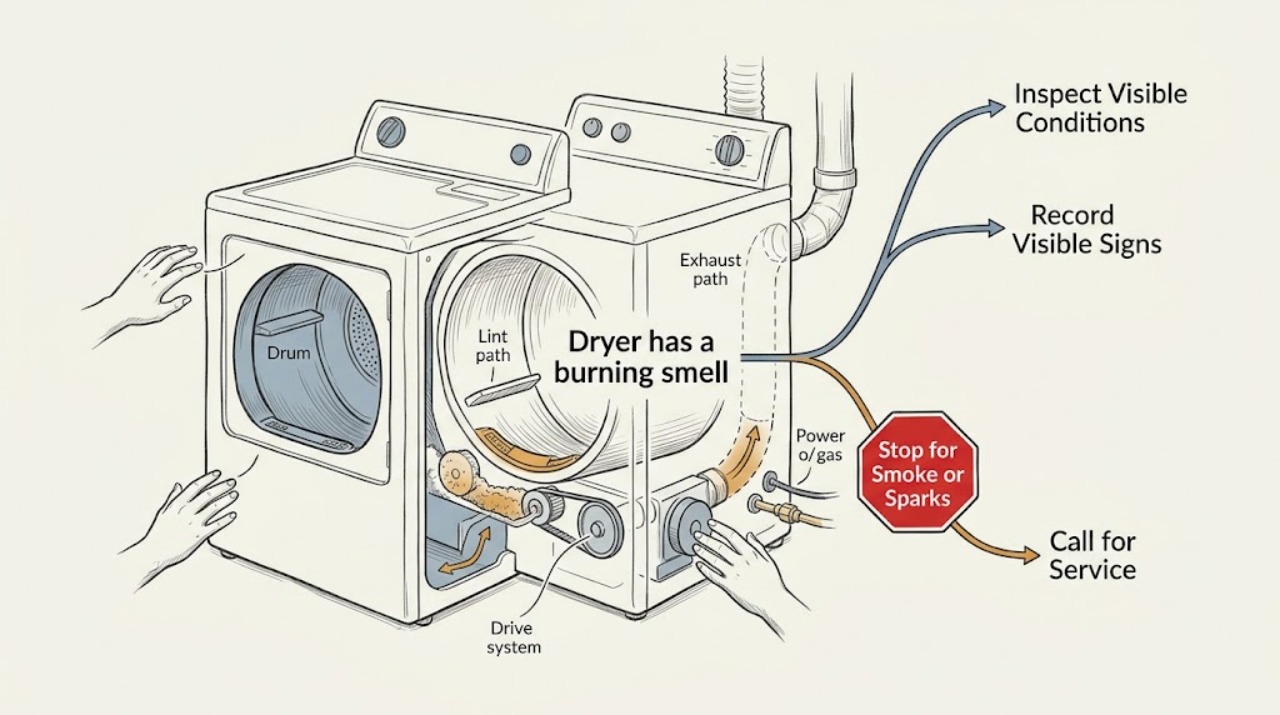
Work through in order
Diagnostic checks
Use only checks that match the exact appliance or system and its official guide.
-
Check 1
From a safe position, observe whether there is smoke, flame, glowing material, crackling, a rapidly worsening odor, or a gas-like odor; do not approach the dryer or attempt another cycle.
Expected result: No emergency sign is visible, or smoke, flame, crackling, a worsening electrical odor, or a gas-like odor is present.
Next step: For an emergency sign, evacuate and call emergency help from outside or another safe location. If none is present, keep the dryer out of service and continue only with distant observations.
Stop if: Stop immediately and leave if smoke, flame, crackling, a burning electrical odor, or a gas-like odor is present.
Why this matters
Why: Any visible fire or smoke is an emergency. A gas-like odor or electrical warning can make approaching, switching, unplugging, or further inspection unsafe.
-
Check 2
From a cool, dry, accessible position, look at the visible cord, plug, and wall outlet without pulling, touching hot parts, moving the dryer, or operating a switch.
Expected result: The visible cord and outlet look normal, or there is discoloration, melting, looseness, charring, a damaged plug, or a cord that appears pinched.
Next step: Keep the dryer out of service and tell the appliance technician exactly what is visible; request qualified electrical assessment when the outlet, plug, or cord appears damaged. Unplug only if it is cool, dry, clearly reachable, and safe without approaching a warning sign.
Stop if: Stop and move away if the outlet or cord is hot, smoking, wet, sparking, charred, or difficult to reach safely.
Why this matters
Why: Visible damage points to an electrical safety issue and does not justify a reset or live test; a normal appearance does not rule out an internal fault.
-
Check 3
Without opening the cabinet or touching the dryer, look from outside for visible lint or debris around the floor, nearby exterior surfaces, and the accessible lint-screen area after the appliance has cooled; note whether the surrounding area is unusually warm or cluttered.
Expected result: Visible lint or clutter is present, or the surrounding exterior appears normal; no heat is assessed by touch.
Next step: Keep combustibles away without reaching toward a hot appliance, record the observation, and ask a qualified technician to inspect the internal lint path and dryer condition before any reuse.
Stop if: Stop if the area is hot, smoke is present, material is glowing, or looking closer would require touching, reaching behind, or opening the dryer.
Why this matters
Why: Visible lint or clutter is a service clue because lint and heat can contribute to fire risk, but it does not prove that the lint screen, heater, or internal chassis is the source.
-
Check 4
From a safe ground-level location, look at the outdoor dryer-vent cover only if it is already visible without climbing or disassembling anything; do not run the dryer to check airflow and do not remove ducting.
Expected result: The cover is visibly unobstructed, visibly blocked, damaged, or cannot be seen safely.
Next step: Tell the technician what was visible and arrange professional vent assessment; leave the dryer off until the burning smell has been evaluated.
Stop if: Stop if viewing requires a ladder, roof access, reaching into the vent, weather exposure, or contact with the duct or cover.
Why this matters
Why: A visible obstruction or damaged cover is a useful exhaust-service clue, while an unobstructed cover does not clear the concealed duct or dryer.
-
Check 5
From a safe location, record when the odor started, whether it appeared at start-up or later, whether it changed with the load, and whether the smell was rubber-like, smoky, electrical, or gas-like; do not restart the dryer to reproduce it.
Expected result: The odor was a single event or recurring event, and its character and timing are known or uncertain.
Next step: Provide the timeline and load details to qualified appliance service, including any smoke, visible damage, or unusual drying time; keep the appliance out of use until cleared.
Stop if: Stop documenting and leave if the odor becomes stronger, smoke appears, or anyone develops symptoms from fumes.
Why this matters
Why: Timing and odor character help a technician prioritize the drum/drive area, exhaust path, electrical supply, or gas safety review, but they cannot identify a part without professional inspection.
Use your observations
Decision map
Find the observation that best matches what you see, then follow the next safe action.
-
PATH 01Safety boundary
What you see
Smoke, flame, crackling, glowing material, a rapidly worsening electrical odor, or a gas-like odor is present.
Do this next
Evacuate, call emergency help from a safe location, and do not return to unplug, move, or inspect the dryer.
Why this path and its safety boundary
Safety stop: No further troubleshooting is appropriate while an emergency sign is present.
-
PATH 02Safety boundary
What you see
There is no visible emergency sign, but a burning smell occurred.
Do this next
Keep the dryer out of service, make only safe external observations after cooling, and arrange qualified appliance repair.
Why this path and its safety boundary
Safety stop: Do not run a confirmation cycle, reset a control, or resume use because the smell temporarily disappeared.
-
PATH 03Safety boundary
What you see
The visible cord, plug, or outlet is damaged, hot, wet, loose, discolored, or charred.
Do this next
Keep away and request qualified electrical and appliance assessment; unplug only when it is plainly safe and accessible without approaching a hazard.
Why this path and its safety boundary
Safety stop: Do not touch, pull, replace, or test the cord, plug, outlet, or wiring.
-
PATH 04Safety boundary
What you see
Lint is visible around the dryer or the exterior vent cover appears blocked or damaged.
Do this next
Keep the dryer off and request professional lint-path and vent assessment; provide the location and appearance of the visible clue.
Why this path and its safety boundary
Safety stop: Do not open the cabinet, disconnect ducting, scrape lint from hot areas, or operate the dryer to test airflow.
-
PATH 05Safety boundary
What you see
The odor is gas-like or the dryer is a gas model and the smell is uncertain.
Do this next
Leave the area and follow local emergency gas guidance from a safe location; arrange professional appliance service only after the area is declared safe.
Why this path and its safety boundary
Safety stop: Do not operate switches, create ignition sources, move the dryer, or inspect or disconnect the gas connection.
Helpful context
Understand the symptom
Why a burning smell changes the decision
A burning odor is a stop-use symptom, not a reason to run another cycle. Lint, restricted exhaust, a drive component, a heating area, a damaged cord or outlet, or a gas-related fault can require different professional handling. A smell by itself cannot identify the failed part, and the inside of a dryer may remain hot after a cycle ends.
Keep observations external and cool
Only look from a stable location after the dryer has stopped and the area is safe. Do not touch the cabinet, drum, vent, cord, outlet, lint, or clothing if they may be hot; do not remove panels, disconnect ducting, probe the exhaust, test wiring, or inspect a gas connection. A qualified technician can make those checks with the correct model and safety controls.
What to tell the service provider
Give the technician the dryer type if known, when the odor first appeared, whether it was rubber-like, electrical, smoky, or gas-like, whether any smoke or visible damage occurred, what was in the drum, and whether the dryer had been running longer or hotter than usual. Mention any damaged cord or outlet and any visible exterior vent restriction without claiming that one observation proves the cause.
Only after diagnosis
Potential parts
- dryer lint screen
Consider only if a technician confirms the screen is missing, damaged, or the wrong fit and identifies the correct replacement for the dryer model.
Confirm the exact model and screen dimensions or manufacturer fit information; do not use a damaged or improvised screen. - dryer drive belt
Consider only if professional inspection identifies a failed or heat-damaged drive belt as the cause of the odor.
Confirm the exact dryer model and the technician's fitment information; belt appearance or odor alone is not enough to select a part. - dryer vent cleaning kit
Consider only when a qualified professional confirms the exhaust path needs service and the kit is suitable for the installed vent configuration; it is not a reason to keep using a dryer with a burning smell.
Confirm the vent layout, access, tool suitability, and manufacturer or professional guidance; do not disassemble or clean a hot or unsafe vent yourself.
When checks do not resolve it
Need a professional?
Arrange qualified appliance service for any burning smell before using the dryer again. Use emergency help for smoke, flame, crackling, a worsening electrical odor, a gas-like odor, or any fire condition.
Safety scope: Do not run another cycle, touch hot equipment, open the cabinet, remove panels, disconnect the vent, test wiring, adjust gas parts, or attempt a repair. Unplug only when cool, dry, clearly reachable, and safe.
Common questions
FAQ
Can I run the dryer once more to see whether the smell comes back?
No. Keep it out of service after a burning smell. Repeating the cycle can increase a fire hazard and does not safely identify the cause.
Should I unplug a dryer that smells like burning?
Only if it is cool, dry, clearly reachable, and safe to do without approaching smoke, flame, a gas-like odor, or damaged electrical parts. Otherwise leave and request emergency help.
Is a rubber smell always the drive belt?
No. A rubber-like odor can be a clue, but lint, exhaust restriction, a heating area, electrical supply, or another fault can produce heat or odor. A technician must identify the cause.
Can I remove the vent or dryer cabinet to inspect it?
Not for this symptom. Do not remove panels, disconnect the vent, test wiring, or adjust gas parts. Give safe external observations to a qualified appliance or vent professional.
Read the exact guide
Official sources
- Appliance and Electrical Fire SafetyU.S. Fire Administration · Supports direct wall connection, avoiding damaged cords or outlets, and treating lint-related dryer fire risk as a safety issue.
- Overheated Clothes Dryers Can Cause FiresU.S. Consumer Product Safety Commission · Supports treating a burning odor as a fire-safety concern and keeping lint and exhaust restrictions in the professional assessment.
- Clothes Dryer Fire SafetyU.S. Fire Administration · Supports professional servicing and observing the visible vent and lint conditions without turning the dryer back on.
Community feedback
Share a repair observation
Share a plain-text repair observation. Accepted observations are published automatically; this page may take a moment to update.