
On this page
Start here
Quick answer
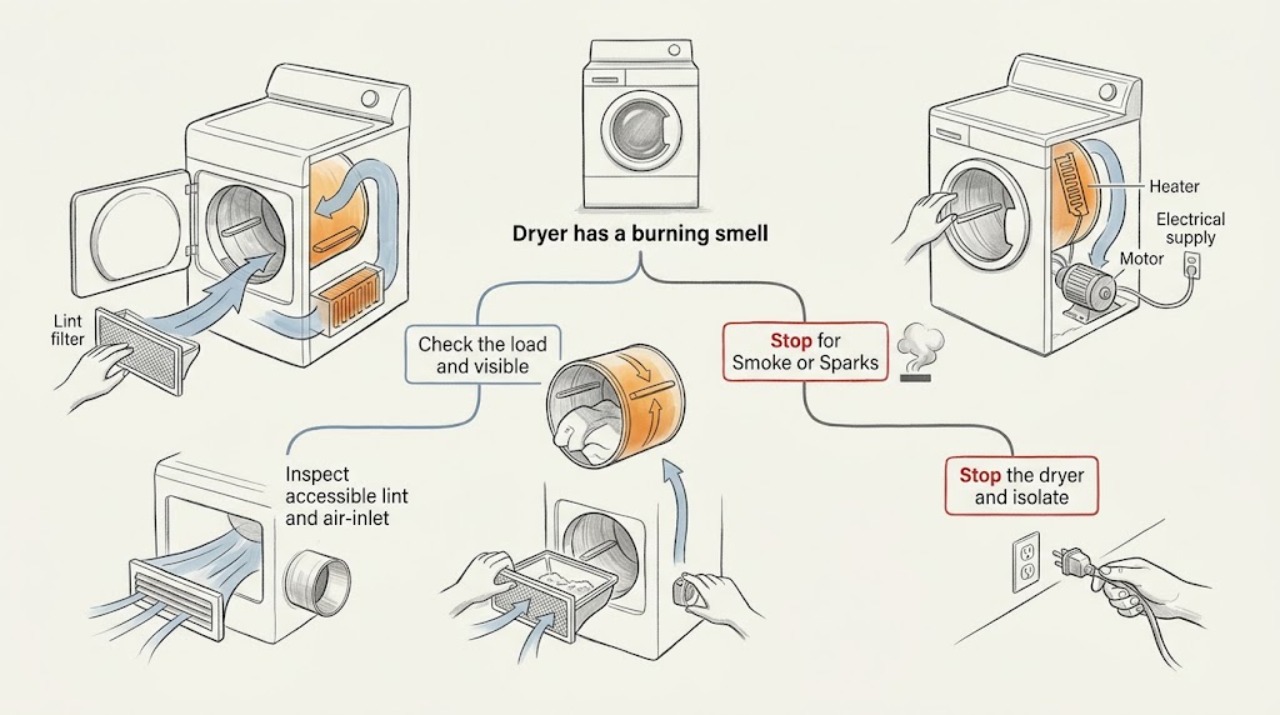
A burning smell from a Bosch dryer is a stop-and-isolate symptom, not a routine odor to mask with a cleaning cycle. Stop the program, remove laundry only if it is safe and cool enough to handle, and disconnect power or switch off the breaker when safe. After the dryer is cool, inspect only the accessible lint filter, air inlet, drum, and door area for accumulated lint, a foreign object, or laundry contaminated with oil, solvent, grease, or other flammable material. Bosch's own burnt-smell guidance directs the user to contact professional support; its manual warns about fire, electric shock, flammable residues, blocked lint, and damaged cords. Do not restart the dryer to see whether the smell returns, open panels, test the heater or motor, use an extension cord, or continue if smoke, heat damage, sparks, a melted part, or an electrical trip is present.
Before you begin
Safety first
- This article covers stopping and isolating the appliance, cool external observation, safe load context, accessible lint-filter care, and documentation only. Heater, thermal protection, motor, belt, drum supports, wiring, control, vent interior, and electrical-supply work belongs to qualified professionals.
Work through in order
Diagnostic checks
Use only checks that match the exact appliance or system and its official guide.
-
Stop the dryer and isolate the immediate hazard
Stop the program using the normal control, keep clear of smoke or sparks, and disconnect the plug or switch off the dryer circuit at the breaker only when it is safe to do so. Do not open the door if flames or heavy smoke are present; do not restart the cycle.
Expected result: There is only an odor, or there is smoke, flame, sparking, abnormal heat, a melted component, an electrical shock, or a breaker that tripped.
Next step: Keep the dryer off and use appropriate emergency help for fire, smoke, shock, or immediate danger. For odor without visible emergency, let the appliance cool and continue only with safe external observations.
Stop if: Do not touch a smoking or energized appliance, throw water on an electrical fire, or re-energize the dryer to test whether the smell returns.
Why this matters
Why: A mild odor still requires professional assessment under Bosch's dedicated burnt-smell guidance. Smoke, flame, sparks, heat damage, shock, or repeated protection trips is an immediate fire or electrical emergency rather than a cleaning check.
-
Check the load and visible drum for a combustible source
After the dryer is cool and power is isolated, identify what was in the load and inspect the accessible drum, door seal, baffles, and lint area for oily or solvent-treated fabric, rubber-like material, a foreign object, melted residue, or a scorch mark. Do not scrape a bonded residue or reach behind the drum.
Expected result: The load contained oil, grease, solvent, wax, stain remover, foam/rubber, or another unusual material; a foreign object or melted residue is visible; or the load and drum appear ordinary.
Next step: Do not dry contaminated or heat-damaged laundry again. Photograph the visible condition and arrange service for a persistent odor, scorch, melted material, or any uncertainty about the load's safety.
Stop if: Do not handle hot or chemically contaminated laundry with bare hands, scrape a melted object with tools, or operate the dryer with damaged drum surfaces or seals.
Why this matters
Why: Bosch warns that flammable residues and some rubber-like materials can ignite, so the load itself may be the hazard. A coin, plastic item, or melted residue can also generate odor or contact damage. An ordinary load with no visible source keeps the heater, airflow, drive, and electrical system in scope.
-
Inspect accessible lint and air-inlet conditions
With power isolated and the dryer cool, remove and inspect the user-accessible lint filter as the manual directs, and look at the external air inlet and accessible vent outlet for visible lint, dust, or an obstruction. Clean only the accessible filter or inlet using the exact manual; do not open the heater, condenser, or rear duct area unless the manual specifically provides a safe user procedure.
Expected result: The lint filter is heavily loaded, the air inlet or vent outlet is visibly blocked, the filter is damaged or missing, or the accessible airflow path is clear.
Next step: Clean and fully dry the accessible filter, restore it correctly, and leave the dryer off after any burning smell. Arrange qualified service for a damaged filter, persistent odor, internal blockage, or any heat symptom.
Stop if: Do not operate without a proper filter, use sharp tools in the air path, remove heater covers, or use compressed air where it could drive lint into electrical parts.
Why this matters
Why: Lint and restricted airflow can contribute to overheating and odor, but a clean filter does not rule out internal heat, motor, or electrical faults. A damaged or missing filter is unsafe to ignore. Bosch marks some heating and electronics problems for authorized technicians.
-
Check the visible power connection and installation context
Without opening the outlet or dryer cabinet, inspect the plug, cord, reachable outlet face, and surrounding area for looseness, discoloration, heat damage, moisture, an extension cord, or a power strip. Note whether the odor began after installation, moving, or a supply change; do not move a heavy or stacked dryer.
Expected result: The cord or plug is damaged or hot, an extension or power strip is used, the outlet is discolored, moisture is present, installation changed, or the visible connection appears normal.
Next step: Keep the dryer disconnected and arrange qualified electrical or appliance service for any damage, heat, moisture, or installation concern. Do not substitute a cord, outlet, fuse, or breaker yourself.
Stop if: Do not use an extension cord or power strip, touch a hot or wet connection, open the outlet, or reset a breaker repeatedly.
Why this matters
Why: Bosch warns that altered or damaged power cords and extension arrangements can create fire or shock risk. A normal visible connection does not clear internal wiring, motor, heater, or control faults, especially after a burning smell.
-
Record timing, airflow, and any Bosch error indication
Record whether the smell started at startup, when heat began, during drum rotation, near the end of a cycle, or after the cycle stopped. Note the display or blinking indication, lint-filter state, drum movement, unusual sound, and whether clothing or the cabinet was unusually hot; do not run another test cycle.
Expected result: A heating-related code, electronics code, lint code, unusual motor or drum sound, stationary heat, or no visible code is present.
Next step: Give the exact code, timing, odor description, and visible observations to a qualified Bosch technician. Keep the dryer off until a professional clears a burning smell.
Stop if: Do not clear an unknown code by repeatedly resetting power, press an internal thermal reset, or operate with a hot, smoking, or mechanically damaged drum.
Why this matters
Why: Bosch's error guide separates lint-filter, heating-circuit, and electronics faults, but the code and timing do not identify a safe user repair. Heat plus a drive or scraping symptom can indicate multiple interacting faults and needs service.
-
Prepare a service handoff without disassembly
Provide the Bosch model marking, load contents and any chemical or oily exposure, exact odor timing, smoke/heat/spark result, filter and air-inlet observations, cord/outlet context, drum or motor sound, error indication, and photos of safe external areas. Do not remove panels to improve the record.
Expected result: The smell was a one-time external contamination with no damage, or it persists, recurs, or has any visible heat, electrical, mechanical, or error symptom.
Next step: Keep the dryer off and arrange qualified Bosch appliance service; use electrical service for outlet, cord, or supply concerns. Seek urgent help for fire, smoke, shock, or immediate danger.
Stop if: Stop all homeowner troubleshooting when diagnosis requires cabinet access, live testing, heater or motor access, belt work, or bypassing thermal or door protections.
Why this matters
Why: A one-time load or external residue clue may explain the context but does not prove the dryer is safe. Persistent or recurring odor, a clean accessible path, or any heat/electrical/mechanical sign points to a service-level fault.
Use your observations
Decision map
Find the observation that best matches what you see, then follow the next safe action.
-
PATH 01Next step
What you see
The load contained oil, grease, solvent, wax, stain remover, foam/rubber, or a foreign object, and the odor began during or immediately after that load.
Do this next
Do not dry that material again or restart the appliance. Keep the dryer off, document the load and visible condition, and arrange qualified inspection if odor, scorch, melting, or uncertainty remains.
-
PATH 02Next step
What you see
The lint filter, external inlet, or visible vent outlet is heavily restricted, while no smoke, wiring damage, or combustible load is present.
Do this next
Clean only the accessible filter or inlet as the manual directs, leave the dryer off, and arrange service for any burning smell or recurrence. Do not open internal air or heater passages.
-
PATH 03Next step
What you see
The plug, cord, outlet, or supply is hot, loose, discolored, wet, damaged, connected through an extension or power strip, or associated with a breaker trip.
Do this next
Keep the dryer disconnected and arrange qualified electrical or appliance service. Do not substitute a cord, open the outlet, or repeatedly reset protection.
-
PATH 04Next step
What you see
The load and visible filter/inlet are normal, but the burning smell persists or recurs, especially with unusual drum sound, rotation, heat, or a Bosch heating/electronics indication.
Do this next
Leave the dryer off and arrange qualified Bosch appliance service. Do not run a confirmation cycle or open panels.
-
PATH 05Next step
What you see
The odor occurred once after a known external residue or unusual load, there is no smoke or damage, the dryer is cool, and no smell returns while it remains unused.
Do this next
Do not reuse the same material. Follow Bosch's burnt-smell service guidance and have the dryer assessed before normal operation if the source was uncertain or any heat mark remains.
-
PATH 06Next step
What you see
Smoke, flame, sparks, shock, exposed wiring, melted plastic, uncontrolled heat, or a serious burning odor is present.
Do this next
If safe, isolate power without touching damaged parts, leave the area for fire or heavy smoke, keep others away, and use appropriate emergency or qualified help. Do not re-energize the dryer.
Helpful context
Understand the symptom
Treat burning odor as a safety symptom first
Bosch gives a direct professional-service boundary for a dryer that smells burnt. A user can stop the program, isolate power when safe, let the appliance cool, and document what happened, but cannot safely identify a heater, motor, wiring, or control fault by smell alone. Smoke, sparks, abnormal heat, a melted cord or plastic part, or a repeated breaker trip requires the dryer to remain off and urgent qualified help.
Accessible lint and airflow checks can narrow the context
Bosch's general dryer guidance associates odors with lint or debris in the lint filter or vent, foreign objects in the drum, moisture-related growth, or chemical and fabric-product residues. The manual also requires the lint filter and air inlet to remain clear. These are context checks after isolation, not a reason to restart a dryer that produced a burning smell or to open its heater and vent housing.
Laundry contamination changes the fire risk
Bosch warns that laundry exposed to solvents, oil, wax, grease, stain remover, or similar flammable material can ignite in a dryer. A burning smell after drying workwear, oily cloths, rubber-like items, or chemically treated fabric should not be diagnosed as a lint issue. Keep the dryer off and follow the material-safety guidance and professional boundary in the manual.
A clean filter does not clear the heater or electrical system
Removing visible lint may reduce one possible source, but it does not prove that the internal air path, heater, motor, belt, control, wiring, or thermal protection is safe. Bosch error guidance marks heating-circuit and electronics faults for authorized-technician attention. Do not remove the rear panel or press an internal reset button to clear a smell without exact model instructions and qualified access.
Safety boundary
Stop conditions
- Stop the dryer for any burning smell, smoke, flame, sparks, shock, abnormal heat, melted or scorched material, exposed wiring, moisture at the supply, or repeated breaker trips; isolate power when safe.
- Do not restart the dryer to reproduce the smell, open panels, test live wiring, press an internal thermal reset, access the heater or motor, bypass a door or thermal interlock, or use an extension cord or power strip.
- Do not dry laundry contaminated with oil, solvent, wax, grease, stain remover, or rubber-like material, and do not operate without a properly installed lint filter or with a damaged cord.
Only after diagnosis
Potential parts
- Bosch dryer lint filter or filter housing
Consider this category only when qualified inspection confirms a damaged, missing, or improperly sealing filter or housing after the burning-smell event.
Confirm the exact Bosch model, filter design, housing, and manufacturer-approved fit before replacement. - Bosch dryer thermal fuse or high-limit thermostat
Consider this category only when qualified testing links the odor, overheating, or protection trip to a failed thermal-protection component after airflow and load causes are evaluated.
Confirm exact model, temperature rating, mounting, and approved component; do not bypass or reset thermal protection as a user repair. - Bosch dryer heating element or heat-pump heating assembly
Consider this category only when qualified diagnosis confirms a heating-circuit fault after the burning smell, airflow, lint, and electrical-supply context is recorded.
Confirm exact Bosch model, dryer design, assembly, wiring, and manufacturer-approved compatibility before replacement. - Bosch dryer drive motor, belt, or drum support
Consider this category only when service links the odor to drive strain, scraping, seized support, belt damage, or motor-circuit failure after load and airflow causes are excluded.
Confirm the exact model and diagnostic evidence; do not infer a drive part from odor alone or access it without qualified service.
When checks do not resolve it
Need a professional?
Arrange qualified Bosch appliance service for any burning smell, even when the visible lint filter is clean; for recurring odor, unusual heat, drum or motor noise, visible scorch or melting, a heating or electronics indication, or any need to access internal airflow, heater, motor, belt, wiring, controls, or thermal protection. Arrange electrical service for a hot, loose, wet, damaged, or discolored outlet, cord, or supply. Stop immediately and seek urgent help for smoke, fire, sparks, shock, uncontrolled heat, or immediate danger.
Safety scope: This article covers stopping and isolating the appliance, cool external observation, safe load context, accessible lint-filter care, and documentation only. Heater, thermal protection, motor, belt, drum supports, wiring, control, vent interior, and electrical-supply work belongs to qualified professionals.
Have this ready
- Provide the exact Bosch model marking, load contents and any oil/solvent/chemical exposure, odor timing, smoke/heat/spark result, filter and air-inlet condition, external cord/outlet context, drum or motor sound, error wording, and safe photos of visible damage.
Common questions
FAQ
What should I do first if my Bosch dryer smells burnt?
Stop the cycle and isolate power at the plug or breaker when safe. Bosch's dedicated burnt-smell guidance sends this symptom to professional support. Do not restart the dryer to test it, especially if smoke, heat, sparks, or electrical damage is present.
Can lint cause a burning smell in a Bosch dryer?
Lint or debris in a filter or vent can contribute to heat and odor, but cleaning the accessible filter does not prove the internal heater, motor, airflow path, or wiring is safe. Leave the dryer off after any burning smell and arrange service if the odor persists or recurs.
Can oily or solvent-treated clothes cause a Bosch dryer to smell burnt?
Yes. Bosch warns that laundry contaminated with oil, grease, solvents, wax, stain remover, or some rubber-like materials can ignite in a dryer. Do not dry that material again; follow the manual's material-safety guidance and keep the appliance off if odor or heat damage occurred.
Is a burning smell from a Bosch dryer just a new-appliance smell?
Do not assume that. A mild ordinary manufacturing odor cannot be distinguished safely from overheating by smell alone, and Bosch directs a dryer with a burning smell to professional assistance. Stop the appliance and provide the model and timing to service.
Should I clean the Bosch dryer filter and run another cycle?
After the dryer is cool and power is isolated, you may inspect and clean the accessible lint filter as the exact manual directs. Do not run another cycle to confirm the repair after a burning smell; a clean filter does not clear internal heat, drive, or electrical faults.
Could a Bosch dryer belt or motor cause a burning smell?
A drive or motor fault is one possible service-level explanation, especially with scraping, stalled rotation, or unusual heat, but the odor alone cannot identify a part. Do not open panels or touch the belt or motor; arrange qualified diagnosis.
When should I call for Bosch dryer burning-smell service?
Call for qualified service for any burning smell, and keep the dryer off for persistent or recurring odor, visible scorch or melting, unusual heat or drum sound, an error, or any need to access the heater, motor, belt, wiring, vent interior, or thermal protection. Use emergency help for fire, smoke, sparks, or shock.
Read the exact guide
Official sources
- Dryer drum smells badBosch Home Appliances · Bosch dryer general odor guidance used only for accessible cleaning context; a burning smell follows the stricter service boundary.
- Dryer Troubleshooting: Dryer is not turning onBosch Home Appliances · Bosch dryer start-condition guidance used to frame supply observations; it does not diagnose a burning smell.
- Bosch Dryer Error CodesBosch Home Appliances · Bosch dryer error guidance; exact model manual controls code interpretation.
- Bosch Dryer Troubleshooting & Repair GuideBosch Home Appliances · Bosch dryer troubleshooting overview; exact model manual and issue pages control the procedure.
- Dryer smells burntBosch Home Appliances · Bosch dryer burnt-odor troubleshooting; the page directs users to professional assistance.
- en-us Use and Care Manual, Installation InstructionsBosch Home Appliances · Official Bosch dryer manual opened for model WTG865H2UC2; used for safety and model-variation boundaries, not universal fitment.
Community feedback
Share a repair observation
Share a plain-text repair observation. Accepted observations are published automatically; this page may take a moment to update.