
On this page
Start here
Quick answer
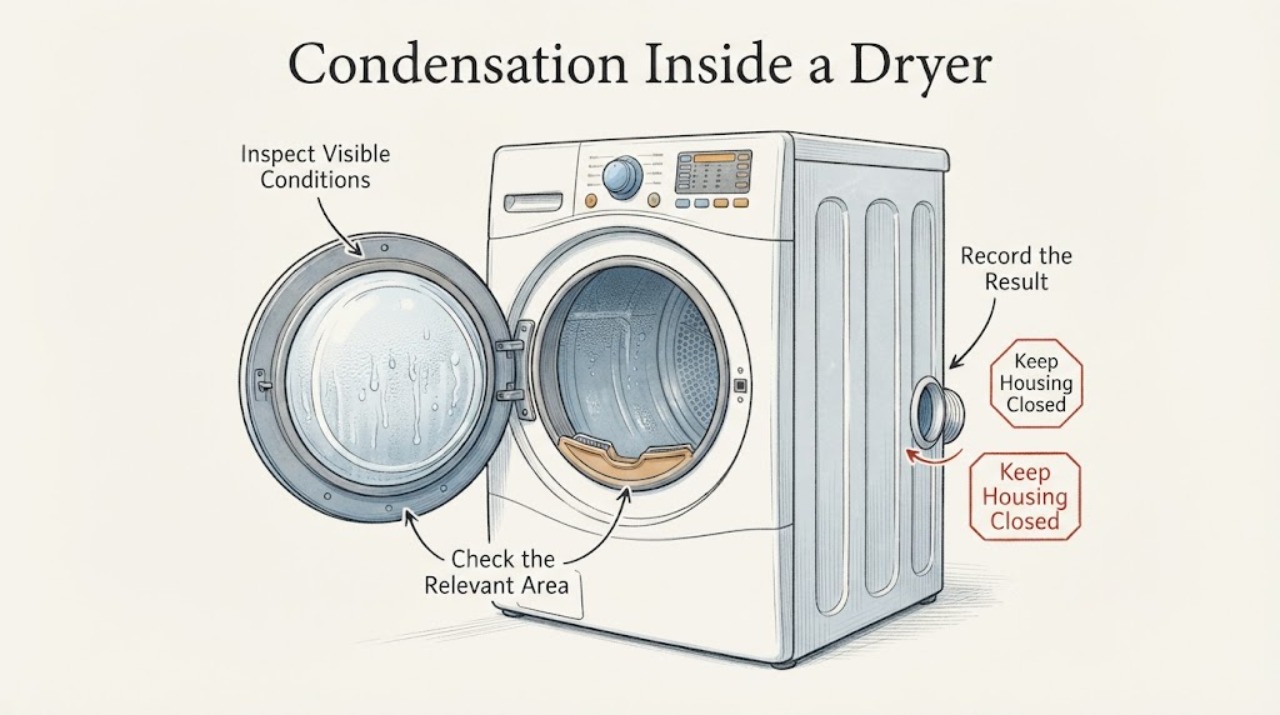
Condensation inside a dryer during hot, humid weather can come from two different designs. A vented dryer sends hot moist air through an outside duct, so a restricted duct, a low or cold duct section, or humid outdoor air entering through a poor outside damper can put moisture back into a cool drum. A ventless condenser or heat-pump dryer is designed to condense water internally, so its manual-specific tank, drain, filter, and heat-exchanger checks come first. Turn the dryer off if water is near the controls, plug, or wiring; wipe accessible moisture and do not run a wet appliance. For a vented model, check the lint filter, duct route, and outside hood without opening the cabinet. If water keeps returning, the vent cannot be cleared safely, or the dryer trips protection or shows a burning smell, arrange qualified service rather than guessing an internal part.
Work through in order
Diagnostic checks
Use only checks that match the exact appliance or system and its official guide.
-
Check 1
Classify the dryer before troubleshooting: look for a duct that runs to an outside wall or roof, or confirm from the model manual that the appliance is a ventless condenser or heat-pump dryer. Record whether the moisture is on the drum/door, inside the lint-filter area, on the exhaust hose, or near the control panel.
Expected result: The dryer has an outside exhaust duct, or it has no exhaust duct and instead uses a water drawer, drain hose, heat exchanger, or other ventless system.
Next step: Use the correct branch below. If water is near the controls, plug, or wiring, stop and disconnect power only if it is safe to do so; do not energize a wet appliance while identifying its design.
Why this matters
Why: A vented model can receive or retain moisture through its exhaust path, while a ventless model is designed to separate water from humid air internally. Mixing those designs can lead to the wrong cleaning step or an unsafe attempt to add a duct.
-
Check 2
For a vented dryer, turn it off and let the accessible surfaces dry, then clean the lint screen and inspect the full duct path from the dryer connection to the outside hood. Look for lint, a kink or crushed section, a low spot that can hold water, a loose gap, a blocked hood, or a damper that does not close when the dryer is idle.
Expected result: The lint screen or duct is restricted/damaged, the outside hood is blocked or does not close, or the accessible path appears clear but condensation returns while the dryer is idle.
Next step: Do not use the dryer against a restricted or damaged duct. Correct only an accessible external issue permitted by the manual or arrange professional vent cleaning/inspection; do not open the dryer cabinet or insert tools into internal airflow components.
Why this matters
Why: Maytag says restricted airflow can leave steam and moisture inside the dryer and can produce water on the floor. Samsung says the exhaust path must meet manual requirements so moisture leaves the dryer and cannot enter from outside on hot, humid days. A clear short section behind the dryer does not prove the concealed run or outside termination is sound.
-
Check 3
For a vented model that is clear and dry after a cycle, observe when the water returns without running another wet or heated load. Note whether condensation appears only after the dryer sits closed in hot humid weather, whether leaving the door ajar changes the next-day result, and whether the outside hood or duct passes through a hot attic, roof, or cold air-conditioned room.
Expected result: Moisture returns while the dryer is idle during humid weather, especially after the door is closed, or it appears immediately after a cycle and is accompanied by long drying times or steam.
Next step: Wipe the accessible drum and leave the door ajar only while the appliance is off and the room is safe, but treat that as drying/observation rather than a repair. Have the outside damper, duct slope/low spots, insulation, and termination checked by a qualified vent professional if the pattern repeats.
Why this matters
Why: Moisture that appears during idle humid conditions is consistent with humid-air backflow or condensation on a cool surface, as described in Samsung's guidance and the opened community report. Moisture immediately after a cycle with poor drying is more consistent with restricted exhaust or another venting condition. Neither pattern proves a blower, sensor, or control failure.
-
Check 4
For a ventless dryer, follow the exact model manual for its water container or drain, lint filters, heat exchanger, and condensate path. Do not add an outside exhaust duct or treat a designed condensate drawer as evidence of a blocked vent.
Expected result: The ventless water drawer is full, the drain path is restricted, the heat exchanger/filter needs the manual's cleaning, or the manual shows none of those conditions.
Next step: Empty or clean only the accessible parts named by the exact manual. If water remains inside the cabinet, the heat exchanger is inaccessible, or condensation reaches electrical controls, stop and request model-specific service.
Why this matters
Why: Whirlpool explains that ventless condenser and heat-pump dryers remove water through a heat exchanger and collect or drain it. Their moisture path is different from a vented dryer, and the correct cleaning and service steps vary by model.
-
Check 5
Escalate when moisture remains after the correct external checks, appears near the control panel or power connection, trips a breaker or GFCI, creates a burning smell, or is accompanied by unusual noise, poor drying, or standing water.
Expected result: The dryer is dry and operates normally after the external vent/environment correction, or moisture and electrical/heat symptoms persist.
Next step: Keep the dryer off and arrange qualified appliance or dryer-vent service. Give the technician the dryer design, moisture location, weather/idle timing, duct route, hood behavior, and any electrical symptom.
Why this matters
Why: A corrected vent or backflow condition can explain seasonal condensation, but persistent moisture near electrical areas or a protection trip may have damaged or exposed parts that cannot be assessed safely from outside. Do not convert a condensation symptom into a diagnosis of a blower, sensor, drain, or board.
Use your observations
Decision map
Find the observation that best matches what you see, then follow the next safe action.
-
PATH 01Next step
What you see
The dryer vents outside, moisture appears after the unit sits closed during hot humid weather, and drying performance remains normal.
Do this next
Wipe the drum dry, keep the door ajar while the dryer is off if the room is safe, and have the outside termination/damper and any attic or low duct section checked before the next humid spell.
Why this path and its safety boundary
Why it matters: The pattern is consistent with humid-air backflow or condensation on a cool drum, but it does not prove that the outside damper or duct is the only cause.
-
PATH 02Next step
What you see
Condensation appears after a cycle and the dryer has long times, damp clothes, steam on the door, little lint on the screen, or water behind the dryer.
Do this next
Stop using the dryer against the restriction, clean the lint screen, and arrange a full duct/hood inspection and cleaning. Do not run repeated cycles to evaporate the moisture.
Why this path and its safety boundary
Why it matters: Those are manufacturer-documented signs of restricted or poorly exhausting venting; water inside is not evidence of a failed internal part.
-
PATH 03Next step
What you see
The appliance is ventless and the moisture is confined to the designed condensate drawer or accessible condensate path.
Do this next
Use the exact manual to empty/clean the drawer, drain, filter, or heat exchanger. Stop and call service if water reaches controls, the cabinet, or an inaccessible area.
Why this path and its safety boundary
Why it matters: Water separation is part of the ventless design, so a vented-dryer backflow explanation does not apply.
-
PATH 04Next step
What you see
Moisture reaches the control panel or power connection, trips protection, smells electrical/burnt, or remains after the correct vent/environment correction.
Do this next
Do not power the dryer again. Keep it disconnected only if that can be done safely and arrange qualified service; do not open the cabinet or replace internal parts based on the condensation alone.
Why this path and its safety boundary
Why it matters: The problem has crossed from seasonal surface condensation into a possible electrical or appliance-safety issue that cannot be narrowed externally.
Helpful context
Understand the symptom
First identify whether the dryer vents outside
Condensation is interpreted differently by dryer design. Whirlpool explains that a ventless dryer recirculates humid drum air through a heat exchanger and collects or drains the separated water; a vented dryer instead pushes hot humid air outside through a duct. Samsung's condensation guidance for vented-style exhaust systems says humid outside air can enter through the exhaust path on hot, humid days and collect on cooler dryer surfaces. Do not apply a vented-dryer backflow explanation to a ventless model without checking its manual.
When checks do not resolve it
Need a professional?
Arrange professional dryer-vent or appliance service when the full vent path cannot be safely inspected, the outside damper/termination does not close or is damaged, condensation persists after the correct external correction, water reaches controls or wiring, the dryer trips protection, or drying performance worsens. Do not open the cabinet, bypass a vent system, add an indoor exhaust filter to a vented dryer, or guess at an internal component.
Common questions
FAQ
Can hot humid summer air cause water inside a vented dryer?
Yes, it can contribute when humid outside air enters through the exhaust path and meets a cooler drum or duct, but restricted venting and poor damper/termination conditions must be checked first. Samsung specifically warns that exhaust requirements help prevent moisture from entering from outside on hot, humid days.
How is a ventless dryer different for condensation troubleshooting?
A ventless condenser or heat-pump dryer intentionally recirculates humid drum air through a heat exchanger and collects or drains the separated water. Use its exact manual for the condensate drawer, drain, lint filters, and heat exchanger instead of searching for an outside vent blockage.
Should I leave the dryer door open after a humid day?
Leaving the door ajar while the dryer is off can help accessible surfaces dry, but it is only an observation or moisture-control measure. It does not repair a restricted duct or faulty outside damper, and it may allow more humid air backflow in some installations.
Can I run the dryer with the vent disconnected to dry it out?
Do not improvise a disconnected-vent heating test. Manufacturer guidance is model- and situation-specific, and a vented dryer must exhaust hot moist air safely outside. Clean or inspect the path with the appliance off and arrange service when water or moisture is near electrical areas.
Read the exact guide
Official sources
- What is a ventless dryer?Whirlpool · Used to distinguish vented dryers that push hot humid air outside from ventless condenser/heat-pump dryers that condense moisture through a heat exchanger and collect or drain it. The article itself says model-specific behavior should be checked in the product manual.
- Leaking During Steam Cycle - DryerMaytag Product Help · Used for the external vent checks that a restricted vent can build condensation and for checking lint screen, crushed/kinked run, lint/debris, outside hood, and model-specific vent length/elbows. Steam-cycle water guidance is not transferred to non-steam dryers.
- Dryer Vent may be Blocked or RestrictedMaytag Product Help · Used for family-level symptom interpretation: long dry times, heat at the cabinet, steam/moisture in the dryer, water on the floor, little lint on the screen, low air movement, and external causes such as lint, nests, kinks, and improper installation. It does not support internal-part diagnosis.
- Condensation on Controls or Display - DryerMaytag Product Help · Used as manufacturer-family evidence that damp humid air can condense on controls when venting is inadequate, that lint-screen residue reduces airflow, and that the home vent line should be cleaned or professionally inspected when condensation or restricted-airflow symptoms persist. It is not treated as a model-specific instruction for an unknown dryer.
- Moisture/Water Inside Clothes DryerReddit r/appliancerepair · Used only as a matching summer-humidity report describing water in the drum/door while drying performance remained normal and a possible idle backflow pattern. The hypotheses and comments are not treated as confirmed diagnosis or service instruction.
- Samsung dryer is leakingSamsung Support US · Used for the distinction between moisture from steam-dry systems, exhaust-vent requirements that prevent outside humid air entering, regular vent cleaning, and condensation on dryer metal surfaces in humid environments. It does not diagnose an internal component for an unspecified model.
Community feedback
Share a repair observation
Share a plain-text repair observation. Accepted observations are published automatically; this page may take a moment to update.