
On this page
Start here
Quick answer
A dryer door-handle replacement cannot be scoped safely from the words “door handle” alone. Handle shapes, fasteners, door shells, latches, and hinge/interlock arrangements vary by brand and model. First photograph the broken handle and the closed-door fit, record the complete model and serial label, and verify the exact part in the manufacturer's model-specific parts/manual path. Keep the dryer unplugged and do not operate it if the handle is loose, the door will not latch, the door shell is cracked, or any safety/interlock part is displaced. Manufacturer guidance shows why: GE lists different model-numbered dryer handles and says to check the appliance model for compatibility, while LG's door guidance warns that illustrations may differ by model and that a supported door must be handled carefully. This page does not provide a generic door-removal or replacement procedure; use the exact manual or qualified service.
Before you begin
Safety first
- Do not operate a dryer with a missing or broken door part, a door that will not latch, or a displaced interlock. Do not provide a generic door-removal tutorial, substitute fasteners, force the door shut, or use a handle solely because it looks similar. Disconnect power before any permitted maintenance and support the door as required by the exact manual.
Work through in order
Diagnostic checks
Use only checks that match the exact appliance or system and its official guide.
-
Check 1
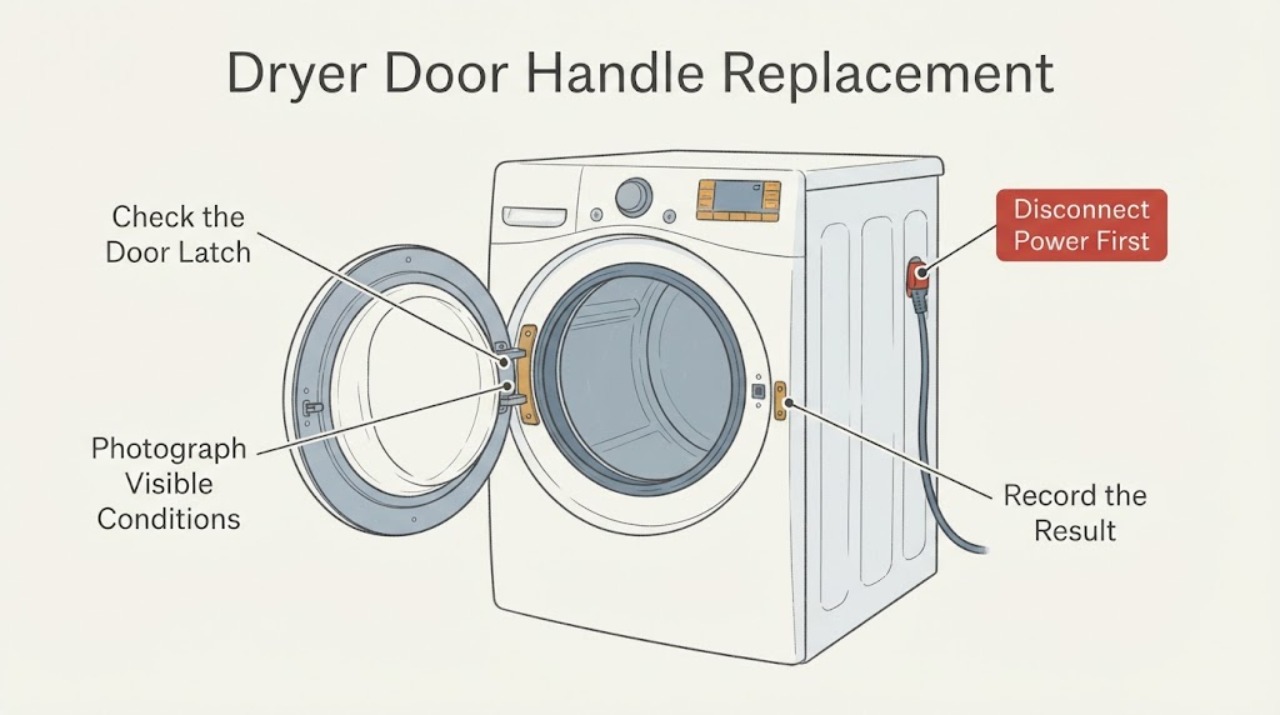
Turn the dryer off, unplug it or disconnect its supply at the accessible disconnect, and let it cool. Photograph the handle, both ends of the handle, the inside of the door edge, the latch/strike area, and any broken screw boss or door-shell crack without removing trim.
Expected result: Only the outer grip is loose or broken, or the door shell, latch, strike, hinge, or interlock area is also damaged or displaced.
Next step: Keep the dryer out of service for a damaged shell, latch, hinge, strike, or interlock. Use the exact model manual or qualified service before any handle work.
Why this matters
Why: A grip-only failure may be a model-specific handle part; damage to the door shell or safety hardware changes the repair scope and can make operation unsafe.
-
Check 2
Find the complete model and serial label on the dryer and record the exact numbers, door style, and whether the door opens in one direction or has a two-way/hamper feature. Do not use a series name, color, or a handle photograph as the part identity.
Expected result: A complete model number is available, or only a partial series/appearance description is available.
Next step: Use the complete model in the manufacturer's official parts and manual path. If it cannot be read, stop at identification and arrange service rather than ordering a generic handle.
Why this matters
Why: Manufacturer parts and door procedures are tied to the appliance model. GE's official handle listings show distinct handle model numbers and tell owners to check model compatibility; LG directs users to model-specific manuals when door content may differ.
-
Check 3
With the dryer still disconnected, close the door gently without forcing it and observe whether the door sits flush, the latch engages, the strike enters its receiver, and the drum-side gasket or seal remains in its normal position. Do not run the dryer to test a loose handle or hold the door shut by hand.
Expected result: The door latches and sits squarely, or it will not latch, rubs, sags, springs open, or leaves a visible gap.
Next step: Do not operate the dryer if the door cannot latch or the seal/door shell is displaced. Have the complete door assembly inspected before selecting a handle.
Why this matters
Why: A handle-only issue may still need a model-specific part, but a latch, strike, hinge, shell, or seal problem affects door closure and requires a broader repair assessment.
-
Check 4
Compare the broken handle and its fastener locations with the exact manufacturer parts diagram or manual for the recorded model. Confirm whether the listing is a handle, cover, bracket, inner door part, or complete door assembly; do not assume a part with a similar name or color fits.
Expected result: The exact model documentation identifies a matching handle and attachment arrangement, or it identifies a different door part/assembly or no matching part.
Next step: Order or schedule service only after the manufacturer confirms model fit. If the documentation is incomplete or the door is damaged beyond the grip, use qualified service rather than improvising fasteners or a substitute handle.
Why this matters
Why: A part name alone does not prove that the screw pattern, handle orientation, door shell, or latch clearance matches. GE lists handle covers and handles as separate model-numbered parts, reinforcing the need to match the exact part class.
-
Check 5
If the exact manual permits owner door work, read its complete safety and reassembly section before touching screws; otherwise give the model, photos, and the observed latch/door condition to the manufacturer or qualified technician. Do not remove the door, inner panel, hinge, latch, or interlock based on another model's instructions.
Expected result: The manual gives a model-matched procedure with door support and correct fasteners, or no model-matched procedure is available.
Next step: Follow only the exact model procedure or arrange qualified service. Keep the dryer unplugged until the handle, door, latch, and any interlock are secure and the manual's final checks are complete.
Why this matters
Why: LG's published door procedures use different screw sets and warn that content may differ by model; its EasyLoad instructions require support for the door and attention to sharp edges. A generic tutorial cannot establish safe reassembly for this dryer.
Use your observations
Decision map
Find the observation that best matches what you see, then follow the next safe action.
-
PATH 01Next step
What you see
The complete model is known, the door shell and latch are intact, and the manufacturer parts path identifies a handle that matches that exact model.
Do this next
Use only the matched manual or qualified service procedure; do not substitute a visually similar handle or generic screw.
Why this path and its safety boundary
Why it matters: A model-specific handle replacement may be a defined repair, but the fasteners, door support, and reassembly still come from the exact manual.
-
PATH 02Next step
What you see
Only a partial model or appearance description is available, or a seller listing says a handle is universal without showing the exact dryer fit.
Do this next
Stop at model identification and contact the manufacturer or qualified service; do not order or install the unverified part.
Why this path and its safety boundary
Why it matters: Compatibility and attachment geometry are unresolved. A handle that looks right can still leave the door unsafe or damage the door shell.
-
PATH 03Next step
What you see
The door will not latch, is sagging or rubbing, has a cracked shell, or the latch, strike, hinge, seal, or interlock is displaced along with the handle.
Do this next
Keep the dryer disconnected and arrange model-matched service; do not run it with a missing or broken door part or hold the door shut by hand.
Why this path and its safety boundary
Why it matters: This is a door-assembly or safety-hardware issue rather than a confirmed grip-only replacement.
-
PATH 04Next step
What you see
A model-matched manual explicitly documents the door procedure, identifies the fasteners, and includes door support and final closure checks.
Do this next
Use the procedure only for the recorded model and stop if the observed door differs. Otherwise, use qualified service rather than adapting the steps.
Why this path and its safety boundary
Why it matters: The manufacturer has scoped the procedure to that design, but the task's unidentified dryer has not yet been shown to match it.
Helpful context
Understand the symptom
Start with identity, not a replacement video
The task contains no brand or model. A dryer door handle can attach to the outer door shell, an inner trim assembly, or a handle-specific bracket, and the same-looking handle may not share the same screw spacing or latch clearance. GE's official parts pages show multiple dryer-handle model numbers and direct owners to check their appliance model for compatibility. That is why a generic replacement step or visually similar part is not enough.
A handle problem can become a door-safety problem
Before ordering anything, check whether the door still closes squarely, the latch or strike is intact, the inner door shell is not cracked, and no hinge or interlock piece has shifted. A loose handle may be cosmetic, but a door that cannot close or a missing piece can affect safe dryer operation. Keep the dryer disconnected while the condition is unresolved and use the exact owner manual or qualified service for the repair boundary.
Do not generalize door-removal hardware
LG's published door-reversal guidance uses several screw types and explicitly says the images or content may differ by model. Its EasyLoad procedure also requires supporting the door and warns about sharp edges. Those instructions demonstrate that door work is model- and design-specific; they are not a generic handle-replacement method for an unidentified dryer.
When checks do not resolve it
Need a professional?
Arrange manufacturer or qualified dryer service when the model cannot be identified, the door will not latch, the shell or hinge is damaged, the latch/strike/interlock is displaced, the exact part cannot be confirmed, or a model-specific door procedure is unavailable.
Safety scope: Do not operate a dryer with a missing or broken door part, a door that will not latch, or a displaced interlock. Do not provide a generic door-removal tutorial, substitute fasteners, force the door shut, or use a handle solely because it looks similar. Disconnect power before any permitted maintenance and support the door as required by the exact manual.
Common questions
FAQ
Can I order a dryer handle by appearance alone?
No. Official GE listings use separate model-numbered dryer handles and tell owners to check model compatibility. Record the complete dryer model and confirm the exact part before ordering.
Can I keep using the dryer if only the handle is broken?
Only the exact manual or a qualified technician can establish that the door remains safe. If the door does not latch squarely, the shell or hinge is damaged, or an interlock or seal is displaced, keep the dryer disconnected and arrange service.
Are door-handle replacement instructions interchangeable between dryer models?
No. LG's official door guidance lists different screw arrangements and warns that images and content may differ by model. Use only the procedure for the complete model number or have the repair performed by qualified service.
Read the exact guide
Official sources
- Dryer Door HandleGE Appliances · Official GE parts page used as a manufacturer-specific example that dryer handles are model-numbered and require compatibility confirmation. It does not identify or fit the assigned dryer.
- LG Dryer – How to Reverse the Dryer DoorLG USA Support · Official LG family guidance used to demonstrate that door hardware and fasteners vary; it is not a generic handle-replacement procedure and does not establish the assigned dryer's design.
- 49-9975GE Appliances · Official GE dryer manual used only for the general safety boundary that maintenance requires disconnection and a damaged or partially disassembled dryer should not be operated. It does not identify the assigned dryer's model or handle.
- LG EasyLoad Dryer - How to Reverse the DoorLG USA Support · Official LG EasyLoad-specific door guidance used only for safety boundaries and the need to support the door; it does not apply to an unidentified dryer or establish handle replacement steps.
- Clothes dryer door handle, white colorGE Appliances · Official GE parts page used only to show that even a similar dryer-handle description is tied to an exact part model and requires model verification. It does not support compatibility with the unidentified dryer.
- Parts & AccessoriesLG USA Support · Official LG support page used as a manufacturer-specific example that genuine appliance parts and service are routed through model-aware support. It does not identify the assigned dryer or authorize a handle fit.
Community feedback
Share a repair observation
Share a plain-text repair observation. Accepted observations are published automatically; this page may take a moment to update.