
On this page
Start here
Quick answer
A dryer making noise should be diagnosed by sound type, timing, location, and whether the drum is empty or loaded. Rattling often points to pockets, zippers, the exhaust duct, a loose object, or the cabinet touching something; thumping can come from a balled-up load, an unlevel floor, or rollers after storage; humming may be a normal blower or, on models equipped with one, a condensation pump. A squeal, grind, scrape, or noise that remains with a normal load or an empty drum needs service rather than a guessed part. Stop immediately for smoke, burning or electrical odor, sparking, a hot or damaged cord, severe shaking, a blocked or crushed vent, or a gas odor on a gas dryer.
Before you begin
Safety first
- This article supports ordinary-access observation, load correction, safe external clearance, model-directed leveling, and accessible filter care only. Do not move a gas dryer, open panels, disconnect fuel or wiring, reach into seams, or test internal parts while energized or hot.
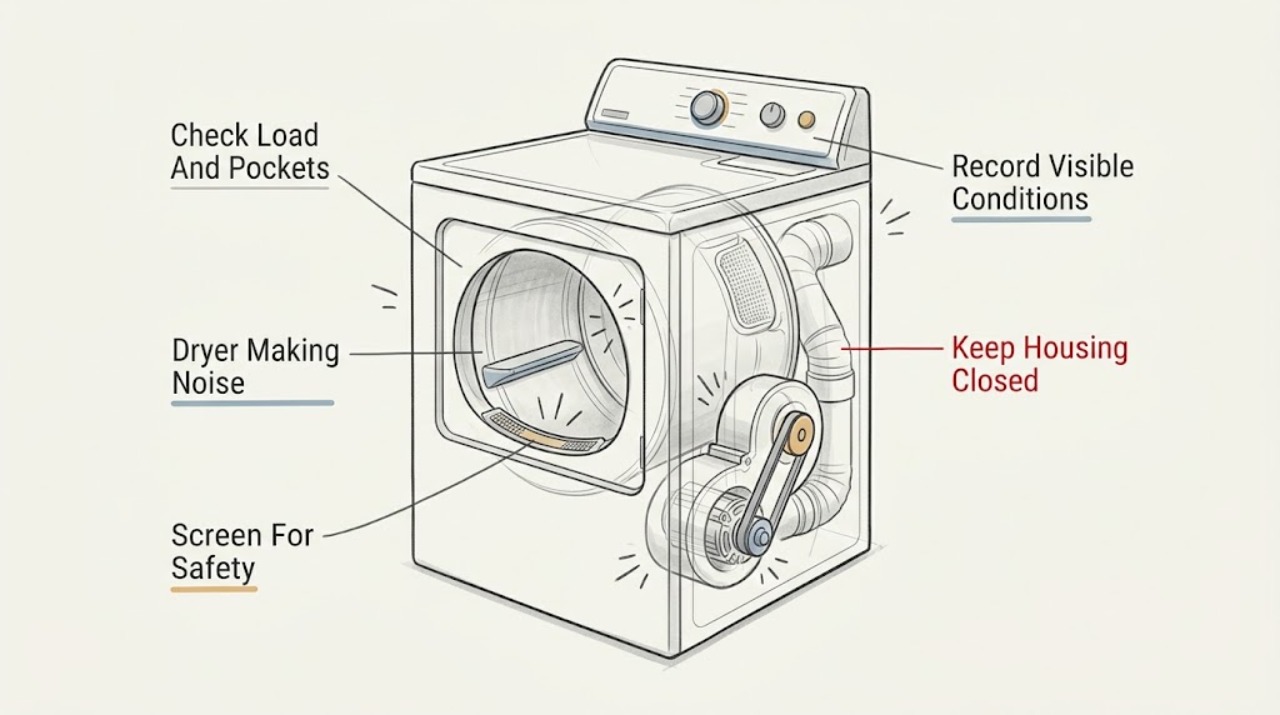
Work through in order
Diagnostic checks
Use only checks that match the exact appliance or system and its official guide.
-
Check 1
Before listening closely, check from a safe position for smoke, a burning or electrical odor, visible sparking, a hot or damaged plug or cord, severe shaking, a crushed vent, or a gas odor if the dryer uses gas.
Expected result: Classify the dryer as free of immediate warning signs for ordinary external checks, or record the specific warning sign.
Next step: If there is no warning sign, continue with the sound record. If smoke, burning odor, sparking, severe overheating, or a damaged cord is present, stop the cycle and isolate power only when safe; if gas is suspected, leave the area without operating switches or electronics and contact local emergency gas help from a safe location.
Stop if: Do not run another cycle, repeatedly reset, or touch a hot, smoking, sparking, or gas-odor dryer.
Why this matters
Why: A safety symptom is not an ordinary noise branch. It can indicate fire, electrical, gas, or mechanical risk.
-
Check 2
Record the sound in plain language and its timing: rattle, click, thump, knock, hum, buzz, squeal, scrape, or grind; note whether it starts, stops, changes with drum rotation or reversal, or occurs only while heating or draining condensation.
Expected result: Note the apparent location, whether the sound is rhythmic with the drum, and whether it changes when the load shifts or the dryer reaches a different stage.
Next step: Use the matching sound branch below and keep the recording or written description for service; do not use a generic part diagnosis based only on the word noisy.
Stop if: Stop listening tests for metal-on-metal scraping, grinding, impact, crackling, smoke, burning odor, or rapid worsening noise.
Why this matters
Why: A load or cabinet sound can vary with weight and contact, while a sound that follows each rotation or persists at every stage points toward a dryer-side inspection. A model-specific hum or pump buzz may be normal only when the model has that function.
-
Check 3
Stop the cycle normally, remove the load, empty every pocket, and inspect the drum opening and the visible front and rear drum edges for coins, keys, fasteners, pens, or another loose object; do not reach into a moving or hot drum.
Expected result: Classify the load as balled or oversized, unusually heavy or wet, carrying metal hardware, or free of obvious objects; note whether a loose item is visible at a safe, ordinary-access edge.
Next step: Remove only a loose object that is plainly accessible without tools or force, redistribute or reduce the load, turn noisy fasteners inward, and compare the result on a normal load only if no stop condition exists.
Stop if: Do not insert tools, hands, or fingers into a seam, rotate a hot drum, or continue using the dryer when an object is trapped, the drum is damaged, or the noise is metal-on-metal.
Why this matters
Why: Large fabric bundles and heavy loads can thump or squeal, while zippers, buckles, coins, and other objects can rattle or scrape. A clear load with the same noise keeps the dryer mechanism in the diagnostic path.
-
Check 4
With the dryer off and cool, inspect from the room side for objects on top, a pedestal drawer item, a washer or wall touching the cabinet, a power cord or hose contacting the rear, and an exhaust duct that is loose or rattling; do not pull a gas dryer forward.
Expected result: Record whether the sound source is external contact, a loose vent connection, a cabinet vibration, or no visible contact.
Next step: Remove safe external objects and restore the clearance specified by the installation instructions. If the vent is damaged, loose, crushed, or inaccessible, stop and arrange qualified vent or appliance service.
Stop if: Do not move a gas dryer, disconnect a gas connector, operate with a crushed vent, or reach into the rear while power or heat is present.
Why this matters
Why: External contact can create knocking or rattling without an internal dryer failure. A clear surrounding area makes a load or internal rotating component more likely.
-
Check 5
With the dryer empty, off, and cool, check from outside that all intended feet contact a solid floor and that the cabinet does not rock; use a level and the installation instructions only if the feet are safely accessible without moving the appliance into an unsafe position.
Expected result: Record whether the floor is uneven, a foot is missing or loose, the cabinet rocks, or the dryer is stable and level.
Next step: Correct only an ordinary accessible leveling adjustment allowed by the installation instructions, then confirm all feet remain supported. Request service if a foot, base, cabinet, stacking hardware, or floor is damaged.
Stop if: Do not lift, tilt, unstack, or move the dryer alone, and stop for severe vibration, cabinet damage, or a unit that can walk across the floor.
Why this matters
Why: An unstable or uneven installation can produce pounding, vibration, and cabinet noise. A stable installation shifts attention back to the load, vent, or dryer mechanism.
-
Check 6
When the dryer is off and cool, clean the lint filter according to the installed manufacturer's instructions and inspect the accessible exhaust path for visible lint buildup, a crushed section, damage, or an outside flap that cannot open; do not disassemble hidden ductwork.
Expected result: Record whether airflow is visibly obstructed, the filter is damaged or missing, lint is accumulating around the cabinet, or the accessible path is clear.
Next step: Do not operate without the lint filter. Arrange professional vent cleaning or appliance service for a damaged, crushed, hidden, or repeatedly blocked path, especially when drying time or heat has increased.
Stop if: Stop for smoke, scorching, a burning smell, excessive heat, a damaged filter, or lint inside an area that requires panel removal.
Why this matters
Why: Restricted airflow can increase heat and fire risk and may make airflow or fan noise abnormal. A clear accessible path does not rule out a concealed restriction, but it avoids blaming the drum mechanism for a vent problem.
-
Check 7
Only if the dryer passed the safety screen and the surrounding checks, run one brief model-appropriate observation with the drum empty and remain nearby; do not open panels or attempt to create a louder symptom.
Expected result: Determine whether the noise disappears when empty, remains at the same drum position or rotation rate, occurs only when heat or airflow begins, or worsens quickly.
Next step: Stop after this single observation. If the noise remains empty, is a scrape, grind, heavy knock, or repeated squeal, arrange service and provide the timing and location record.
Stop if: Do not perform this test for smoke, gas odor, burning smell, sparking, severe shaking, metal-on-metal noise, or a hot or damaged cord.
Why this matters
Why: A noise that disappears with no load supports a load, fastener, or balance explanation. A noise that remains with an empty drum points toward a dryer-side service diagnosis; a sound tied to airflow or a model-specific pump may need the model manual to interpret.
-
Check 8
Compare the observed hum, buzz, click, or whoosh with the exact dryer's user manual and fuel or condensation configuration; do not assume that a sound described as normal on another model is normal on this one.
Expected result: Record whether the manual identifies a blower, gas-valve sequence, drain or condensation pump, relay, reversing action, or another normal sound for this model and stage.
Next step: If the sound matches the model documentation and there is no performance or safety symptom, monitor it. If it does not match, persists with an empty drum, or is accompanied by poor drying or heat, arrange service.
Stop if: Do not treat a normal-sound description as permission to continue with smoke, burning odor, electrical smell, gas odor, abnormal heat, or sparking.
Why this matters
Why: A normal sound depends on the design and operating stage. Some dryers have a condensation pump and some do not; gas-valve clicking applies only to gas models. An unlisted, new, or progressively louder sound remains a service clue.
-
Check 9
After a safe load or external-contact correction, run one normal cycle with a modest, balanced load while staying nearby; observe whether the noise returns at the same stage and whether drying, airflow, and cabinet stability remain normal.
Expected result: Record a completed quiet cycle, a load-only noise, a persistent empty-drum or cabinet noise, worsening vibration, abnormal heat, or any odor, smoke, spark, or breaker response.
Next step: Stop testing after this comparison. Arrange service for persistent or worsening noise and retain the sound description, load, stage, and observations.
Stop if: Do not run another cycle after smoke, gas odor, burning or electrical smell, sparking, severe vibration, overheating, or a repeated trip.
Why this matters
Why: A quiet cycle after removing a load or contact supports that external cause. A repeatable noise or any safety symptom indicates unresolved service work rather than another adjustment.
-
Check 10
Prepare service information with the model and fuel type, sound recording or description, location, stage, empty-versus-loaded result, load type, installation history, vent observations, heat or drying symptoms, and any safety event.
Expected result: Confirm that the handoff distinguishes an external rattle or load thump from a persistent scrape, grind, squeal, motor or blower sound, and that it records whether the dryer was empty when the sound remained.
Next step: Arrange qualified appliance service, and use qualified gas or electrical service when the fuel supply, connector, cord, outlet, or circuit is involved. Keep the dryer out of service after any safety stop.
Stop if: Do not order or install a roller, belt, motor, blower, pump, bearing, idler, control, or other part solely from the sound name; do not open panels as an ordinary check.
Why this matters
Why: A precise symptom record lets a qualified technician inspect the appropriate rotating, airflow, support, electrical, or gas-related system without a guessed replacement part.
Use your observations
Decision map
Find the observation that best matches what you see, then follow the next safe action.
-
PATH 01Safety boundary
What you see
The sound appears only with clothing, changes as the load shifts, and disappears or improves after pockets are emptied, fabric is untangled, or the load is reduced.
Do this next
Redistribute or reduce the load, turn noisy fasteners inward, and keep pockets clear. Monitor one normal cycle only while no safety condition exists.
Why this path and its safety boundary
Why it matters: The load, metal fasteners, or an overloaded or balled-up item is the leading explanation; this does not establish an internal part failure.
Safety stop: Stop if the sound persists with an empty drum, becomes a scrape or grind, or is accompanied by severe vibration, heat, smoke, or odor.
-
PATH 02Safety boundary
What you see
The sound is caused by a vent, cord, hose, wall, washer, pedestal drawer, floor, or object touching or vibrating against the cabinet.
Do this next
With the dryer cool and safely accessible, restore the installation clearance or remove the external object. Use professional vent or appliance service for hidden, damaged, or inaccessible connections.
Why this path and its safety boundary
Why it matters: The contact is external to the dryer mechanism, but a loose or crushed vent can also create a heat and fire-safety concern.
Safety stop: Do not move a gas dryer, disconnect a gas connector, or operate with a crushed or damaged vent.
-
PATH 03Safety boundary
What you see
The cabinet rocks, a foot is missing or unsupported, or vibration changes when the dryer is leveled on a solid surface.
Do this next
Follow the model installation instructions for safe leveling and confirm all intended feet are supported. Request service for damaged feet, base, stacking hardware, or floor.
Why this path and its safety boundary
Why it matters: Installation stability is contributing to the noise; continued movement can create additional cabinet or connection problems.
Safety stop: Stop for severe shaking, walking, cabinet damage, or any need to lift or unstack the dryer without qualified help.
-
PATH 04Safety boundary
What you see
The sound is a brief hum, buzz, click, or whoosh identified by the exact model manual as a normal blower, pump, valve, relay, or airflow sound, with no abnormal heat or performance issue.
Do this next
Monitor the sound and keep the lint filter and venting maintained. Arrange service if it becomes louder, changes type, persists at an unlisted stage, or affects drying.
Why this path and its safety boundary
Why it matters: The sound may be an operating characteristic of that dryer, but a different design or a sound that is new or worsening may not share the same explanation.
Safety stop: Stop for smoke, burning or electrical odor, gas odor, sparking, overheating, severe vibration, or a tripping circuit.
-
PATH 05Safety boundary
What you see
The same squeal, scrape, grind, repeated knock, or strong vibration remains with the drum empty and the surrounding installation stable.
Do this next
Stop operating the dryer and arrange qualified appliance service; provide the sound recording, stage, location, fuel type, and empty-drum result.
Why this path and its safety boundary
Why it matters: The noise is no longer explained by clothing or a loose pocket object. A rotating support, drive, blower, pump, cabinet, or other internal system needs model-specific inspection.
Safety stop: Do not remove panels, lubricate, reach into seams, or keep running the dryer to identify the exact internal part.
-
PATH 06Safety boundary
What you see
Noise is accompanied by longer drying, weak airflow, an obstructed or crushed vent, lint buildup, unusual heat, smoke, or scorching.
Do this next
Stop using the dryer for smoke, scorching, or excessive heat. Clean only the accessible filter as directed and arrange professional vent or appliance service for hidden or damaged airflow paths.
Why this path and its safety boundary
Why it matters: Airflow or lint conditions can create a fire risk and should not be treated as only a noise complaint.
Safety stop: Do not operate without a lint filter, bypass a vent restriction, insert a homemade screen, or continue a cycle with smoke or burning odor.
-
PATH 07Safety boundary
What you see
A gas dryer has a gas odor, or any dryer has visible sparking, electrical smell, a hot or damaged cord, smoke, or a breaker that trips again.
Do this next
Stop using the dryer. For suspected gas, leave without operating switches or phones inside and contact local emergency gas help from a safe location. For electrical smoke, sparking, or a damaged cord, isolate power only if safe and arrange qualified electrical or appliance service.
Why this path and its safety boundary
Why it matters: This is a gas or electrical safety event, not a noise diagnosis.
Safety stop: Do not relight, re-energize, reset repeatedly, move the appliance, or run another test after a gas or electrical warning.
-
PATH 08Safety boundary
What you see
The noise returns at the same stage after safe load, contact, and leveling checks, or is progressively louder even though the load and vent are appropriate.
Do this next
Keep the dryer out of service if the noise is severe or accompanied by heat or odor, and arrange service with the complete observation record.
Why this path and its safety boundary
Why it matters: The symptom is persistent and needs qualified diagnosis; sound alone cannot identify a compatible replacement component.
Safety stop: Do not continue cycles or buy a part from a generic noise description.
Helpful context
Understand the symptom
Describe when the noise happens
Write down whether the sound begins when Start is pressed, only during drum rotation, when heat begins, when the drum reverses, near the end of a cycle, or when the machine is idle. Also note whether it comes from the drum opening, rear duct, lower front area, top panel, or the floor. A brief click or hum can be part of a normal operating sequence on some models, while a new scrape, grind, electrical crackle, or sound that follows every drum revolution is a stronger reason to stop and arrange service.
Separate the load and installation from the dryer
Remove loose objects from pockets, untangle large items, and reduce an overloaded or unusually heavy load. Check from outside that the dryer stands firmly on a solid, level surface and that the vent, power cord, hoses, wall, washer, pedestal, and objects on top are not touching or rattling against the cabinet. Do not move a gas dryer or reach behind it while it is running; use the installation instructions for safe access.
Use an empty-drum result carefully
If there is no smoke, burning smell, gas odor, sparking, severe vibration, or other stop condition, a brief observation with the drum empty can separate load noise from a dryer-side noise. If the same noise remains with the drum empty, or if it is scraping, grinding, or a heavy repeated knock, stop. An empty-drum result does not identify a roller, belt, motor, blower, pump, bearing, or control as the failed part; the exact model and a qualified inspection are still needed.
Treat heat and vent symptoms as safety clues
Lint and restricted or crushed venting can raise dryer fire risk and can change the sound of airflow. Clean the lint filter as the manufacturer directs and inspect only accessible venting for visible crushing or blockage; do not operate without the filter or improvise a vent screen. If the dryer is hot beyond normal operation, smoke appears, a burning or electrical smell continues, or a gas dryer smells of gas, discontinue use and arrange the appropriate emergency or qualified service response.
Safety boundary
Stop conditions
- Stop immediately for smoke, scorching, a burning or electrical odor, visible sparking, a hot or damaged cord or plug, severe shaking, or a breaker that trips again.
- For a gas dryer gas odor, leave the area without operating switches, flames, or phones inside and contact local emergency gas help from a safe location.
- Do not operate without the lint filter or with a crushed, damaged, or visibly blocked vent; arrange qualified vent or appliance service for hidden airflow problems.
- Do not reach into a moving or hot drum, insert tools into drum seams, open panels, lubricate internal parts, or keep running the dryer to make a noise louder.
- Do not move a gas dryer or disconnect a gas connector to inspect the rear; use qualified service when access, fuel, wiring, or an internal component is involved.
- Stop after one safe comparison when the noise persists with an empty drum, is metal-on-metal, or returns at the same stage; do not guess a replacement part from the sound alone.
Only after diagnosis
Potential parts
- drum support or idler component
Consider this category only if a qualified diagnosis finds a persistent empty-drum thump, squeal, scrape, or rotation-related noise caused by a support or idler system.
Confirm the exact dryer model and the diagnosed component; do not infer compatibility or replace a part from the sound name alone. - dryer drive belt
Consider this category only when model-specific inspection confirms a damaged, stretched, or misrouted belt is responsible for the noise or drum-drive symptom.
Verify the exact model and approved service procedure; internal access is not an ordinary user check. - dryer blower or exhaust component
Consider this category only when qualified inspection links a persistent airflow-stage noise to the blower or an internal exhaust component after external vent checks are complete.
Confirm the model, fuel type, vented or condensation design, and component diagnosis before ordering. - dryer condensation pump
Consider this category only for a model equipped with condensation drainage when the noise occurs during documented pump operation and qualified testing supports pump service.
Not all dryers have a condensation pump; confirm the exact model and documented configuration before selecting any component.
When checks do not resolve it
Need a professional?
Arrange qualified appliance service when a squeal, grind, scrape, repeated knock, or strong vibration remains with a normal or empty drum; when the sound returns after load, contact, and leveling checks; or when the dryer has poor drying, abnormal heat, a persistent odor, a damaged cabinet, or a recurring code. Use qualified vent service for a crushed, blocked, damaged, or inaccessible exhaust path. Use qualified electrical service for sparking, electrical odor, damaged wiring or cord, or repeated breaker trips, and qualified gas service for any gas-supply or ignition concern. A gas odor, smoke, burning smell, or visible arc is a stop event, not a routine troubleshooting branch.
Safety scope: This article supports ordinary-access observation, load correction, safe external clearance, model-directed leveling, and accessible filter care only. Do not move a gas dryer, open panels, disconnect fuel or wiring, reach into seams, or test internal parts while energized or hot.
Common questions
FAQ
Why is my dryer making a thumping or rattling noise?
Check whether the sound changes with the load. Balled-up or heavy items, zippers, buttons, coins, and other pocket objects can thump or rattle. An unlevel cabinet, a vent or cord touching the dryer, or an object on top can also transmit noise. If it remains with the drum empty, arrange service.
Is a humming or buzzing dryer noise normal?
It can be normal on a particular model when the blower, airflow system, gas valve, or condensation pump is operating. Check the exact user manual and stage. A new, louder, grinding, or persistent hum with poor drying or abnormal heat needs service.
What does a scraping or grinding sound mean?
First stop and check for a plainly visible loose object at a safe drum edge after the dryer is off and cool. Do not reach into seams or open panels. If the sound remains, especially with an empty drum or each rotation, keep the dryer off and arrange qualified service.
Should I run my dryer empty to find the noise?
Only one brief observation is reasonable when there is no smoke, odor, gas smell, sparking, severe vibration, abnormal heat, or metal-on-metal noise. If the sound remains empty, stop; an empty-drum result points to service but does not identify a specific part.
Can an unlevel dryer cause noise?
Yes. A cabinet that rocks or lacks stable contact with the floor can pound and vibrate. Check the installation instructions and make only a safe accessible leveling adjustment. Do not lift, tilt, unstack, or move the dryer alone.
Can a blocked dryer vent cause noise?
Restricted or crushed venting can change airflow and increase heat and fire risk. Clean the accessible lint filter as directed and inspect visible venting without dismantling hidden ductwork. Stop for smoke, scorching, excessive heat, or a burning smell and arrange qualified service.
When should I stop using a noisy dryer?
Stop for smoke, burning or electrical odor, visible sparking, a hot or damaged cord, severe shaking, a blocked or crushed vent, repeated breaker trips, gas odor, or a scrape or grind that persists with an empty drum. Keep the dryer out of service until the appropriate qualified professional assesses it.
Should I replace a roller, belt, motor, or blower because the dryer is noisy?
No. Several systems can create similar sounds, and dryer designs differ. Record the sound, stage, location, load result, and installation checks, then have a qualified technician diagnose the exact model before selecting a component.
Read the exact guide
Official sources
- Sounds or Noises in a DryerWhirlpool · Whirlpool dryer support guidance used as a cross-model diagnostic reference; exact sounds and parts vary by dryer.
- Samsung dryer is too noisySamsung · Samsung dryer support guidance used for sound classification and model-dependent examples; other dryer designs may differ.
- Samsung dryer smells or smokesSamsung · Samsung dryer safety guidance used for general stop boundaries; fuel type and model instructions control a particular dryer.
- Why is my dryer vibrating and making noisesSamsung · Samsung New Zealand dryer guidance; installation and functions vary by country and model.
- Clothes Dryer Fire SafetyU.S. Fire Administration · USFA household clothes-dryer fire prevention guidance.
Community feedback
Share a repair observation
Share a plain-text repair observation. Accepted observations are published automatically; this page may take a moment to update.