
On this page
Start here
Quick answer
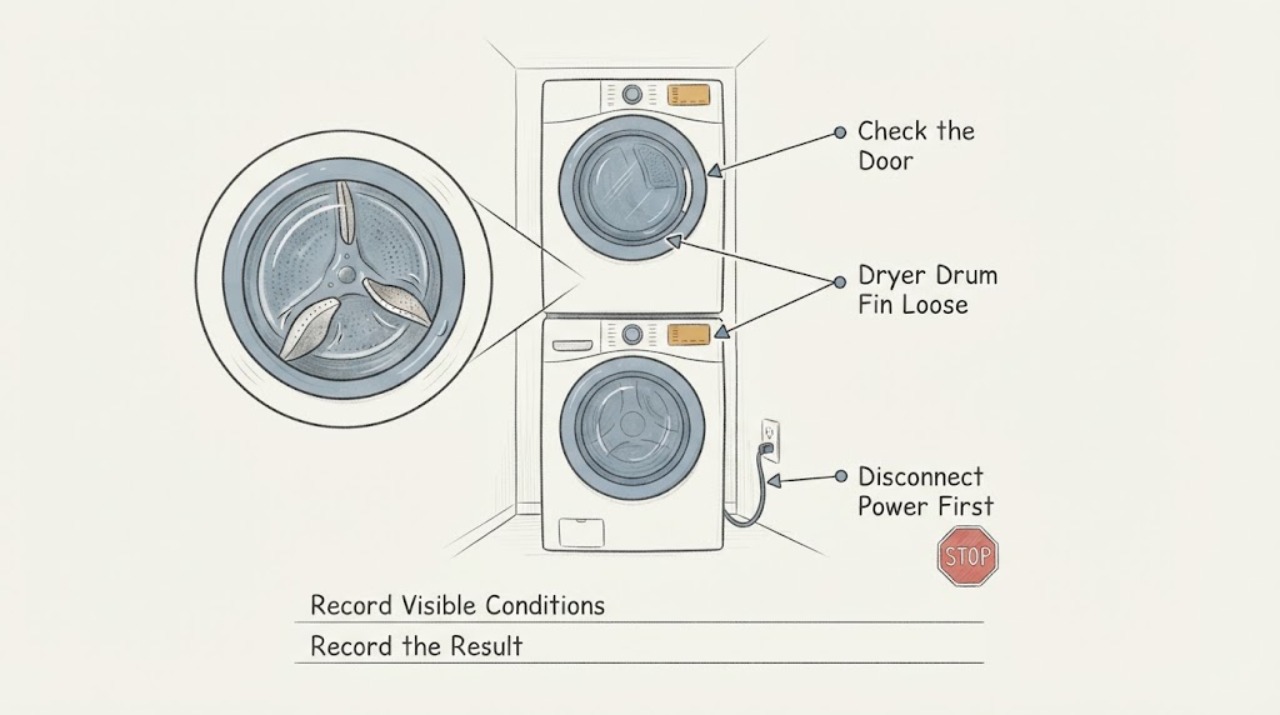
A loose dryer drum fin, also called a baffle, should not be ignored: manufacturer guidance describes the baffles as drum-mounted parts that lift and circulate clothing, and says a loose or fallen baffle needs the correct replacement part. Unplug the cooled dryer, inspect the fin and clothing path from the door, and turn the drum only by hand to look for a sharp edge, snag, scraping, or a loose fastener. Do not run the dryer if the fin catches fabric, has a sharp edge, scrapes, or is partly detached. Because this dryer is in a tight stacked space and the brand and model are unknown, do not guess at a screw, adhesive, replacement fin, stacking clearance, or unstacking method; use the exact manual, compatible stacking kit information, or qualified appliance service.
Work through in order
Diagnostic checks
Use only checks that match the exact appliance or system and its official guide.
-
Check 1
Find the dryer's full brand, model and serial label, and record whether it is a separate front-load washer/dryer pair or a single laundry center. Keep the exact installation manual and any stacking-kit information with the appliance details.
Expected result: The label and exact manual are available, or the label is missing and the installation type or stacking kit cannot be confirmed.
Next step: If the identity is confirmed, use only that model's parts and service instructions. If it is not confirmed, limit work to external observation and arrange appliance service rather than choosing a generic fin, screw or adhesive.
Why this matters
Why: A fin, fastener, drum access method and stacking procedure are model-specific. A missing identity prevents a safe compatibility or repair claim, even though the loose-fin symptom can still be triaged.
-
Check 2
With the dryer empty, cool and unplugged, open the door and inspect the fin from inside the drum. Turn the drum slowly by hand only far enough to view the attachment area; do not start a cycle.
Expected result: The fin is secure, visibly lifted at one edge, partly detached, missing a fastener, or has a sharp edge or scrape mark.
Next step: Leave the dryer unplugged if there is any lift, sharp edge, missing fastener, scrape, or uncertainty. Do not reach behind the fin or open the cabinet; provide the photos and model label to qualified service or follow the exact owner manual only if it gives a model-matched external repair.
Why this matters
Why: A lifted, partly detached or sharp fin is a direct clothing and drum-contact hazard. A fin that looks secure at the visible position is not proof that its hidden attachment is sound.
-
Check 3
Check the drum surface, front and rear edges visible through the door, and a sample of clothing for snagged threads, tears, dark rub marks or a repeating scrape. Keep hands away from any sharp edge and do not use a garment as a test load.
Expected result: Fabric is catching or damaged, a repeating scrape is visible, or the drum and clothing path show no damage during the cool hand check.
Next step: For any catch, tear, scrape or sharp edge, unplug and arrange service. If no damage is seen, continue only with identification and access checks; do not run the dryer to see whether the noise returns.
Why this matters
Why: Catching or scraping means the loose fin is already affecting the load path and the dryer should remain out of service. A clean hand check reduces the immediate snag evidence but does not establish that the fin is safe to run.
-
Check 4
Without moving the stack, inspect only the accessible front area and installation surroundings for a blocked door, unstable cabinet, crushed visible vent, or a need to pull the dryer away from the wall. Do not loosen the stack or lift one appliance out of position.
Expected result: The door and front service area are accessible and the stack appears stable, or safe access would require moving, unstacking or disturbing the vent, cord or water connections.
Next step: If access requires moving or unstacking, stop and use an installer or appliance technician with the exact model and stacking information. Do not work around a partially supported or unstable stack.
Why this matters
Why: Stacking guidance depends on compatible units, a stacking kit, stability and model-specific clearances. Tight access can turn a simple drum inspection into an installation or lifting hazard.
-
Check 5
Use the exact model manual or manufacturer service channel to identify the approved fin/baffle part and attachment method. Compare the manual's instructions with the observed damage before any repair decision.
Expected result: The manual identifies a model-matched baffle and safe owner procedure, or it gives no owner repair and the part or attachment remains uncertain.
Next step: Follow the exact manual only within its stated owner boundary; otherwise have service supply and install the correct part. After a documented repair, use only the manual's test procedure and stop immediately for scraping, vibration, snagging or renewed looseness.
Why this matters
Why: A documented model-matched procedure can distinguish a permitted external repair from work requiring cabinet or drum access. A generic screw, wider screw, adhesive or cross-brand fin is not evidence of a safe repair.
Use your observations
Decision map
Find the observation that best matches what you see, then follow the next safe action.
-
PATH 01Next step
What you see
The fin is partly detached, sharp, catches fabric, leaves rub marks, scrapes during the cool hand check, or a fastener is missing.
Do this next
Keep the dryer unplugged and arrange qualified appliance service. Do not run a load, add adhesive, substitute a generic screw or reach behind the baffle.
Why this path and its safety boundary
Why it matters: The drum attachment is not a safe run condition and can damage clothing or the drum; the symptom does not identify which internal part is at fault.
-
PATH 02Next step
What you see
The fin appears secure and there is no snag or scrape during the cool hand check, but the dryer identity, fastener specification or approved part remains unknown.
Do this next
Keep the model and serial information with the appliance and obtain the exact manual or service assessment before normal operation; do not use a test load to prove the repair.
Why this path and its safety boundary
Why it matters: The immediate hazard was not reproduced by an external check, but the baffle may still loosen under drum motion and the correct fit cannot be inferred from appearance.
-
PATH 03Next step
What you see
Reaching the fin would require pulling the dryer out, unstacking the pair, loosening the stacking kit, or disturbing a vent, cord or water connection in the tight space.
Do this next
Do not move or unstack the appliance alone. Have a qualified installer or appliance technician verify the stacking kit, support, clearance and model-specific repair access.
Why this path and its safety boundary
Why it matters: The problem has crossed from a visible drum check into stack stability and installation access; a generic unstacking instruction is unsafe without the exact setup.
-
PATH 04Next step
What you see
A model-matched baffle repair is completed, but the dryer still scrapes, vibrates, snags clothing or the fin loosens again.
Do this next
Stop the dryer and request service with the model, repair details, sound or scrape pattern and any damaged clothing. Do not keep cycling it to reproduce the noise.
Why this path and its safety boundary
Why it matters: The original symptom is unresolved or another drum, seal or support issue may be involved; the opened manufacturer pages do not support naming that internal part from the symptom alone.
Helpful context
Understand the symptom
What the loose fin means
A fin or baffle is mounted inside the dryer drum and helps lift and circulate clothing. Whirlpool and Maytag both describe a loose or fallen baffle as a condition that needs the correct replacement part, but those pages are manufacturer guidance rather than proof that a particular fastener or replacement part fits an unidentified dryer. A loose fin can also catch fabric or scrape the drum, so the immediate decision is whether the appliance can be kept safely out of service while its exact model is identified.
Why the stacked installation changes access
A tight stacked installation adds an access and stability question. Manufacturer stacking guidance calls for compatible appliances, a compatible stacking kit, a level and stable installation, and clearance checked against the exact manual. A clearance recommendation from one brand is not a universal specification for another dryer, and a stack should not be pulled apart casually just to reach a drum fastener.
When checks do not resolve it
Need a professional?
Keep the dryer unplugged and arrange service for a partly detached or sharp fin, clothing snagging, scraping, damaged clothing, a missing fastener, uncertain model or part fit, or any repair that requires moving or unstacking the stack. Stop immediately for smoke, burning odor, an electrical smell or a damaged cord, and use appropriate emergency or electrical service if there is an immediate hazard.
Common questions
FAQ
Can I just tighten the screw or use a wider screw on a loose dryer fin?
Do not guess. The exact fastener, baffle and drum attachment vary by model, and the opened manufacturer guidance supports using the correct replacement part rather than a generic workaround. Identify the dryer and follow its manual or have service make the repair.
Should I run the dryer once to see whether the loose fin is really a problem?
No. First unplug and cool the dryer, then inspect and slowly hand-turn the empty drum. A sharp, detached, snagging or scraping fin is a reason to keep the dryer out of service; a quiet hand check does not prove it is safe under powered rotation.
Can I unstack the dryer to reach the drum fin?
Do not unstack or pull a tight installation apart without the exact setup instructions and appropriate help. Manufacturer stacking guidance calls for compatible appliances, a compatible stacking kit, stable support and model-specific clearance; use an installer or appliance technician when access requires moving the stack.
Read the exact guide
Official sources
- Stackable Washer and Dryer SetsWhirlpool · Opened Whirlpool manufacturer guidance for compatible front-load pairs, stacking kits and model/manual-dependent installation. It is used to set an access and stability boundary, not to prescribe an unidentified stack's dimensions or disassembly.
- Washer and Dryer Dimensions: Standard and Stackable SizesWhirlpool · Opened Whirlpool manufacturer sizing guidance for measuring a laundry space and considering clearance behind, at the sides and in front. Dimensions are Whirlpool examples and are not transferred as universal clearances to an unidentified dryer.
- What are The Parts of a Dryer?Whirlpool · Opened Whirlpool manufacturer guidance for the role of drum baffles and the statement that a loose or fallen baffle needs a replacement part. It is used as a documented manufacturer example, not as proof of fit or repair procedure for an unidentified dryer.
- Parts of a Dryer: A Guide to Repair or Replace Common Gas or Electric Dryer PartsMaytag · Opened Maytag manufacturer guidance for baffle location, lifting/tumbling function and the need for replacement when loose or fallen. It does not establish the part, fastener or procedure for an unknown brand/model.
- Stackable Washers and Dryers: How to Stack a Washer and DryerMaytag · Opened Maytag manufacturer guidance for compatible models, stacking kits, level floors and clearance measurement. It supports the professional boundary for tight access, not an exact procedure for this unbranded installation.
Community feedback
Share a repair observation
Share a plain-text repair observation. Accepted observations are published automatically; this page may take a moment to update.