
On this page
Start here
Quick answer
The original report describes a 1994 dryer that made grinding noises for several days, then stopped, with grinding still felt when the drum was turned by hand. That is enough to stop using it and request a diagnosis; it is not enough to declare the drum bearing, rollers, belt, motor, or any other part failed. Unplug the dryer before accessible inspection, check only for an obvious object or lint/vent restriction, and ask for a written estimate tied to the exact model. If the estimate depends on unavailable parts or an unverified internal diagnosis, replacement may be more practical, but age alone does not establish a repair price or a safety outcome.
Work through in order
Diagnostic checks
Use only checks that match the exact appliance or system and its official guide.
-
Check 1
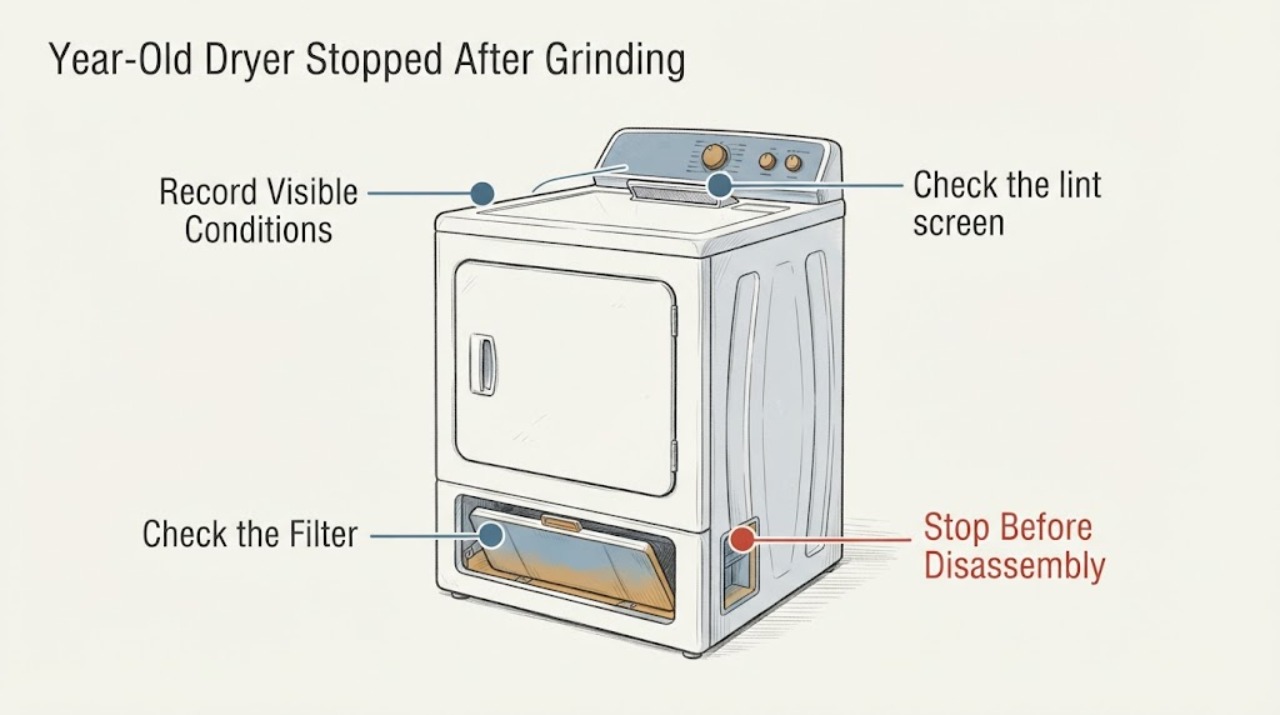
Stop the dryer, unplug it, and record the exact model/serial label, whether it is gas or electric, the last normal cycle, the duration of the grinding, and any burning smell, heat, smoke, or breaker trip.
Expected result: The dryer is quiet when off, or there is a burning smell, heat damage, smoke, gas odor, or electrical damage around the appliance or outlet.
Next step: Keep the appliance disconnected. For smoke, gas odor, or visible electrical damage, leave the area safe and use qualified appliance/electrical or gas service; do not open the cabinet.
Why this matters
Why: The original grinding sequence is a meaningful symptom to give a technician, while smoke, gas odor, heat damage, or electrical damage raises a safety issue that should not be tested by another cycle.
-
Check 2
With power disconnected, inspect only the drum opening and the lint-filter opening for an obvious loose object; use gloves for the lint-filter opening because exposed edges can be sharp.
Expected result: A coin, fastener, or other object is visibly accessible, or the openings are clear while the drum still feels rough or grinds when turned gently by hand.
Next step: Remove only an obviously accessible object without reaching into the cabinet. If the noise or roughness remains, stop and arrange qualified service.
Why this matters
Why: An accessible object can create scraping or rattling, but a clear opening with persistent rough rotation does not prove a bearing or roller failure and points to a service diagnosis rather than repeated operation.
-
Check 3
Check the lint screen, the visible rear exhaust connection, and the outside vent from a safe position; do not run the dryer just to perform this check.
Expected result: Lint is packed in the screen or behind the dryer, the exhaust duct is crushed/blocked, or the outside vent has no clear path; alternatively the visible exhaust path is clear.
Next step: Clean the accessible lint screen and arrange qualified vent/chassis cleaning for a blockage. Reconnect ducting correctly before any future use; do not treat vent cleaning as a repair for persistent grinding.
Why this matters
Why: CPSC identifies blocked lint or exhaust paths as a source of restricted airflow and heat buildup. A clear vent does not explain mechanical grinding, but a blocked path is a separate safety and maintenance issue.
-
Check 4
Ask a qualified servicer for a written diagnosis and estimate using the exact model, including the confirmed failed part or inspection result, labor, parts availability, and whether additional wear items are involved.
Expected result: The estimate identifies one supported repair with available parts, or it depends on an unconfirmed internal part, multiple age-related parts, or unavailable model-specific parts.
Next step: Approve work only after the diagnosis and total scope are clear. If the cause or parts support cannot be confirmed, keep the dryer out of service and compare replacement options based on the household’s capacity, installation, and venting needs.
Why this matters
Why: A documented diagnosis lets the household compare a repair decision with replacement without treating the Reddit author’s bearing assumption or other comments as proof. Missing parts support can make an otherwise repairable old dryer impractical.
Use your observations
Decision map
Find the observation that best matches what you see, then follow the next safe action.
-
PATH 01Next step
What you see
The dryer made grinding noises for days and the drum still grinds or feels rough when turned gently with power disconnected.
Do this next
Do not run another load. Give the servicer the symptom sequence and exact model, and request a written diagnosis before deciding repair or replacement.
Why this path and its safety boundary
Why it matters: The symptom pattern is consistent with a mechanical problem that needs model-specific inspection, but it does not identify a bearing, roller, belt, or motor by itself.
-
PATH 02Next step
What you see
An object is visible at the drum or lint-filter opening and the dryer has no smoke, gas odor, or heat damage.
Do this next
Remove only the visible object with power disconnected and gloves as needed. If the drum still grinds, leave the dryer disconnected and arrange service.
Why this path and its safety boundary
Why it matters: The object may explain a scraping or rattling sound, but an accessible finding does not prove that the preceding grinding and stop had no other cause.
-
PATH 03Next step
What you see
The lint screen, exhaust duct, or outside vent is blocked, crushed, or heavily contaminated.
Do this next
Stop use until the accessible lint and vent path is corrected or professionally cleaned, and reconnect the exhaust path before operating again.
Why this path and its safety boundary
Why it matters: Restricted airflow can create excessive heat and fire risk; it is a safety/maintenance finding separate from the mechanical noise.
-
PATH 04Next step
What you see
There is smoke, a burning smell, gas odor, visible heat damage, a damaged cord/outlet, or a breaker trip.
Do this next
Keep the dryer off and obtain the appropriate qualified service. Do not open panels, bypass a safety device, or make live measurements.
Why this path and its safety boundary
Why it matters: The appliance or its installation may present a fire, gas, or electrical hazard, so troubleshooting by repeated operation is unsafe.
-
PATH 05Next step
What you see
The diagnosis confirms a supported repair with available parts and a clear scope, or instead finds multiple age-related concerns or no parts support.
Do this next
Use the written estimate and exact installation requirements to choose. If the diagnosis or parts support remains uncertain, do not spend on an unverified component and keep the old dryer out of service.
Why this path and its safety boundary
Why it matters: Repair-versus-replace is a decision about confirmed scope, safety, parts and household needs; the 31-year age and Reddit comments alone do not determine it.
Helpful context
Understand the symptom
The useful decision here is whether the dryer has an identifiable, serviceable fault and whether safe parts support still exists. The post does not identify a brand, model, gas/electric type, or exact repair quote, so no component or replacement recommendation can be made from the age and noise alone.
Treat the grinding sequence as a stop signal. Do not keep running the dryer to see whether it fails again, do not reach into the cabinet, and do not remove panels or make live electrical measurements.
When checks do not resolve it
Need a professional?
Give the technician the exact model/serial, gas or electric type, the grinding timeline, whether the drum grinds by hand with power disconnected, any odor or heat damage, and the vent condition. Request a written diagnosis and parts-availability statement; do not authorize a bearing, roller, belt, motor, or control replacement solely from the symptom wording.
Common questions
FAQ
Does grinding prove the drum bearing failed?
No. The exact post reports grinding during hand rotation, but that observation does not identify a bearing, roller, belt, motor, or other component. Have the exact model inspected before ordering a part.
Should I run the dryer once more to confirm the noise?
No. GE advises discontinuing use when unusual noise is unresolved. Keep the dryer unplugged and arrange qualified service, especially if there was odor, heat damage, smoke, or electrical trouble.
Can vent cleaning decide whether this 31-year-old dryer is worth repairing?
No. CPSC supports lint and exhaust maintenance for fire prevention, but a clear vent does not diagnose mechanical grinding. Use a written model-specific diagnosis, parts availability and scope to compare repair with replacement.
Read the exact guide
Official sources
- My 31-year-old dryer finally quit.Reddit r/Appliances · Opened exact Reddit post. It reports a 1994 dryer, several days of grinding, grinding when the tumbler is turned by hand, and a purchase/repair decision; it does not confirm a failed part or completed repair.
- Dryer - NoisesGE Appliances · Opened GE general dryer-noise guidance. It is used only for low-risk external checks and the stop-use/service boundary; no GE-specific part or model diagnosis is transferred to the unidentified dryer.
- CPSC Publication 5022 - Overheated Clothes Dryers Safety AlertU.S. Consumer Product Safety Commission · Opened CPSC dryer safety alert. It supports lint-screen, exhaust-path and qualified interior-cleaning safety boundaries for household dryers without identifying the unknown dryer’s mechanical fault.
Community feedback
Share a repair observation
Share a plain-text repair observation. Accepted observations are published automatically; this page may take a moment to update.