
On this page
Start here
Quick answer
Treat a Siemens E 44.10 dryer whose mains filter burst on first energization as an electrical safety event, not as an ordinary no-power or filter-replacement problem. Do not reconnect it, bypass the filter, substitute a guessed part, reset a breaker repeatedly, or open the cabinet. From a safe, de-energized position, record the complete E-Nr from the rating plate, photograph the damage without touching it, and note whether the outlet, plug, cord, wall protection, or surrounding area also shows heat, soot, moisture, or impact damage. Siemens identifies E 44.10 as a condenser-dryer family with several E-Nr variants and directs users to model-specific documentation and service; its support guidance sends a recurring electrical fault to a qualified electrician or appliance service. Because the task label E 44.10 is not a complete E-Nr and the exact failed cause is not established, the correct next step is qualified inspection of the appliance and supply before any replacement is selected.
Work through in order
Diagnostic checks
Use only checks that match the exact appliance or system and its official guide.
-
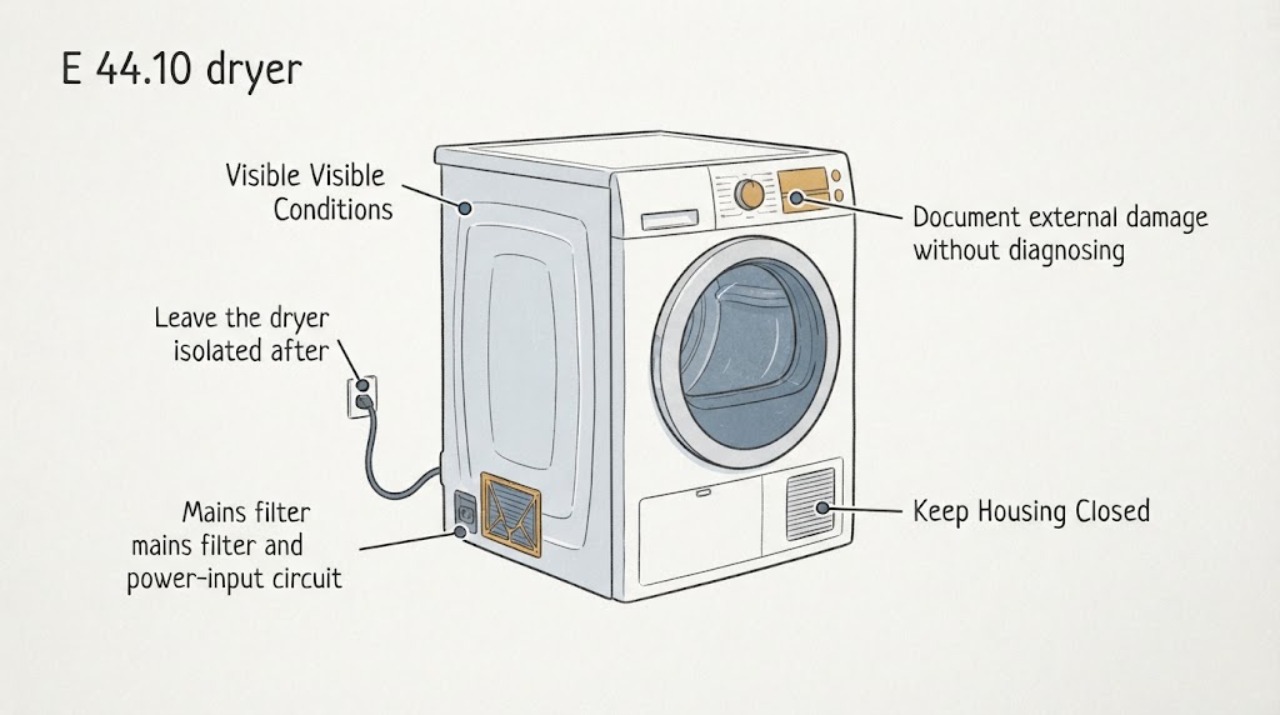
Leave the dryer isolated after the event
Do not plug the dryer back in, start a programme, bypass the mains filter, replace a fuse or breaker repeatedly, or remove a panel. If the plug is already disconnected and the damaged area is cool and dry, leave it disconnected. If the plug, cord, outlet, or appliance is hot, wet, smoking, or arcing, keep clear and use local emergency guidance as appropriate.
Expected result: The dryer is isolated with no active heat, smoke, or arcing, or a heat, smoke, wetness, damaged cord/plug, or repeated protective-device event remains.
Next step: Keep the appliance out of service. For an active hazard, clear the area and contact emergency or electrical help; for a cool isolated appliance, continue only with the external identity and evidence checks below.
Stop if: Do not reconnect the dryer merely to see whether it still works, and do not touch a damaged filter or exposed conductor.
Why this matters
Why: The described burst has moved the situation out of routine user troubleshooting. Siemens says a recurring electrical supply problem should be handled by a qualified electrician, and a device-side fault should go to appliance repair; neither path is safely tested by re-energizing the dryer.
-
Record the complete E-Nr and market information
From a safe external position, read the rating plate and record the full Siemens E-Nr, including every suffix after the slash, plus the product number if shown. Photograph the label and the outside of the damage without moving the dryer or removing a cover. Treat E 44.10 or E-44-10 alone as an incomplete family/model clue.
Expected result: A complete E-Nr is legible, only E 44.10 is available, or the rating plate cannot be read without moving or opening the appliance.
Next step: Give the complete E-Nr and the label photograph to Siemens-qualified service. If it is missing or unclear, request identity help before anyone orders an electrical part.
Stop if: Do not move a heavy dryer, expose the rear, or remove trim to find the plate after an electrical failure.
Why this matters
Why: Siemens' E 44.10 support page demonstrates that the family contains separate E-Nr variants, such as WT44E100SK/07, with their own documents and service choices. The family name or a suspected display string cannot establish the correct mains-filter specification or market version.
-
Document external damage without diagnosing the cause
Without touching the filter or opening the cabinet, inspect the accessible plug, power cord, outlet face, nearby wall, floor, and dryer exterior. Note soot, melted plastic, discoloration, odor, loose material, moisture, a tripped protective device, and whether damage is confined to the visible power-input area. Keep photographs and the date of the event for the technician or insurer.
Expected result: Damage is confined to the dryer exterior, or the outlet/cord/wall also has heat marks, moisture, looseness, or other damage; no external damage is visible.
Next step: If the outlet, cord, or wall is affected, leave that point out of service and have a qualified electrician assess it. For appliance-only evidence, provide the photos and observations to qualified dryer service; do not select a filter from a visual match.
Stop if: Stop if inspection would require touching residue, opening a cover, moving the appliance, or working near moisture or exposed conductors.
Why this matters
Why: A clean exterior cannot rule out an internal fault, while damage outside the dryer means the building supply or connection also needs attention. The appearance does not prove whether the filter, cord, control, or another component initiated the event.
-
Use the correct service route for the supply and appliance
Ask a qualified electrician to assess any outlet, cord, protective-device, grounding, or supply-side concern, and ask Siemens-qualified appliance service to assess the isolated dryer. Give both parties the complete E-Nr, market, storage history, first-use event, and photographs. Do not ask a technician to fit a generic mains filter before the fault path is inspected.
Expected result: The supply-side check is clear but the dryer remains damaged, the supply is also damaged or uncertain, or the complete E-Nr cannot be confirmed.
Next step: Keep the dryer isolated until the responsible professional has inspected the relevant side and identified an approved repair plan. Obtain model-specific part confirmation only after the full E-Nr is matched.
Stop if: Do not bridge, bypass, or substitute the protective filter or reconnect after a supply-side trip.
Why this matters
Why: Siemens separates electrical-supply troubleshooting from appliance repair and directs recurring problems to qualified help. A clear outlet does not clear the dryer, and an appliance label without a verified supply does not clear the installation.
-
Do not treat a filter replacement as a complete repair
If a service provider proposes a replacement, require the part and repair procedure to be matched to the complete E-Nr and market. Do not rely on the E 44.10 family label, a similar-looking component, a generic online listing, or a claim that long storage alone proves the cause. Keep the old part and event photographs available for the inspection.
Expected result: The exact E-Nr and an approved repair path are documented, or the proposed part is based only on E 44.10, a visual match, or an unverified fault assumption.
Next step: Proceed only with qualified, model-matched repair after supply and appliance inspection. If the E-Nr or cause remains uncertain, stop and request a written diagnosis rather than experimenting with another part.
Stop if: Do not operate the dryer without its required protective components or with a defective filter; Siemens warns that a dryer should not be operated without a proper, undamaged lint filter, and the mains filter is not a user-serviceable bypass item.
Why this matters
Why: Siemens' parts system asks for the appliance E-Nr before compatibility is checked. The official E 44.10 support page also shows that the same family label can correspond to a specific full E-Nr and appliance variant; neither page establishes that the mains filter alone caused the burst.
Use your observations
Decision map
Find the observation that best matches what you see, then follow the next safe action.
-
PATH 01Next step
What you see
The mains filter burst, the appliance is isolated, and the complete E-Nr is not known.
Do this next
Use the accessible rating-plate information or service records to recover the full E-Nr, then contact Siemens-qualified service. Do not reconnect or order a filter from the family name.
Why this path and its safety boundary
Why it matters: E 44.10 is a family designation rather than enough identity for an electrical part or repair instruction; the safe decision is identity recovery and professional inspection.
-
PATH 02Next step
What you see
The outlet, plug, cord, or wall also shows heat, soot, moisture, looseness, or a protective device trips again.
Do this next
Keep the affected circuit and dryer out of service and obtain qualified electrical assessment plus appliance service. Do not reset and retry.
Why this path and its safety boundary
Why it matters: The incident may involve the supply or connection as well as the dryer, so an appliance-only part swap would leave a safety question unresolved.
-
PATH 03Next step
What you see
The supply looks normal externally, but the dryer filter is burst or the appliance remains dead after the event.
Do this next
Leave the dryer disconnected and have Siemens-qualified appliance service inspect it using the complete E-Nr and the preserved event evidence.
Why this path and its safety boundary
Why it matters: The dryer still has an unresolved device-side electrical fault. A normal-looking outlet cannot prove the filter, wiring, control, or protective path is safe.
-
PATH 04Next step
What you see
A proposed repair uses a generic filter, skips the supply check, or requires bypassing a protective component.
Do this next
Decline the workaround and request a model-matched diagnosis and approved repair from qualified service. Keep the dryer isolated until then.
Why this path and its safety boundary
Why it matters: The repair is not supported by the available identity and safety evidence and could defeat a protection designed for an electrical fault.
Helpful context
Understand the symptom
The name E 44.10 identifies a Siemens dryer family, not the complete appliance identity. Siemens' support page for one E 44.10 variant shows a full E-Nr such as WT44E100SK/07 and exposes model-specific manuals, troubleshooting, and parts. Do not use the family name to choose an electrical replacement.
A filter that has visibly burst, cracked, charred, or expelled material can indicate an upstream or downstream electrical fault. The user-level task ends with isolation, evidence preservation, and safe handoff; the cabinet, mains filter, wiring, and protective components belong to qualified service.
When checks do not resolve it
Need a professional?
Call qualified electrical and appliance service rather than continuing user checks whenever the mains filter burst, the dryer remains dead, the E-Nr is incomplete, the outlet or cord is affected, a protective device trips, or any smoke, burning odor, heat, moisture, or arcing is present.
Have this ready
- Provide the full Siemens E-Nr and market, the fact that the dryer had been unused for years, the first-energization sequence, photographs, whether it was connected to a surge device or extension, and the condition of the outlet, plug, cord, and protective device.
Common questions
FAQ
Is E 44.10 the complete Siemens model number?
No. Siemens' E 44.10 support page shows a full appliance E-Nr such as WT44E100SK/07. Use the complete rating-plate E-Nr, including its suffix, before choosing documentation or an electrical component.
Can I replace only the mains filter and try the dryer again?
Do not do that as a user repair. A burst filter does not prove that the filter alone failed, and reconnecting could repeat the event. Keep the dryer isolated until qualified service checks the supply and appliance and confirms a model-matched repair.
Does long storage prove that the dryer failed because it was unused?
No. The storage history is useful context, but it does not identify the initiating fault. Record it for the technician without turning it into a component diagnosis.
Can I use a generic lint or mains filter while waiting for service?
No. Siemens requires the correct, undamaged protective components and uses the appliance E-Nr to check parts. Do not operate the dryer with a defective filter or bypass a mains protection component.
Read the exact guide
Official sources
- Trockner Online-Fehlersuche | Siemens HausgeräteSiemens Home Appliances · Siemens troubleshooting overview directs the user to select the actual dryer problem and consult the appliance manual or service; it supports stopping at the service boundary when the incident is an electrical failure.
- Search for original cleaning and care products | Siemens HomeSiemens Home · Siemens explains that the appliance model number/E-Nr is used for product and parts searches and shows where the rating plate information is located; the page does not identify a mains-filter part for this task.
- Trockner hat keinen Strom: Woran kann es liegen? | Siemens HausgeräteSiemens Home Appliances · Siemens guidance separates outlet/protective-device checks from a device fault, directs repeated electrical problems to a qualified electrician, and directs appliance faults to Siemens repair. It does not authorize re-energizing a dryer after a mains filter burst.
- Model WT44E100SK/07: User manuals, spare parts, accessories | Siemens HomeSiemens Home · The opened Siemens support page identifies E 44.10 as a condenser dryer family and gives WT44E100SK/07 as a complete E-Nr variant; it also exposes model-specific troubleshooting, manuals, and parts routes. It is identity and routing evidence, not proof of the cause of a burst filter.
- How to clean the lint filter of my dryer? | Siemens HomeSiemens Home · Siemens warns not to operate a dryer without a proper, undamaged lint filter. This supports the broader protective-component boundary but is not a mains-filter replacement instruction.
Community feedback
Share a repair observation
Share a plain-text repair observation. Accepted observations are published automatically; this page may take a moment to update.