
On this page
Start here
Quick answer
First confirm what your Siemens dryer uses for condensate: a container or a connected drain hose. Siemens explains that, when no drain hose is connected, condensation runs into the condensate container; the container should be emptied after each drying cycle and whenever it becomes full during a cycle. Switch the dryer off and let it stop safely, then pull the container out horizontally, empty it, check the filter for deposits, and push the container back until it locks. If a drain hose is fitted, inspect only its visible route and connections for a kink, disconnection, or leak, following the exact E-Nr. manual. Do not drink or reuse condensate water, run the dryer with a removed filter or unsecured container, open the cabinet, or test a wet appliance. If water is inside the cabinet, a hose or container is damaged, the drain remains blocked after the user-accessible checks, or the source is unclear, leave the dryer out of service and arrange qualified Siemens appliance service.
Work through in order
Diagnostic checks
Use only checks that match the exact appliance or system and its official guide.
-
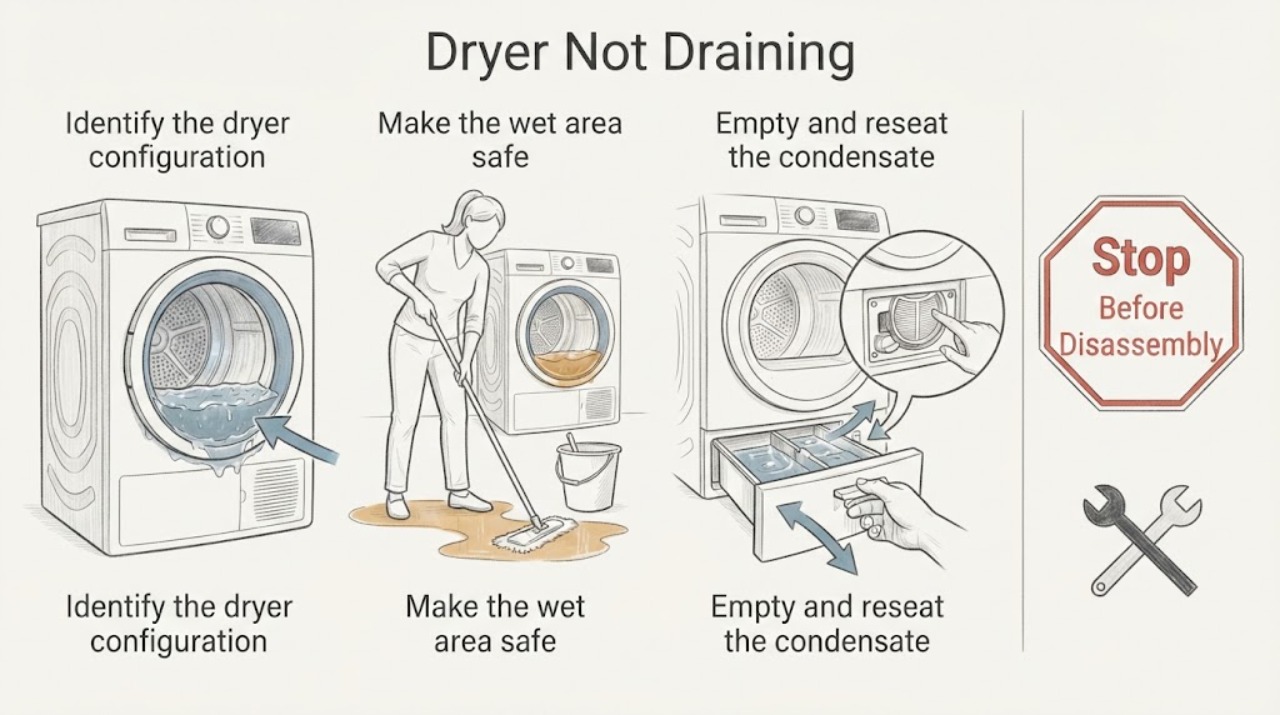
Identify the Siemens dryer configuration
From a dry, stable position, record the Siemens E-Nr. and check whether the dryer has a condensate container, a connected drain hose, or a model-specific arrangement described in its manual. Note whether water remains after a cycle, appears during drying, or is found on the floor.
Expected result: A container is present with no drain hose, a drain hose is visibly connected, or the model-specific water path cannot be identified; the timing and first wet location are recorded.
Next step: If the container or visible hose route is clear and the area is safe, continue to the corresponding external check. If the E-Nr. or configuration is unclear, keep the dryer out of service and use the exact manual or qualified service.
Stop if: Stop for water near the plug or controls, an unstable stacked appliance, smoke, a burning odor, or any need to move a wet dryer.
Why this matters
Why: Siemens says the condensate route depends on whether a drain hose is connected and that dryer modules may differ by model. The E-Nr. is needed to avoid applying the wrong path.
-
Make the wet area safe
Stop the programme and wait until the drum and accessible surfaces are safe to touch. Unplug the dryer only when the plug and surrounding floor are dry enough to reach safely; otherwise isolate the circuit at the breaker. Do not run another cycle to reproduce a drain problem or open a panel.
Expected result: The dryer is de-energized and the accessible area is dry, or water blocks safe plug access or has reached electrical parts.
Next step: If power is isolated and the visible container or hose can be handled safely, continue. If safe isolation is not possible, leave the appliance alone and arrange qualified service.
Stop if: Stop immediately for water at the plug or controls, a damaged cord, breaker tripping, smoke, a burning smell, or an uncontrolled leak.
Why this matters
Why: Isolation prevents a recurring condensate problem from becoming an electrical hazard. Water near a cord, control, or cabinet is beyond a routine container-emptying check.
-
Empty and reseat the condensate container
When no drain hose is connected and the exact model uses a container, pull the condensate container out horizontally, empty it completely into a suitable receptacle, and slide it back until it locks. Keep the water away from the plug and controls; do not drink or reuse the condensate.
Expected result: The container was full and empties normally, then locks securely; or it is cracked, stuck, cannot be reseated, or fills again immediately.
Next step: If the container is intact, locked, and the surrounding area is dry, continue to the filter and visible-path check. If it is damaged, stuck, or immediately refills, keep the dryer disconnected and arrange service.
Stop if: Stop for a cracked container, water inside the cabinet, a fitting requiring force, or any water near electrical parts.
Why this matters
Why: Siemens identifies a full container as the expected collection path when no drain hose is connected. A damaged or immediately refilling container suggests a leak, routing, or internal condensate fault rather than a simple missed emptying.
-
Inspect the accessible filter and hose route
Check the condensate-container filter for visible deposits and remove only residue the exact model instructions permit. If a drain hose is connected, inspect its visible length and accessible connection for a kink, disconnection, crushed section, or leak without pulling out a stacked appliance or removing panels.
Expected result: The filter has removable deposits, the hose route is kinked or disconnected, or the visible path is clean, connected, and dry; alternatively the suspected blockage is hidden.
Next step: If the visible filter or hose issue is corrected exactly as the manual permits, continue with a cautious confirmation. If the path is hidden, damaged, or still not draining, leave the dryer out of service and arrange model-specific service.
Stop if: Stop for a split hose, water inside the cabinet, a hose that needs force to disconnect, or any need to access the pump, heat exchanger, wiring, or sealed cabinet.
Why this matters
Why: Siemens says the container filter should be checked regularly and that a drain hose changes where condensation goes. A visible external defect can explain poor drainage, but a hidden obstruction or internal fault is not identified by this check.
-
Confirm a dry return or call for service
After the container is locked or the visible hose connection is corrected, dry the floor and accessible surfaces. Follow the exact E-Nr. manual for any permitted test and remain present; stop at the first new drop, full-container indication, abnormal noise, odor, or electrical symptom.
Expected result: The model-approved test completes with no new water, or water returns, the container fills abnormally, the drain remains blocked, or another fault appears.
Next step: If the dryer remains dry and normal, follow the exact model's regular filter and container care. If the problem returns or any unsafe symptom appears, isolate power and arrange qualified Siemens service with the E-Nr. and observations.
Stop if: Stop for any recurrence, water near electrical parts, breaker trip, smoke, burning odor, or a need to remove panels.
Why this matters
Why: A dry test supports that the visible collection step was completed; it does not prove that an internal pump, seal, heat exchanger, or drain path is sound. Recurrence or an unknown source needs diagnosis.
Use your observations
Decision map
Find the observation that best matches what you see, then follow the next safe action.
-
PATH 01Next step
What you see
No drain hose is connected, and the Siemens dryer stops with a full condensate container or water remains in the container after drying.
Do this next
Empty the container horizontally, check the filter for deposits, reseat it until it locks, and use the exact E-Nr. manual if the full indication or water returns immediately.
Why this path and its safety boundary
Why it matters: This is consistent with Siemens' documented collection arrangement, where condensation runs into the container when no drain hose is connected.
-
PATH 02Next step
What you see
A Siemens dryer has a connected condensate drain hose, but water remains in the dryer or appears at the hose connection.
Do this next
Keep power isolated, inspect only the visible hose for a kink, disconnection, crush, or leak, and follow the exact E-Nr. installation guidance. Arrange service for a hidden blockage, damage, or recurrence.
Why this path and its safety boundary
Why it matters: The hose route, connection, drain destination, or an internal condensate component may be involved; the container-emptying sequence alone is incomplete for this configuration.
-
PATH 03Next step
What you see
The container filter has visible deposits, while the container and accessible hose remain intact and the cabinet is dry.
Do this next
Remove only accessible residue as the exact manual permits, reinstall every filter and container securely, then perform only a model-approved attended test.
Why this path and its safety boundary
Why it matters: Siemens says the filter should be checked regularly for remaining deposits; contamination can interfere with the condensate path, but the exact cleaning method is model-specific.
-
PATH 04Next step
What you see
Water is inside the cabinet, the container or hose is cracked, the dryer repeatedly refills or leaks after the external checks, or water reaches electrical parts.
Do this next
Leave the dryer disconnected, do not move or dismantle it, record the E-Nr. and symptom timing, and arrange qualified Siemens appliance service.
Why this path and its safety boundary
Why it matters: The fault is not safely identified by user-accessible drainage checks and may involve an internal component or unsafe water path.
Helpful context
Understand the symptom
Confirm which Siemens water path you have
Not every Siemens dryer is configured the same way. Siemens' troubleshooting guidance lists the condensate container among the important dryer modules but notes that the arrangement may differ from the appliance at home. Find the E-Nr. on the type plate, usually inside the door or on the back, and determine whether your dryer collects water in a container or has a drain hose connected. Do not assume that a visible puddle proves an internal pump fault: a loose external hose, a mis-seated container, or a full container can produce different symptoms.
Empty the container without spreading condensate
If there is no drain hose connected, Siemens directs you to pull the condensate container horizontally, pour it out completely, and push it back until it locks. Condensate may contain fluff and other contamination, so do not drink it or reuse it. Wipe spilled water with the dryer switched off and keep the plug, controls, and floor dry before any further test.
Check the filter and visible drain route
After emptying the container, check the container filter for remaining deposits and remove only what the exact model instructions allow. If a drain hose is connected, inspect its visible route and accessible connections for a kink, disconnection, crush point, or leak; do not pull the appliance out of a stack or remove panels to reach hidden plumbing. Siemens' guidance separates the container arrangement from the drain-hose arrangement, so use the E-Nr. manual for any hose rerouting or conversion.
Escalate when the external path is not enough
A full container that returns immediately, water inside the cabinet, a cracked container, a damaged or persistently blocked hose, repeated leakage, or an appliance that stops with water still trapped after the documented emptying step is not a safe guess-and-replace repair. Keep the dryer disconnected if water reaches electrical parts, record the E-Nr., cycle timing, and first wet location, and arrange qualified Siemens service.
When checks do not resolve it
Need a professional?
The dryer remains unable to drain after the container is emptied and the visible filter or hose path is checked according to the exact manual., A hose or container is cracked, leaking, stuck, or immediately refills., Water is inside the cabinet or reaches electrical parts, or the dryer trips a breaker, smells burned, or smokes., The diagnosis would require moving a stacked unit, removing panels, or testing an internal component.
Have this ready
- The complete Siemens E-Nr. from the type plate and whether the dryer uses a condensate container or connected drain hose.
- Whether the water appears during drying, at cycle end, or on the floor, plus the first visible wet location.
- Photos or a description of the container, filter, visible hose connection, full-container indication, and any electrical symptom.
Common questions
FAQ
Why is my Siemens dryer not draining?
If no drain hose is connected, Siemens says condensation runs into the condensate container, which must be emptied after each cycle and when it becomes full during drying. If a hose is connected, the visible hose route and model-specific installation must be checked instead. A hidden or recurrent blockage needs service.
How do I empty a Siemens dryer condensate container?
Siemens' sequence is to pull the container out horizontally, pour out the condensation completely, and push the container back until it locks. The water may contain fluff and is not for drinking or reuse.
Can I keep running the dryer if it is not draining?
Do not keep running it when water is near electrical parts, the cabinet is wet, the leak is recurrent, or the source is unclear. Isolate power safely and follow the exact E-Nr. manual or arrange qualified service.
Does every Siemens dryer have the same condensate filter and drain layout?
No. Siemens notes that the important modules may differ by model and asks for the E-Nr. to identify the correct appliance information. Do not remove panels or use another model's drain procedure.
Read the exact guide
Official sources
- Tumble dryer troubleshooting for your Siemens dryerSiemens Home Appliances / BSH Home Appliances Group · Directly supports Siemens' model caveat, condensate-container and fluff-filter modules, the no-drain-hose container arrangement, regular container emptying, and the need to use the E-Nr. for model-specific information. It does not identify a universal internal drain part.
- Condensate container: How to empty it the right waySiemens Home Appliances / BSH Home Appliances Group · Directly supports the documented three-step container emptying sequence, the no-drain-hose arrangement, the warning not to drink or reuse condensate water, and regular visual checking of the container filter. Apply only when the reader's exact Siemens model uses this container arrangement.
Community feedback
Share a repair observation
Share a plain-text repair observation. Accepted observations are published automatically; this page may take a moment to update.