
On this page
Start here
Quick answer
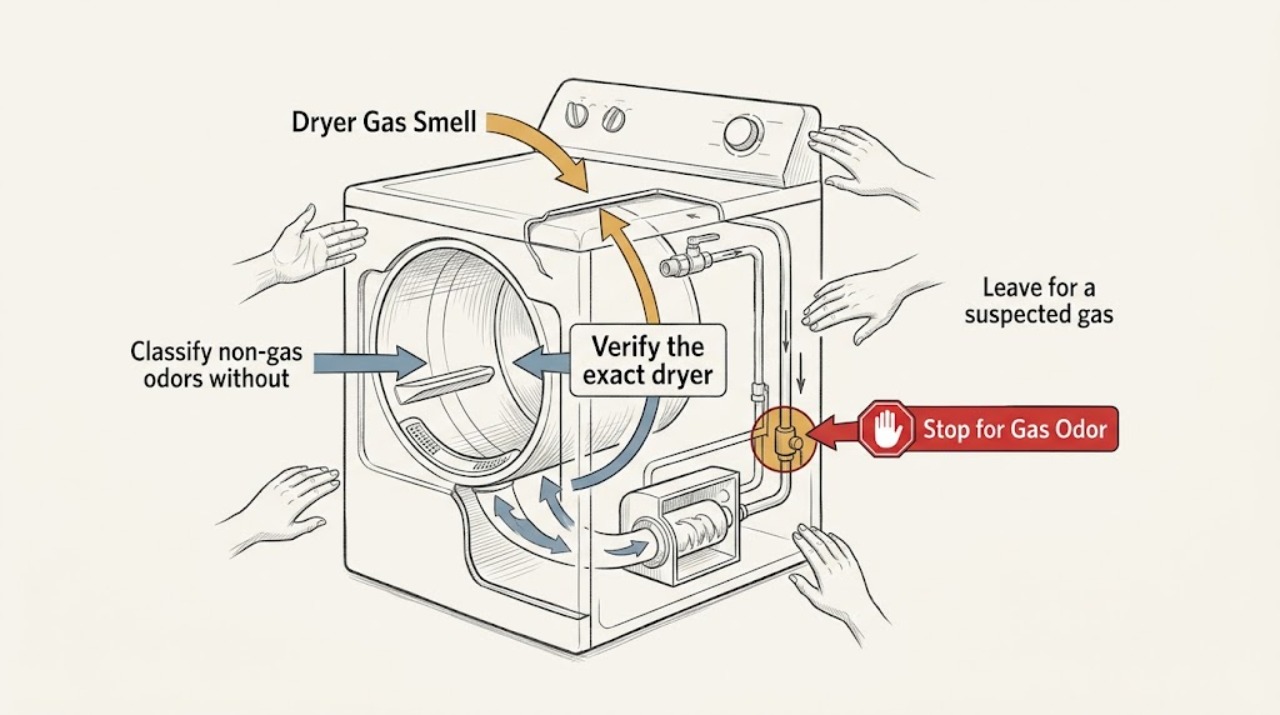
Do not assume that a Siemens dryer has a gas burner: dryer fuel and design vary by model and region. If the smell is raw gas or rotten eggs, or if you hear gas, stop using every appliance in the area, avoid flames, switches, and electronics, leave immediately, and contact local gas or emergency assistance from outside. Do not move the dryer or try to locate a connector. If the smell is burning, plastic, smoke, or an electrical odor, stop the dryer and keep it out of service; disconnect power only if that can be done safely without touching a wet appliance or entering a hazardous area. After the area is cleared, record the Siemens E-Nr. model data, fuel type, cycle, timing, and odor description. Use the exact Siemens manual or qualified service to distinguish a dryer fault from an odor coming from another gas appliance, drain, vent, or the room; do not run a cycle to reproduce the smell.
Work through in order
Diagnostic checks
Use only checks that match the exact appliance or system and its official guide.
-
Leave for a suspected gas leak
If the odor is raw gas or rotten eggs, or you hear gas, do not light anything, touch switches, operate the dryer, use electronics in the area, or open panels. Leave immediately and contact local gas or emergency assistance from outside. Do not move the dryer to inspect its rear connection.
Expected result: The odor is present or intensifying, gas is audible, or the area has been cleared by the appropriate gas or emergency responder.
Next step: Do not return to find the leak or run the dryer again. Resume model identification only after responders declare the location and appliance safe.
Why this matters
Why: A suspected gas leak is an emergency response condition, not a dryer troubleshooting check. Ignition sources and movement can increase the risk.
-
Classify non-gas odors without a test cycle
After clearance, record what was already noticed: burning lint or fabric, hot plastic, electrical odor, smoke, mildew, detergent, or a drain-like smell. Note whether it occurred during startup, heating, tumbling, cooldown, or while the dryer was Off. Do not run another cycle just to compare odors.
Expected result: The odor is accompanied by smoke, scorching, visible heat damage, a tripped protective device, or an odor that remains after the dryer is Off; or it is limited to a room drain or nearby source.
Next step: Keep the dryer unused and give the timing and description to qualified Siemens service. Do not restart it to prove the source.
Why this matters
Why: Smoke, scorching, persistent heat damage, or electrical symptoms indicate a stop-use appliance path. An odor isolated to a drain or other appliance may not originate in the dryer, but it still needs safe source confirmation.
-
Verify the exact Siemens dryer identity and fuel type
When no active hazard remains, photograph the type plate and record the Siemens E-Nr., FD, Z-Nr., region, and installation type. Use the exact manual or product support to determine whether the dryer is electric, heat-pump, condenser, vented, or another model-specific design; do not infer a gas burner from the user-facing problem label.
Expected result: The model and fuel design are confirmed, or the type plate and manual cannot be matched.
Next step: Give the model data to Siemens support or a qualified technician. If the design remains unknown, keep the dryer out of service rather than opening it or applying another model's procedure.
Why this matters
Why: Siemens supplies multiple dryer designs and model-specific support; a generic gas-appliance procedure could be irrelevant or unsafe for an electric dryer.
-
Check for carbon-monoxide warning signs
From a safe location, note whether a carbon-monoxide alarm sounded or anyone developed headache, nausea, dizziness, weakness, confusion, or breathing difficulty around the odor. Do not treat the absence of a gas smell as proof that combustion is safe, and do not use a fuel-burning appliance for room heat.
Expected result: A carbon-monoxide alarm or compatible symptom occurred, or no alarm and no symptom occurred.
Next step: Leave for fresh air and obtain emergency help for an alarm or symptoms. Keep any suspected appliance out of service until qualified personnel evaluate the location and combustion or ventilation path.
Why this matters
Why: Carbon monoxide is colorless and odorless. An alarm or compatible symptom requires an emergency response and is not resolved by resetting or restarting a dryer.
-
Separate room-source odors from dryer odors after clearance
Only after the area is safe, observe from a distance whether the odor is strongest at the dryer, a nearby boiler or cooker, a wall or supply point, a floor drain, or a vent outlet. Do not open walls, remove a gas connection, pour chemicals into a drain, or reach into the dryer to trace an odor.
Expected result: The odor is strongest near a gas appliance or supply point, near a drain, at the dryer cabinet or vent, or cannot be localized safely.
Next step: Use the appropriate gas, plumbing, or qualified appliance service route. Keep the dryer Off when its source cannot be ruled out.
Why this matters
Why: The source may be outside the Siemens dryer. A gas-source location remains an emergency path; a drain odor needs plumbing assessment; a cabinet or vent odor needs appliance and airflow inspection.
-
Escalate smoke, heat damage, or a recurring smell
Assemble the Siemens model data, fuel design, cycle, load, odor timeline, exact odor description, location, alarm or symptom details, and any displayed message for Siemens support or qualified service. If safe and already available, retain a photo of visible scorching without touching damaged parts. Do not repeat the cycle, bypass a protective device, or perform internal electrical or fuel-system work.
Expected result: The smell returns, cannot be matched to the exact model guidance, or is accompanied by smoke, scorching, melted material, abnormal heat, sparks, or a protective trip.
Next step: Keep the dryer out of service and arrange qualified repair. For fire, active gas odor, smoke, a carbon-monoxide alarm, or suspected exposure, leave and use emergency assistance from a safe location.
Why this matters
Why: A recurring or heat-damage symptom can involve airflow, lint, heating control, wiring, motor, or an external fuel source; the cause cannot be confirmed safely by repeated home starts.
Use your observations
Decision map
Find the observation that best matches what you see, then follow the next safe action.
-
PATH 01Next step
What you see
Raw gas or rotten-egg odor is present, gas is audible, or the smell persists near a fuel appliance.
Do this next
Leave immediately, avoid flames, switches, phones, and electronics in the area, and contact local gas or emergency assistance from outside. Do not return to locate the source.
-
PATH 02Next step
What you see
The Siemens model is electric or the fuel design cannot be confirmed.
Do this next
Do not assume the dryer itself can produce gas. Keep it out of service if the odor is unexplained, and have Siemens support or qualified service identify the appliance and inspect the surrounding source.
-
PATH 03Next step
What you see
The odor is burning, plastic-like, electrical, or accompanied by smoke, scorching, sparks, or abnormal heat.
Do this next
Stop the dryer and keep it out of service. Disconnect power only if it is safe and dry to do so without contact with damaged equipment; arrange qualified appliance service and treat fire or smoke as an emergency.
-
PATH 04Next step
What you see
The odor is strongest at a floor drain or nearby non-dryer source and no gas warning is present.
Do this next
Do not pour chemicals into the drain or restart the dryer to compare. Arrange appropriate plumbing or building-service assessment, while keeping the dryer unused if its source remains uncertain.
-
PATH 05Next step
What you see
A carbon-monoxide alarm sounded or anyone has compatible symptoms.
Do this next
Leave for fresh air and obtain emergency help. Do not use the dryer or another fuel-burning appliance again until qualified personnel assess the location and ventilation or combustion path.
-
PATH 06Next step
What you see
The smell was brief and a model-specific Siemens document identifies a harmless material or cleaning condition, with no gas, smoke, heat damage, alarm, or recurring symptom.
Do this next
Follow only the exact model's low-risk care instructions after clearance. Stop use and arrange service if the odor returns, becomes stronger, or cannot be explained by that document.
Helpful context
Understand the symptom
First identify what kind of odor and appliance you have
A Siemens dryer is not automatically a gas dryer. The exact E-Nr. and regional model documentation are needed to establish whether the machine uses only electricity or has any fuel-burning system. A raw-gas smell in a laundry room may come from another appliance or a building supply, while a burning or drain-like smell may have a different cause. The safety response comes before source-hunting: treat a suspected gas leak as an evacuation event.
Do not confuse a dryer fault with a gas emergency
CPSC advises leaving immediately if gas is smelled or heard and avoiding electrical equipment before seeking assistance from outside. Do not move the dryer to inspect behind it. If the odor is smoke, scorched fabric, hot plastic, or an electrical smell, stop the machine and arrange qualified appliance inspection. A carbon-monoxide alarm or compatible symptoms also require fresh air and emergency help, even if no fuel odor is present.
What to give Siemens support
After the location and appliance have been cleared for observation, provide the complete E-Nr., FD, and Z-Nr. from the type plate, region, cycle, load, point in the cycle, odor description, and whether the odor was present with the dryer Off. Siemens directs owners to model-specific manuals and repair support; do not substitute advice for a different dryer design.
Safety boundary
Stop conditions
- Stop immediately and leave for a raw-gas or rotten-egg odor, audible gas, or a suspected leak; avoid flames, switches, phones, and electronics in the affected area.
- Stop for smoke, fire, scorching, melting, sparks, an electrical odor, abnormal cabinet heat, or a protective trip. Do not restart the dryer to test it.
- Stop and obtain emergency help for a carbon-monoxide alarm or headache, nausea, dizziness, weakness, confusion, or breathing difficulty associated with appliance use.
- Do not move the dryer to inspect a fuel connector, open panels, alter a gas system, pour chemicals into a drain, defeat a protective device, or perform live electrical work.
Only after diagnosis
Potential parts
- heating or temperature-control component
Consider only if qualified model-specific diagnosis links a burning odor or abnormal heat to the heating and temperature-control path.
Confirm the complete Siemens E-Nr. and manufacturer fit information before ordering; do not infer a part from an odor alone. - airflow, lint-filter, or heat-exchanger component
Relevant only if model-specific inspection finds restricted airflow, damaged filtering, or heat-exchanger contamination associated with the odor.
Use only the exact model documentation and service diagnosis; do not dismantle the dryer to inspect internal airflow parts. - motor, wiring, or electronic control component
Consider only when qualified service connects an electrical odor, sparks, or protective trip to a specific component.
Keep the dryer disconnected only through a safe user-accessible means and do not attempt internal electrical work. - fuel-system component if the exact model is confirmed as fuel-burning
Consider only after the exact model documentation confirms a fuel-burning design and a qualified technician identifies a fuel-system fault.
Never infer gas hardware from this problem label; fuel-system inspection and repair require qualified service.
When checks do not resolve it
Need a professional?
Keep the Siemens dryer out of service and arrange qualified appliance repair for any recurring or unexplained odor, smoke, scorching, sparks, abnormal heat, protective trip, or odor that cannot be localized safely. If the smell may be gas, contact local gas authorities; for active gas odor, fire, smoke, carbon-monoxide alarm, or suspected exposure, leave and obtain emergency assistance from a safe location.
Common questions
FAQ
Does a Siemens dryer use gas?
Do not assume. Siemens dryer designs vary by model and region. Use the complete E-Nr. and the exact manual to establish the fuel design. If raw gas is suspected, leave immediately and seek gas or emergency assistance from outside.
What should I do if I smell gas near my Siemens dryer?
Do not operate the dryer, use flames, touch switches, or use electronics in the area. Leave immediately and contact local gas or emergency assistance from outside. Do not move the dryer or return to search for the source.
Could a burning smell be different from a gas smell?
Yes, but smell alone is not enough to clear the dryer. Smoke, scorching, hot plastic, sparks, abnormal heat, or a protective trip requires stopping the dryer and qualified inspection. A drain-like odor may originate outside the dryer and needs safe source assessment.
Can I run one cycle to see whether the smell returns?
No. Do not recreate an unexplained gas, burning, smoke, electrical, or heat-damage odor. Record what already happened and provide the timing and model data to qualified service.
What information should I give Siemens support?
Provide the complete E-Nr., FD, and Z-Nr., region, dryer design, cycle and load, odor description and location, start and end timing, whether the dryer was Off, any smoke, heat damage, sparks, protective trip, displayed message, gas or carbon-monoxide alarm, and symptoms.
Read the exact guide
Official sources
- Protect Your Family from Carbon Monoxide PoisoningU.S. Consumer Product Safety Commission · Carbon-monoxide odorless nature, alarms, symptoms, and response to suspected exposure
- As Winter Storms Impact Millions CPSC Issues Safety Tips to Help Families Prevent Carbon Monoxide Poisoning and FiresU.S. Consumer Product Safety Commission · Gas-leak evacuation and avoiding electronics, lights, and phones before leaving the home
- Gas Appliance SafetyU.S. Consumer Product Safety Commission · Gas-leak emergency response, avoiding ignition sources and electrical equipment, leaving the area, and not moving an appliance to inspect a connector
- Siemens Repair Services for all Siemens DryersSiemens Home Appliances · Siemens dryer model identification, E-Nr./FD/Z-Nr. appliance data, instruction manuals, troubleshooting, and qualified repair support
Community feedback
Share a repair observation
Share a plain-text repair observation. Accepted observations are published automatically; this page may take a moment to update.