
On this page
Start here
Quick answer
If your ASKO dryer is not heating, first confirm the selected program and note whether the drum still tumbles. With the dryer off and cool, clean the door lint filter and, if fitted, the heat-pump filter; empty the condensate tank and check its drain path. Make sure the air vents are clear and the installation has adequate airflow. If it still tumbles without heat, stops from overheating, shows a fault, or smells hot or electrical, stop using it and arrange qualified service rather than opening the cabinet.
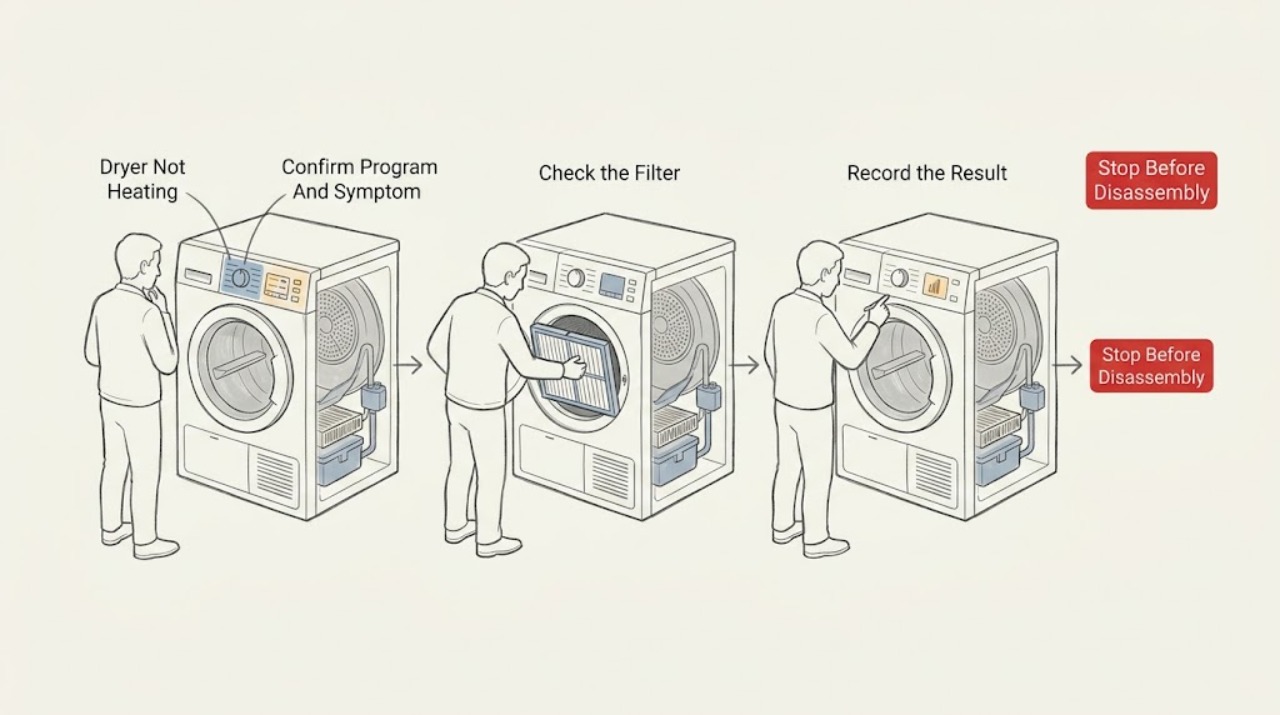
Work through in order
Diagnostic checks
Use only checks that match the exact appliance or system and its official guide.
-
Check 1
Record the selected drying program and options, then observe from outside whether the drum tumbles, the cycle ends early, the display shows a fault, or the laundry is merely taking longer to dry.
Expected result: The drum does not move, the drum tumbles but the load stays cold or damp, the program stops, or a fault message appears.
Next step: If the drum tumbles without heat, continue with the filter, condensate, and airflow checks. If a fault message appears, record it and use the exact model manual rather than guessing at a reset.
Stop if: Do not reach into the drum while it is moving or tamper with controls and safety interlocks.
Why this matters
Why: No drum movement is not the same diagnosis as a no-heat condition. A cycle that stops or reports a fault may be responding to a full tank, blocked filter, overheating, or a model-specific control problem.
-
Check 2
Switch the dryer off and let it cool, then remove and clean the door lint or net filter exactly as the model instructions show; clear lint around the filter seat and the lower door opening without damaging the seal.
Expected result: The filter is heavily coated or the door opening is restricted, or the filter and opening are already clean.
Next step: Reinstall the dry filter securely and make one model-approved test after the dryer has cooled. If it still has no heat or stops again, continue to the heat-pump and ventilation checks.
Stop if: Do not run the dryer with the filter removed, use a damaged filter, or clean hot surfaces while they are still hot.
Why this matters
Why: ASKO states that a clogged door filter can raise dryer temperature enough to trigger overheating protection and stop the machine. A clean filter makes a simple airflow restriction less likely but does not prove the heater is sound.
-
Check 3
If the dryer has a heat-pump filter or heat-exchanger access specified by the manual, disconnect power before cleaning, use hand protection, and remove lint with the approved soft brush or vacuum method.
Expected result: The heat-pump filter, housing, or strainer is clogged, or the filter area is clean and correctly reassembled.
Next step: Reassemble the filter housing fully and allow the dryer to cool before a single approved test. If airflow is clear but the drum remains cold, stop and arrange service.
Stop if: Do not touch bare metal fins with unprotected hands, press on them, rinse a foam filter when the manual forbids it, or open sealed refrigeration components.
Why this matters
Why: Restricted heat-pump airflow can reduce drying performance and contribute to overheating. ASKO warns that the heat-exchanger fins are sharp and can be damaged by pressure or hard tools.
-
Check 4
For a condenser or heat-pump model, check whether the condensate tank is full and whether the supplied drain hose is kinked, clamped, under tension, or loose at the drain; empty or reconnect it only as the manual permits.
Expected result: The tank is full, the drain hose is restricted or has slipped, or the condensate path is empty and secure.
Next step: Empty the tank or correct only an accessible hose position using the model instructions, dry any spill, and check whether the dryer resumes normal heating. If the tank refills unusually fast or the pump does not move condensate, call service.
Stop if: Do not pull a drain hose under tension, work on a wet electrical area, or dismantle a condensate pump or sealed water path.
Why this matters
Why: ASKO identifies a full condensate tank as a reason a dryer may stop, and its installation instructions warn that a poorly secured or bent drain hose can spill water or interrupt condensate removal.
-
Check 5
With the dryer off, check that the front intake, housing vents, rear discharge area, and surrounding space are not blocked by lint, furniture, a closed enclosure, or a long-fibre carpet; confirm the appliance is stable and not pressed against nearby surfaces.
Expected result: Air vents are blocked, the dryer is in a hot or confined space, the rear cannot dissipate warm air, or the installation has clear airflow.
Next step: Clear only external obstructions and allow the machine to cool. If it still produces no heat in a properly ventilated installation, stop and arrange service.
Stop if: Do not move a stacked dryer alone, bypass the tipping guard, block ventilation to fit it into a cabinet, or remove panels to improve airflow.
Why this matters
Why: ASKO says blocked vents, inadequate fresh air, heat buildup, and poor clearance can lengthen drying or cause a fault. Clear airflow can be restored without touching the heater, but it cannot repair an internal no-heat fault.
-
Check 6
After the permitted cleaning and airflow checks, let the dryer cool completely and make one model-approved test while recording whether heat returns, the machine stops again, or the display identifies a temperature, pump, relay, or control fault.
Expected result: Heat returns after cooling, no heat remains while the drum tumbles, the machine stops again, or a fault repeats.
Next step: Stop using the dryer for persistent no heat or repeat faults. Give a qualified technician the model details, filter and tank results, program used, and any displayed message; do not test the heater or controls live.
Stop if: Stop immediately for smoke, a burning or electrical smell, a very hot cabinet, damaged wiring, arcing, or a tripped protective device that recurs.
Why this matters
Why: A temporary return after cooling supports an overheating or airflow branch, but repeated shutdown is not a repair. ASKO's troubleshooting table directs persistent errors and several temperature or control faults to service.
Use your observations
Decision map
Find the observation that best matches what you see, then follow the next safe action.
-
PATH 01Next step
What you see
The dryer tumbles and heat returns after cleaning a clogged door filter and cooling down.
Do this next
Keep the filter clean before each load and stop if the shutdown or no-heat symptom returns.
Why this path and its safety boundary
Why it matters: Restricted lint airflow or an overheating protection event was the likely immediate cause.
-
PATH 02Next step
What you see
The dryer has a heat-pump filter or heat-exchanger filter that is blocked.
Do this next
Clean and reinstall it using the exact manual procedure; do not bend fins or access the sealed refrigeration circuit.
Why this path and its safety boundary
Why it matters: Restricted heat-pump airflow may be reducing drying performance or causing overheating.
-
PATH 03Next step
What you see
The condensate tank is full or the condensate hose is kinked, loose, or not draining.
Do this next
Empty or reconnect only the accessible path described by the manual. Arrange service if the tank refills abnormally or the pump cannot move water.
Why this path and its safety boundary
Why it matters: The water-collection path may be stopping the program or spilling water.
-
PATH 04Next step
What you see
The dryer is in a confined, hot, or poorly ventilated location, or an intake or exhaust area is blocked.
Do this next
Restore external clearance and airflow without moving a stacked unit alone, then reassess after the dryer cools.
Why this path and its safety boundary
Why it matters: Heat buildup or restricted airflow may be extending the cycle or triggering a fault.
-
PATH 05Next step
What you see
The dryer tumbles but remains cold after the filters, condensate path, program, and airflow are correct.
Do this next
Stop using the dryer and arrange qualified appliance service; do not open the cabinet or perform live electrical tests.
Why this path and its safety boundary
Why it matters: An internal heater, temperature sensor, relay, control, or related fault is more likely.
-
PATH 06Next step
What you see
There is smoke, a burning or electrical smell, arcing, damaged wiring, a very hot cabinet, or a recurring protective-device trip.
Do this next
Stop the appliance, isolate power only if safe, keep clear of the hazard, and obtain qualified urgent service.
Why this path and its safety boundary
Why it matters: This is an immediate safety boundary.
Helpful context
Understand the symptom
Separate no heat from slow drying
A dryer that tumbles but takes longer can have restricted filters, poor airflow, a full condensate tank, a damp load, or an unsuitable installation. A drum that tumbles while the air stays cold after those checks is a different branch and may involve internal temperature or control hardware.
ASKO models are not identical
The door net filter, heat-pump filter, condensate tank, and direct drain are model-dependent. Use the complete model and serial information to select the correct ASKO manual before opening a filter housing or changing a drain arrangement.
Respect heat and electrical boundaries
The rear of a dryer can become very hot during operation, and the manual reserves repairs and electrical work for trained or licensed people. Let the machine cool before cleaning and do not remove covers or reach into a moving drum.
Safety boundary
Stop conditions
- Do not open the cabinet, reach into a moving drum, bypass a safety control, or test live heater or relay circuits.
- Do not touch heat-exchanger fins bare-handed, press them with hard tools, or damage the sealed refrigerant circuit.
- Do not move a stacked dryer alone or continue operation after smoke, arcing, severe overheating, or a recurring electrical trip.
Only after diagnosis
Potential parts
- dryer temperature sensor or thermistor
Consider this only when filters, condensate handling, program selection, airflow, and overheating causes are ruled out and the service diagnosis identifies a temperature-sensing fault.
Sensor designs differ by ASKO model; confirm the complete model and manufacturer fit information before selecting a part. - dryer heater or control relay assembly
Consider this only when the drum tumbles with clear airflow but produces no heat and a qualified technician confirms a heater or relay fault.
Heating and control assemblies vary by model and power configuration; do not order from appearance or series name alone.
When checks do not resolve it
Need a professional?
Arrange service if the dryer tumbles but remains cold after the model-approved filter, condensate, program, and airflow checks., Call a qualified technician for repeat overheating, a full tank that returns unusually quickly, pump or heat-pump faults, or any internal electrical diagnosis., Stop using the dryer and seek urgent qualified help for smoke, arcing, damaged wiring, a burning or electrical smell, or a recurring protective-device trip.
Common questions
FAQ
Why is my ASKO dryer running but not heating?
Start with the selected program, door lint filter, heat-pump filter if fitted, condensate tank or drain, and external airflow. If the drum tumbles but remains cold after those checks, an internal heater, sensor, relay, or control fault needs service.
Can a clogged filter make an ASKO dryer stop heating?
Yes. ASKO states that a clogged door filter can raise the temperature and trigger overheating protection. Clean the filter as directed, allow the dryer to cool, and call service if the symptom returns.
Can a full condensate tank stop an ASKO dryer?
On condenser and heat-pump models, ASKO identifies a full condensate tank as a reason the dryer may stop. Empty the tank or use the model-approved drain arrangement, and stop if the tank refills abnormally or leaks.
Does dryer placement affect heating?
Yes. ASKO warns that blocked vents, a confined or hot room, and heat that cannot dissipate can lengthen drying or cause a fault. Restore external airflow without dismantling the dryer.
When should I stop troubleshooting an ASKO dryer with no heat?
Stop for smoke, a burning or electrical smell, arcing, damaged wiring, severe overheating, a recurring protective-device trip, or persistent no heat after the safe filter, tank, program, and airflow checks.
Read the exact guide
Official sources
- Instructions for Use: TD75.B3XX / T208H.W.U2 Tumble DryerASKO · ASKO tumble dryer filters, condensate tank, airflow, overheating, and troubleshooting
- Installation Instructions: TD75 Heat pump Tumble DryerASKO · ASKO TD75 heat-pump dryer ventilation, placement, condensate drain, and electrical safety
Community feedback
Share a repair observation
Share a plain-text repair observation. Accepted observations are published automatically; this page may take a moment to update.