
On this page
Start here
Quick answer
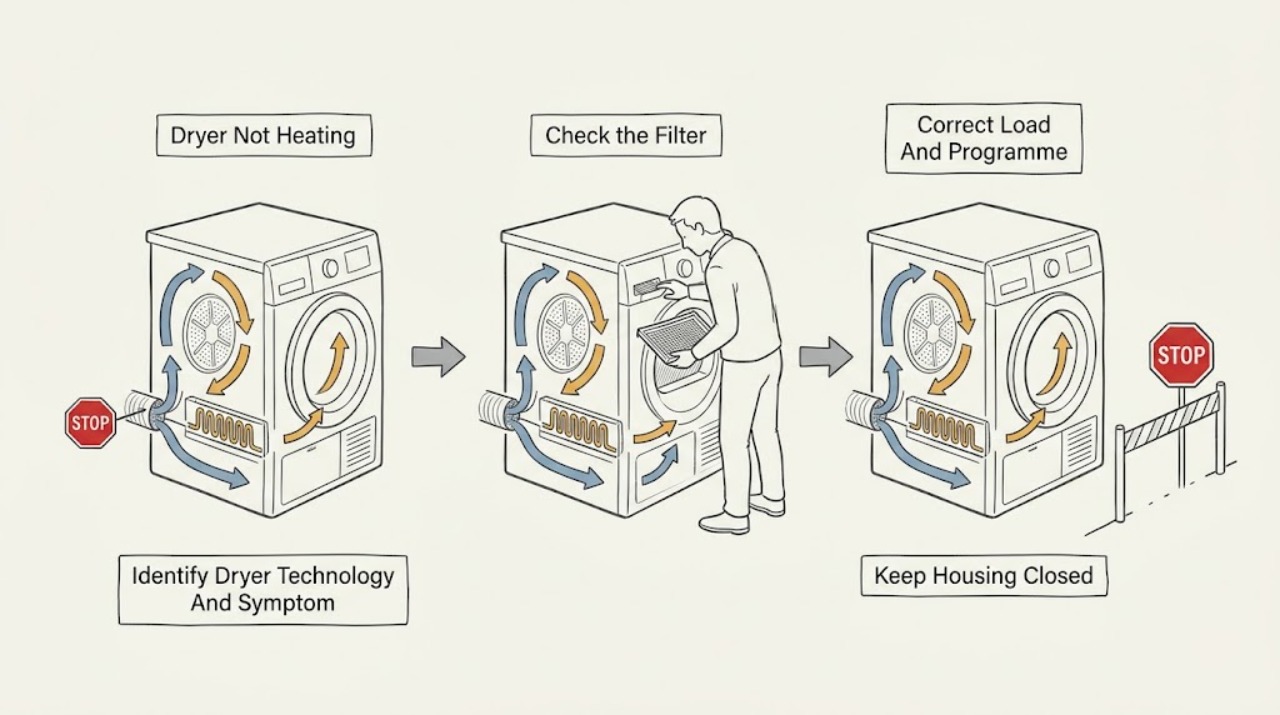
An AEG dryer that seems not to heat may be a heat-pump model running at a lower temperature, or it may have restricted airflow, an unsuitable load or programme, or a genuine heating fault. Identify the dryer technology, clean the user-accessible filter and condenser where fitted, check the load, programme and ventilation, then run one model-directed timed heat check while observing the drum without opening the cabinet. If the drum remains cold, an error returns, or there is smoke, burning smell, sparking, repeated tripping or unusual heat, stop using the dryer, unplug it if safe and arrange an authorised technician.
Work through in order
Diagnostic checks
Use only checks that match the exact appliance or system and its official guide.
-
Check 1
Identify whether the AEG dryer is heat-pump, condenser or vented from its model documentation, and note whether the current cycle is simply long or whether the drum stays cold.
Expected result: A heat-pump cycle may feel only gently warm and take longer; a drum that remains cold through the model-directed timed check is a different result. Record any displayed code or flashing pattern.
Next step: If the dryer is warm and progressing, continue with airflow and load checks. If it is cold or shows a code, complete the safe checks below once and then use the service branch if the result persists.
Stop if: Stop immediately for smoke, burning smell, sparking, unusual heat or repeated electrical trips.
Why this matters
Why: Lower heat alone does not prove a failed heater on a heat-pump model, while persistent coldness or a heating code needs a fault path.
-
Check 2
Switch the dryer off and clean the user-accessible lint filter; on models with a removable condenser or condenser filter, clean it only as the model instructions direct and refit it correctly.
Expected result: Look for lint or a film on the filter and condenser. A filter can appear clean yet still restrict air, so compare the result after cleaning rather than relying only on its appearance.
Next step: After the appliance is cool and the filters are correctly installed, repeat one suitable cycle with a normal load. If airflow remains weak or the result is still cold, move to ventilation and service checks.
Stop if: Do not remove fixed panels or continue if a filter, condenser housing or duct is damaged, hot, or cannot be refitted safely.
Why this matters
Why: Restricted airflow can make drying poor and can prevent the appliance from managing heat correctly; a clear filter does not rule out an internal fault.
-
Check 3
Use a load that has been spun well, is within the model limit and is sorted by fabric; select the programme and dryness setting suited to that load rather than a short or unsuitable cycle.
Expected result: An overloaded load, mixed fabric load, poorly spun laundry or a programme that ends when items are nearly dry can leave some items damp without showing a heater failure.
Next step: Retry with a smaller, well-spun compatible load and the documented programme. If this produces normal warmth and drying, keep the prior load or programme as the likely cause; otherwise continue to the ventilation check.
Stop if: Stop if the drum, controls or laundry become unusually hot, or if the cycle ends with an unsafe smell or electrical symptom.
Why this matters
Why: The moisture level, load size and selected programme change cycle duration and heat demand, so damp clothes alone is not enough to condemn the heating system.
-
Check 4
For a vented model, inspect the accessible vent hose and outlet for a fold, blockage or crushed section; for any model, check that the room and enclosure are ventilated as the installation instructions require.
Expected result: A restricted hose, obstructed outlet or unsuitable room condition can coincide with long cycles, poor drying and excess heat around the appliance.
Next step: Correct only an obvious, accessible routing issue without dismantling the appliance, then repeat one documented cycle. If the hose is inaccessible or the air path remains restricted, arrange service.
Stop if: Do not move a heavy or built-in appliance, dismantle ducting, or continue if the outlet area is hot, damaged or inaccessible.
Why this matters
Why: The dryer needs a usable air path and suitable surroundings to move moisture and regulate temperature; this check does not establish that an internal heater or sensor is sound.
-
Check 5
After the user checks, select the model-directed timed programme and observe warmth through the closed door; note the exact error code or indicator pattern without opening the cabinet.
Expected result: If the appliance becomes warm and the cycle progresses, the earlier airflow or operating condition may have been the cause. If it stays cold, repeats a heating code such as E60, loses power or trips the supply, the fault remains.
Next step: Stop troubleshooting and contact an AEG Authorised Service Centre for a persistent cold drum, recurring code, dead controls after the outlet check, or any unsafe symptom. Give the technician the model identification, code and observations.
Stop if: Unplug the dryer if safe and keep it out of use after smoke, burning smell, sparking, repeated tripping, damaged wiring or unusual heat.
Why this matters
Why: A persistent cold result after the documented user checks can involve the heater, thermal protection, sensor, fan, wiring or control system and requires authorised diagnosis rather than live testing.
Use your observations
Decision map
Find the observation that best matches what you see, then follow the next safe action.
-
PATH 01Next step
What you see
The dryer is heat-pump technology, feels gently warm and is progressing rather than remaining cold.
Do this next
Clean the filters, use a suitable well-spun load and allow the documented cycle to run before judging the result.
Why this path and its safety boundary
Why it matters: Lower temperature and a longer cycle can be normal for this technology.
-
PATH 02Next step
What you see
The result improves after filter, condenser, vent, load or programme checks.
Do this next
Keep the corrected setup and follow the model cleaning and loading instructions; arrange service if the symptom returns with a normal setup.
Why this path and its safety boundary
Why it matters: Airflow or operating conditions were more likely than an internal heating failure.
-
PATH 03Next step
What you see
The drum remains cold after the safe checks or a heating code returns.
Do this next
Contact an authorised technician and provide the model, programme, code and whether any warmth was observed.
Why this path and its safety boundary
Why it matters: The remaining fault needs internal diagnosis; a user should not test the heater, wiring or safety components.
-
PATH 04Next step
What you see
The appliance is completely unresponsive.
Do this next
Perform only the external power and control checks in the model instructions; if it still does not work, keep it unplugged until service confirms it is safe.
Why this path and its safety boundary
Why it matters: The outlet, breaker or fuse, door closure, controls and reset state should be checked before assuming a heating fault.
-
PATH 05Next step
What you see
Smoke, burning smell, sparking, repeated trips, damaged wiring or unusual heat is present.
Do this next
Stop the cycle, disconnect power only if it can be done without contact with a hazard, leave the appliance out of use and arrange urgent professional assessment.
Why this path and its safety boundary
Why it matters: This is a safety stop, not a drying-performance experiment.
Helpful context
Understand the symptom
First distinguish normal low heat from a cold drum
Heat-pump dryers deliberately transfer heat at a lower temperature and may run longer. A warm, slowly progressing cycle is different from a drum that stays cold throughout a model-directed timed check. Start with the checks that restore airflow and correct the drying conditions; do not remove the cabinet or work inside the appliance.
Keep the boundary clear
The user checks below are limited to controls, the outlet, the door, the load, ventilation and removable filters described by the model instructions. Do not probe a live circuit, open the cabinet, bypass a thermal or door safety, run the dryer without its required filters, or continue after smoke, a burning smell, sparking, a hot-plastic smell or repeated electrical trips.
What the result changes
A restored warm cycle after cleaning or changing the load points toward airflow or operating conditions. A persistently cold drum, a recurring heating code, a dead control panel after the outlet check, or an unsafe symptom moves the case to authorised diagnosis rather than more user troubleshooting.
Only after diagnosis
Potential parts
- dryer lint filter or condenser filter
Cleaning or damage may justify a replacement, but filter shape and model fit must be confirmed from the appliance documentation.
Do not order until the full model identification and filter type are confirmed. - heater, thermal protection or temperature-sensing component
A persistently cold drum can involve several internal parts; only an authorised diagnosis should identify a failed component.
No part fit is asserted. Do not remove the cabinet or replace an internal part as a first user step.
When checks do not resolve it
Need a professional?
Call an authorised technician if the dryer remains cold after the filter, load, programme and ventilation checks; if a heating code returns; if power or controls remain dead; or immediately after smoke, a burning smell, sparking, repeated trips, damaged wiring or unusual heat.
Common questions
FAQ
Why does my AEG dryer seem not to heat?
A heat-pump model can use lower heat and a longer cycle. A blocked filter or condenser, restricted vent, unsuitable load or programme can also reduce drying. A truly cold drum after a model-directed timed check points to service.
Should a heat-pump dryer feel hot?
It may feel only gently warm compared with a conventional dryer. Judge it by documented cycle progress and drying result, not by expecting a very hot drum.
What should I do if the drum is still cold after cleaning?
Run one model-directed timed heat check and record any code. If the drum remains cold, stop further troubleshooting and contact an authorised service centre rather than opening the cabinet.
What if the dryer shows E60?
Check the accessible ventilation path and filters as directed by the model instructions, then use the documented timed-programme check. If it remains cold or the code returns, arrange authorised service.
Read the exact guide
Official sources
- Tumble dryer displays error message E60 and does not heat upAEG Support · Manufacturer guidance to check ventilation and filters, then use a timed programme and seek service if the appliance stays cold.
- Tumble dryer not drying, not drying properly, too long dryingAEG Support · Manufacturer troubleshooting for long cycles, poor drying, filters, condenser, loading, programmes, ventilation and room conditions.
- Tumble dryer has no powerAEG Support · Manufacturer external checks for a non-responsive dryer, outlet, breaker or fuse, door, controls, reset and safe service escalation.
Community feedback
Share a repair observation
Share a plain-text repair observation. Accepted observations are published automatically; this page may take a moment to update.