
On this page
Start here
Quick answer
When a dryer tumbles but does not heat, first confirm that a heated cycle is selected and that the symptom is not an Air Only or Fluff setting. Electric dryers can tumble when one side of the household supply is unavailable, so check for a tripped breaker only from the panel and stop if it trips again. A gas dryer can tumble without heat when its supply valve is closed, but do not handle gas fittings and leave immediately for a gas odor. Clean the lint screen and inspect the visible exhaust path only when the dryer is off and cool; restricted airflow can trigger overheating protection and poor drying, but it does not identify the failed component. If the correct heated cycle, supply, and airflow checks do not restore heat, the heating element, igniter or burner, thermal fuse, thermostat, wiring, or control requires model-specific professional diagnosis. Do not open the cabinet, bypass a thermal device, or keep running a dryer that smells hot, sparks, or overheats.
Before you begin
Safety first
- This article covers cycle selection, one safe heat confirmation, panel-level supply observation, accessible lint and vent checks, and documentation only. Do not open the chassis, handle gas fittings, test live electrical parts, bypass thermal protection, or run repeated cycles to reproduce a no-heat fault.
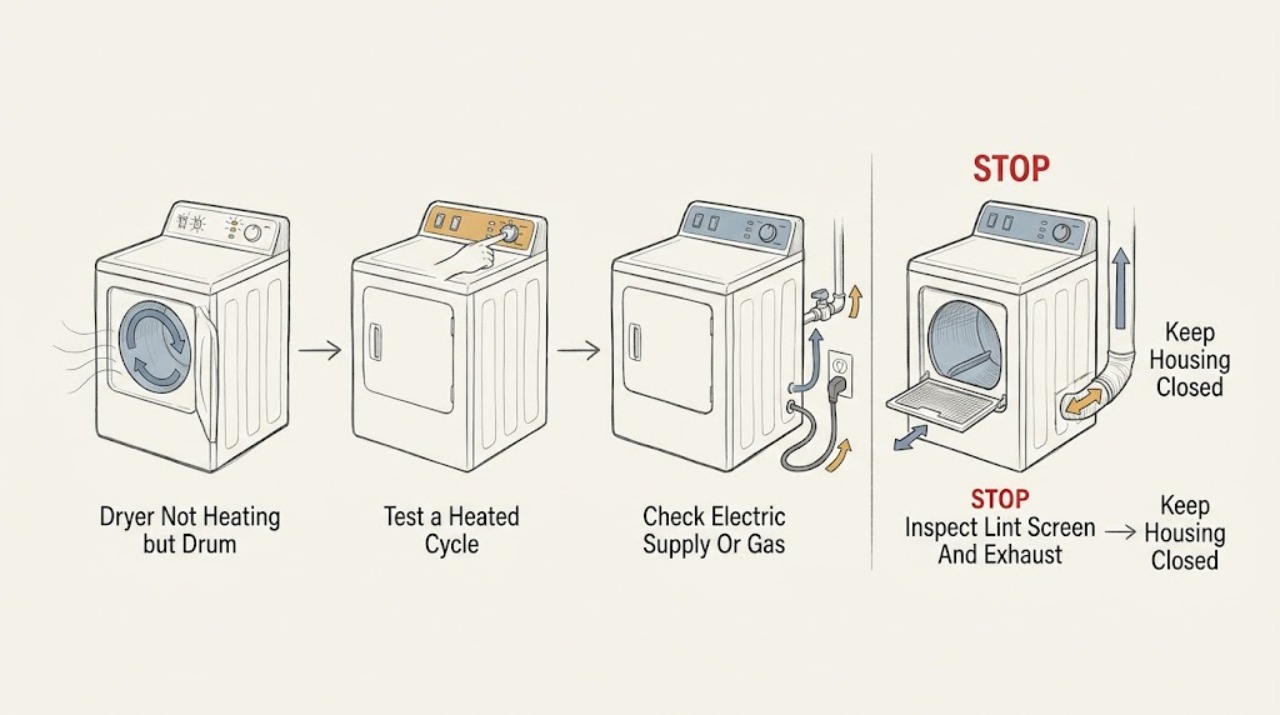
Work through in order
Diagnostic checks
Use only checks that match the exact appliance or system and its official guide.
-
Check 1
Remove the load, check that the drum is empty, and select a documented heated timed cycle rather than Air Only, Air Fluff, or another no-heat option. If there is no odor, smoke, sparking, or abnormal heat and the model instructions permit a brief check, run one short observation and open the door carefully to compare whether the air and drum are warming.
Expected result: The cycle was Air Only or low heat, the drum and air remain cool on a heated cycle, warmth is present but drying is slow, or an odor, smoke, sparking, or unusual heat appears.
Next step: Correct only the cycle selection and perform no more than one safe confirmation. Keep the dryer off and use the relevant service branch for persistent no heat, poor airflow, or any hazard sign.
Stop if: Do not continue the cycle for diagnosis, touch a hot surface or heating area, or test further for smoke, flame, sparking, a burning smell, or abnormal heat.
Why this matters
Why: A no-heat setting explains a cool drum. A genuinely cool heated cycle supports a supply, heater, burner, thermal, or control problem. Warmth with long drying makes airflow, load, or moisture issues more likely than total heater failure. Odor, smoke, sparks, or severe heat is a stop-use condition.
-
Check 2
With the dryer Off, identify whether it is electric or gas. For an electric model, look at the household panel for a tripped dryer breaker and reset it no more than once according to the panel instructions. For a gas model, check only that the external supply valve is visibly in its normal open position if it is accessible without moving the dryer or touching gas fittings.
Expected result: An electric breaker is tripped, it trips again, the gas supply valve appears closed, a cord or receptacle is hot or damaged, a gas odor is present, or the visible supplies appear normal.
Next step: If a breaker reset does not hold or the connection is abnormal, leave the dryer off and arrange electrician or appliance service. If gas odor is present, avoid switches and flames, leave the area, and contact the gas utility or emergency services from a safe location. If supplies appear normal, continue to airflow and service checks without opening the machine.
Stop if: Do not remove panels, test live voltage, move a gas dryer to reach a valve, disconnect gas fittings, or reset a breaker repeatedly.
Why this matters
Why: Electric supply paths can allow tumbling while the heater is unpowered. A closed gas valve can allow the drum to turn without burner heat. A repeated breaker trip, damaged connection, or gas odor indicates an electrical or gas hazard, not a reset opportunity. Normal visible supplies do not rule out an internal fault.
-
Check 3
After the dryer is cool and disconnected from use, clean the removable lint screen and inspect the visible exhaust duct, outside hood, and area behind the dryer without opening the cabinet. Look for lint accumulation, a crushed or kinked duct, a disconnected joint, a blocked hood, or little air movement previously noticed during normal use.
Expected result: The screen is blocked, lint is visible around the housing or behind the dryer, the duct is crushed or disconnected, the outside hood is blocked, or the visible exhaust path looks clear.
Next step: Clean only the removable screen and plainly accessible loose lint, and arrange vent cleaning or repair for a restriction or disconnection before use. Keep the dryer off when no heat persists; do not restart it to prove airflow.
Stop if: Do not reach into the cabinet, insert tools into the duct, use a crushed or damaged duct, or operate the dryer with a loose, blocked, or missing lint screen.
Why this matters
Why: Lint and restricted exhaust can reduce airflow, lengthen drying, and raise operating heat enough to involve thermal protection. A clear exterior does not prove that the internal heater path or chassis is clear. Hidden lint requires qualified cleaning and inspection.
-
Check 4
Record whether the problem affects every load or only one cycle, whether clothes are warm or completely cool, whether they were soaking wet or overloaded, whether drying times changed, and whether the dryer was recently installed or serviced. Do not add another load merely to reproduce no heat.
Expected result: Only Air Only or low-heat loads seem affected, the load was unusually wet or large, clothes are warm but damp, every heated cycle is cool, or the symptom began after service or installation.
Next step: Use the correct documented cycle and avoid overloaded or abnormally wet loads only after the dryer has passed safety and supply checks. Keep persistent no heat out of service and provide the pattern to a technician.
Stop if: Do not change thermal settings to force heat, dry chemical- or oil-contaminated items, or continue if clothes or the cabinet become unusually hot or smell burnt.
Why this matters
Why: Cycle selection and load moisture can mimic a heating failure. Warm but damp clothes support airflow, load, or vent concerns. A cool drum on every heated cycle supports supply, heater, burner, thermal, or control diagnosis. A post-installation symptom raises power, gas, wiring, vent, or configuration questions.
-
Check 5
Photograph the model and serial label, cycle display, lint screen, visible duct and hood, and any accessible cord or gas-supply condition. Record whether the dryer is electric or gas, whether the drum tumbles normally, and whether there was a fault code, odor, unusual sound, or breaker operation. Do not remove panels or heater covers.
Expected result: The model is clear, the model is unknown, an error code or unusual sound is present, an electrical or gas abnormality is visible, or only the no-heat symptom is present.
Next step: Use the exact owner manual or give the record to qualified appliance service. Keep the dryer off until persistent no heat, unusual noise, or supply abnormality is evaluated.
Stop if: Do not probe wiring, bypass a fuse or thermostat, inspect a burner while operating, or use a generic part based only on the symptom.
Why this matters
Why: Exact model information determines the heater, burner, thermal-device, and control layout. An error, abnormal sound, or supply condition may narrow the service path but cannot safely identify a part from outside. A simple symptom with normal visible conditions still requires internal diagnosis if heat is absent.
-
Check 6
If a heated cycle is selected, the visible supply is normal, and the drum still tumbles without heat, leave the dryer out of use and arrange qualified appliance service. Ask the technician to evaluate the heater or burner, igniter, thermal fuse or limiter, thermostat, wiring, motor switch, and control according to the exact model.
Expected result: Heat returns after a permitted external correction, no heat persists, the dryer trips a breaker, gas ignition does not occur, or a burning odor or overheating accompanies the failure.
Next step: Keep the dryer disconnected from use and provide the complete record to qualified appliance, electrical, or gas service. Do not replace or bypass internal heating or safety components without model-specific diagnosis.
Stop if: Do not open the cabinet, test energized parts, bypass a thermal fuse or limiter, defeat a door or safety switch, or run repeated cycles after a no-heat failure.
Why this matters
Why: A lasting external correction can explain the symptom, but persistent no heat supports an internal component or supply fault. Breaker operation, failed gas ignition, burning odor, or overheating raises the urgency and makes repeated use unsafe.
Use your observations
Decision map
Find the observation that best matches what you see, then follow the next safe action.
-
PATH 01Next step
What you see
The dryer tumbles and the selected cycle is Air Only, Air Fluff, no-heat, or a documented low-temperature setting.
Do this next
Select the heated cycle specified for the load and perform no more than one safe confirmation. If the heated cycle remains cool, use the supply and service branches.
Why this path and its safety boundary
Why it matters: The control selection can explain a cool drum without a heater failure.
-
PATH 02Safety boundary
What you see
An electric dryer tumbles but one breaker is tripped, the breaker will not hold, the cord or receptacle is abnormal, or the power supply was recently changed.
Do this next
Reset the breaker no more than once only if safe and permitted by the panel instructions. If it trips again or the connection is hot, damaged, or discolored, leave the dryer off and call a qualified electrician or appliance technician.
Why this path and its safety boundary
Why it matters: The motor can operate while the heating path lacks its required supply, or an electrical fault may be present.
Safety stop: Do not reset repeatedly, remove the terminal cover, measure live voltage, or operate a damaged connection.
-
PATH 03Safety boundary
What you see
A gas dryer tumbles but the burner does not heat, the accessible supply valve appears closed, or there is a gas odor or abnormal ignition sound.
Do this next
If no gas odor is present and the external valve is safely accessible, verify its normal position without touching fittings; otherwise arrange qualified service. For gas odor, leave immediately, avoid switches and flames, and contact the gas utility or emergency services.
Why this path and its safety boundary
Why it matters: A closed supply can explain no heat, while gas odor or failed ignition requires gas and appliance service rather than repeated cycling.
Safety stop: Do not relight, disassemble, test, or repeatedly operate the burner or gas valve.
-
PATH 04Next step
What you see
The drum and air become warm but clothes remain damp, drying takes much longer, the lint screen or vent is blocked, or the duct is crushed or kinked.
Do this next
Clean the removable screen and arrange vent cleaning or repair, using the exact installation instructions. Keep using the dryer only after the airflow problem is corrected and no odor or overheating remains; persistent symptoms need service.
Why this path and its safety boundary
Why it matters: The heater may be producing heat, while restricted airflow, load size, moisture, or venting is preventing normal drying and can raise heat stress.
-
PATH 05Safety boundary
What you see
The correct heated cycle is selected, supplies and visible venting are normal, the drum tumbles, but the air remains cool on every heated cycle or the dryer has a recurring fault.
Do this next
Leave the dryer out of use and arrange model-specific appliance service. Provide the model, dryer type, cycle, temperature result, breaker or gas observations, and any odor or error code; do not identify or order an internal part from the symptom alone.
Why this path and its safety boundary
Why it matters: A heating element, igniter, burner, thermal fuse or limiter, thermostat, wiring, motor switch, or electronic control is more likely than a user-setting issue.
Safety stop: Do not open panels, bypass a fuse or thermostat, test live voltage, or run additional cycles to confirm the internal fault.
Helpful context
Understand the symptom
Tumbling proves the drive is operating, not the heater
A rotating drum shows that the motor and drive path are doing at least some of their job. It does not prove that the heater or burner is receiving the required electrical or gas supply. The first useful split is the selected cycle and actual heat, followed by electric-versus-gas supply checks. Do not repeatedly run loads to see whether heat returns, especially if lint, odor, or unusual warmth is present.
Electric and gas dryers fail differently
Whirlpool notes that electric dryers use separate household supply paths for the motor and heating element, so one tripped breaker can leave the drum turning while heat is absent. For gas dryers, the drum can turn with the gas shutoff closed. The external supply check must stay within the user's safe access; wiring, burner, igniter, valve, and live-voltage diagnosis belong to qualified service.
Airflow is a safety check, not proof of a heater failure
A clogged lint screen or exhaust path can lengthen drying and raise heat inside the dryer, and manufacturers list restricted venting as a reason to inspect airflow. Clean the removable screen and observe only accessible duct and outside-hood conditions with the dryer off. If airflow is poor or lint is inside the cabinet, arrange vent or appliance service rather than opening the chassis or bypassing thermal protection.
Safety boundary
Stop conditions
- Do not open the dryer cabinet, test energized wiring, bypass a thermal fuse or limiter, defeat a safety switch, or inspect a burner while operating.
- Stop using the dryer for a burning smell, smoke, flame, sparking, melted or hot wiring, repeated breaker operation, gas odor, unusual heat, or water near electrical equipment.
- Do not reset a breaker repeatedly, relight or adjust gas components, or move a dryer to reach a connection when the duct or supply could be damaged.
- Do not run loads contaminated with gasoline, oil, cleaning agents, or other volatile substances; follow the product and garment-care instructions and use qualified advice.
- Do not order a heater, igniter, thermal device, thermostat, burner component, or control from the symptom alone; confirm the exact model and diagnosis first.
Only after diagnosis
Potential parts
- dryer heating element or burner assembly
Consider this category only after qualified testing isolates the electric heating element or gas burner path as failed and excludes supply, airflow, and control causes.
Confirm the exact dryer model, electric or gas type, component rating, installation requirements, and safety controls before ordering or replacing. - dryer igniter or gas valve component
Consider this category only when qualified gas-dryer diagnosis confirms an ignition or valve fault and there is no gas-supply or combustion safety issue.
Confirm the exact model, gas type, component specification, and manufacturer service procedure; do not handle or test gas components as an ordinary-user repair. - dryer thermal fuse, limiter, or thermostat
Consider this category only when qualified testing identifies a failed thermal or temperature-control component and the underlying airflow or overheating cause has been assessed.
Confirm the exact dryer model, temperature and electrical ratings, safety function, and manufacturer fit information; never bypass the component. - dryer power cord or electrical control
Consider this category only when an electrician or appliance technician confirms a damaged supply connection, wiring fault, motor switch, or electronic control after safe testing.
Confirm the dryer electrical requirements, connection type, ratings, control revision, and local code through qualified service before ordering.
When checks do not resolve it
Need a professional?
Arrange qualified appliance service when a dryer tumbles but remains cool on a correct heated cycle after the safe supply and setting checks, or when an element, burner, igniter, thermal device, thermostat, wiring, or control may be involved. Arrange electrical service for a tripped or recurring breaker, hot or damaged cord, or abnormal receptacle, and gas utility or emergency help for gas odor. Arrange vent service when airflow is restricted, the duct is crushed or disconnected, or drying remains poor; stop immediately for smoke, flame, sparks, burning odor, or dangerous heat.
Safety scope: This article covers cycle selection, one safe heat confirmation, panel-level supply observation, accessible lint and vent checks, and documentation only. Do not open the chassis, handle gas fittings, test live electrical parts, bypass thermal protection, or run repeated cycles to reproduce a no-heat fault.
Common questions
FAQ
Why does my dryer tumble but not heat?
The drum motor can operate even when the heating path is unavailable. Check that a heated cycle is selected, then check the electric supply or gas-supply condition safely. If the drum remains cool on every heated cycle, a heater, burner, igniter, thermal device, thermostat, wiring, or control may need qualified diagnosis.
Can one breaker make an electric dryer tumble but not heat?
Yes. Manufacturer guidance explains that electric dryers use separate supply paths for the motor and heating element, so one tripped breaker can leave the drum turning without heat. Check the panel safely and reset no more than once; if it trips again or the connection is hot or damaged, call a qualified electrician or appliance technician.
Can a gas dryer tumble if the gas valve is closed?
Yes. A gas dryer can tumble without heat when its gas supply is unavailable. Check only an accessible external valve if there is no gas odor and it can be observed without moving the dryer or touching fittings. Leave immediately and contact the gas utility or emergency services for gas odor.
Can the Air Only setting make a dryer seem like it is not heating?
Yes. Air Only or Air Fluff cycles do not add heat. Select the heated cycle specified for the load and perform only one safe confirmation. If the heated cycle is still cool, continue with supply, vent, and professional service checks.
Can a blocked vent cause a dryer not to heat?
Restricted venting can reduce airflow, lengthen drying, and raise heat stress; it may also involve thermal protection. Clean the removable lint screen and inspect accessible duct and hood conditions with the dryer off. Do not open the cabinet or keep running the dryer if no heat, odor, or overheating persists.
When should I call for dryer no-heat service?
Call when a correct heated cycle remains cool after the safe supply and setting checks, when a breaker trips again, when gas ignition or supply is abnormal, or when an element, burner, igniter, thermal device, thermostat, wiring, or control may be involved. Stop immediately for smoke, flame, sparks, burning odor, gas odor, severe heat, or a damaged connection.
Read the exact guide
Official sources
- TROUBLESHOOTING – DRYER (CONT.)Whirlpool · Whirlpool owner manual for the identified model family; it is used for general manufacturer examples, not as a universal dryer procedure.
- 49-90105GE Appliances · GE dryer manual for the documented model family; used as a manufacturer example, not a universal repair procedure.
- Dryer is Not Heating - Product HelpWhirlpool · Whirlpool consumer support guidance; exact dryer model and installation instructions control.
- Dryer not heating: troubleshooting guideWhirlpool · Whirlpool consumer troubleshooting guidance across dryer types; model instructions and qualified service control repairs.
Community feedback
Share a repair observation
Share a plain-text repair observation. Accepted observations are published automatically; this page may take a moment to update.