
On this page
Start here
Quick answer
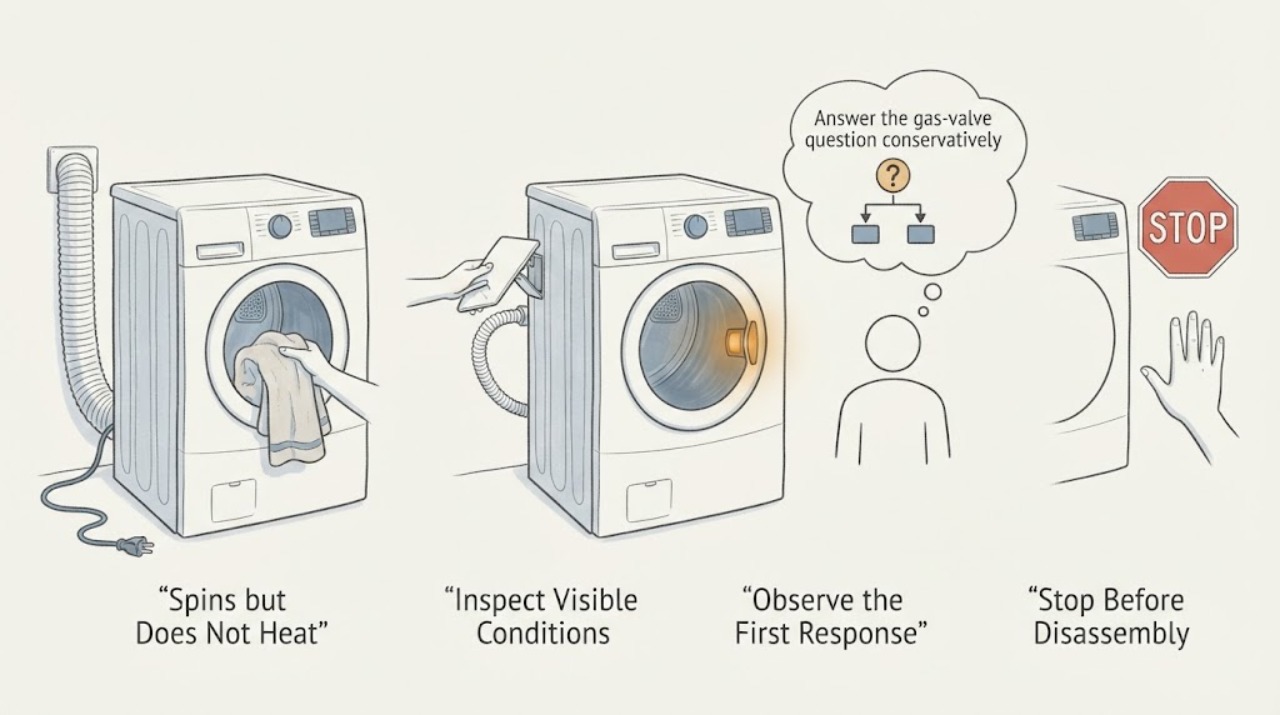
A GE GTD42GASJWW dryer can tumble without heat when it is on Air Fluff or another no-heat setting, when its gas supply is unavailable, or when a vent or internal heating fault needs service. GE's exact-model installation instructions require an accessible manual gas shutoff within 6 feet and tell an installer to turn it off before connection and open it afterward, but they do not establish a universal parallel-versus-perpendicular handle rule. Do not move the dryer, touch a gas connection, relight anything, or turn an unidentified valve just to test it. First confirm a heated cycle and temperature, check only safe external power and airflow conditions, and stop immediately for gas odor, smoke, burning odor, sparking, unusual heat, or a carbon-monoxide alarm.
Work through in order
Diagnostic checks
Use only checks that match the exact appliance or system and its official guide.
-
Check 1
Before starting another cycle, keep the dryer off and observe from a dry position for gas odor, smoke, burning odor, sparking, unusual cabinet or plug heat, damaged wiring, or a carbon-monoxide alarm.
Expected result: Any gas, fire, electrical, or carbon-monoxide warning is present, or the area is dry and free of those warnings.
Next step: For gas odor, do not light an appliance or operate electrical switches; clear the area and follow the local gas supplier or emergency procedure. For smoke, sparking, unusual heat, or a carbon-monoxide alarm, leave the dryer off and obtain emergency or qualified service help. Do not run another test.
Why this matters
Why: A safety warning takes priority over deciding whether a gas valve is open. A stable appliance can proceed only to visible, external checks.
-
Check 2
Confirm the control is set to a heated dry cycle and an appropriate fabric or temperature setting, not Air Fluff, Quick Fluff, Cool Down, or another no-heat option. Close the door normally and observe whether the drum tumbles and the timer advances.
Expected result: The dryer was on a no-heat setting, or it tumbles and advances on a correct heated setting but the load remains cold.
Next step: Use the correct heated setting only when no safety warning is present. If it remains cold, stop repeated trial cycles and continue with the safe external checks below.
Why this matters
Why: A no-heat setting explains a cold load without proving a gas-supply or component fault. Correct cycle selection with continued cold operation leaves gas, airflow, power, or internal service possibilities open.
-
Check 3
Answer the gas-valve question conservatively: look only for a clearly identified, already accessible appliance shutoff and its own marking, without moving the dryer, touching the flexible connector, loosening a fitting, or opening a panel.
Expected result: The valve is clearly labeled and its on/off marking is understood, or the valve/pipe identity, handle position, or marking is uncertain or inaccessible.
Next step: If the marking and appliance identity are unambiguous, document what is visibly marked and use a qualified gas installer or appliance technician for any change. If anything is uncertain, do not turn the valve or move the dryer; arrange qualified gas or GE service. Never relight a burner or test by opening a fitting.
Why this matters
Why: The exact installation document requires an accessible manual shutoff and describes when an installer closes or opens it, but it does not support a universal handle-orientation rule. Tumble-without-heat cannot identify the valve state.
-
Check 4
From a dry, safe position, check the accessible wall outlet, plug, and household breaker or fuse state. Do not open a cover or inspect the rear terminal block; this gas model uses a grounded 120-volt supply.
Expected result: The outlet or circuit is off or tripped, the plug or cord looks damaged, the breaker trips again, or household power appears normal.
Next step: Restore only a normal breaker or outlet condition once when safe and understood and no hazard is present. For repeated trips, damage, or persistent no heat with normal power, leave the dryer off and arrange qualified electrical or appliance service.
Why this matters
Why: GE says this gas dryer should use a dedicated 120-volt outlet and that power conditions can affect operation. A repeated trip or visible damage is an electrical fault, not a reason to keep resetting or test live wiring.
-
Check 5
With the dryer cool and off, clean the lint filter and inspect only the visible exhaust hose, front air intake, and outside wall cap for a kink, collapse, lint buildup, blockage, or a blocked flap. Keep the vent connected.
Expected result: The lint filter or accessible duct path is blocked or damaged, the wall cap has weak or obstructed airflow, or the visible path is clear.
Next step: Correct only an accessible lint or routing issue and have the full duct professionally cleaned when its interior is obstructed. Do not disconnect the vent and run this gas dryer as a test; if it stays cold with a clear path, use the service branch.
Why this matters
Why: Restricted airflow can lengthen drying and trap heat and humidity; lint accumulation is also a fire concern. A clear visible path does not prove that the full duct or burner system is healthy.
-
Check 6
Record the full model and serial information, selected cycle and temperature, whether the drum tumbles, whether any heat is felt, the safe gas-supply observation, breaker behavior, vent condition, and any safety symptom. Do not remove panels, change gas-conversion parts, adjust a gas regulator, or identify an igniter or coil from the symptom alone.
Expected result: The dryer heats after a safe setting or external correction, or it remains cold after the cycle, power, supply, and accessible vent checks are normal.
Next step: Keep the dryer off and give the recorded sequence to GE-authorized appliance service or a qualified gas appliance technician. Do not keep running cycles to reproduce the fault.
Why this matters
Why: A safe correction can explain the symptom; persistent no heat after those checks requires diagnosis of the gas-heating system or controls that cannot be established from outside. GE recommends service when gas is on but the dryer still does not heat.
Use your observations
Decision map
Find the observation that best matches what you see, then follow the next safe action.
-
PATH 01Next step
What you see
Gas odor, smoke, a carbon-monoxide alarm, sparking, burning odor, unusual heat, or visible damage is present.
Do this next
Stop using the dryer and leave the area as appropriate. For gas odor, avoid flames and electrical switches and follow local gas-emergency instructions; for smoke, fire, sparking, or a carbon-monoxide alarm, obtain emergency help. Do not restart the appliance.
Why this path and its safety boundary
Why it matters: This is a gas, combustion, fire, or electrical safety event rather than a valve-identification problem.
-
PATH 02Next step
What you see
The control was on Air Fluff, Quick Fluff, Cool Down, or another no-heat selection, and the dryer otherwise has no safety warning.
Do this next
Select the exact model's heated cycle and correct temperature once. If the load is still cold, stop repeated testing and use the gas, power, airflow, and service branches.
Why this path and its safety boundary
Why it matters: The selected program can account for a cold load without showing that the gas valve or burner is faulty.
-
PATH 03Next step
What you see
A clearly labeled shutoff is already accessible without moving the dryer, but the person cannot confidently identify its on/off marking or the handle's relationship to the pipe.
Do this next
Do not turn it, move the dryer, touch the connector, or test the burner. Ask a qualified gas installer, utility, or appliance technician to identify and verify the supply safely.
Why this path and its safety boundary
Why it matters: The exact GE documents do not justify inferring valve state from a generic parallel or perpendicular rule, and a wrong valve operation could create a gas-safety problem.
-
PATH 04Next step
What you see
The visible lint filter, hose, front intake, and wall cap are obstructed or damaged, with no gas odor or other immediate hazard.
Do this next
Correct the accessible restriction and arrange full duct cleaning when needed. Keep the vent attached; if the dryer remains cold, stop and request service.
Why this path and its safety boundary
Why it matters: An accessible airflow restriction can impair drying and increase heat and fire risk, but it does not prove that the gas burner is the cause of a completely cold drum.
-
PATH 05Next step
What you see
A correct heated cycle, normal household power, an unconfirmed-but-not-manipulated gas supply, and an accessible vent path are all normal, yet the GTD42GASJWW still tumbles without heat.
Do this next
Leave the dryer off and arrange GE-authorized appliance service or qualified gas-appliance service. Provide the exact model, serial, cycle, temperature, timing, valve uncertainty, and safety observations.
Why this path and its safety boundary
Why it matters: The remaining possibilities include a gas-supply or internal heating/control condition that cannot be safely distinguished by observing the outside or by guessing a part.
Helpful context
Understand the symptom
The drum turning proves only that the motor and control are running; it does not prove that gas is reaching the burner or that the selected cycle calls for heat. On this exact model, the first useful distinction is a heated cycle versus Air Fluff or another no-heat selection, followed by safe external checks.
The GTD42GASJWW installation document shows that a manual supply shutoff should be accessible in the same room and within 6 feet. It instructs the installer to close it before gas connection and open it after connection, but it does not say that every handle's visual orientation means on or off. A friend should not move the dryer or manipulate a valve whose pipe identity or marking is uncertain.
Keep the vent connected during any user-level observation. GE warns that a gas dryer must not be operated without its exhaust because combustion products, including carbon monoxide, could enter the room. Gas odor, smoke, burning odor, sparking, unusual heat, or a carbon-monoxide alarm changes this from troubleshooting to an immediate stop and safety response.
When checks do not resolve it
Need a professional?
Stop immediately for gas odor, smoke, burning odor, sparking, unusual heat, visible damage, or a carbon-monoxide alarm. Arrange qualified gas or GE appliance service when the shutoff identity or position is uncertain, when the dryer remains cold on a correct heated cycle after safe external checks, when a breaker trips again, or when any gas connection, conversion, burner, or internal heating diagnosis would be required. Do not move the dryer, remove panels, loosen fittings, relight a burner, bypass a safety device, or run this gas dryer without its vent.
Common questions
FAQ
Does a GE GTD42GASJWW dryer spinning prove that the gas valve is on?
No. Tumble only proves that some operating functions are running. GE lists cycle and temperature selection, gas service, airflow, and service conditions as separate possibilities. Do not operate an unidentified shutoff or use a burner test to answer the question.
Is the gas valve open when its handle is parallel or perpendicular to the pipe?
That generic rule is not established by the exact GE GTD42GASJWW installation document. It requires an accessible manual shutoff and tells the installer when to close or open it, but it does not provide a universal handle-orientation rule. If the marking or pipe identity is not unambiguous, do not turn it; use qualified gas service.
Can I disconnect the vent briefly to see whether the dryer heats?
No. GE's venting guidance limits that type of performance test to electric models and warns not to operate a gas dryer without the vent because carbon-monoxide fumes could enter the room. Inspect accessible airflow and keep the vent connected.
Read the exact guide
Official sources
- Dryer - Things To Check For A Venting Issue | GE AppliancesGE Appliances · Opened official GE venting support article. It covers visible hose and wall-cap obstructions, airflow, lint, and the warning not to operate a gas dryer without its vent because carbon monoxide may enter the room.
- User Manual & Care for GTD42GASJWW | GE AppliancesGE Appliances · Opened official GE Owner Center page whose model field identifies GTD42GASJWW as a GE 7.2 cu. ft. gas dryer and links its exact Owner's Manual and installation resources.
- GTD42GASJWW Owner's Manual (GE Appliances)GE Appliances · Opened from the exact GTD42GASJWW Owner Center page. The manual covers heated versus no-heat cycles, gas warnings, contaminated loads, venting, and a dryer-does-not-heat troubleshooting table.
- Gas Dryer - Runs But Does Not Heat | GE AppliancesGE Appliances · Opened official GE support article. It directs owners to confirm cycle, fabric and temperature settings, unobstructed airflow, a dedicated 120-volt outlet, and gas service, then contact service if a gas dryer still does not heat.
- Installation Instructions for GTD42GASJWW | GE AppliancesGE Appliances · Opened through the exact GTD42GASJWW Installation & Setup page. It requires an accessible manual shutoff within 6 feet, instructs installers to close it before connection and open it afterward, and does not state a universal handle-orientation rule.
Community feedback
Share a repair observation
Share a plain-text repair observation. Accepted observations are published automatically; this page may take a moment to update.