
On this page
Start here
Quick answer
An exhaust fan that is not working should be separated into no power/control response, a blocked or dirty grille/blower, and a motor/control fault. Turn off power before removing a grille, clean only accessible dust, and check switch/breaker without opening live wiring. A dead motor, hum, damaged wiring, or burning odor needs qualified service.
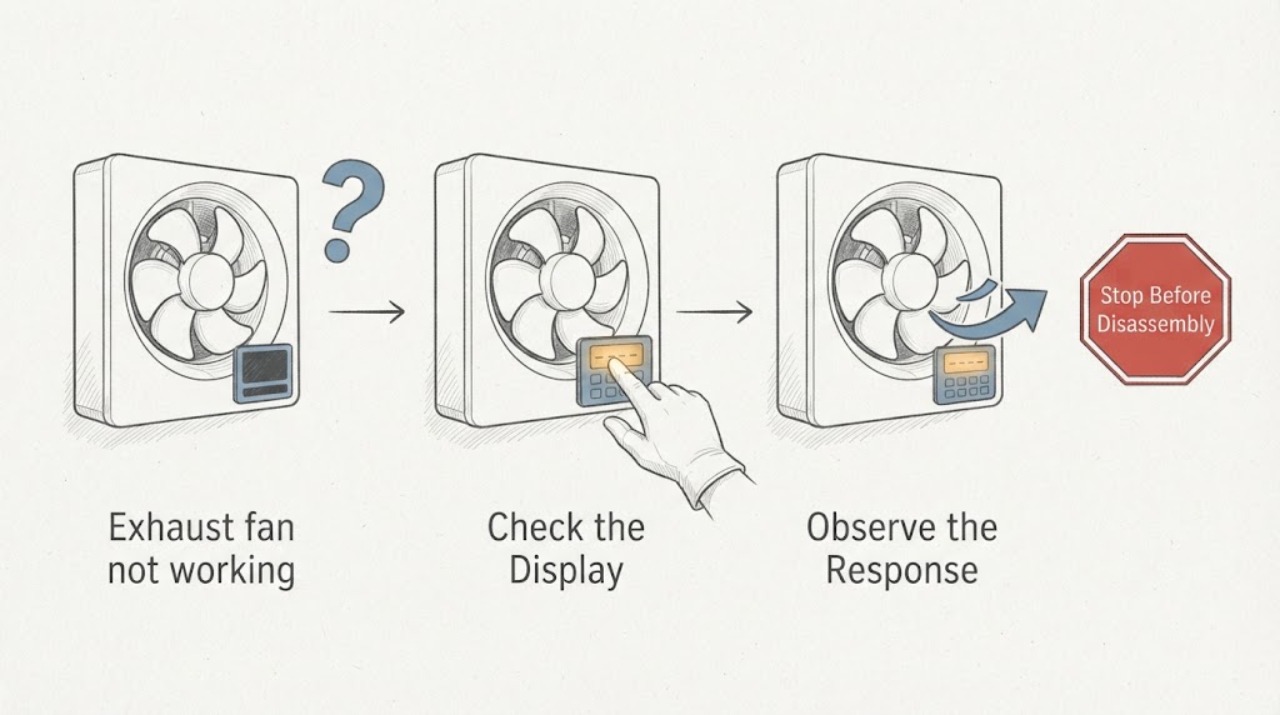
Work through in order
Diagnostic checks
Use only checks that match the exact appliance or system and its official guide.
-
Check 1
From switch, note separately whether light/timer/display and blower respond; listen for silence/hum/slow start.
Expected result: Whole unit dead, controls respond but motor silent, or motor hums/runs with weak airflow.
Next step: Check accessible switch/breaker, then isolate power before grille work.
Why this matters
Why: This separates supply/control from motor/airflow restriction.
-
Check 2
With power isolated, remove only accessible grille/filter and vacuum dust from visible blower area.
Expected result: Dust is heavy, blower obstructed/damaged, or area is clear.
Next step: Clean/refit and restore power once; do not touch wiring/capacitor.
Why this matters
Why: Dust can restrict airflow and load the motor; damage needs more than cleaning.
-
Check 3
Check switch, breaker, isolator/plug and visible cord/cover for off state, scorch, looseness, or damage.
Expected result: Breaker/switch off or loose, connection hot/damaged, or supply normal.
Next step: Reset once only if safe and no damage; leave off for hot/damaged connections or repeat trip.
Why this matters
Why: A supply issue can leave fan dead; heat/scorching raises risk.
-
Check 4
Run once after cleaning and record airflow and any grinding/rattle/burning odor.
Expected result: Airflow returns, remains weak with motor running, or motor remains off/abnormal.
Next step: Stop abnormal fan and arrange qualified service.
Why this matters
Why: Improvement supports dust; weak airflow may be duct restriction; dead/noisy motor needs service.
Use your observations
Decision map
Find the observation that best matches what you see, then follow the next safe action.
-
PATH 01Next step
What you see
Light/control works but blower is silent with normal supply.
Do this next
Keep power off and arrange service.
Why this path and its safety boundary
Why it matters: Motor, capacitor, interlock, or control fault is more likely.
-
PATH 02Next step
What you see
Motor runs but airflow is weak and dust is visible.
Do this next
Vacuum isolated grille/blower; have duct checked if weak persists.
Why this path and its safety boundary
Why it matters: Accessible restriction is plausible.
-
PATH 03Next step
What you see
Fan hums, grinds, overheats, or stops after starting.
Do this next
Stop use and arrange service; do not casually test capacitors.
Why this path and its safety boundary
Why it matters: Worn motor/bearing, obstruction, or electrical component fault is possible.
-
PATH 04Next step
What you see
Burning odor, smoke, sparks, hot wiring, or repeated trip.
Do this next
Stop and isolate power only if safe, then obtain qualified electrical service.
Why this path and its safety boundary
Why it matters: Immediate electrical safety boundary.
Helpful context
Understand the symptom
“Not working” may mean dead controls, silent blower with light working, or weak airflow with motor running.
Power isolation and accessible cleaning are homeowner checks; live wiring, capacitors, and motor work require a professional.
When checks do not resolve it
Need a professional?
Arrange qualified exhaust-fan/electrical service if inoperative after one safe supply/cleaning check, airflow stays weak, motor hums/grinds, or wiring/capacitor/control work is needed.
Common questions
FAQ
Why is fan silent while light works?
A normal light with silent blower points toward motor, capacitor, interlock, or control path; persistent symptom needs service.
Can dust stop airflow?
Dust can restrict airflow and load the motor. Isolate power and vacuum accessible surfaces.
Should I replace the motor myself?
Follow the exact model instructions and qualified service boundary; do not open live wiring or casually test a capacitor.
Read the exact guide
Official sources
- Help! My Bath Fan Sounds Like a Lawnmower!Broan-NuTone · bathroom exhaust fan dust, blower, motor and service guidance
- Operating Instructions FV-TX9ABBMPQPanasonic · exhaust/range hood fan power and motor troubleshooting
Community feedback
Share a repair observation
Share a plain-text repair observation. Accepted observations are published automatically; this page may take a moment to update.