
On this page
Start here
Quick answer
First decide which stage failed. If there are no lights or display, verify the plug and wall outlet without opening the appliance; Haier also says the refrigerator must be switched on and its temperature control set to a cooling position. If the interior light or display works but the cabinet is not cooling, check the model-specific control or lock state, door sealing, accessible air vents, and whether the unit was just installed or power was recently restored. Haier notes that controls can sleep or lock on some electronic models, compact models use a dial where 0 is Off, and a newly installed refrigerator can need up to 24 hours to reach its set temperature. Do not bypass a door or control interlock, open the rear cover, test energized wiring, or work on the compressor or sealed system. If the refrigerator remains warm after the documented external checks, arrange qualified appliance service.
Before you begin
Safety first
- The owner may observe indicators, verify a normal external outlet and user-accessible breaker/GFCI condition, consult the exact manual, check accessible door and vent conditions, and monitor recovery. Internal electrical parts, interlocks, fans, compressor-start components, controls, and sealed refrigeration components require qualified service.
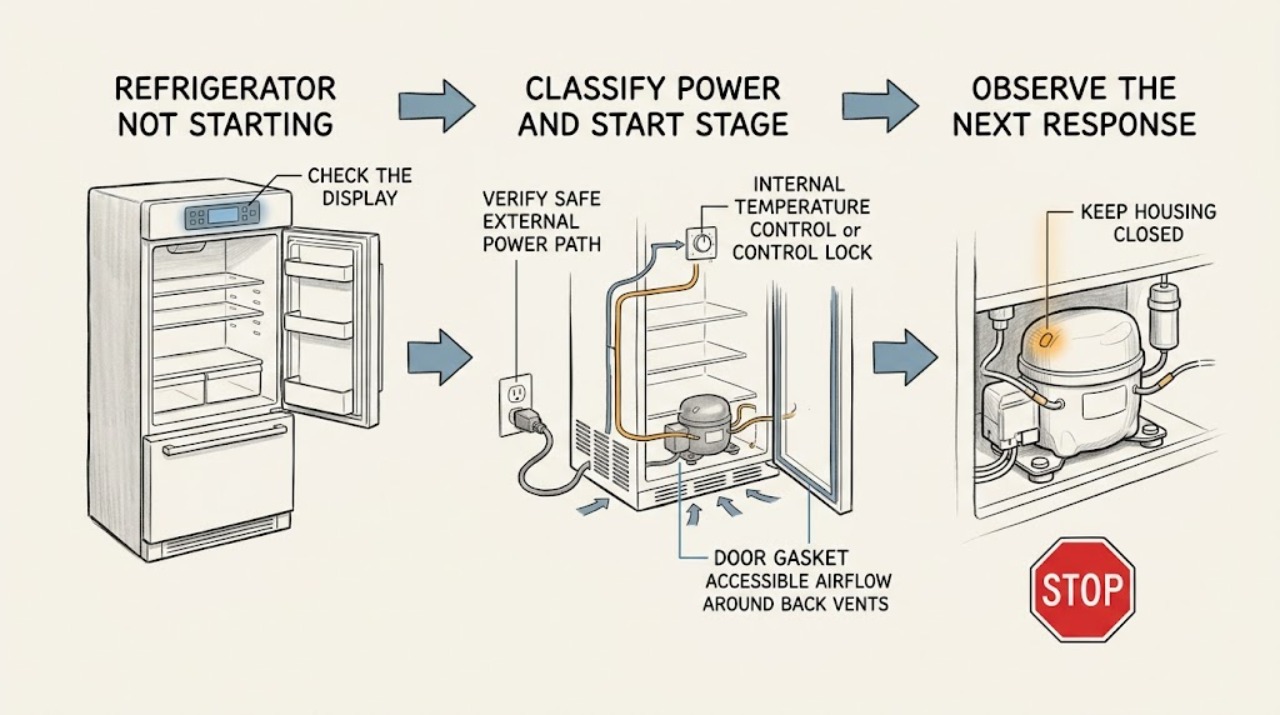
Work through in order
Diagnostic checks
Use only checks that match the exact appliance or system and its official guide.
-
Check 1
With the refrigerator closed normally, note whether the interior light, display, or a response to opening the door or pressing an accessible control is present. Also note whether the cabinet is warming, whether the freezer is affected, and whether there is smoke, a burning odor, a hot or damaged cord, water near electrical parts, or repeated breaker trips.
Expected result: There are no power signs; a light or display responds but cooling is absent; the unit is cooling one compartment; or an electrical hazard is present.
Next step: For any electrical hazard, stop using the refrigerator and arrange qualified service or an electrician as appropriate. Otherwise continue to the matching external check; do not remove panels to find the compressor.
Stop if: Immediately unplug or isolate the appliance only if it can be done without contacting a damaged or wet electrical connection; do not repeatedly reset a breaker or operate a sparking, hot, smoky, or water-damaged appliance.
Why this matters
Why: No power signs point to the supply or switched-off branch. Power signs with no cooling are a start/control/cooling branch rather than proof of a dead refrigerator. A single-compartment symptom needs model-specific airflow guidance. Smoke, heat, water near electrics, or repeated trips makes continued testing unsafe.
-
Check 2
Without opening the refrigerator or performing a live electrical test, confirm that the plug is fully seated, the cord is not visibly damaged, and the wall outlet is controlled by power. Check the home's breaker or GFCI only from its normal user controls and only once; do not use an extension cord or repeatedly cycle power as a test.
Expected result: The plug was loose, the outlet or breaker is not supplying power, the cord or receptacle shows damage or heat, or the external supply appears normal.
Next step: Restore only a normal household supply condition that can be safely corrected at the user control. If the outlet, cord, or breaker is damaged, hot, wet, or repeatedly trips, stop and call a qualified electrician or appliance technician. If supply is normal, continue to the model controls.
Stop if: Do not remove the plug cover, open the outlet, probe the receptacle, bypass grounding, or open the refrigerator's electrical compartment.
Why this matters
Why: A failed outlet or switched-off circuit can prevent any start. Visible heat, damage, or a circuit that will not hold is an electrical fault, not a refrigerator adjustment. A normal external supply with a dark appliance makes an internal power/control fault more likely.
-
Check 3
Use the exact model manual to confirm the refrigerator is on and the temperature control is not Off or set outside its operating range. On an applicable electronic-control Haier refrigerator, open the door or press an accessible button to see whether the display wakes; if the panel shows a lock state, use only the documented unlock instruction. On a compact model, check that the dial is not at 0.
Expected result: The unit was switched off, the panel was asleep or locked, a compact dial was at 0, the control responds normally, or the control remains unresponsive or unclear.
Next step: Correct only the model-documented On, unlock, or cooling setting and leave it unchanged while monitoring. If the control remains unresponsive, obtain the exact manual and arrange service rather than using an unverified reset or service mode.
Stop if: Do not bypass a lock, door switch, or other interlock; do not enter service mode, short contacts, or replace a control based on this symptom alone.
Why this matters
Why: A sleep display does not by itself mean a no-start fault, and a locked panel can prevent settings from changing. A control at Off can prevent cooling. If the control is correct and responsive but the cabinet stays warm, the issue moves beyond a simple setting.
-
Check 4
If lights or controls work but cooling has not begun, inspect only accessible conditions: confirm the doors close fully, the gasket contacts the cabinet without a visible gap, packages are not holding a door open, and food is not blocking the model's accessible air vents. Note whether one compartment is warm or both are, and whether the refrigerator was recently loaded with warm food or has had frequent long door openings.
Expected result: A door or gasket gap, obstruction, blocked vent, heavy warm load, frequent opening, or no external issue is found.
Next step: Remove only an accessible obstruction, close the doors, and allow the model's documented recovery time. If both compartments remain warm or the unit repeatedly attempts to run and stops, stop owner troubleshooting and arrange qualified appliance service.
Stop if: Do not remove interior covers, reach for a fan, touch the compressor or tubing, scrape frost, or add refrigerant.
Why this matters
Why: Poor sealing, blocked vents, warm loads, and door use can make a refrigerator appear not to start or can delay recovery even when the cooling system is operating. A normal seal and clear airflow with both compartments warming makes an internal control, start, fan, or sealed-system diagnosis more likely.
-
Check 5
Record the time of installation or power restoration, the control setting, which compartments are warming, any display or alarm behavior, and whether the refrigerator ever produces normal cooling. Compare the result only after the exact manual's stabilization period; Haier's installation guidance allows up to 24 hours for temperatures to reach the set point.
Expected result: Cooling returns during the documented recovery period; the refrigerator remains warm after recovery; it repeatedly clicks, stops, or never produces cooling; or food-safety temperatures cannot be maintained.
Next step: If recovery does not occur, protect or relocate perishable food and arrange qualified Haier appliance service with the model and symptom timeline. Do not keep changing settings or attempt internal diagnosis.
Stop if: Stop using the refrigerator if it cannot maintain safe food conditions or shows smoke, burning odor, damaged wiring, water near electrical parts, or another electrical hazard.
Why this matters
Why: Recovery after installation, a power interruption, or a warm load can be different from a persistent no-start fault. Continued warming or repeated failed starts after external checks is not safely distinguishable among a control, start component, fan, or sealed-system issue from observation alone.
Use your observations
Decision map
Find the observation that best matches what you see, then follow the next safe action.
-
PATH 01Safety boundary
What you see
No interior light, display, or other response is present, and the external outlet and breaker do not provide a normal supply.
Do this next
Stop at the household power check and use a qualified electrician for a damaged, hot, wet, or repeatedly tripping circuit. If the supply is normal but the appliance remains dark, arrange appliance service.
Why this path and its safety boundary
Why it matters: The refrigerator has not reached a meaningful start-stage test; the supply path or household circuit is more likely than a cooling diagnosis.
Safety stop: Do not repeatedly reset the circuit, open the appliance, or probe live wiring.
-
PATH 02Safety boundary
What you see
The display is dark after inactivity but wakes when the door opens or an accessible control is touched, or the panel shows a lock state.
Do this next
Follow the exact model instruction to wake or unlock the panel, then verify the cooling setting. If the refrigerator remains warm after the model's recovery period, use the service branch.
Why this path and its safety boundary
Why it matters: On applicable Haier electronic-control models, display-off and automatic locking are documented control behavior rather than proof that the refrigerator has no power.
Safety stop: Do not bypass the lock or a door switch and do not apply an instruction from a different model family.
-
PATH 03Safety boundary
What you see
The appliance is a Haier compact refrigerator and its temperature dial is at 0 or its setting is unclear.
Do this next
Use the compact model's manual; if it confirms the dial control, set it as directed and allow the documented stabilization period before reassessing.
Why this path and its safety boundary
Why it matters: Haier's compact-refrigerator guidance defines 0 as Off, so the unit may have power without being commanded to cool.
Safety stop: Do not force a dial, replace it, or assume the compact dial positions apply to a full-size electronic model.
-
PATH 04Safety boundary
What you see
The refrigerator was just installed, reconnected after an outage, or loaded with a large amount of warm food, and no electrical hazard is present.
Do this next
Keep the doors closed as practical, use the model's documented setting, and record the recovery time. If it remains warm afterward, arrange qualified appliance service.
Why this path and its safety boundary
Why it matters: The refrigerator may be in documented temperature recovery rather than failing to start; Haier says a newly installed unit can take up to 24 hours to reach its set temperature.
Safety stop: Do not repeatedly unplug/replug as a test or keep perishable food in a refrigerator that cannot maintain safe conditions.
-
PATH 05Safety boundary
What you see
The light or controls work, the model is on and set to cool, doors and accessible vents are normal, but one or both compartments remain warm after stabilization or the unit repeatedly tries and stops.
Do this next
Stop owner diagnosis, protect perishable food, and arrange qualified Haier appliance service with the model number, timing, compartment pattern, and any sounds or alarms.
Why this path and its safety boundary
Why it matters: External settings and airflow no longer explain the symptom. A control, start component, fan, or sealed-system problem may be involved, but the part cannot be identified safely from this pattern alone.
Safety stop: Do not remove the rear cover, touch the compressor or refrigerant tubing, test energized wiring, bypass interlocks, or add refrigerant.
Helpful context
Understand the symptom
Use the symptom stage, not just the word “starting”
A refrigerator can fail to start in several observable ways. No interior light or display points first to the supply path or a switched-off control. A light or display that responds, but a warm cabinet, means the appliance has at least some power and the investigation moves to controls, door and airflow conditions, recovery after installation or an outage, and then qualified cooling-system diagnosis. A dark display is not conclusive on electronic models because some Haier controls enter a display-off or locked state after inactivity.
Controls are model-specific
Use the owner's manual for the exact model before changing a setting. Applicable Haier bottom-mount, French-door, and quad-door electronic controls can sleep and lock; a compact refrigerator may instead use a dial where 0 is Off. Do not apply a button sequence from another Haier product or infer that a dark panel means the refrigerator has no power.
Allow documented recovery time, then stop guessing
After installation or restoration of power, record when the refrigerator was connected and use the model documentation for the expected stabilization period. Haier says temperatures may take up to 24 hours after delivery and installation to reach the set point. If the cabinet remains warm after that period, or if the unit repeatedly attempts and stops, further owner checks should not become compressor or control disassembly.
Safety boundary
Stop conditions
- Stop immediately for smoke, burning odor, sparking, a hot or damaged plug or cord, water near electrical parts, damaged wiring, or repeated breaker/GFCI trips.
- Do not bypass a door switch, control lock, or other interlock, and do not perform live electrical tests.
- Do not open the rear cover, touch the compressor or sealed refrigeration tubing, remove concealed air-channel covers, or add refrigerant.
- If the refrigerator remains warm after the exact model's documented recovery period and external checks, protect perishable food and arrange qualified appliance service.
Only after diagnosis
Potential parts
- temperature control or electronic control assembly
Consider only after qualified diagnosis confirms the refrigerator has a normal external supply and the model's control is not simply Off, asleep, or locked, but cooling still does not start.
Control assemblies and procedures are model-specific. Do not order or replace one from a no-start symptom alone, and do not bypass an interlock. - compressor-start or cooling-system component
Consider only when a qualified technician confirms a persistent powered-but-no-cooling condition after external settings, door, airflow, and recovery checks.
Compressor-start, fan, and sealed-system parts require model identification and qualified diagnosis; the owner should not access or test them.
When checks do not resolve it
Need a professional?
Call a qualified electrician for a damaged, hot, wet, sparking, or repeatedly tripping household supply. Call qualified Haier appliance service when the external supply is normal but the refrigerator remains dark, when the control is correct but cooling never starts, when it repeatedly attempts and stops, or when it remains warm after the model's documented stabilization period. Provide the exact model, installation or power-restoration time, control state, compartment temperatures or warming pattern, and any alarm or sound observations.
Safety scope: The owner may observe indicators, verify a normal external outlet and user-accessible breaker/GFCI condition, consult the exact manual, check accessible door and vent conditions, and monitor recovery. Internal electrical parts, interlocks, fans, compressor-start components, controls, and sealed refrigeration components require qualified service.
Common questions
FAQ
Why does my Haier refrigerator have lights but not start cooling?
Lights show that some power is present, not that the cooling cycle is healthy. Check the model-specific On/cooling setting or lock state, the door seal and accessible vents, and whether the refrigerator is still within its installation or power-restoration recovery period. If it remains warm after those checks, arrange qualified service.
Is a dark Haier refrigerator display proof that it is not starting?
No. On applicable electronic-control Haier refrigerators, the display LEDs can turn off after 30 seconds and the controls can lock. Open the door or press an accessible button to see whether the display wakes, then follow the exact model's unlock instruction if needed. A compact refrigerator may instead use a dial, where 0 is Off.
How long should a newly installed Haier refrigerator take to start cooling?
Haier's installation guidance says temperatures may take up to 24 hours to reach the set temperature. Use the exact model manual and monitor the result; if the unit remains warm afterward or repeatedly tries and stops, arrange qualified appliance service rather than opening the cooling system.
What should I do if my Haier refrigerator trips the breaker when it tries to start?
Stop repeatedly resetting the breaker. If there is smoke, burning odor, a hot or damaged plug or cord, water near electrical parts, or repeated trips, stop using the appliance and arrange qualified electrical or appliance service. Do not perform a live test or open the refrigerator.
Read the exact guide
Official sources
- Haier - Delivery & Installation: Appliance Damaged, Not Working or Parts are Missing at DeliveryHaier Appliances · Supports the recent-installation branch; it is used only for Haier's stated recovery guidance, not as a universal repair deadline.
- Haier - Refrigerator Controls Not WorkingHaier Appliances · Directly supports the display/control branch for applicable bottom-mount, French-door, and quad-door electronic-control refrigerators; it is not applied to every Haier model.
- Haier - Refrigerator Not Coming On / Not RunningHaier Appliances · Directly supports the assigned Haier refrigerator start-stage topic; it addresses a unit that does not come on or run and does not identify internal parts.
- Haier - Support by Product LineHaier Appliances · Supports the instruction to use the exact model's documentation because controls and procedures vary by product line.
- Haier - Refrigerator Running but Not CoolingHaier Appliances · Supports the powered-but-no-cooling branch and its external checks; the page is used to distinguish a cooling symptom from a completely unpowered refrigerator.
- Haier - Refrigerator Power InterruptionHaier Appliances · Supports the recent-power-restoration branch and the instruction not to treat an outage as a reason for repeated cycling; model recovery remains conditional.
- Haier - Compact Refrigerator Temperature SettingsHaier Appliances · Directly supports compact Haier refrigerators only; the dial scheme must not be generalized to full-size electronic models.
Community feedback
Share a repair observation
Share a plain-text repair observation. Accepted observations are published automatically; this page may take a moment to update.