
On this page
Start here
Quick answer
If a Bosch refrigerator is not starting, first separate a completely dead appliance from one that has lights or a display but is not cooling. For no display, no interior light, and no cooling, check the plug, outlet, breaker, and external power only if they are safe to touch. If the display and light work but the cabinet is not cooling, check whether the model is in showroom or demo mode and follow only that model's manual; do not assume a silent compressor has failed. A recent installation or power interruption can also require the model's stated startup or temperature-recovery time. If power and controls are normal but cooling never begins, a compressor, start device, fan, sensor, or control fault may require diagnosis. Do not open the rear cover, test live wiring, or replace an internal starting part; arrange Bosch or qualified service, especially for a tripping breaker, damaged cord, burning smell, unusual heat, or food-safety risk.
Before you begin
Safety first
- The user may observe the display and light, check a safe external plug and breaker, read the model manual for demo/showroom mode, and inspect only obvious external ventilation blockage. Compressor, start device, capacitor, fan, sensor, control board, wiring, and sealed-system work belongs to trained or qualified service.
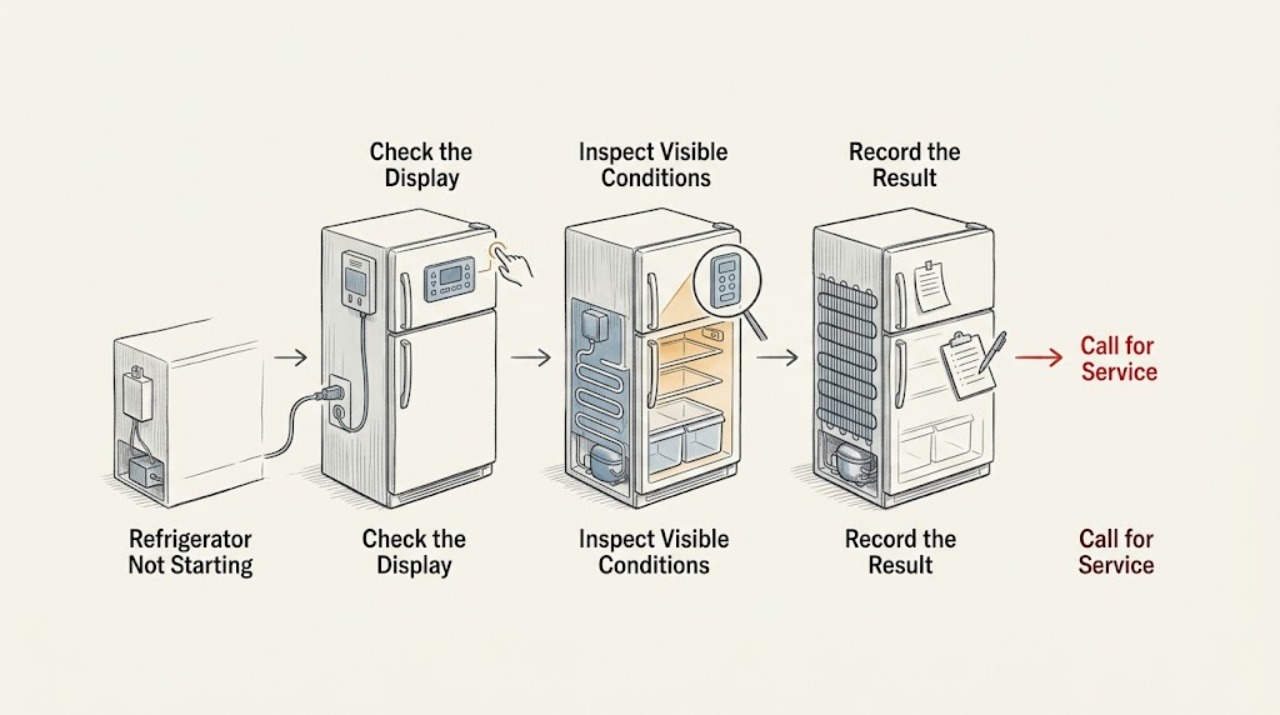
Work through in order
Diagnostic checks
Use only checks that match the exact appliance or system and its official guide.
-
Check 1
Classify the symptom without opening the appliance: check whether the display responds, whether the interior light comes on when the door is opened, whether controls respond, whether the cabinet is cooling, and whether the compressor or fan behavior has changed since a power interruption or installation.
Expected result: There is no display and no interior light; the display and light work but the cabinet is warm; the appliance has recently been installed or power was restored; or the display/light and cooling cut out together.
Next step: Use the branch that matches the pattern. If there is a burning smell, smoke, unusual heat, water near electrics, damaged insulation, or a breaker that trips again, stop and arrange qualified help immediately.
Stop if: Do not diagnose a compressor or start component by touching, tapping, bypassing, or probing it, and do not repeatedly cycle the power.
Why this matters
Why: No display and no light point first to supply or appliance power. A lit display and light with no cooling make demo/showroom mode, startup recovery, settings, or an internal cooling fault possible. A simultaneous loss of light, display, and cooling points back to power or control rather than a light-only issue.
-
Check 2
Check the external power path only from a safe position: confirm the plug is fully seated if it is safe to touch, look for a tripped household breaker or fuse, and note whether another appliance or the outlet indicates a wider power problem. Do not touch a hot, wet, loose, scorched, or damaged cord, plug, or receptacle.
Expected result: The plug is loose or disconnected, a breaker or fuse is off, the outlet is dead, the refrigerator loses power again, or the external power path appears stable.
Next step: Restore a safe connection only when there is no damage and the breaker does not immediately trip. Have an electrician assess a dead, damaged, or repeatedly tripping outlet/circuit. If the outlet is sound but the refrigerator remains dead, keep it off and contact Bosch or qualified appliance service.
Stop if: Do not use an extension cord or adapter as a workaround, repeatedly reset a tripping breaker, or perform live voltage measurements.
Why this matters
Why: A disconnected plug, outage, or tripped protection device can explain a refrigerator that does not start. A dead or damaged receptacle is a household electrical issue. If power is stable and the refrigerator still has no display or response, the appliance power path needs service; if display and light are stable, the fault is not a total loss of supply.
-
Check 3
If the display and interior light are on but the refrigerator is not cooling, look at the display for a showroom, demo, or similar non-cooling indication and check the model's owner manual for that mode. Confirm the refrigerator controls are on and record any displayed message; do not use a generic button sequence from another Bosch model.
Expected result: The display identifies showroom/demo mode, the controls are off or show an unfamiliar message, or the display appears normal without a demo indication while the cabinet remains warm.
Next step: Follow only the exact model manual to leave demo/showroom mode or restore the control setting. If the model manual does not identify the message or cooling does not begin after the stated startup/recovery period, keep food cold elsewhere and arrange service.
Stop if: Do not change hidden service settings, disassemble the control panel, or keep changing modes while the refrigerator is warm and food is at risk.
Why this matters
Why: Bosch manuals document a mode in which lighting and displays can operate while cooling is disabled. Control settings or an error message can also prevent normal operation. A normal display without demo mode does not prove that the compressor or start system is defective; the remaining cause may be internal and model-specific.
-
Check 4
For a recent installation or power restoration, record the elapsed time, keep the doors closed as much as practical, and check only the external ventilation openings for obvious blockage. Do not move the appliance or access the compressor area to see whether a motor is starting.
Expected result: The refrigerator is within the model's stated startup or recovery period and temperature is changing; the period has passed with no cooling; or an external vent is blocked while controls and lighting are otherwise normal.
Next step: Clear only an obvious external obstruction without removing panels and continue following the model manual. If the appliance remains warm after the applicable period, arrange qualified service and preserve food safely rather than changing the temperature repeatedly.
Stop if: Do not remove panels, force a fan, touch refrigerant tubing, or try to make the compressor start by cycling power.
Why this matters
Why: A new installation or recovery period can explain a delayed return to temperature. A blocked external vent can make cooling harder but does not identify a failed starting component. No cooling after the applicable period with clear vents and normal controls needs professional diagnosis.
-
Check 5
Prepare the exact Bosch model and serial information, the plug and breaker observations, whether the display and light work, any demo-mode indication, the elapsed time since installation or power restoration, temperature observations, and any click, hum, smell, heat, leak, or breaker event for Bosch support or a qualified technician.
Expected result: Power and controls are normal but cooling never begins, the refrigerator repeatedly clicks or trips protection, an error persists, or the cord, cabinet, or electrical area is damaged or hot.
Next step: Keep the refrigerator out of service when there is electrical or physical danger and arrange Bosch or qualified appliance service. Ask the provider to diagnose the start and cooling circuit before any part is ordered or replaced.
Stop if: Do not open the compressor compartment, test live terminals, bypass a protection device, or replace an internal starting component.
Why this matters
Why: The remaining possibilities can include a compressor, start device, fan, sensor, control board, wiring, or another internal fault. The user-visible symptom cannot safely select or confirm one of those parts.
Use your observations
Decision map
Find the observation that best matches what you see, then follow the next safe action.
-
PATH 01Next step
What you see
The display, interior light, and cooling are all absent, the plug or breaker is abnormal, and there is no safe evidence of appliance operation.
Do this next
Address only a safe loose connection or confirmed household supply issue. If the breaker trips again, the cord or outlet is damaged, or the refrigerator remains dead with a sound supply, stop resetting it and arrange electrical or Bosch service.
Why this path and its safety boundary
Why it matters: A supply, outlet, breaker, plug, or appliance power-path problem is more likely than a cooling-only fault, but a tripped breaker can also reflect an appliance fault.
-
PATH 02Next step
What you see
The display and interior light work, the cabinet is warm, and the model indicates showroom/demo mode or the controls show that mode is enabled.
Do this next
Use the exact model manual to exit the mode. If the mode cannot be identified or cooling does not resume after the manual's stated process, arrange service and protect perishable food.
Why this path and its safety boundary
Why it matters: The refrigerator may be intentionally displaying and lighting without running normal cooling; this is a control-mode path rather than proof of a failed compressor.
-
PATH 03Next step
What you see
The display and light work, demo/showroom mode is not indicated, the startup or recovery period has passed, and the refrigerator remains warm with clear external vents.
Do this next
Keep food in a known-cold appliance and arrange Bosch or qualified service. Do not access the compressor, start device, capacitor, control board, or wiring.
Why this path and its safety boundary
Why it matters: The safe external and control checks have not isolated the cause. A cooling-system or internal start/control fault is possible, but the symptom does not identify the component.
-
PATH 04Next step
What you see
The appliance clicks repeatedly, loses power, trips a breaker, smells burnt, becomes unusually hot, leaks near an electrical area, or has a damaged cord or cabinet.
Do this next
Keep clear, disconnect only if safe or use the appropriate breaker, protect food, and contact qualified electrical or appliance service. Do not operate the refrigerator to reproduce the symptom.
Why this path and its safety boundary
Why it matters: This is a safety escalation, not a home start-component diagnosis. Continued operation or repeated resets can increase electrical, fire, or food-loss risk.
Helpful context
Understand the symptom
“Not starting” can describe three different symptoms
A refrigerator with no display, no interior light, and no cooling has a power or control-on question first. A refrigerator with a working display and light but no cooling may be in showroom/demo mode, may still be in a startup or recovery period, or may have a cooling-system fault. A refrigerator that repeatedly clicks, trips a breaker, smells hot, or loses power needs a service assessment rather than a home diagnosis of its starting parts.
Keep internal starting components out of the user check
Do not remove the rear cover, access the compressor compartment, bridge a relay, probe live terminals, or replace a start device, capacitor, control board, fan, or sensor. If the power cord, plug, outlet, cabinet, or electrical area is damaged, wet, hot, or scorched, keep clear and use the breaker or qualified electrical help only when safe. Protect perishable food while the diagnosis or service visit is pending.
A delay after installation or an outage is not proof of a failed start
Bosch manuals note that a newly switched-on refrigerator may take several hours to reach its set temperature, and a recent power failure can raise compartment temperature. Record when power was restored or the appliance was installed and follow the exact model manual for its startup behavior. Do not repeatedly unplug and reconnect the appliance to force a start.
When checks do not resolve it
Need a professional?
A qualified technician should assess persistent no-start or no-cooling symptoms, a refrigerator that repeatedly trips protection, unexplained clicking, a control or demo-mode fault that cannot be resolved from the exact manual, and any cord, plug, cabinet, or electrical damage.
Safety scope: The user may observe the display and light, check a safe external plug and breaker, read the model manual for demo/showroom mode, and inspect only obvious external ventilation blockage. Compressor, start device, capacitor, fan, sensor, control board, wiring, and sealed-system work belongs to trained or qualified service.
Common questions
FAQ
Why does my Bosch refrigerator have lights but not start cooling?
Bosch manuals identify showroom or demo mode as one possibility when displays and lighting work but cooling does not. Check the exact model manual and controls first. If demo mode is not indicated or cooling does not return after the model's startup period, arrange service instead of diagnosing the compressor yourself.
What should I check if my Bosch refrigerator has no display or interior light?
From a safe position, check whether the plug is seated and whether a breaker or fuse is off. A damaged, hot, wet, or loose cord, plug, or outlet should not be touched; obtain qualified help. If safe household power is present but the refrigerator remains dead, contact Bosch service.
Can demo mode make a Bosch refrigerator seem like it is not starting?
Yes. Bosch documentation describes a showroom/demo mode in which the display and lighting operate while cooling is disabled. The controls and exit steps vary by model, so use the exact owner manual and do not use a button sequence from another refrigerator.
How long should a Bosch refrigerator take to start cooling after installation or an outage?
The applicable time varies by model and situation. Bosch manuals note that a newly switched-on refrigerator may take several hours to reach its set temperature. Record when it was installed or power was restored, keep the doors closed as much as practical, and follow the exact manual rather than repeatedly cycling power.
Could the compressor or start relay be the reason my Bosch refrigerator is not starting?
It is one possibility when power and controls are normal but cooling never begins, but the symptom cannot identify a compressor, start device, capacitor, control, fan, sensor, or wiring fault. Do not open the compressor compartment or test live terminals; have Bosch or a qualified technician diagnose it.
Read the exact guide
Official sources
- Servicer Finder | BoschBosch Home Appliances · Bosch refrigerator no-start cases requiring a qualified technician or authorized service provider
- Use and Care Manual B36BT130NS, B36IT100NP | BoschBosch · Bosch B36BT130NS/B36IT100NP manual used as a model-specific example for showroom mode and service boundaries; other Bosch refrigerators may use different controls and timings.
- Get Support - Refrigeration | Bosch Home AppliancesBosch Home Appliances · Bosch refrigerator not-starting cases requiring the correct model documentation or support route
- Instructions for use and installation DU KAN90..Bosch · Bosch DU KAN90.. refrigerator manual used for the manufacturer's separation of power, controls, LED lighting, and door/light-switch symptoms; exact model behavior may differ.
- Fridge repairs | BoschBosch Home Appliances · Bosch refrigerator no-start or no-cooling cases that remain unresolved after safe external and model-manual checks
- 8001068741_FBM_en_fr_es_20191002Bosch · Bosch refrigerator-freezer manual used for manufacturer distinctions among no display/no light/no operation, demo mode, light-switch, and LED-light symptoms; exact controls and procedures vary by model.
- Refrigerator Not Cooling Properly | Troubleshooting | Bosch Home AppliancesBosch Home Appliances · Bosch refrigerator troubleshooting when a not-starting complaint must be separated into power, controls, cooling, and professional-assessment paths
Community feedback
Share a repair observation
Share a plain-text repair observation. Accepted observations are published automatically; this page may take a moment to update.