
On this page
Start here
Quick answer
Do not assume that a stalled LG ice maker has a failed motor or valve. First identify the refrigerator model and ice-maker style, confirm that the ice maker is on, the freezer is cold enough, the door closes, and the water supply is available. LG's official guidance says a tray can be tilted as part of normal operation shortly before harvest, but a tray that stays tilted beyond the model's stated interval, does not cycle in the matching test, or has no water/ice when the test runs needs service. Remove only accessible ice or bin obstructions with the appliance in the condition specified by the model guidance; do not force the tray, probe the mechanism, bypass a sensor or disassemble the ice maker. If the model-specific test fails, stop at the external checks and arrange LG service.
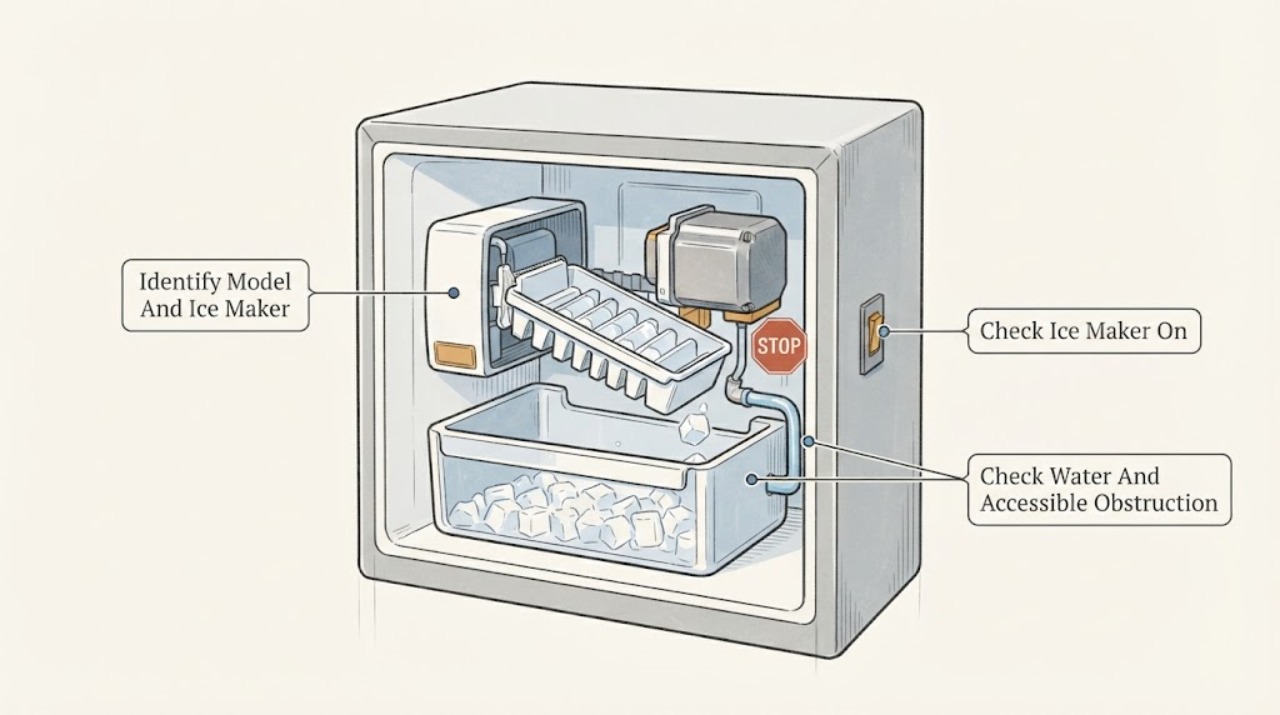
Work through in order
Diagnostic checks
Use only checks that match the exact appliance or system and its official guide.
-
Check 1
Record the complete LG refrigerator model and identify the ice-maker style from the model manual or the matching LG support page. Note whether the unit has a Twist/Flex Tray, Heater/Custom Cube, Early Twist/Flex Tray or Craft Ice design, and whether the control is a switch, TEST/FILL button or recessed test opening.
Expected result: The exact model and a matching ice-maker style are confirmed, or the ice maker cannot be matched confidently.
Next step: If the style is uncertain, stop at identification and use the exact owner guidance or LG support; do not press an unknown button, insert a tool or force the tray.
Why this matters
Why: LG's test control, tray movement and normal harvest timing differ among ice-maker styles. A control sequence from another style could produce a misleading result or damage the mechanism.
-
Check 2
Check the model-appropriate Ice On/Off control, confirm the freezer is cold enough for the model, and make sure the refrigerator door and ice-room door close completely. Move food that prevents sealing and observe only after the unit has had the model's stated time to cool.
Expected result: The ice maker was off, the freezer is warmer than the stated target, the door is not sealing, or the unit is newly installed; otherwise these conditions are normal.
Next step: Correct the accessible condition using the model controls, then allow the official waiting period and monitor. If the tray still will not harvest, continue to the water and obstruction checks.
Why this matters
Why: LG identifies an off ice maker, insufficient freezer temperature, warm-air leakage and recent installation as reasons for delayed or reduced ice production. These findings do not establish an internal ice-maker failure.
-
Check 3
With the refrigerator in its normal safe operating state, check the accessible water tank or supply valve, look for a kinked hose, and inspect the bin, tray and feeler area for a visible clump or ice obstruction. Do not remove covers or reach into the mechanism.
Expected result: Water is unavailable or restricted, the hose is kinked, the bin is clumped, or visible ice is preventing tray/arm movement; or the accessible path is clear.
Next step: Restore only the accessible water/ice-bin condition described by the model guidance and allow a new cycle. If water and the accessible path are normal, use the matching ice-maker test.
Why this matters
Why: LG links restricted water flow and ice obstructions with poor ice production and says ice on the tray or arm can prevent return to the upright position. The absence of an obstruction does not prove a particular component failed.
-
Check 4
After the model and ice-maker style are confirmed, follow that style's LG TEST/FILL or test-button instructions. Keep hands clear, use a towel if the official procedure calls for one, and observe whether the motor cycles and whether water or ice is present in the tray.
Expected result: The motor cycles and water/ice is present; the motor does not cycle; or the cycle runs but no water/ice is present.
Next step: If the test succeeds, reinstall accessible parts as directed and monitor ice production. If it fails or produces no water/ice, stop testing and request LG service with the model and observations.
Why this matters
Why: LG identifies motor movement and tray contents as the two useful test observations. A successful cycle supports monitoring; a missing cycle or missing water/ice points to service rather than a user-confirmed motor or valve diagnosis.
-
Check 5
Stop after the applicable external checks and one model-matched test when the tray still does not harvest, the tray is fully inverted or stuck, the mechanism makes abnormal sounds, or water is leaking. Preserve the model number and the observed test result for service.
Expected result: The ice maker remains unable to complete harvest or the issue returns after a successful reset/test.
Next step: Arrange LG or qualified appliance service. Do not bypass the sensor, force the tray, open the sealed refrigerator system or replace an unverified part.
Why this matters
Why: LG directs owners to service for a proper diagnosis when the tray position or test result remains abnormal. The evidence does not support naming a failed motor, valve, heater or control board without model-specific service diagnosis.
Use your observations
Decision map
Find the observation that best matches what you see, then follow the next safe action.
-
PATH 01Next step
What you see
The model-matched LG guidance says the tray is tilted shortly before harvest, and it has not exceeded that style's documented interval.
Do this next
Leave the mechanism undisturbed, keep the ice maker on and monitor for the model's stated cycle. If it remains tilted beyond that interval, continue to the matching test and service boundary.
Why this path and its safety boundary
Why it matters: A tilted tray can be normal operation while the ice is freezing or the mechanism is approaching harvest.
-
PATH 02Next step
What you see
The tray remains tilted beyond the applicable interval, is fully inverted, or the matching test does not make the mechanism cycle.
Do this next
After checking for an accessible ice obstruction as the model permits, stop and request service. Do not pry, bypass or disassemble the ice maker.
Why this path and its safety boundary
Why it matters: LG treats the persistent abnormal tray position or failed cycle as a service condition; the observation does not identify which internal component failed.
-
PATH 03Next step
What you see
The model-matched test cycles the motor but the tray has no water or ice, or water flow is visibly unavailable/restricted.
Do this next
Check only the accessible tank, valve, hose and model-approved filter condition. If the path is normal and the tray remains empty, arrange service.
Why this path and its safety boundary
Why it matters: LG identifies the water supply, tank, valve, hose and filter as external conditions that can limit ice production; this does not prove a failed inlet valve.
-
PATH 04Next step
What you see
The ice maker completes a model-matched cycle and the accessible water/temperature/door checks are normal, but ice production does not resume after the model's waiting period.
Do this next
Monitor for the documented interval, then contact LG service if harvesting or production remains absent. Do not replace an internal part based only on the sound or one successful cycle.
Why this path and its safety boundary
Why it matters: A successful test does not prove the whole refrigerator is repaired; production still depends on model conditions and may require service if it does not resume.
Helpful context
Understand the symptom
Confirm the ice-maker style before interpreting a stalled harvest
LG uses more than one ice-maker design. Its support material distinguishes Twist/Flex Tray, Heater/Custom Cube, Early Twist/Flex Tray and Craft Ice styles, and notes that the test control may be a button under the tray, a recessed opening or another model-specific control. Find the complete refrigerator model and compare the physical ice maker with the matching owner guidance before pressing a test control.
Check the conditions that can prevent a harvest
With the refrigerator operating normally, confirm that the ice maker is turned on, the freezer is cold enough for ice production, the door closes fully, and the water tank or supply valve is available for that model. Inspect only accessible areas for a kinked supply hose, a clump blocking the bin or ice on the tray or feeler area. These observations identify conditions that can interrupt production; they do not prove that a valve, motor or control board has failed.
Interpret the tray position instead of forcing it
LG says a tilted tray can be normal shortly before harvest, with the timing depending on the ice-maker style. If the tray remains tilted longer than the applicable interval, check for visible ice preventing movement and use only the matching TEST/FILL or test-button procedure. Do not pry the tray upright, hold the motor, bypass a sensor or reach into the mechanism while it is cycling.
Use the official test as a decision point
For the identified ice-maker style, LG's test is intended to reveal whether the motor runs and whether water or ice is present in the tray. Place a towel where the official procedure calls for one, keep hands clear, and observe without forcing the mechanism. A successful cycle supports monitoring ice production; a failed cycle or absent water/ice sends the decision to service rather than to an unverified part diagnosis.
When checks do not resolve it
Need a professional?
Have this ready
- complete LG refrigerator model and serial information
- ice-maker style and whether the tray is tilted, inverted or stuck
- whether the ice maker is on and the freezer/door checks performed
- water tank, supply valve, hose and filter observations
- whether the model-matched test cycled the motor and whether water or ice was present
- any leak, abnormal sound or visible obstruction
Common questions
FAQ
Is a tilted LG ice tray always a failure?
No. LG documents tilted trays as normal for some ice-maker styles shortly before harvest. Use the exact model's timing; if the tray remains tilted beyond that interval or the matching test fails, request service.
What does the LG ice-maker test tell me?
LG says to observe whether the motor runs and whether water or ice is in the tray. A no answer to either observation is a service decision, not proof of one particular failed component.
Can I use a paper clip to reset any LG ice maker?
Do not assume that. LG's support page shows different ice-maker styles and different test controls. Use a paper clip or other tool only if the exact model's official instructions explicitly call for it, and never force the mechanism.
Does a failed harvest prove the ice-maker motor is bad?
No. Water flow, temperature, the on/off state, door sealing and an obstruction can affect production. If the model-matched test still fails after those external checks, LG directs the owner to service rather than naming a component from the symptom alone.
Read the exact guide
Official sources
- LG Refrigerator – Why is My Refrigerator Not Making Ice?LG USA · LG refrigerator ice-maker test observations, reset limits, harvest follow-up and service decision
- Tray Will Not Turn UprightLG USA · LG refrigerator ice-maker tray position, normal tilt timing, accessible obstruction check and model-style test guidance
- If Your LG Refrigerator Is Not Making Ice or Not Making EnoughLG USA · LG refrigerator external ice-production checks, water supply, freezer conditions, ice-maker state and model variation
Community feedback
Share a repair observation
Share a plain-text repair observation. Accepted observations are published automatically; this page may take a moment to update.